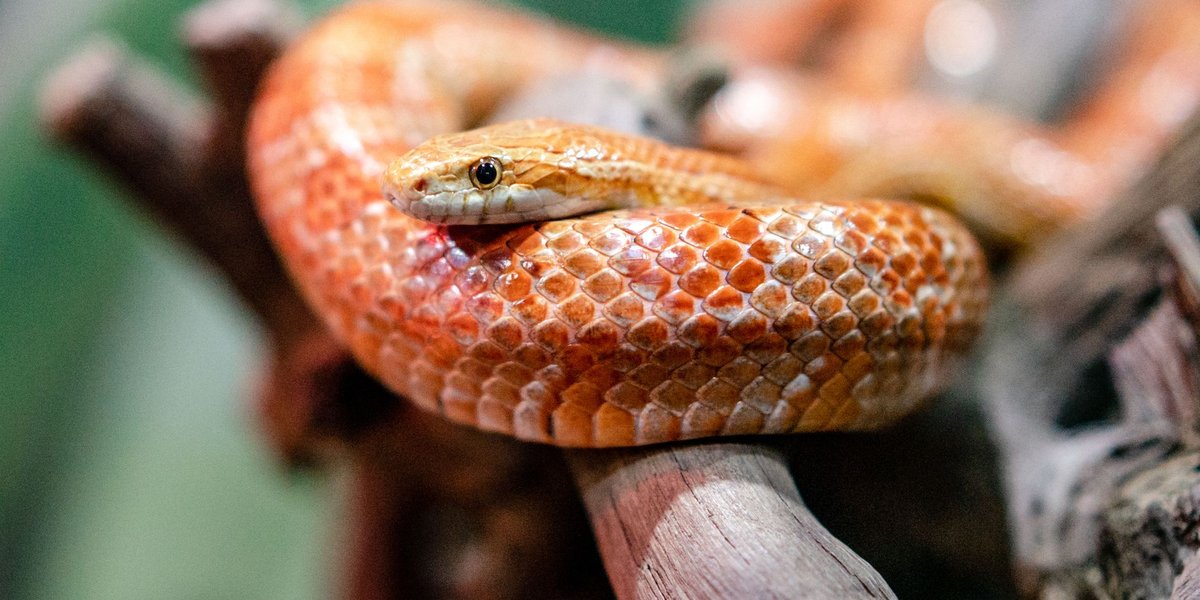
The corn snake (Pantherophis guttatus, formerly Elaphe guttata) is a slender, non-venomous constrictor from the southeastern United States. It grows to about 2 to 5 feet, wears red-orange saddles outlined in black, and has a checkered belly that looks like a kernel pattern on Indian corn. It is also the most commonly bred snake in the pet trade, which is why most people meet one long before they see one in the wild.
Quick Facts
| Characteristic | Corn snake |
|---|---|
| Scientific name | Pantherophis guttatus (older name: Elaphe guttata) |
| Adult length | About 2 to 5 ft, occasionally up to 6 ft |
| Weight | Roughly 1 to 2 lb as an adult |
| Lifespan | 10 to 15 years in the wild, 20+ in captivity, 32-year record |
| Venom | None |
| Activity | Crepuscular to nocturnal, mostly hidden by day |
| Prey | Rodents, birds, bats, lizards, frogs, eggs |
| Range | Southeastern and south-central US, from New Jersey to the Florida Keys and west into Louisiana and Kentucky |
Table of Contents
- Appearance
- Size and Growth
- Temperament and Behavior
- Diet
- Habitat and Range
- Reproduction
- Corn Snake vs Copperhead
- Are Corn Snakes Good Pets?
Appearance
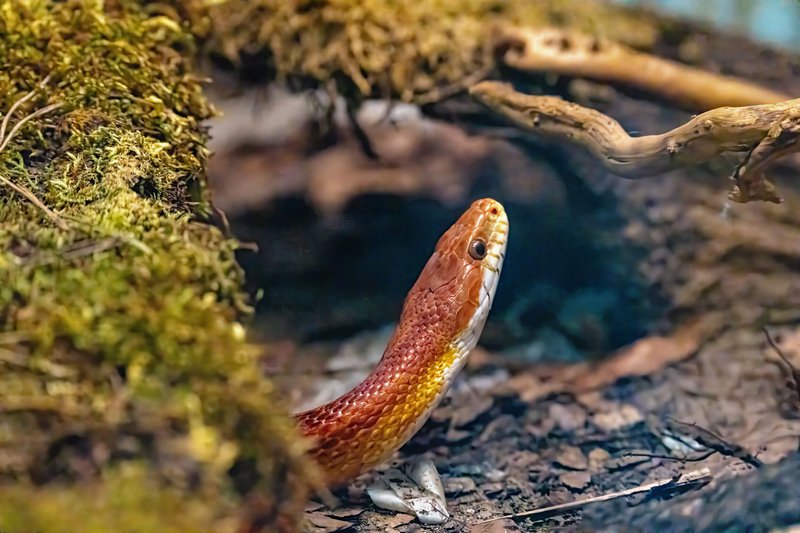
A wild corn snake has an orange or brownish-gray body with a row of large red or reddish-brown blotches down the back. Each blotch is edged in black, and smaller, similar spots run along the flanks. The head carries a dark stripe through each eye and usually a spear-shaped or V-shaped mark on top.
Flip one over and the belly gives the species its common name: black and white squares in a checkerboard, a bit like the kernels on a cob of dried corn. Nothing else in its range has that belly.
Color also changes with age. Hatchlings are paler and more muted, with grayer backgrounds, and they brighten as they grow. Captive breeders have pushed this much further. Morphs such as amelanistic (no black pigment, so the snake is orange, red, and white), anerythristic (no red, so black and gray), and “snow” (both traits removed) all come from natural genetic variation that keepers selected for. The wild pattern is still the one you will see outdoors.
Size and Growth
Adults usually land between 2 and 5 feet. The Smithsonian’s National Zoo gives a range of 24 to 72 inches, and a 6-footer is a large outlier. Hatchlings emerge at 10 to 15 inches, roughly the length of a pencil.
Growth is fast early and flattens out around the two-year mark. Corn snakes mature sexually at about 18 to 36 months, and most of their final length is in place by then. Males tend to run a little longer and heavier than females, though individual snakes vary a lot. Even a big adult is slender, rarely thicker than a man’s wrist.
Lifespan depends heavily on where the snake lives. In the wild, 10 to 15 years is a good run, since hawks, other snakes, and mammals all take them, and cars take plenty more. In captivity, 20 years is common. The National Zoo lists up to 23 years in human care, and the Animal Diversity Web at the University of Michigan documents a captive record of just over 32 years.
Temperament and Behavior
Corn snakes are secretive. Most of their day goes to hiding under loose bark, logs, rocks, and debris, or moving through rodent burrows underground. They are active mainly at dusk and through the night, with some daytime movement, especially in spring.
They are also good climbers. They go up trees and into barns and abandoned buildings, which is how they earned the nickname “red rat snake” among farmers who noticed the rats disappearing.
When threatened, a corn snake runs through a short script:
- It tries to hide or flee.
- If cornered, it vibrates its tail rapidly. In dry leaves that sounds a lot like a rattlesnake.
- It strikes, mostly as a bluff.
- It releases a foul-smelling musk from its vent.
A bite from a corn snake is a row of small scratches, not a medical event, and the snake is far more likely to freeze or flee than bite. It is also non-venomous and kills prey by constriction, wrapping a loop of its body around the animal and tightening until it stops breathing. Corn snakes also hibernate (technically brumate) through cold winters in the northern part of their range.
Diet
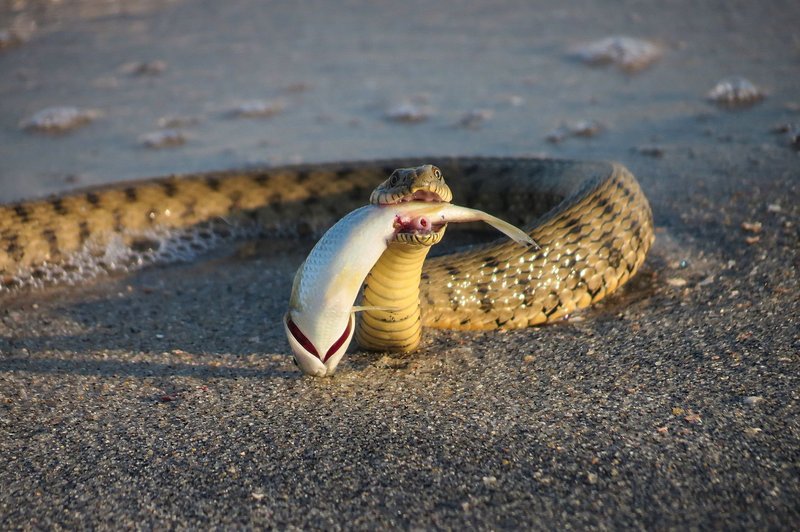
A corn snake’s diet changes with its size:
- Hatchlings: lizards, tree frogs, and newborn mice.
- Juveniles: small rodents, small lizards, and more frogs.
- Adults: mice, rats, birds and their eggs, and bats.
The snake bites to get a grip, throws its coils around the prey, squeezes, and swallows it whole, usually head first. Adults eat every few days in the wild when food is available and go much longer between meals in cold weather. In captivity, a healthy adult is typically fed one pre-killed mouse or small rat every 1 to 2 weeks.
That rodent habit is the main ecological value of the species. Corn snakes keep mouse and rat numbers down around farms and woodland edges, and fewer rodents means fewer of the diseases they carry.
Habitat and Range
Corn snakes live across the southeastern and south-central United States, from southern New Jersey down through Florida and the Keys, and west into Louisiana and Kentucky. Within that range they favor pine flatwoods, hardwood forest, overgrown fields, rocky hillsides, and the edges of farms and old buildings.
They tolerate people better than many snakes do, which is the reason they turn up in sheds and barns. The population as a whole looks stable, but habitat loss hurts local groups, and the species has some state-level protection. Florida lists it as a species of special concern and Georgia protects it, according to the National Zoo. Many corn snakes also get killed because someone mistook them for a copperhead.
Reproduction
Mating takes place from March to May. Females lay eggs (the species is oviparous) in late May to July, usually 10 to 30 per clutch, in rotting stumps, piles of decaying vegetation, or other warm, humid spots. The eggs get no parental care. They incubate for about 60 to 65 days at roughly 82°F and hatch between July and September.
The hatchlings are on their own from the first day.
Corn Snake vs Copperhead
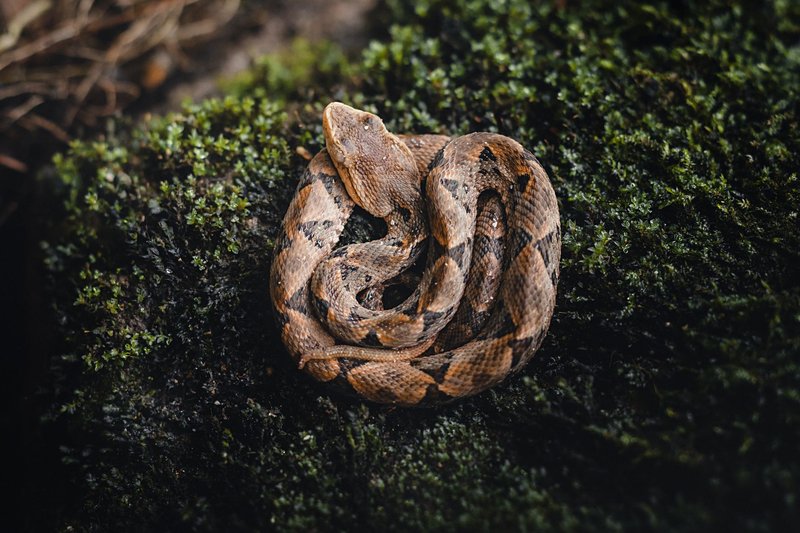
The mix-up is common and often fatal for the corn snake. Both are orange-brown with blotches, and both turn up in leaf litter in the Southeast. These features separate them:
| Feature | Corn snake | Copperhead |
|---|---|---|
| Pattern | Rounded red blotches on the back, edged in black | Hourglass bands, narrow across the back and wide on the sides |
| Head | Narrow, slightly wider than the neck, often with a V or spear mark | Broad, triangular, copper-colored |
| Pupils | Round | Vertical slits, like a cat |
| Belly | Black and white checkerboard | Plain, mottled, with no checkerboard |
| Build | Slender | Thick-bodied |
| Venom | None | Venomous |
The belly is the fastest tell if you can see it. Pupils work if you can see the eyes safely, but that is closer than you should get to an unidentified snake. If you aren’t sure what it is, leave it alone and give it room. It will go away on its own.
Are Corn Snakes Good Pets?
Yes, and they are the standard beginner snake. They are docile, rarely bite, stay at a manageable size, and live long enough that you should plan for 15 to 20 years. They are also escape artists that will push on any gap in a lid.
A few practical numbers. A standard-colored hatchling often costs under $100, but the enclosure, heat source, thermostat, hides, and substrate cost several times that. Adults need an enclosure of at least 40 gallons, ideally larger, with a warm side and a cool side. Frozen mice, thawed before feeding, handle the diet.
The characteristics of a corn snake that make it a good pet are the same ones that make it a good wild animal. It is calm, small enough to handle, non-venomous, and happy to eat something you can buy at a pet store. Captive-bred animals are the right choice, and wild-caught snakes belong where they were found.