A meerkat (Suricata suricatta) is a small, social mongoose that lives in the Kalahari and Namib deserts of southern Africa. It stands about a foot tall, digs for a living, and survives because someone in the group is always watching the sky.
The characteristics of a meerkat fall into two groups: the body, which is built for digging and desert glare, and the behavior, which is built around group defense. Both are covered below.
Table of Contents
- Characteristics at a Glance
- Physical Characteristics of a Meerkat
- Meerkat Adaptations for Desert Life
- Diet: What Meerkats Eat
- Meerkat Behavior and Social Structure
- Burrows, Habitat and Lifespan
- Meerkat FAQ
Characteristics at a Glance
| Trait | Detail |
|---|---|
| Scientific name | Suricata suricatta |
| Family | Herpestidae (mongooses) |
| Body length | 10 to 14 inches |
| Tail length | 7 to 10 inches |
| Weight | About 2 pounds |
| Range | Kalahari and Namib deserts, southern Africa |
| Lifespan | About 8 years in the wild, 10 to 14 in human care |
| Diet | Insects, larvae, scorpions, small reptiles, eggs |
| Group size | 10 to 30 animals |
| Conservation status | Least Concern |
Physical Characteristics of a Meerkat
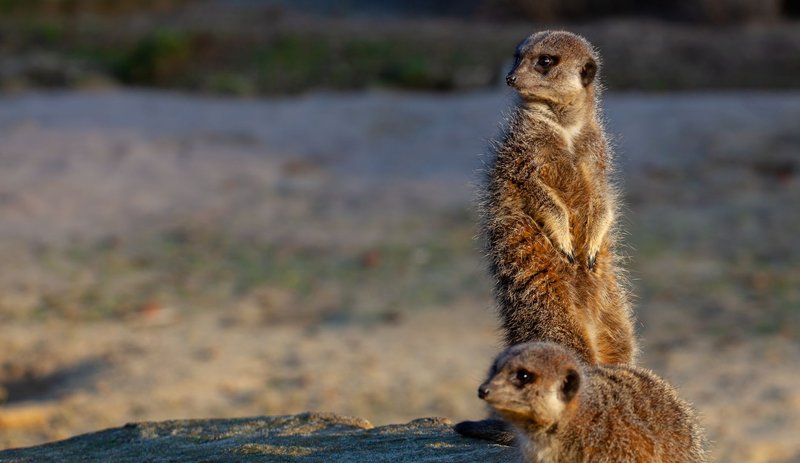
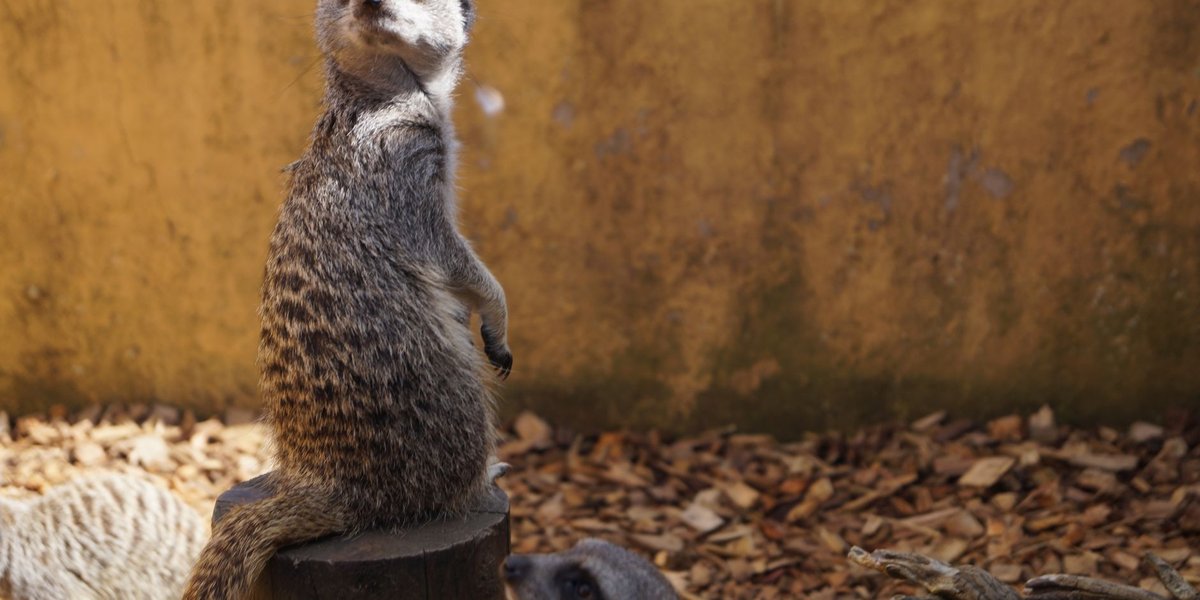
An adult meerkat weighs about as much as a bag of sugar. The body is long and slim, the head is narrow and pointed, and the tail runs 7 to 10 inches, nearly as long as the body itself. That tail works as a prop. When a meerkat stands upright, the tail braces against the ground like the third leg of a tripod.
The coat is a sandy gray-brown with darker bands across the back, which breaks up the outline against dry grass and rock. The tail tip is dark. The belly is a different story: it has thin fur and bare, dark skin. That is deliberate, and it matters in the next section.
The feature everyone recognizes is the dark patch around each eye. It looks like a smudge of eyeliner, and it does a job.
Meerkat Adaptations for Desert Life
Every distinctive trait on a meerkat solves a specific desert problem.
Eye patches cut glare. The dark fur around the eyes absorbs light before it bounces up into the eye, the same trick athletes use with eye black. In open desert with no shade, that matters from sunrise to sunset.
Horizontal pupils widen the view. A wide, horizontal slit lets a meerkat take in the landscape from side to side without moving its head. For an animal whose survival depends on spotting a shadow on the horizon, that’s useful.
Claws are built for digging. Each front paw carries long, curved claws, up to about an inch, and they don’t retract the way a cat’s do. A meerkat can dig out a beetle larva or excavate a burrow in minutes.
Ears close against dirt. A meerkat can fold its ears shut while digging, so sand stays out of the ear canal.
The bare belly is a heater. Desert mornings are cold. A meerkat will stand upright facing the sun with its belly exposed, absorbing warmth through that dark skin before heading out to forage. According to the Smithsonian’s National Zoo, this sunbathing posture is a regular part of the morning routine.
Diet: What Meerkats Eat
Meerkats are mostly insectivores. Beetles, termites, grasshoppers and caterpillar larvae make up the bulk of the menu. They also eat spiders, centipedes, small lizards, snakes, eggs and the occasional plant bulb.
Scorpions are the unusual part. A meerkat will eat a venomous scorpion, and adults appear to have at least partial resistance to the venom. They still take precautions: a meerkat typically bites off or breaks off the stinger before eating. Adults also teach pups this skill in stages, first handing over dead scorpions, then crippled ones, then live ones.
Meerkats get most of their water from their food. They forage by digging small cone-shaped holes, sniffing for prey and moving on, and a single animal can dig hundreds of them in a day.
Meerkat Behavior and Social Structure
Meerkats live in groups called mobs, or sometimes gangs or clans. A typical mob holds 10 to 30 animals, and larger ones exist. The group runs on cooperation, and the clearest example is sentry duty.
Rotating Sentry Duty
While most of the mob forages with their heads down, one meerkat climbs a rock, termite mound or shrub and scans for hawks, eagles, jackals and snakes. Sentries rotate, and the one on duty is usually a well-fed animal that can afford to skip a meal. When the sentry is on guard, it makes a low, steady peeping call that tells the group all is clear.
Alarm Calls That Mean Different Things
Meerkats don’t have one alarm. They have several, and they differ by predator. A call for a bird of prey sends the group diving for the nearest hole. A call for a ground predator, like a jackal, makes the group bunch up and watch. Research summarized by National Geographic describes how these calls carry information about the type of threat and its distance.
Dominance and Cooperative Pup-Rearing
A mob is led by a dominant breeding pair, with the dominant female doing most of the breeding. Litters usually hold two to four pups. Everyone else pitches in as a “helper”: babysitting at the burrow, guarding pups while the others forage, and sharing food with young animals. Helpers will do this for pups that aren’t theirs, sometimes at the cost of their own body weight.
Mobbing a Threat
When a snake or rival group approaches, meerkats don’t always flee. They sometimes bristle their fur, arch their backs and advance as a group, which makes a small animal look bigger and more dangerous than it is.
Burrows, Habitat and Lifespan
Meerkats live in dry, open country: scrubland, grassy plains and rocky desert. Their burrows are where they spend the nights and the hottest part of the day.
A typical burrow system has multiple entrances, which gives the group several escape routes, and a shared latrine area. Mobs usually move among several burrows within their territory, and they defend that territory against neighboring mobs.
In the wild, a meerkat lives about 8 years. Predators, drought and disease cut that short for many. In zoos and sanctuaries, with steady food and vet care, they commonly reach 10 to 14. The IUCN Red List classifies the species as Least Concern, with a stable population across its range.
Meerkat FAQ
Are meerkats rodents? No. Meerkats belong to the mongoose family, Herpestidae, which is part of the order Carnivora. They eat insects, not seeds.
Are meerkats related to cats? Distantly. Mongooses and cats are both in the suborder Feliformia, so they share a common ancestor, but a meerkat is no more a cat than a dog is a bear. Meerkats are closer to other mongooses, and further out, to hyenas.
Can you keep a meerkat as a pet? Not a good idea, and illegal in many places. Meerkats are intensely social and need a group. A lone meerkat in a house tends to become stressed, destructive and loud. They dig through floors and furniture, and they bite.
How big is a meerkat? About 10 to 14 inches long, with a 7 to 10 inch tail, weighing around 2 pounds.
Why do meerkats stand up? Standing serves two purposes: spotting predators from a better angle, and warming the bare belly in the morning sun.