Contents
- TLDR
- Why nobody has watched one eat
- What turns up in the stomachs
- How a dive works
- Suction, not chewing
- Blainville’s vs. Cuvier’s beaked whale
- FAQ
TLDR
The Blainville’s beaked whale diet is mostly deep-water squid, with some fish and a few crustaceans. Nobody has filmed one feeding. What we know comes from the stomachs of stranded animals, backed up by tags that show where and when the whales hunt.
Why nobody has watched one eat
Blainville’s beaked whales (Mesoplodon densirostris) hunt below 500 m, in water that is effectively black. They surface briefly, breathe, and go back down for the better part of an hour. There is no footage of a capture, no observer on a boat who saw prey in a mouth.
So the diet question has a different answer than it does for, say, a humpback. Researchers piece it together from three sources: stomach contents of dead animals, tag data from living ones, and what they know about which animals live at the depths where the whales feed.
That’s also why most species profiles say little more than “squid.” The evidence is thin, and honest sources hedge.
What turns up in the stomachs
The best-known dataset comes from a mass stranding in the Canary Islands in September 2002, when several beaked whales of different species came ashore. A team led by Santos examined their stomach contents and published what they found. Only one Blainville’s beaked whale was in that group, so the sample is tiny. Other strandings elsewhere add a few more stomachs, but the total is still small.
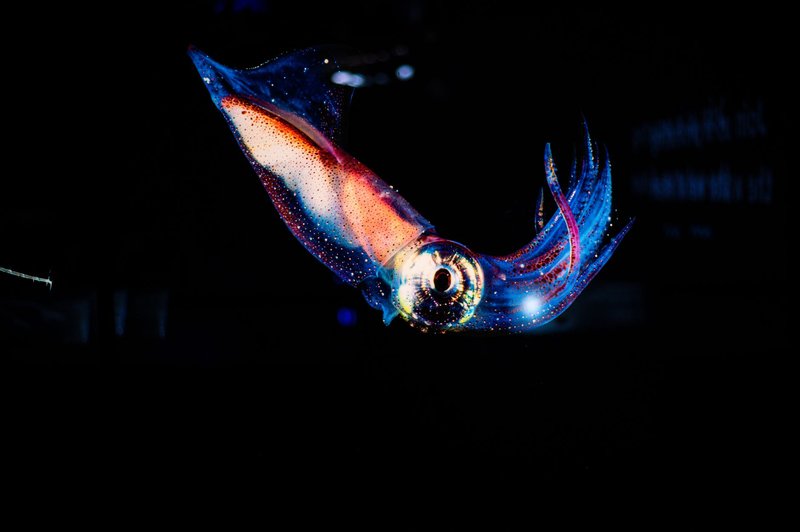
The prey that shows up is mostly squid, identified from the hard beaks that survive digestion:
- Cock-eyed squid (genus Histioteuthis), named for one eye that is much larger than the other
- Peacock cranch squid, a small, glassy deep-water species
- Rüppell’s octopus-squid, a mid-water squid with eight arms and no feeding tentacles
Fish are in there too. Among the non-Cuvier’s whales in the Canaries stranding, the commonest fish remains came from gadid fish (the cod family), followed by viperfish. Crustaceans appear occasionally.
Researchers have put a rough number on the split: about 80% invertebrates (squid, mainly) and about 20% fish. Treat that as a small-sample estimate, not a measurement. A few stomachs from animals that were sick or injured enough to strand may not represent a healthy whale’s average meal. Shepherd’s beaked whale is also described as eating squid, deep-sea fish, and crab.
How a dive works
A foraging dive is the whole feeding strategy, so it’s worth knowing what one looks like.
In the first major tagging study of beaked whales, published in the Journal of Experimental Biology in 2006, Blainville’s beaked whales averaged dives of about 835 m (2,740 ft) and roughly 46 minutes. The deepest dive in that study reached about 1,250 m (4,100 ft) and lasted 57 minutes. Those were the longest and deepest average dives reported for any breath-holding animal at the time.
This also clears up the depth numbers that conflict across species pages. “About 1,400 m” and “about 4,600 ft” are the same figure in two units, since 1,400 m is roughly 4,590 ft. “200 to 1,000 m” describes a typical working range rather than a maximum. The whales are not feeding at one fixed depth. They go through the deep scattering layer, where squid and fish gather, and feed on what they find.
They find prey by echolocation. A beaked whale stays quiet for the first stretch of its descent, then starts producing foraging clicks at depth and keeps clicking while it hunts. Clicks speed up into a rapid buzz as it closes on a target. Then it stops, and the whale ascends without making a sound. That silence is generally read as protection against killer whales, which hunt beaked whales and listen for them.
Why go this deep at all? One explanation is competition: few other air-breathers can reach these depths, so the squid there face little pressure from other marine mammals. Deep-water squid are also soft-bodied and slow, with a low energy cost to catch, and a whale that can stay down an hour gets many chances per dive.
Suction, not chewing
Blainville’s beaked whales don’t bite. They suck.
The whale draws its tongue back and expands the grooves under its throat, which drops the pressure inside the mouth. Prey is pulled in with the water, and swallowed whole. There is no chewing, which is why squid beaks arrive in the stomach intact and why researchers can identify the squid from them.
The tusks have nothing to do with it. Adult males carry a pair of teeth that grow up from the lower jaw, which is arched to make room for them. They are often fouled with barnacles, and the jaw itself is among the densest bone known in any animal, which is where the species name densirostris (“dense-beaked”) comes from. Males use the tusks to fight each other. The parallel scars across their backs and sides come from rivals’ teeth. Females and young whales have no erupted teeth and eat the same food, which is the quickest proof that the tusks aren’t feeding tools.
Blainville’s vs. Cuvier’s beaked whale
Cuvier’s beaked whale (Ziphius cavirostris) is the better-studied relative and a squid specialist. Its stomachs in the same Canaries study held mainly oceanic squid. Cuvier’s holds the mammal diving record: a tag study recorded a dive to 2,992 m, and another that lasted about 137 minutes.
Blainville’s whales dive less extremely. The authors of the Canaries study suggested that Mesoplodon species may eat relatively more fish than Cuvier’s whales do. That’s a suggestion built on very few animals, but it fits with the 80/20 estimate above, and it’s the main place where the two whales’ diets seem to differ. For comparison, Longman’s beaked whale is described as eating mostly squid, plus some deep-sea fish, hunted in near-total darkness more than 1,000 m down.
FAQ
Do Blainville’s beaked whales eat squid? Yes. Squid make up most of the diet, mainly deep-water species such as cock-eyed squid.
Do they eat fish? Some. Fish are a minority of the diet, around 20% in small-sample estimates.
Do they chew their food? No. They suck prey into the mouth and swallow it whole.
What are the tusks for? Fighting between males. The tusks erupt in adult males only and play no part in feeding.
How deep do they feed? Mostly below 500 m. Tagged whales averaged about 835 m on deep dives and reached about 1,250 m in the first major study.
How do scientists know what they eat if no one sees it? They examine stomach contents of stranded whales, identify squid from their beaks, and use tags to confirm when and where the whales hunt. For a species that feeds this deep, it’s the best evidence available.