TLDR
The groundhog (Marmota monax), also called a woodchuck, is a stocky, brown, short-legged rodent and one of the largest members of the squirrel family. Adults weigh roughly 5 to 14 pounds and measure about 2 feet including the tail. They eat plants, dig deep burrows with multiple exits, whistle when alarmed, and hibernate for months each winter. Wild groundhogs usually live two to three years.
Contents
- Groundhog Facts at a Glance
- Physical Characteristics of a Groundhog
- Groundhog Behavior
- What Groundhogs Eat
- Groundhog Burrows and Habitat
- Hibernation
- Reproduction and Young
- Groundhog vs. Gopher, Marmot, Prairie Dog and Beaver
- Why the Groundhog Gets a Holiday
Groundhog Facts at a Glance
| Trait | Detail |
|---|---|
| Scientific name | Marmota monax |
| Other names | Woodchuck, whistle-pig, land beaver |
| Length | About 16 to 26 inches, tail included |
| Weight | 5 to 14 pounds, heaviest in autumn |
| Tail | Short and bushy, 4 to 7 inches |
| Diet | Herbivore: grasses, clover, leaves, fruit, vegetables |
| Activity | Daytime (diurnal) |
| Lifespan | 2 to 3 years in the wild, longer in captivity |
| Hibernation | True hibernation, roughly October to March or April |
| Range | Eastern and central North America, up into Alaska and Canada |
Groundhog and woodchuck are the same animal. The second name has nothing to do with wood. It comes from an Algonquian word, wuchak, that English speakers bent into something that sounded familiar.
Physical Characteristics of a Groundhog
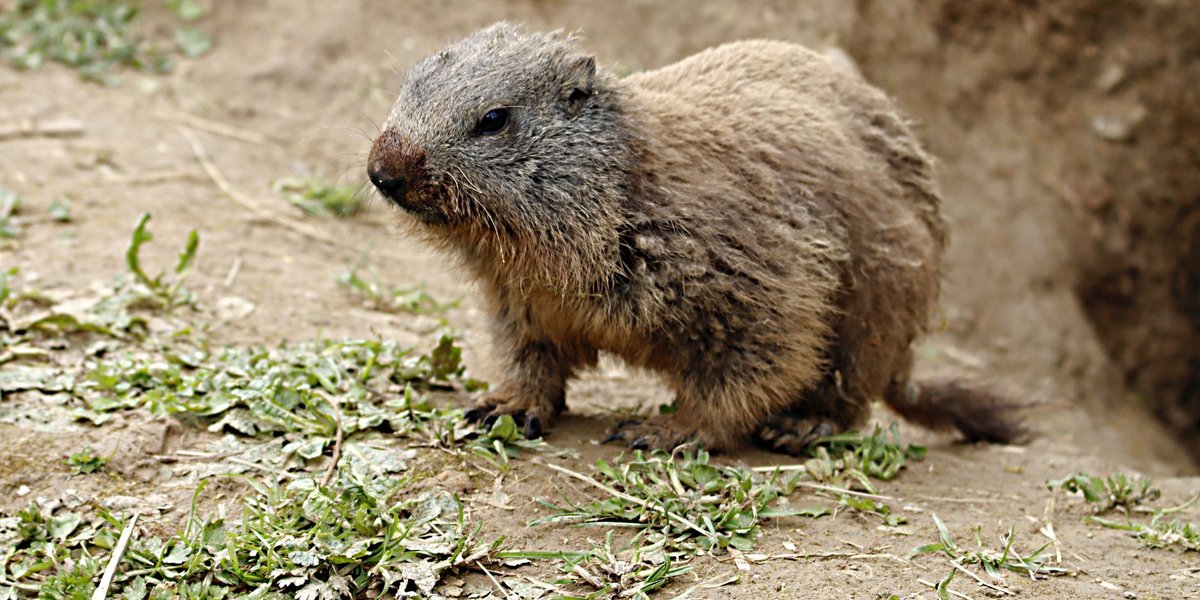
A groundhog looks like a squirrel that gave up climbing and took up construction. The body is thick and barrel-shaped, built low to the ground on four short legs.
Coat. The fur is grizzled brown to gray. Long guard hairs have pale tips, which gives the back a frosted look, and a dense undercoat sits beneath. The feet, face and tail are usually darker. Rare black (melanistic) and pale individuals turn up in some regions.
Head. The nose is blunt, the ears are small and rounded, and the dark eyes sit high on the skull. That placement lets a groundhog watch for hawks and foxes while most of its body stays in the burrow mouth.
Teeth. Like all rodents, groundhogs have a pair of large incisors in the upper and lower jaw that never stop growing. Chewing wears them down. The front surface is orange-yellow, which surprises people who see it for the first time.
Claws. The front feet carry long, curved claws that work as shovels. A groundhog can move a startling amount of dirt in an afternoon, and the claws are the reason it can excavate tunnels in compacted soil.
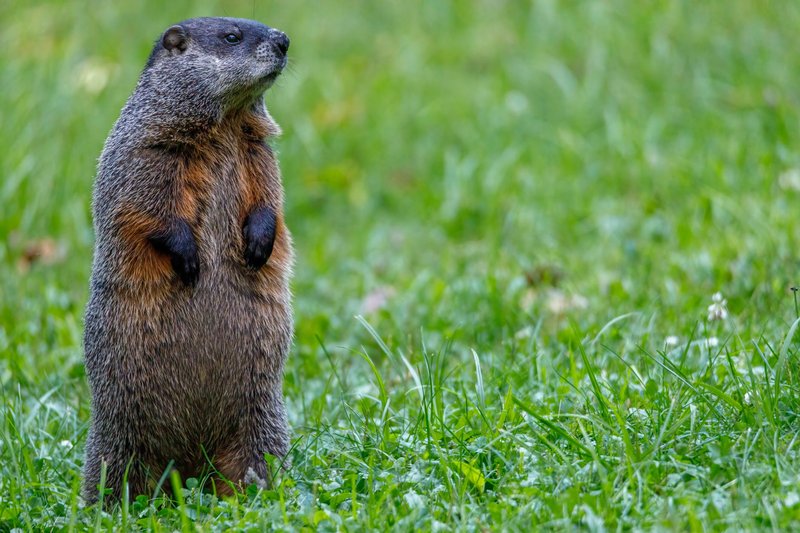
Tail. The tail is bushy but short, nothing like a gray squirrel’s plume. It helps with balance when the animal stands upright on its hind legs to look around, a posture that suits the “whistle-pig” nickname.
Weight swings. Groundhogs fatten up all summer. A groundhog that weighs 6 pounds in April can approach double that by October. They burn through it over the winter, per National Geographic, which describes the animal as a heavy-bodied member of the squirrel family that lives off stored fat during hibernation.
Groundhog Behavior
Groundhogs are active in daylight, mostly early morning and late afternoon. That makes them one of the easiest wild mammals to watch, and it is why homeowners notice them so quickly.
Mostly solitary. Outside of mating season and the weeks a mother spends with her pups, groundhogs live alone. Each animal defends its own burrow system and will chatter its teeth or fight a rival that moves in.
The whistle. When a groundhog spots danger, it gives a sharp, high whistle that carries across a field. Neighbors hear it and dive for cover. The sound is the reason for the nickname whistle-pig. They also squeal, bark and grind their teeth, depending on the threat.
Climbing and swimming. Groundhogs are heavy-looking animals, but they climb trees and swim well. A groundhog on a low branch is not a lost animal. It’s often getting a better view, or reaching for fruit, or escaping a dog.
Standing guard. Before and after feeding, a groundhog sits upright near its burrow entrance, scanning. If it senses anything unusual, it bolts for the hole, usually the nearest one, not the one it started from.
What Groundhogs Eat
Groundhogs are herbivores. Most of the diet is grasses, clover, alfalfa, dandelions, plantain and other green plants, along with berries, apples and other fruit when available. They also take garden vegetables, which explains their reputation among gardeners: beans, peas, lettuce and squash are favorites. They occasionally eat insects, snails or grubs, but plants make up nearly all of the diet.
Almost all the water they need comes from dew and wet vegetation, so they seldom visit streams or puddles.
Eating is the groundhog’s summer job. The goal is to build enough body fat to survive months without food. That is why feeding picks up sharply in late summer and early fall.
Groundhog Burrows and Habitat
Groundhogs live along woodland edges, open fields, pastures, road embankments and suburban yards. They like places where they can find food in open ground and dive into cover within seconds.
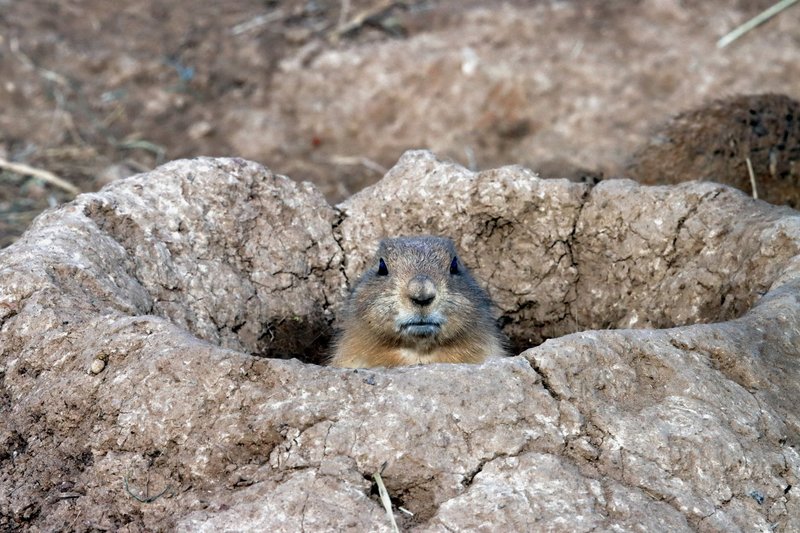
The burrow is their most distinctive trait. According to the Indiana Department of Natural Resources, a groundhog digs a tunnel system with several entrances, and the main entrance usually has a conspicuous mound of excavated soil next to it. Other entrances are often hidden and have no mound, which gives the animal an escape route.
A typical burrow includes:
- A main entrance with a large dirt pile, about 10 inches across
- One or more concealed escape holes
- A nesting chamber lined with grass for sleeping and raising young
- A separate chamber used as a toilet
- A deeper hibernation chamber, below the frost line
Groundhogs often keep separate summer and winter burrows. Their abandoned holes matter to other wildlife too: rabbits, foxes, skunks, opossums and snakes all move into empty groundhog dens.
Hibernation
Groundhogs are true hibernators, one of the few North American mammals that really are. This isn’t winter napping. According to National Geographic, they retreat to the burrow in autumn and stay there until early spring.
During hibernation, the animal’s body temperature drops from about 99°F to roughly 40°F or lower. The heart slows from around 80 beats per minute to about 5, and breathing becomes so slow that a minute can pass between breaths. The groundhog lives off the fat it stored in summer and can lose a third of its body weight before spring.
Timing depends on climate. In the northern part of the range, males emerge in late February or March, often before the snow is gone, and females follow a few weeks later.
Reproduction and Young
Mating happens soon after emerging from hibernation, in March or April. Gestation lasts about 31 to 32 days, and a litter usually holds 2 to 6 kits, born in the nesting chamber in April or May.
Newborns are hairless, blind and weigh about an ounce. Their eyes open at around four weeks, and they begin venturing outside by about five to six weeks. By late summer, the young move out and dig their own burrows. Females typically breed once a year.
Groundhog vs. Gopher, Marmot, Prairie Dog and Beaver
Groundhogs get mistaken for several animals. Here’s how to separate them.
| Animal | Size | Key difference |
|---|---|---|
| Groundhog | 5 to 14 lb | Stocky, bushy short tail, whistles, visible above ground |
| Pocket gopher | Under 1 lb | Small, fur-lined cheek pouches, almost never leaves its tunnels |
| Yellow-bellied marmot | 3 to 11 lb | Mountain dweller, yellowish belly, lives in colonies |
| Prairie dog | 1 to 3 lb | Smaller, lives in large colonies, tan coat, black-tipped tail |
| Beaver | 30 to 60 lb | Flat, scaly paddle tail, webbed hind feet, lives near water |
The groundhog is a marmot, the lowland, eastern member of that group. Marmots in the Rockies and Alps are cousins. The most common mix-up is with the gopher. If the animal in your yard is the size of a cat and sits upright in daylight, it’s a groundhog. If you only see fresh mounds of dirt and never the animal, it’s likely a pocket gopher.
Why the Groundhog Gets a Holiday
Every February 2, people in Punxsutawney, Pennsylvania wait to see whether a groundhog named Phil sees his shadow. A shadow supposedly means six more weeks of winter. No shadow means an early spring. The tradition traces to German settlers and an older European custom tied to Candlemas, which used a badger or hedgehog as the weather forecaster. The U.S. version has been running since 1887.
As a forecaster the groundhog is unreliable. The animal is checking whether the weather is good enough to leave the burrow, not predicting anything. The National Park Service covers more groundhog natural history for anyone who wants to go further.