As an Amazon Associate we earn from qualifying purchases. Disclosure
The best spotting scope for birding for most people is an angled 80 to 85 mm scope with HD or ED glass, a 20-60x zoom eyepiece and a waterproof, gas-purged body, set on a tripod with a pan head. Our top pick is the Vortex Diamondback HD 20-60×85: bright enough for ducks at dusk, sharp at the 20x to 40x settings birders use most and covered by an unconditional lifetime warranty. The best budget spotting scope for birding is the Celestron Regal M2 80ED, the cheapest scope here with true ED glass. If you want the scope for the rest of your life, r/birding sends people to the Kowa TSN-88A.
My first fall shorebird season I spent an hour on a mudflat with 10x binoculars, looking at a flock of small sandpipers, and wrote “peep sp.” in my notebook for all of them. A bird club member set up his scope beside me, turned the zoom to 25x and stepped aside. I could see which birds had yellowish legs and which had black legs, and the flock turned into least sandpipers and semipalmated sandpipers. That is what a scope does for a birder: it turns distant shapes into birds you can name. Every scope below is waterproof and fog-proof, takes a standard tripod and comes from a brand that repairs its scopes.
Best spotting scopes for birding at a glance
| Spotting scope | Best for | Tier |
|---|---|---|
| Vortex Diamondback HD 20-60×85 | Best overall for most birders | Mid-range |
| Celestron Regal M2 80ED | Best budget scope with ED glass | Budget |
| Vortex Crossfire HD 20-60×80 | Budget scope with a no-questions warranty | Budget |
| Celestron Ultima 80 | Entry-level 80 mm scope | Budget |
| SVBONY SV28 | Cheapest scope worth buying, for kids and backyards | Budget |
| Vortex Viper HD 15-45×65 | Light scope to carry on walks | Mid-range |
| Vortex Viper HD 20-60×85 | Brighter step up from the Diamondback | Upgrade |
| Athlon Ares G2 UHD 20-60×85 | ED glass for less | Upgrade |
| Nikon Monarch 82ED-A 20-60x | Close focus and a flat field | Upgrade |
| Vortex Razor HD 27-60×85 | Near-premium view | Premium |
| Kowa TSN-88A with 25-60x zoom | The scope r/birding names for a splurge | Premium |
| Swarovski ATX eyepiece module | Premium modular system | Premium |
| Kowa TSN-55A travel kit | Travel and long hikes | Compact |
| Vanguard Alta Pro 2 264AO with pan head | Tripod with a pan head for any scope | Accessory |
| Celestron NexYZ phone adapter | Digiscoping with a phone | Accessory |
Do you need a spotting scope for birding?
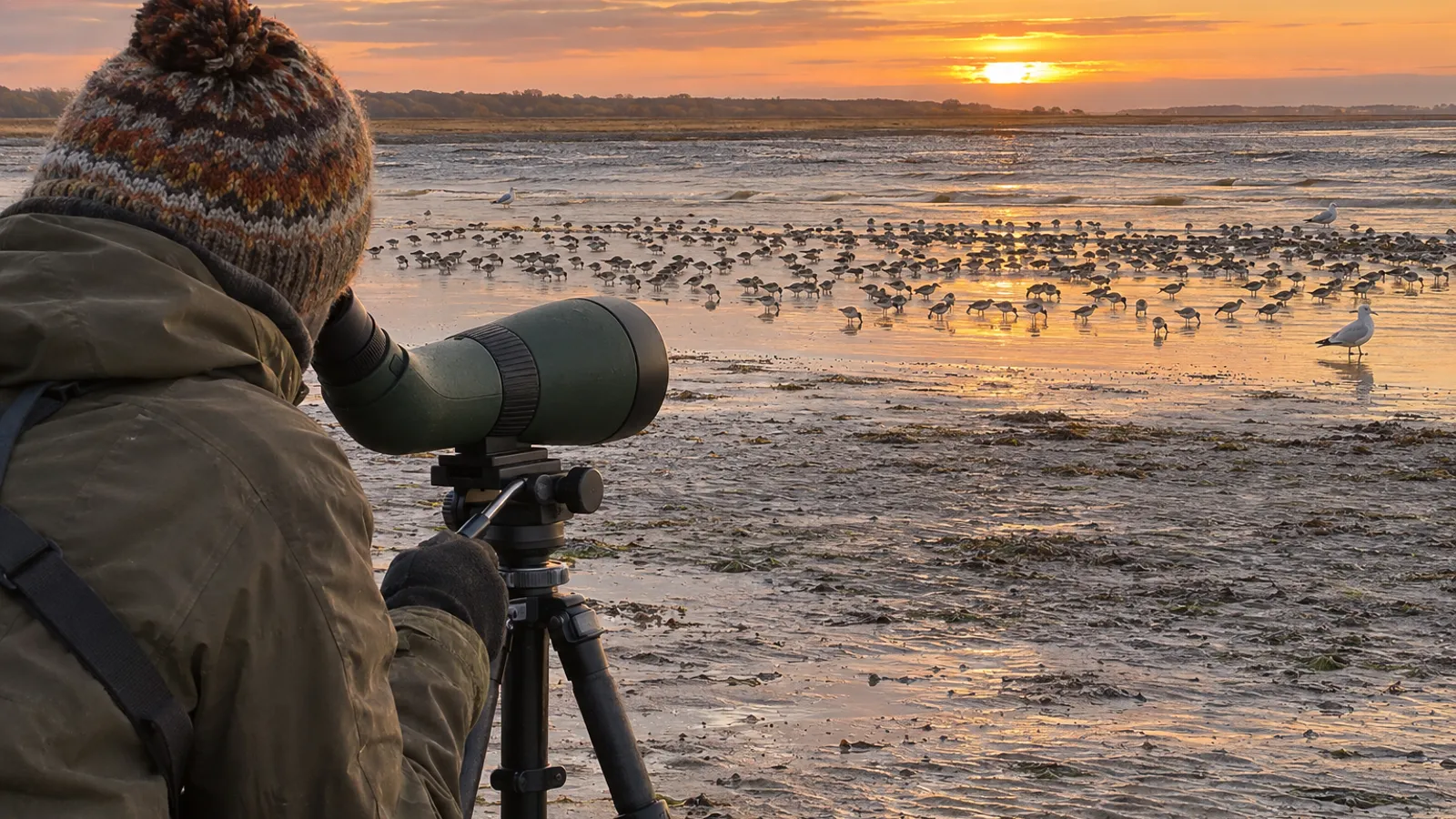
A spotting scope does not replace binoculars. It does two things better than binoculars: it shows birds that are far away at 20x to 60x, and it holds the view steady on a tripod for as long as you want to look. It does most other things worse. It is heavy, slow to point, shows a narrow view and needs a tripod every time.
Buy a scope if most of your birding happens in open country, where birds sit still at a distance:
- Shorebirds on mudflats, beaches and flooded fields.
- Ducks, geese, loons and grebes on lakes, reservoirs and the ocean in winter.
- Gulls, where the shade of the back and the color of the legs decide the species.
- Hawks and eagles perched on distant poles, nests and cliff faces.
- Seabirds from a jetty, a point or a ferry dock.
If you mostly bird in woods and backyards, a scope will stay in the closet. Spend the money on better binoculars first: our guide to the best binoculars for bird watching covers every budget. On r/birding, the common advice is to bird for a year with binoculars and buy a scope once you know you keep looking at birds that are too far away.
Budget for the tripod too. A scope on a flimsy tripod shakes at high power and shows less than a good pair of 10x binoculars. Plan to spend about a third as much on the tripod as on the scope.
What to look for in a birding spotting scope
Eight things separate a scope that shows the bird from one that shows a gray blur.
- Objective lens size. The second number in 20-60×85 is the width of the front lens in millimeters. 80 to 85 mm scopes gather more light, so they stay bright at high zoom and at dawn and dusk. 60 to 65 mm scopes weigh about a pound less and are easier to carry on a long walk. For a first scope used near the car, buy 80 to 85 mm.
- Zoom range. A 20-60x zoom eyepiece is the birding standard. You find the bird at 20x and zoom in only as far as the light and heat shimmer allow. Best magnification explains why you will spend most of your time below 40x.
- Angled or straight. Angled scopes have the eyepiece tilted 45 degrees. They are easier to share, work on a shorter tripod and are better for birds overhead. Most birders buy angled. Angled vs straight has the details.
- Glass. ED (extra-low dispersion), HD, UHD and fluorite glass reduce the purple and green color fringes around a bright gull or a dark cormorant against water. They also keep the image sharper at high zoom. At the budget end, a scope with plain glass is usable up to about 40x.
- Eye relief. Glasses wearers need about 16 mm or more and an eyecup that twists down. Every scope in this guide has 16 mm or more.
- Close focus. Scopes focus no closer than 10 to 40 feet. Under 25 feet lets you watch a bird at a feeder or a dragonfly on a nearby reed.
- Focus control. Birders prefer a focus ring around the barrel (helical focus) or a dual knob with coarse and fine focus. Both reach focus faster than a single small knob.
- Weather sealing and warranty. Look for O-ring seals and nitrogen or argon gas inside, which stop fogging. Vortex and Athlon repair or replace their scopes for life with no questions. Celestron covers defects under a limited lifetime warranty.
Best spotting scope for birding overall
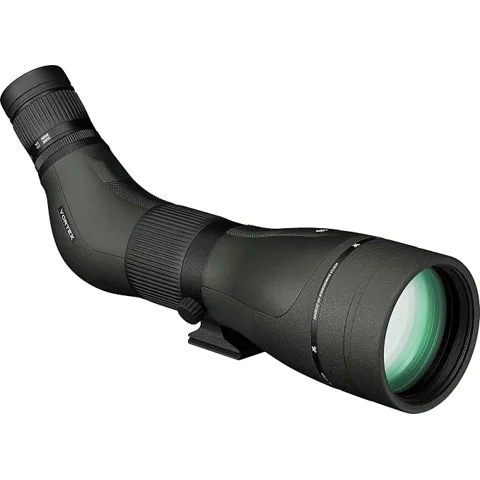
Best overall
1. Vortex Diamondback HD 20-60×85 Angled
The Diamondback HD 85 is the scope we recommend to most birders buying their first good scope. It has an 85 mm objective, the size you want for ducks at dusk and shorebirds at high zoom, with HD glass that keeps color fringing low. The eye relief runs from 18.3 to 20.3 mm, so it works with glasses at every zoom setting.
On r/birding, birders who own Diamondback scopes say the same thing: sharp from 20x to about 40x, with some softness at full 60x zoom, which is true of every scope at this level. The Vortex VIP warranty covers it for life, including damage you cause yourself.
- 20-60x zoom, 85 mm objective, HD optical system
- 108 ft field of view at 1,000 yards at 20x, 60 ft at 60x
- Eye relief 18.3 to 20.3 mm, close focus 24.6 ft
- Argon purged, O-ring sealed, 60.9 oz, 16 in long
- Neoprene stay-on cover in the box
Good: bright 85 mm glass and an unconditional warranty at a mid-range price. Not great: at nearly 4 pounds it needs a solid tripod, and the view softens at 60x.
Best budget spotting scopes for birding
A budget spotting scope for birding still needs to be waterproof, show a sharp image at 20x to 40x and take a standard tripod. Below this tier, image quality drops fast. On r/birding, birders warn that very cheap scopes are blurry at any zoom and that Barska and Simmons scopes are a waste of money. These four are the exceptions worth buying.
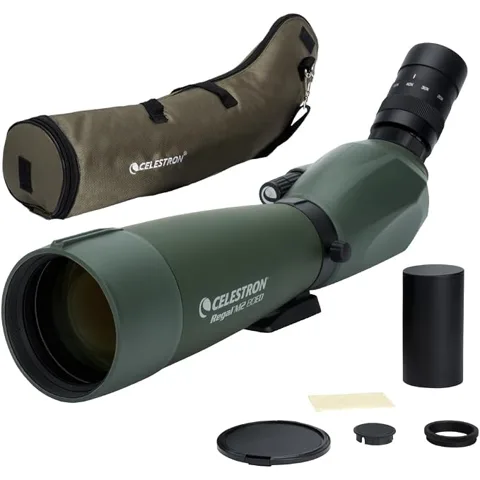
Best budget spotting scope
2. Celestron Regal M2 80ED
The Regal M2 80ED is the least expensive scope we know of with real ED glass and an 80 mm objective. ED glass is what keeps a white egret against dark water free of color fringes, and it is the reason the Regal stays sharper at high zoom than other budget scopes. The earlier Regal M2 80 tied for the top score in the Good Value group of the Audubon spotting scope test.
A birder on r/birding who uses one for shorebirds said it gives a clear image even at the highest magnification. It has a dual focus knob, coarse and fine, and comes with a soft case and a T-adapter for a camera.
- 20-60x zoom, 80 mm ED objective, XLT coatings
- 110 ft field of view at 20x, 52 ft at 60x
- Eye relief 20 mm, close focus 21.3 ft
- Nitrogen filled, waterproof, 66.6 oz with eyepiece
- Celestron limited lifetime warranty
Good: ED glass and an 80 mm objective at a budget price. Not great: heavier than the Vortex scopes, and the warranty does not cover accidents.
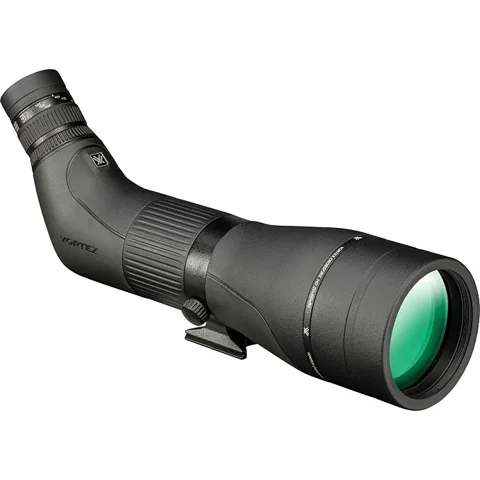
Budget scope with a lifetime warranty
3. Vortex Crossfire HD 20-60×80 Angled
The Crossfire HD 80 is the cheapest scope from Vortex with an 80 mm objective, and it carries the same unconditional lifetime warranty as their premium scopes. That matters for a scope that will ride in a car trunk and stand on wet rocks. The current version has HD glass and a helical focus ring around the barrel.
It is also the lightest 80 mm scope in this guide at 53 ounces. On r/birding, birders choosing between this scope and the Diamondback say the Crossfire is fine for medium distances and the Diamondback is worth the step up if you scope at full zoom often.
- 20-60x zoom, 80 mm objective, HD glass
- 105 ft field of view at 20x, 53 ft at 60x
- Eye relief 18 mm, close focus 26 ft
- Gas purged, O-ring sealed, 53 oz, 15.6 in long
- Vortex VIP unlimited lifetime warranty
Good: the lightest 80 mm scope here, with a no-questions warranty. Not great: no ED glass, so color fringing shows on bright birds at high zoom.
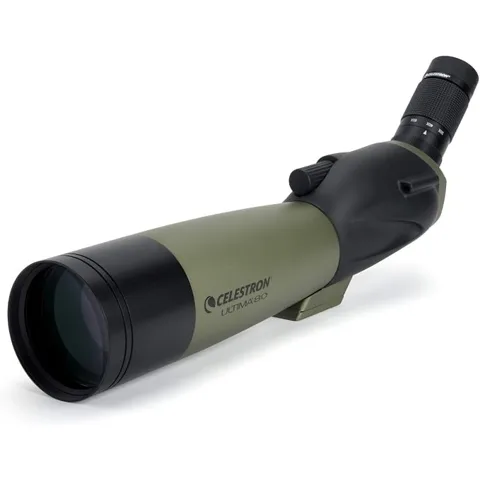
Entry-level 80 mm scope
4. Celestron Ultima 80 Angled
The Ultima 80 has been the standard entry-level birding scope for years, and it has more Amazon ratings than any other scope in this guide. It has fully multi-coated optics and BaK-4 prisms, plain glass rather than ED, and a nitrogen-filled body. It comes with a padded case and a T-adapter for a camera.
Expect a bright, sharp view at 20x to 40x and a dimmer, softer one above that. For ducks on a pond and hawks on a pole, that range is enough.
- 20-60x zoom, 80 mm objective, fully multi-coated
- 105 ft field of view at 20x, 53 ft at 60x
- Eye relief 18 mm, close focus 26.2 ft
- Waterproof, nitrogen filled, 57 oz
- Padded case and camera T-adapter included
Good: a proven 80 mm scope at a low price, with a case in the box. Not great: no ED glass, so it is soft above about 40x.
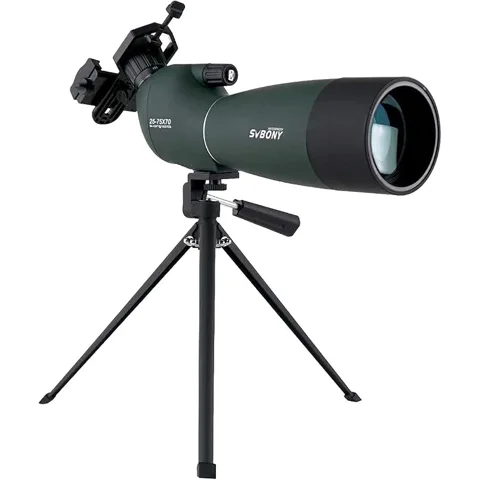
Cheapest scope worth buying
5. SVBONY SV28 Spotting Scope
The SV28 is a 25-75×70 angled scope, and the scope to buy for a child who wants to look at ducks, for a kitchen window that faces a pond or for anyone who wants to try a scope before spending more. It costs a fraction of the others here and has thousands of Amazon ratings. A birder on r/birding bought one for a 12-year-old and called the scope good for the money, but said the included tripod is a joke and should be swapped for a real one.
Ignore the 75x on the label. The image is usable from 25x to about 40x and dim above that. Treat it as a starter scope, not a shorebird scope.
- 25-75x zoom, 70 mm objective, angled eyepiece
- Waterproof, built-in sunshade
- Tabletop tripod and phone adapter included
- Over 3,000 Amazon ratings
Good: the lowest price for a scope that shows a usable image. Not great: dim and soft at high zoom, and the included tripod is too light.
For a little more reach on a budget, the 100 mm version of the Regal M2 exists, but at over 4 pounds for the body alone it is a scope for a car window or a backyard, not a walk.
Best mid-range spotting scopes for birding
In this tier the glass gets sharper at high zoom and the view gets brighter at dusk. These are the scopes birders buy when a budget scope has convinced them they need one.
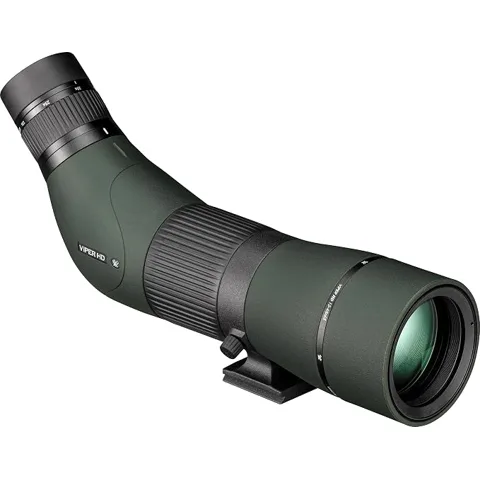
Best light scope
6. Vortex Viper HD 15-45×65 Angled
The Viper HD 65 is the scope for birders who carry it on walks. It is 14 inches long and weighs a pound less than the 85 mm scopes, and its 15x low end shows a 137 ft field of view, the widest in this guide. A wide view makes it faster to find a bird in the scope.
A birder on r/birding who has used scopes for work for a lifetime said a 15-45x scope sits at 15x most of the time, and they zoom in only for birds that are far away and still. The previous Viper HD 65 tied for the top score in the Good Value group of the Audubon test.
- 15-45x zoom, 65 mm objective, HD glass
- 137 ft field of view at 15x, 68 ft at 45x
- Eye relief 17.8 to 19.6 mm, close focus 23 ft
- Argon purged, 59 oz, 14 in long
- Vortex VIP unlimited lifetime warranty
Good: compact and easy to carry, with the widest view here. Not great: tops out at 45x and is dimmer than an 85 mm scope at dusk.
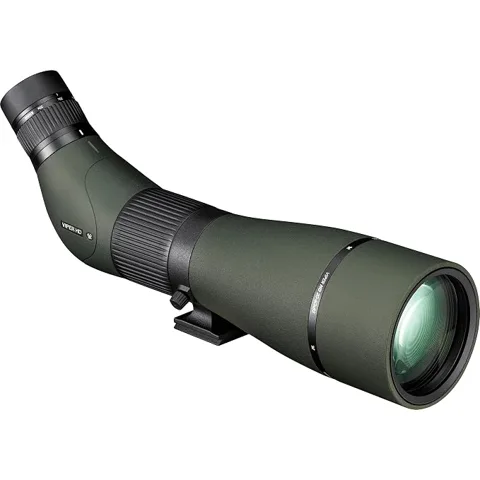
Step up from the Diamondback
7. Vortex Viper HD 20-60×85 Angled
The Viper HD 85 has better lens coatings than the Diamondback, which shows as a brighter, higher-contrast image at the top of the zoom and in poor light. It has a dual focus knob for coarse and fine focus. One r/birding commenter who studies gulls uses the Viper because the extra reach at the top of the zoom matters for them.
It is the heaviest scope in this guide at 76.6 ounces, so pair it with a full-size tripod.
- 20-60x zoom, 85 mm objective, HD glass, XR Plus coatings
- 101 ft field of view at 20x, 50 ft at 60x
- Eye relief 17.8 to 19.6 mm, close focus 36 ft
- Argon purged, O-ring sealed, 76.6 oz
- Vortex VIP unlimited lifetime warranty
Good: brighter and sharper at high zoom than the budget scopes. Not great: heavy, and the 36 ft close focus is long for birds at a feeder.
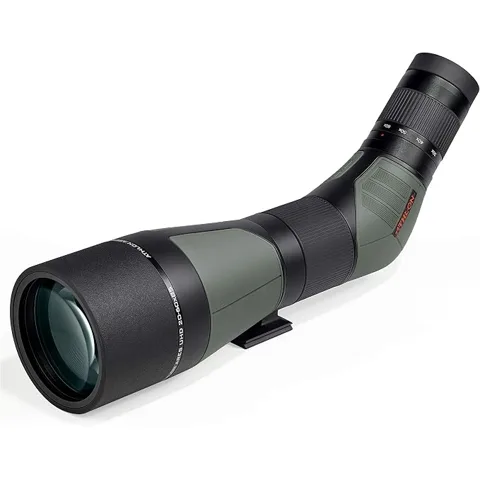
ED glass for less
8. Athlon Ares G2 UHD 20-60×85 Angled
The Ares G2 UHD has extra-low dispersion glass in an apochromatic lens design, the kind of optics usually found one price tier higher. Athlon covers it with a lifetime warranty that, like Vortex, covers accidents.
The trade-offs are weight and close focus. At 70 ounces and with a close focus of 39.4 feet, it is a scope for open water and fields, not for a backyard feeder.
- 20-60x zoom, 85 mm UHD (ED) objective, apochromatic design
- 99 ft field of view at 20x, 48 ft at 60x
- Eye relief 18 to 19.5 mm, close focus 39.4 ft
- Argon purged, waterproof, 70 oz
- Athlon Gold Medal lifetime warranty
Good: ED glass and an accident-proof warranty in the mid-range. Not great: the longest close focus in this guide.
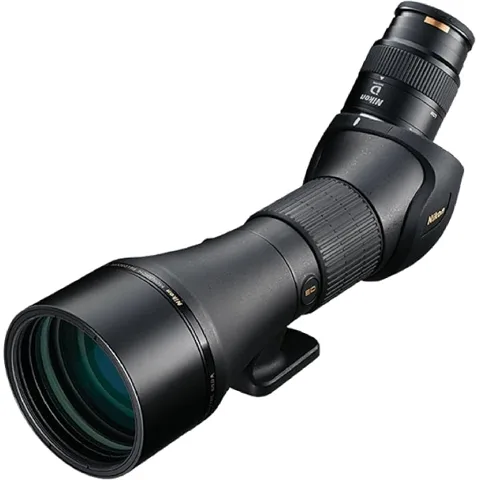
Close focus and a flat field
9. Nikon Monarch 82ED-A 20-60x
The Monarch 82ED-A pairs ED glass with a field-flattener lens, which keeps the bird sharp from the center to the edge of the view. It focuses down to 16.4 feet, close enough for a bird on a feeder across the yard. The Audubon test placed the earlier Monarch ED 82 near the top of its Midrange group.
It is nitrogen filled and waterproof to 1 meter for 10 minutes.
- 20-60x zoom, 82 mm ED objective, field-flattener lens
- 111 ft field of view at 20x
- Eye relief 16.1 mm at 20x, close focus 16.4 ft
- Nitrogen filled, O-ring sealed, 57.8 oz
Good: edge-to-edge sharpness and the closest focus of the mid-range scopes. Not great: the shortest eye relief here, tight for some glasses wearers.
Best premium spotting scopes for birding
Premium scopes stay sharp and bright at 60x in failing light, where budget scopes give up. They are the scopes tour leaders and hawk counters carry. On r/birding, the advice from people who own them is to look through one before buying, because each brand fits the eye a little differently.
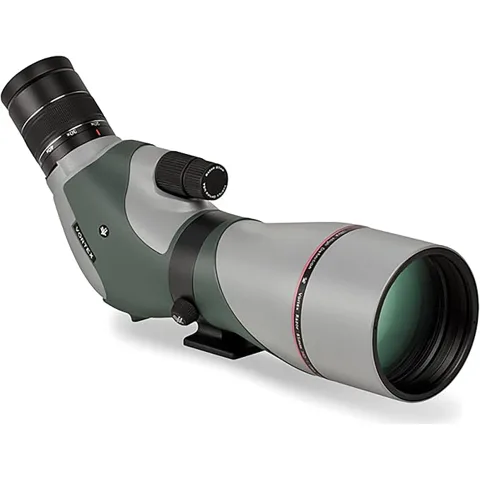
Near-premium view
10. Vortex Razor HD 27-60×85 Angled
The Razor HD 85 is Vortex’s top scope, with HD glass in an apochromatic design. It focuses to 16.4 feet and shows a 117 ft field of view at 27x, both better than the other 85 mm Vortex scopes, and the view stays wide at 60x.
Its eyepiece starts at 27x rather than 20x, so finding a moving bird takes a little more practice. It has the same unconditional lifetime warranty as every Vortex scope.
- 27-60x zoom, 85 mm objective, HD glass, APO design
- 117 ft field of view at 27x, 68 ft at 60x
- Eye relief 16.7 to 17 mm, close focus 16.4 ft
- Argon purged, O-ring sealed, 65.6 oz
- Vortex VIP unlimited lifetime warranty
Good: near-premium glass with the best warranty in optics. Not great: the 27x low end makes birds harder to find than at 20x.
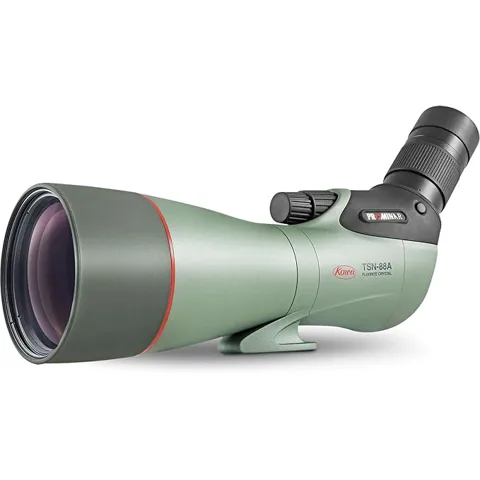
The splurge r/birding recommends
11. Kowa TSN-88A Prominar with TE-11WZ II 25-60x
When someone on r/birding asks which scope to buy as a splurge, the Kowa TSN-88 is the most common answer. Owners say Kowa scopes compete with Swarovski for less money, and one birder still uses a Kowa bought in 2003. Another said Kowa scopes are easier for beginners to use than Vortex scopes, because they are less fussy about where you hold your eye.
The 88 mm objective is pure fluorite crystal, the material that gives the cleanest color of any scope glass. This kit includes the TE-11WZ II wide-angle 25-60x eyepiece, with 17 mm of eye relief.
- 25-60x wide zoom, 88 mm pure fluorite objective
- About 126 ft field of view at 25x, 69 ft at 60x
- Eye relief 17 mm, close focus 16.4 ft
- Waterproof, nitrogen filled, dual focus
- Body 51.5 oz, 13.5 in long
Good: fluorite glass, a wide view and an easy eye position. Not great: premium price, and the full kit is heavy after a few miles.
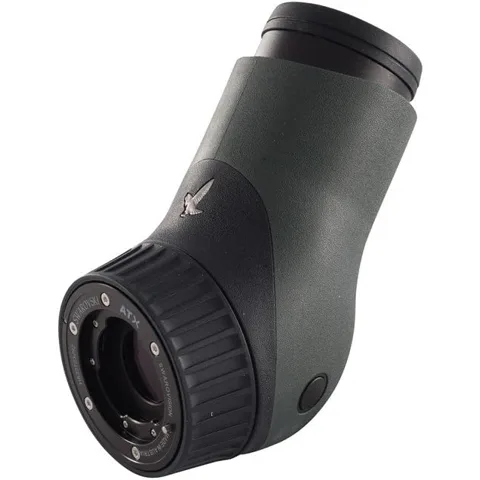
Premium modular system
12. Swarovski ATX Angled Eyepiece Module
The ATX is a two-part scope. This link is the angled 25-60x eyepiece module; it clips onto a 65, 85 or 95 mm objective module, sold separately. Most birders pair it with the 85 mm module, and you can add the 65 for travel and use the same eyepiece on both. With the 85 mm module it focuses to 11.8 feet, the closest of any full-size scope in this guide.
The eyepiece has 20 mm of eye relief and Swarovski’s field-flattener lenses, which keep the view sharp to the edge. On r/birding, birders joke that every serious birder ends up with a Swarovski; others prefer Kowa or Zeiss for less.
- 25-60x zoom with the 85 mm objective module
- 124 ft field of view at 25x, 68 ft at 60x (85 mm set)
- Eye relief 20 mm, close focus 11.8 ft (85 mm set)
- Gas filled, submersible to 4 m, 67.4 oz as an 85 mm set
Good: the closest focus and most flexible system here. Not great: the most expensive scope in this guide, and the objective module is a second purchase.
Best compact spotting scope for travel
A travel scope trades reach and brightness for weight. Buy one if you fly to bird, hike a mile or more to a marsh or already own a full-size scope for the car.
Best for travel
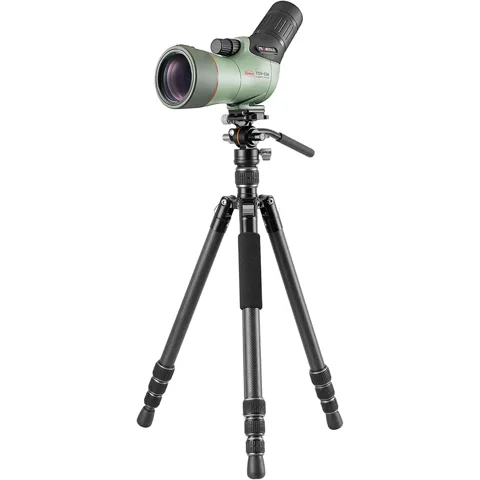
13. Kowa TSN-55A Prominar Travel Kit
The TSN-55A is the newer version of the Kowa TSN-553, the compact scope that tied for the top score in the Midrange group of the Audubon test. It weighs 965 grams (about 34 ounces), around half as much as an 85 mm scope, and is 255 mm (10 inches) long. It has a 55 mm pure fluorite objective and a built-in 17-40x wide-angle zoom with a dual focus knob.
This kit pairs the scope with a lightweight Vanguard travel tripod, so the whole setup comes in one box. One r/birding owner of the older 55 mm Kowa said it has been hauled all over the world and is still good as new.
- 17-40x wide zoom, 55 mm pure fluorite objective
- Waterproof, nitrogen filled, dual focus
- 965 g (about 34 oz), 255 mm long
- Vanguard travel tripod included
Good: half the weight of a full-size scope, with fluorite glass and a tripod in the box. Not great: tops out at 40x and is dim in poor light compared with 85 mm scopes.
Angled vs straight spotting scopes for birding
Buy an angled scope unless you have a reason not to. Most birders do, and most scope models come in both versions.
| Angled (45 degrees) | Straight | |
|---|---|---|
| Sharing | Set the tripod for the shortest person and everyone can look | Each person has to adjust the tripod height |
| Tripod | Works on a shorter tripod, which is steadier | Needs a tripod tall enough for eye level |
| Birds overhead | Comfortable for hawks and birds in treetops | Hard on the neck |
| Finding a bird | Takes practice, because you look down while the scope points out | Easier, you look along the barrel |
| Car window mount | Awkward | Better |
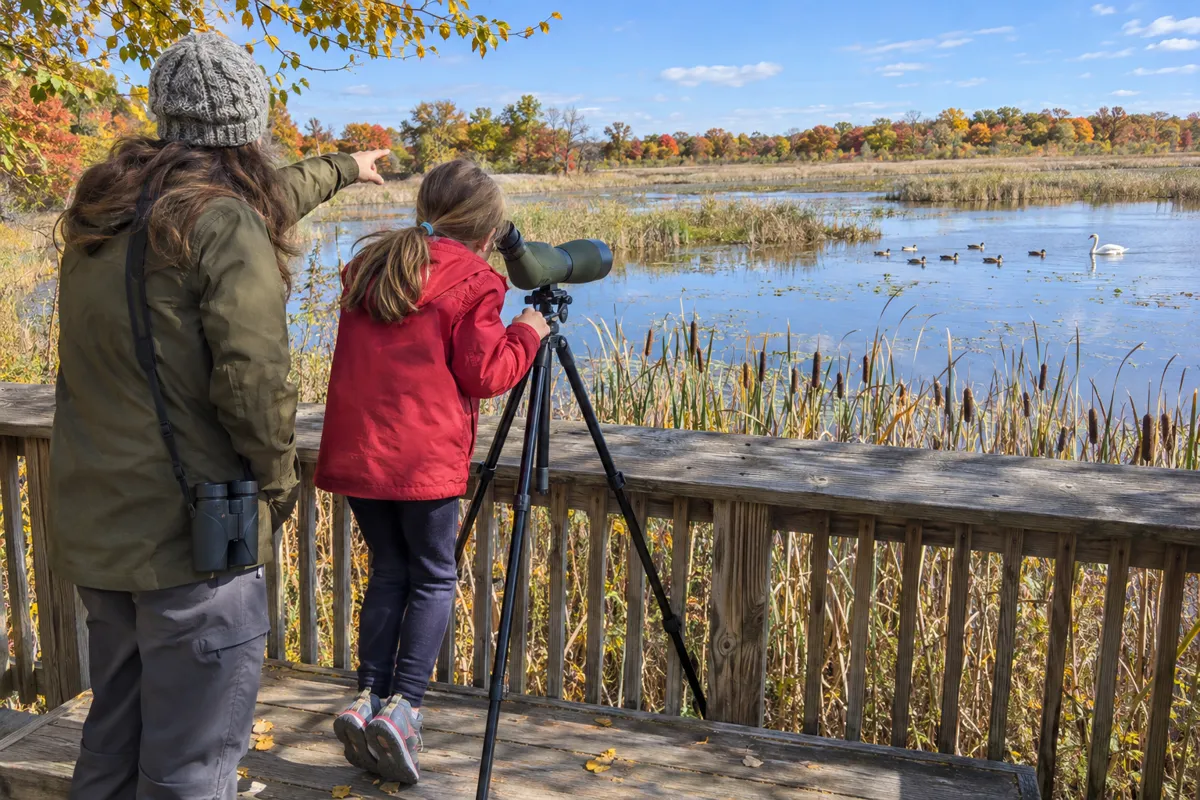
When I led beginner walks at a nature center, I set the tripod low enough for the shortest child in the group. With an angled scope, every adult could bend and look at the same swan without anyone touching the legs. With a straight scope, we would have rebuilt the tripod for each person. Kenn Kaufman, writing for Audubon, makes the same point: angled scopes are easier to share and better for birds overhead, and straight scopes suit a solo birder with a tall tripod.
Best magnification for a birding spotting scope
20x to 40x is the useful range for most birding. A 20-60x zoom is still the right eyepiece to buy, because 60x helps on a still, distant bird in good light. Three things limit the top end:
- Heat shimmer. Warm air over sand, water and pavement bends light. At high zoom, it turns a sandpiper into a wobbling shape.
- Light. The image gets dimmer as you zoom. A 65 mm scope at 45x is dim at dusk; an 85 mm scope at 60x is dim on an overcast morning.
- Shake. Wind and your own touch move the scope. Every tremor is magnified 60 times.
On an August mudflat at midday I zoomed to 60x on a distant plover and saw a shimmering blob. Back at 30x the bird was smaller and sharp, and I could see the breast band. On r/birding, the advice from people who used scopes for work is the same: find the bird at the lowest power, zoom in only for birds that are far away and not moving, and leave the scope at low power when you hand it to beginners.
Best tripod for a spotting scope
The tripod decides how much detail a scope shows. A good scope on a light camera tripod shakes at 30x and shows less than a budget scope on a solid one. Four rules from birders on r/birding:
- Use a pan head, not a ball head. A pan or fluid head moves smoothly left and right while staying level, so you can follow a swimming duck. A ball head flops when you loosen it.
- Match the tripod to the scope. 80 to 85 mm scopes weigh 3.5 to 5 pounds and need a full-size tripod with thick legs. A 65 mm scope can use a lighter one.
- Check the height. With an angled scope, the tripod should put the eyepiece at chin height without the center column raised. A raised center column wobbles.
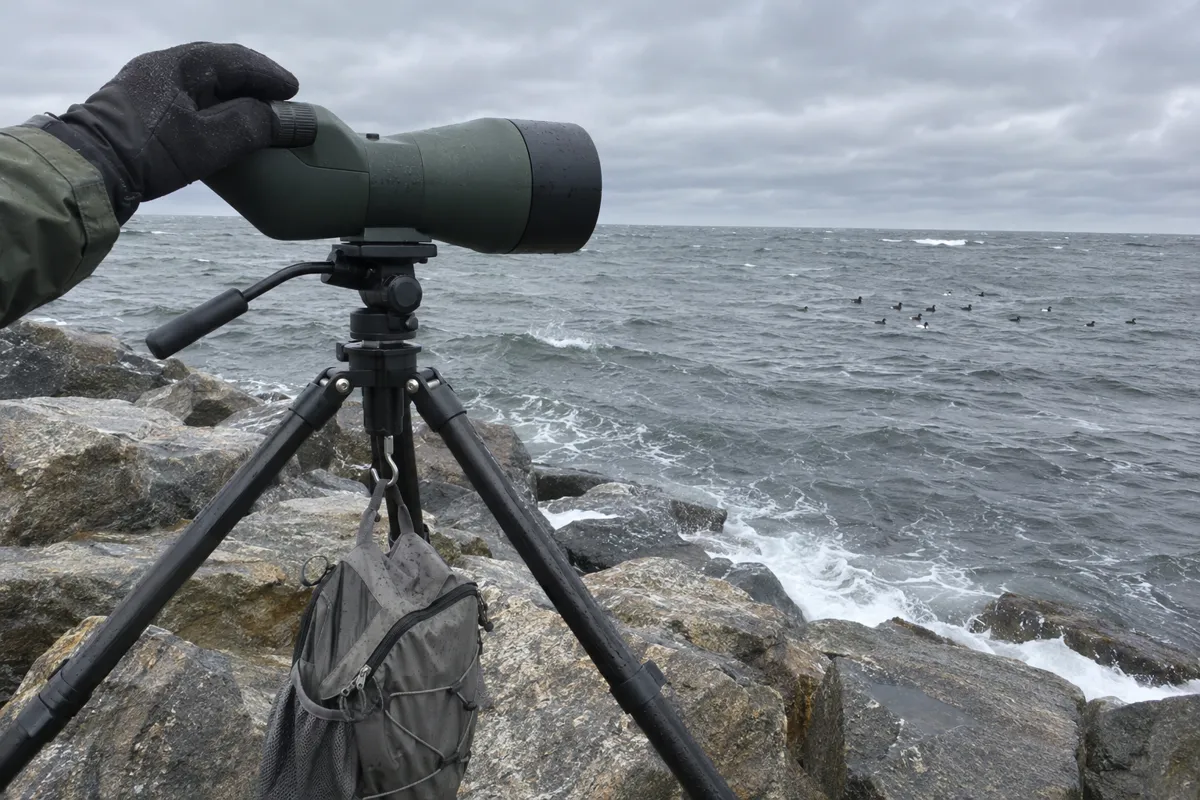
- Hang weight from the hook. Most tripods have a hook under the center column. Hanging a pack from it steadies the scope in wind.
On a windy jetty one winter, I borrowed a scope on a light travel tripod to look at a raft of scoters. At 40x the ducks shook so much I could not tell surf scoters from black scoters. The trip leader hung my pack from the tripod hook and turned the zoom down to 25x, and the white head patches came into focus.
Tripod for any scope
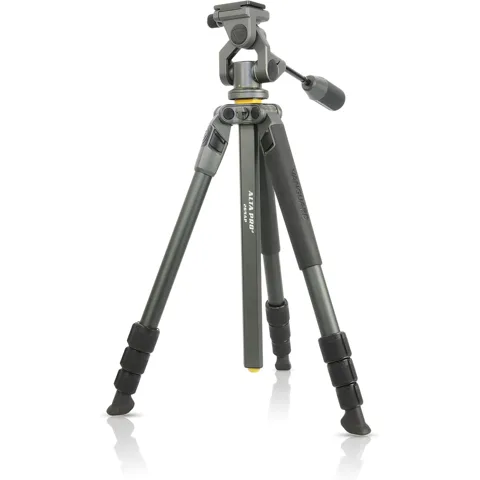
14. Vanguard Alta Pro 2 264AO with PH-31 Pan Head
Vanguard Alta tripods come up on r/birding as sturdy tripods that survive years of field use. One commenter said they are steadier than the tripods Vortex sells and uses the hook under the column to hang a bag in wind. This kit has the two-way, Arca-compatible PH-31 pan head, the kind birders recommend for scopes, and a loop under the center column for a counterweight.
It holds 11 pounds, more than double the weight of the heaviest scope here, and folds to 27.7 inches.
- 26 mm aluminum legs, 4 sections, twist locks
- PH-31 two-way pan head, Arca compatible
- Extended height 63.8 in, folded 27.7 in
- 5.1 lb, 11 lb max load, counterweight loop
Good: steady enough for an 85 mm scope, with the right kind of head. Not great: at 5 pounds it adds a lot to a scope you carry far.
Digiscoping: taking photos through your scope
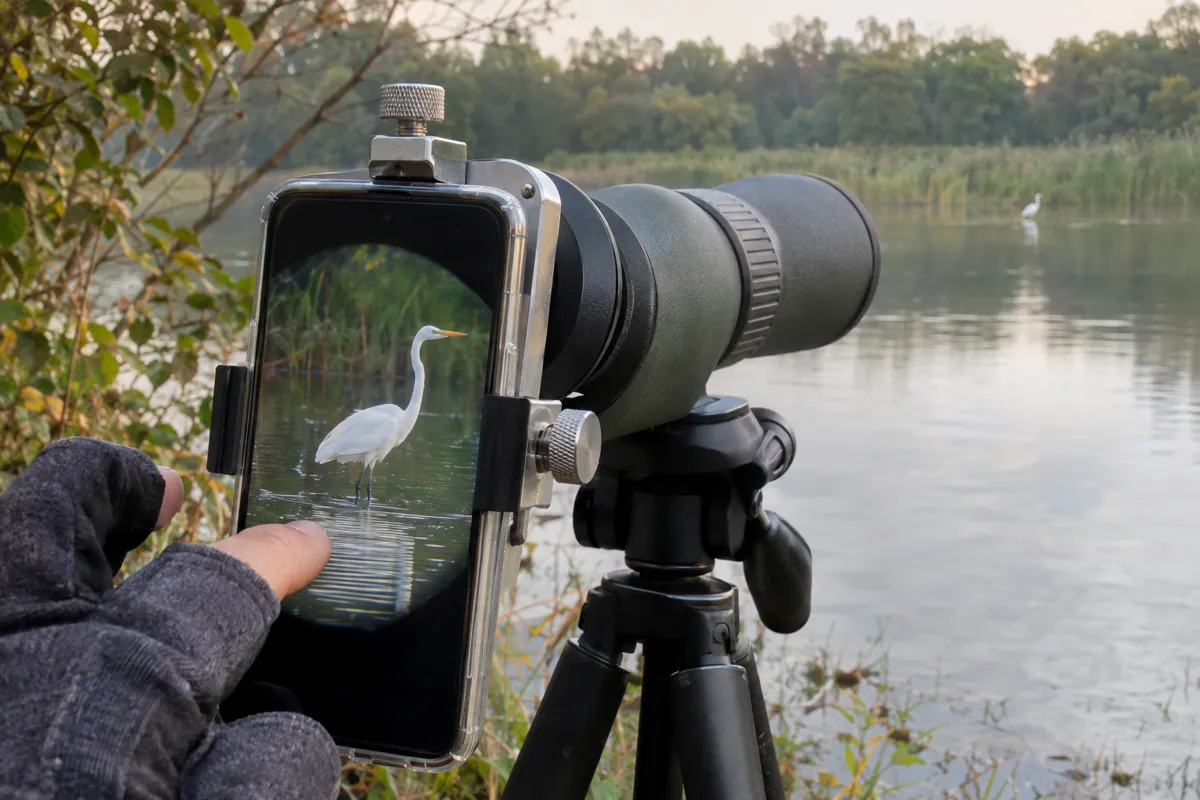
Digiscoping means photographing a bird through a spotting scope with a phone or camera. It turns a scope into a 1,000 mm-plus telephoto lens for record shots of rare birds, and many birders on r/birding post their first scope photos within a week of buying one.
- Use a phone adapter. Holding a phone to the eyepiece by hand works for a quick shot, but an adapter keeps the phone camera centered.
- Zoom the scope to 20x to 30x and use the phone’s 1x lens. Higher zoom shows a dark ring around the image.
- Focus with the scope, then tap the bird on the phone screen to lock focus and exposure.
- Do not touch the scope to take the picture. Use the phone’s timer, volume buttons on headphones or a Bluetooth remote.
Best phone adapter
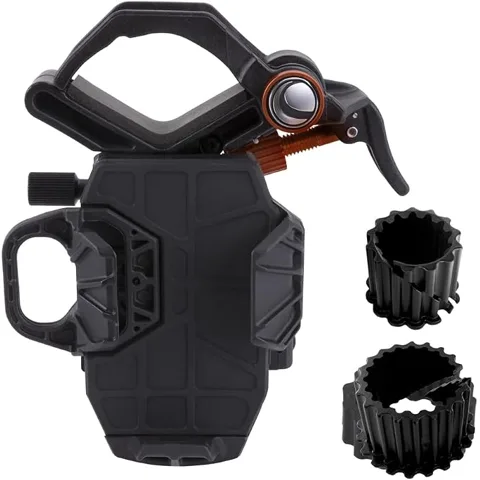
15. Celestron NexYZ 3-Axis Phone Adapter
The NexYZ holds a phone over an eyepiece and moves it on three axes, left and right, up and down, and toward or away from the lens, so you can center the camera and set the distance that removes the dark ring. It fits eyepieces from 35 to 60 mm across, which covers most spotting scopes, and holds phones with most cases on.
It has over 6,000 Amazon ratings, more than any other adapter we found.
- 3-axis adjustment (X, Y and Z)
- Fits eyepieces 35 to 60 mm in diameter
- Metal frame, spring-loaded phone clamp
- Works with most phones in a case
Good: fits nearly any scope and phone. Not great: takes a minute to align each time you mount it.
What r/birding recommends
We read the spotting scope threads on r/birding from the last two years. These points came up again and again:
- A scope is not an upgrade from binoculars. One commenter put it this way: a scope does two things better and a whole bunch of things worse. Unless you watch shorebirds most of the time, you will still use your binoculars more.
- The tripod matters as much as the glass. The most repeated advice in every thread. Budget for a sturdy tripod with a pan head.
- Vortex for value. The Diamondback, Crossfire and Viper scopes are the most named first scopes, for the glass and the warranty.
- Celestron Regal M2 80ED for a budget scope with ED glass.
- Kowa for a splurge. The TSN-88 is the most upvoted answer for an “if money is no object” scope, and the 55 mm Kowa for travel.
- Avoid cheap no-name and big-box scopes. Barska, Simmons and low-end Bushnell come up as scopes to skip.
- Buy used or last year’s model. Scopes last decades, and a used scope of a good brand beats a new cheap one.
Spotting scopes to skip for birding
- No-name “30-90x” and “HD” bundles with a tabletop tripod. The high numbers sell the scope, but small, plain-glass scopes are blurry and dark above about 40x, and the tripods shake. The SVBONY SV28 above is the one cheap scope birders vouch for.
- Target shooting scopes with a reticle. The crosshair sits in your view of every bird.
- Monoculars sold as scopes. A handheld 10x or 12x monocular shows less than binoculars of the same power.
- Straight scopes for a group. If you bird with a partner or children, buy angled.
- A premium scope on a cheap tripod. Split the budget instead.
How to use a spotting scope for birding
Finding a bird in a scope is the part beginners struggle with. On r/birding, a new scope owner with years of telephoto lens experience said it took weeks to feel comfortable. These steps shorten that.
- Set the zoom to the lowest power. The view is widest and brightest there.
- Find the bird with binoculars first. Note something next to it: a post, a rock, a different-colored bird.
- Aim with the sight line. Most scopes have a sight or a ridge on top of the barrel. Look along it at the landmark, then look into the eyepiece.
- Focus, then zoom. Bring the bird into focus at low power, zoom in, then refocus with the fine focus.
- Use your dominant eye and keep the other open. Closing one eye tires it fast.
- Do not lean on the scope. Rest your hands beside the eyepiece, not on it, and let the view settle after each touch.
Shorebirds and ducks are the best birds to practice on, because they stay put. Our guides to seabirds of Polynesia and birds of Costa Rica list birds that birders usually see through a scope. If you are buying a scope as a present, see our Christmas gifts for bird lovers and stocking stuffers for birders for smaller gear to go with it.
FAQ
What is the best spotting scope for birding?
For most birders the best spotting scope is the Vortex Diamondback HD 20-60×85 Angled: an 85 mm objective, HD glass, long eye relief and an unconditional lifetime warranty. The Celestron Regal M2 80ED is the best budget scope, the Vortex Razor HD and Kowa TSN-88A are the best premium scopes and the Kowa TSN-55A is the best travel scope.
What is the best budget spotting scope for birding?
The Celestron Regal M2 80ED is the best budget spotting scope for birding because it has ED glass and an 80 mm objective, which keep the image sharp at high zoom. The Vortex Crossfire HD 20-60×80 is lighter and has a no-questions lifetime warranty. For a child or a first try, the SVBONY SV28 is the cheapest scope worth buying.
What magnification spotting scope is best for birding?
A 20-60x zoom eyepiece is best for birding. You find the bird at 20x and zoom in as far as light and heat shimmer allow. Most birding happens between 20x and 40x; 60x is useful only for still, distant birds in good light.
Is an angled or straight spotting scope better for birding?
An angled spotting scope is better for most birders. It is easier to share with people of different heights, works on a shorter and steadier tripod and is more comfortable for birds overhead. Straight scopes are easier to aim and better on a car window mount.
Is a 65 mm or 85 mm spotting scope better for birding?
An 80 to 85 mm scope is better if you use it near the car, because it is brighter at high zoom and at dawn and dusk. A 60 to 65 mm scope weighs about a pound less and is better if you carry it on long walks or travel.
Do I need a spotting scope for birding?
You need a spotting scope only if you often watch birds that are far away and sit still, such as shorebirds, ducks, gulls and perched hawks. For birding in woods and backyards, binoculars are enough. A scope complements binoculars; it does not replace them.
What tripod do I need for a spotting scope?
Use a full-size tripod with a pan or fluid head, not a ball head, rated for well over the weight of your scope. It should put the eyepiece of an angled scope at chin height without raising the center column. Vanguard Alta tripods with a pan head are a common choice among birders.
Can you take pictures through a spotting scope?
Yes. Taking pictures through a spotting scope is called digiscoping. Mount a phone on the eyepiece with an adapter such as the Celestron NexYZ, set the scope to 20x to 30x, focus with the scope and take the photo with a timer or remote so you do not shake it.
Are spotting scopes good for people who wear glasses?
Yes, if the eye relief is about 16 mm or more and the eyecup twists down. Every scope in this guide meets that. The Celestron Regal M2 80ED and Swarovski ATX have 20 mm, and the Vortex Diamondback HD 85 has 18.3 to 20.3 mm.
What spotting scope does Reddit recommend for birding?
On r/birding, the most recommended scopes are the Vortex Diamondback HD, Crossfire HD and Viper HD for value, the Celestron Regal M2 80ED on a budget and the Kowa TSN-88 for a splurge. The most repeated advice is to spend as much attention on the tripod as on the scope.
Sources
- Kenn Kaufman, National Audubon Society. How to Choose Your Spotting Scope.
- National Audubon Society. The Audubon Guide to Spotting Scopes, with the Good Value and Midrange results.
- Vortex Optics. Diamondback HD 20-60×85 Angled specifications.
- Celestron. Regal M2 80ED Spotting Scope specifications.
- Kowa Optics. PROMINAR spotting scope specifications.
- Swarovski Optik. Spotting scope fact sheets.
- r/birding. Scope recommendations?
- r/birding. Budget spotting scope suggestions?
- r/birding. Best intro-level budget spotting scope? Considering between the Vortex Crossfire and Diamondback
- r/birding. Recommend (splurging on) spotting scope as a gift
- r/birding. What’s the learning curve for a spotting scope?
- r/birding. Can someone explain spotting scope tripods?
- r/birding. Best spotting scope for obsessed 12 year old twitcher