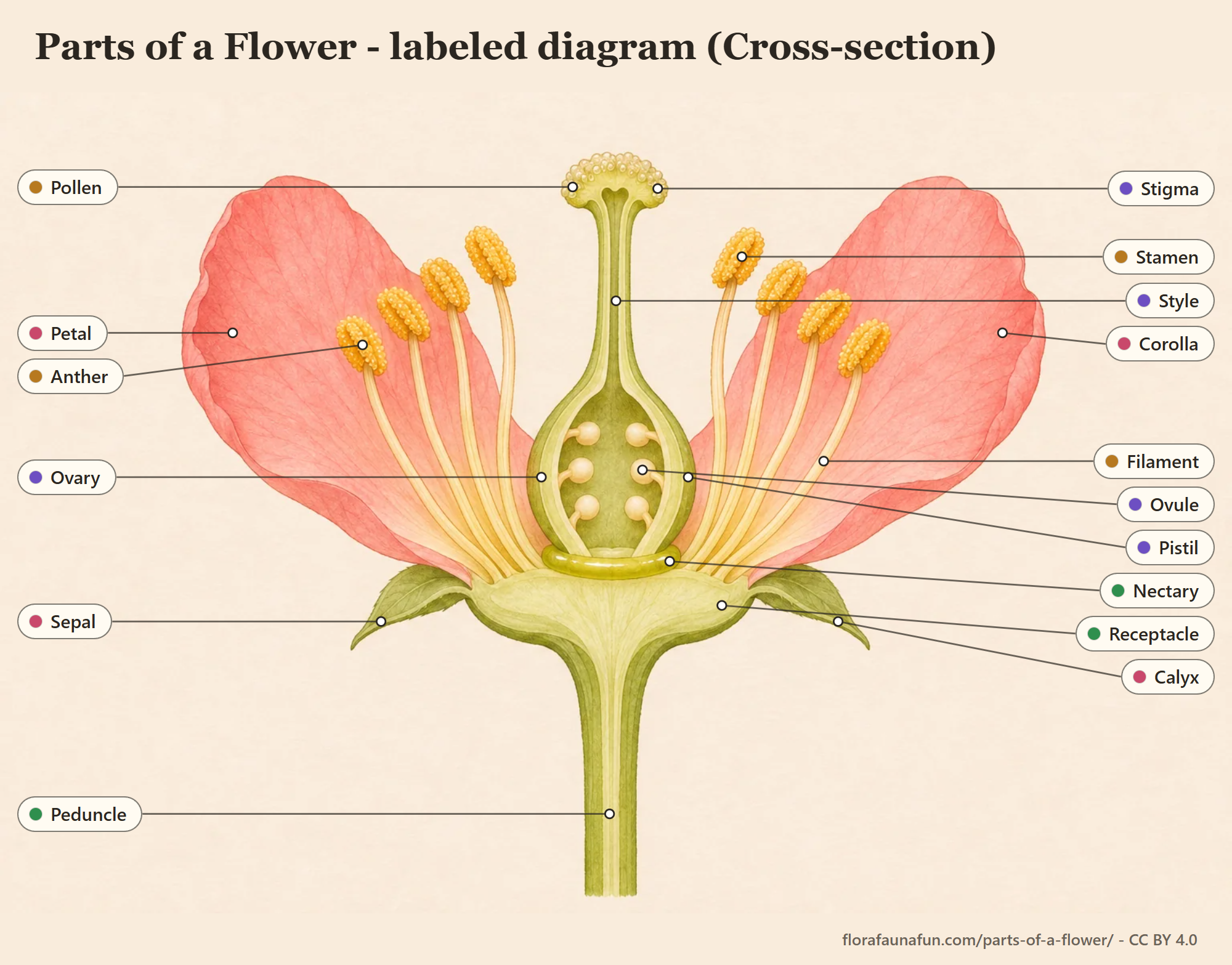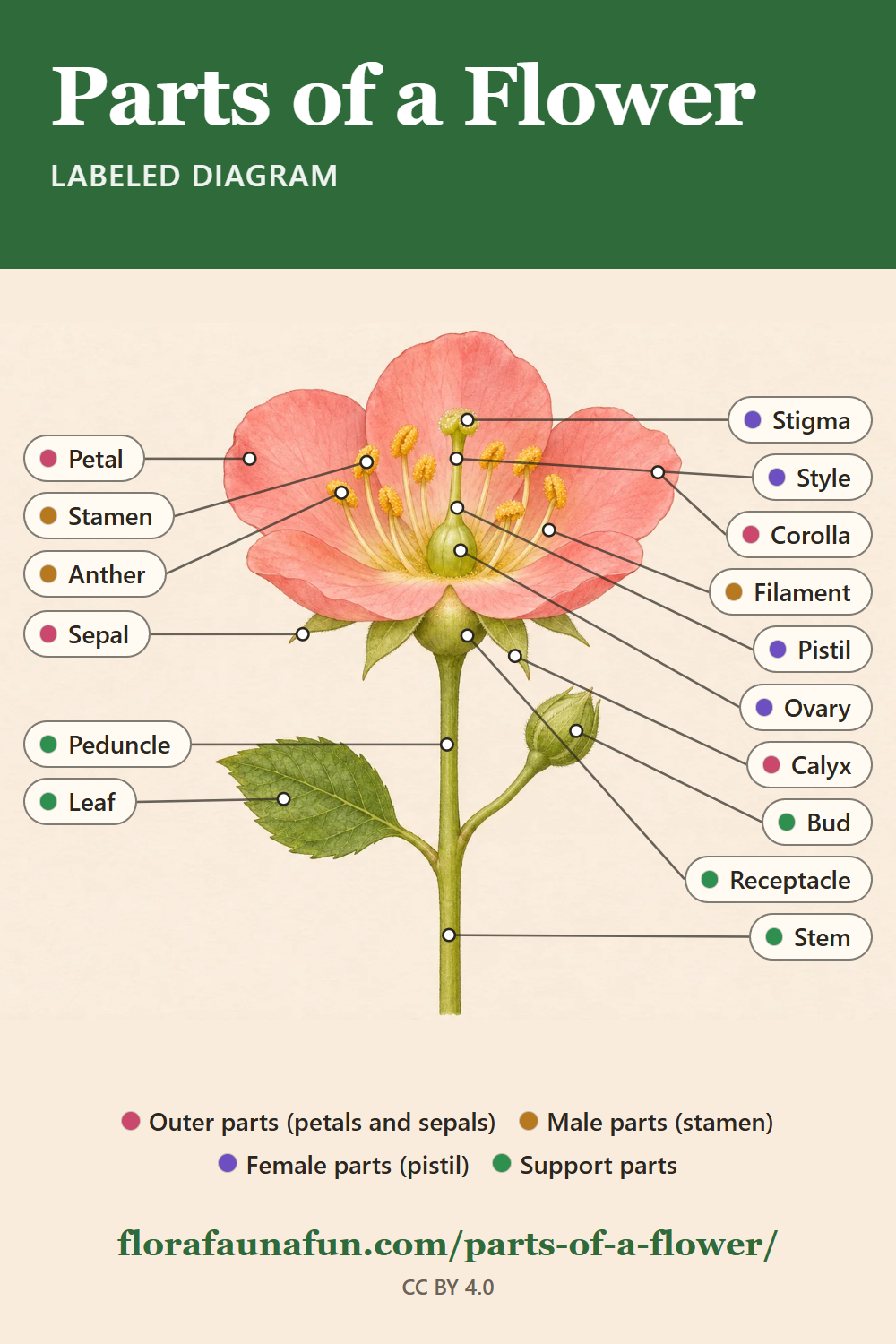
Short answer: A flower has four main parts: sepals, petals, stamens and a pistil. Sepals protect the bud and petals attract pollinators. The stamens (an anther on a filament) make pollen, and the pistil (stigma, style and ovary) holds the ovules that become seeds.
Tap any label in the diagram above to see what the part does. Switch views to see the whole flower, a cross-section and a close-up of pollen reaching an ovule.
This article contains Amazon affiliate links. Florafaunafun earns a commission on qualifying purchases. See our affiliate disclosure.
Outer parts: sepals and petals
The outer parts form the flower’s wrapping. They do not make seeds, but they protect the flower and bring in the animals that carry pollen.
Not every flower has petals. Grass flowers rely on wind and have no showy petals at all.
Male parts: the stamen
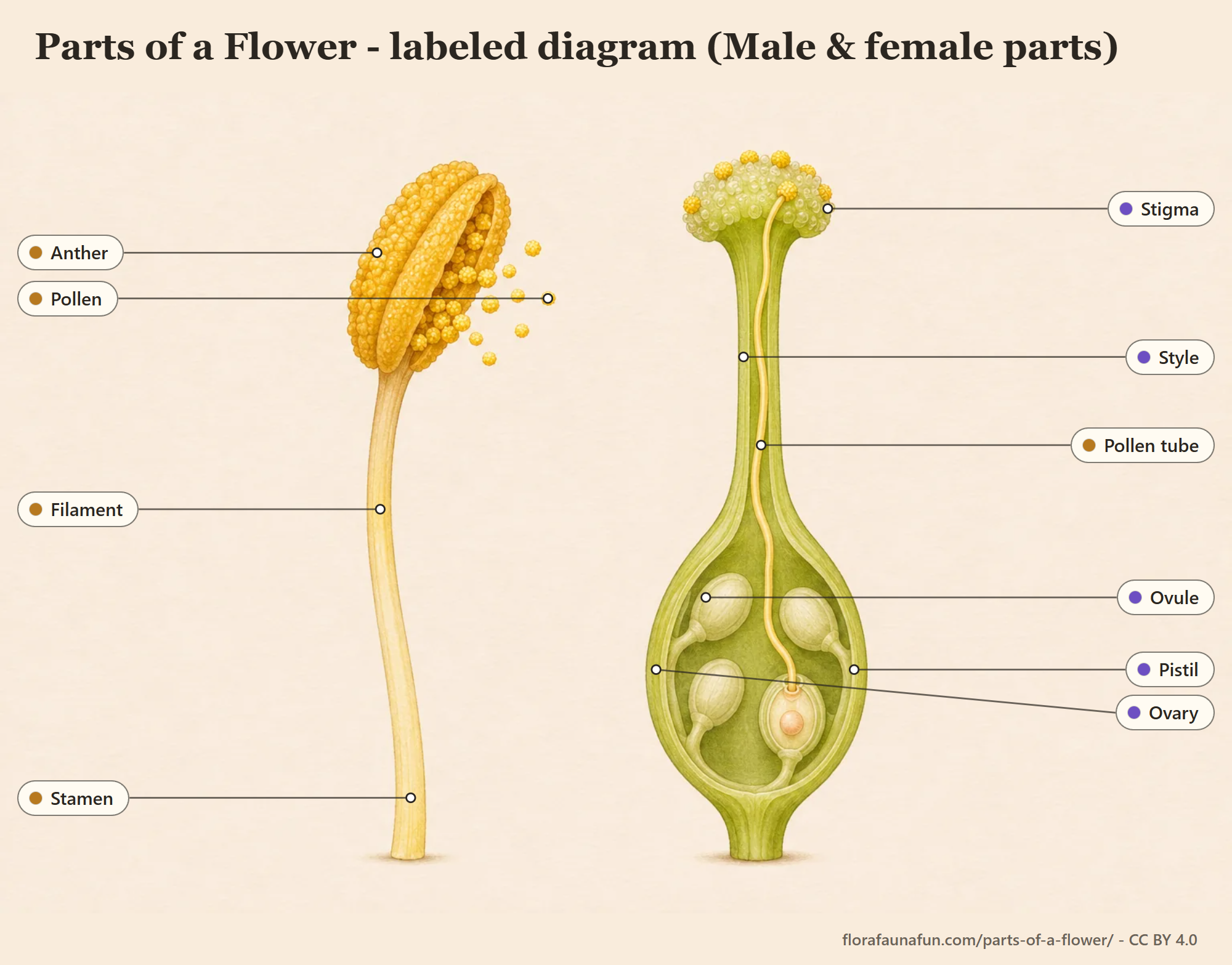
The male part of a flower is the stamen: a thin stalk topped by a pollen-making sac. A flower usually has several stamens, and together they are called the androecium.
Female parts: the pistil
The female part is the pistil, in the center of the flower. It has three sections from top to bottom: stigma, style and ovary.
Support parts: stalk, receptacle and nectary
These parts hold the flower up and feed the animals that visit it.
Parts of a flower and their functions
| Part | Group | Function |
|---|---|---|
| Sepal | Outer | Protects the bud; usually green |
| Petal | Outer | Attracts pollinators with color, scent and markings |
| Stamen | Male | The whole male unit: an anther on a filament |
| Anther | Male | Makes and releases pollen |
| Filament | Male | Holds the anther up for pollinators or wind |
| Pollen | Male | Carries the cells that form sperm |
| Pistil | Female | The whole female unit: stigma, style and ovary |
| Stigma | Female | Sticky top that catches pollen |
| Style | Female | Lifts the stigma; pollen tubes grow down it |
| Ovary | Female | Holds the ovules; grows into the fruit |
| Ovule | Female | Holds the egg cell; becomes the seed |
| Receptacle | Support | Widened stalk tip where the flower parts attach |
| Peduncle | Support | Stalk that holds the flower up |
| Nectary | Support | Gland that makes nectar to reward pollinators |
Male vs female parts of a flower
Complete, perfect and incomplete flowers
These words are often mixed up. They describe different things.
| Term | Meaning | Example |
|---|---|---|
| Complete | Has all four ring types: sepals, petals, stamens and pistil | Rose, lily |
| Incomplete | Missing at least one of the four | Many grasses |
| Perfect | Has both stamens and a pistil, even if petals are missing | The diagram flower |
| Imperfect | Has only stamens or only a pistil | Corn, squash |
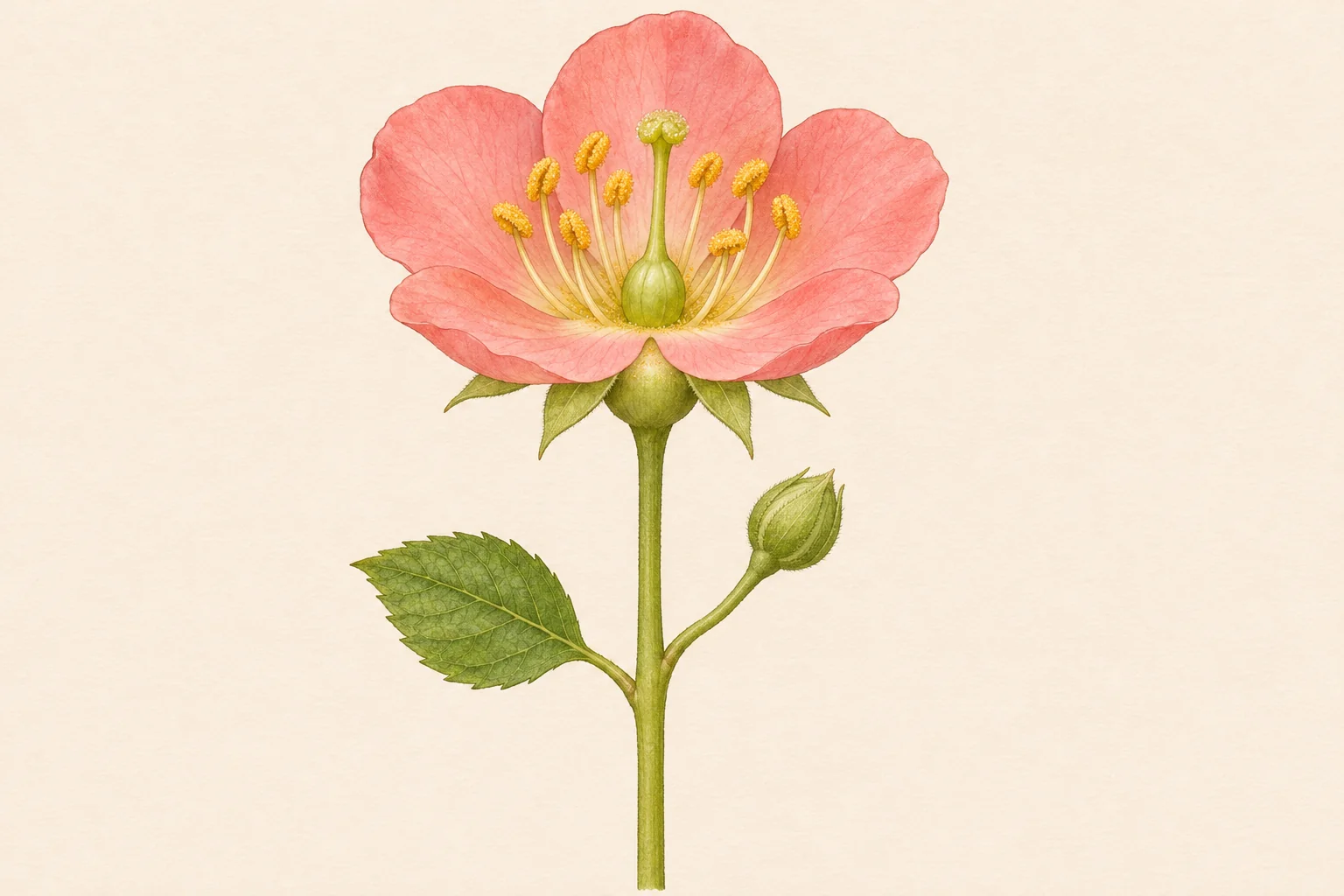
A flower can be perfect without being complete. The flower in the diagram is both, which is why it is the textbook model. Most flowers do not look exactly like it.
You can also count parts. Monocot flowers such as lilies and tulips usually have parts in threes. Eudicot flowers tend to have four or five parts, or multiples of those. This is a tendency, not a rule. The diagram shows a generic five-part eudicot flower.
From flower to seed
Pollination and fertilization are two separate steps. Hours to days pass between them.
Key facts about flower parts
Free printable labeled flower diagram
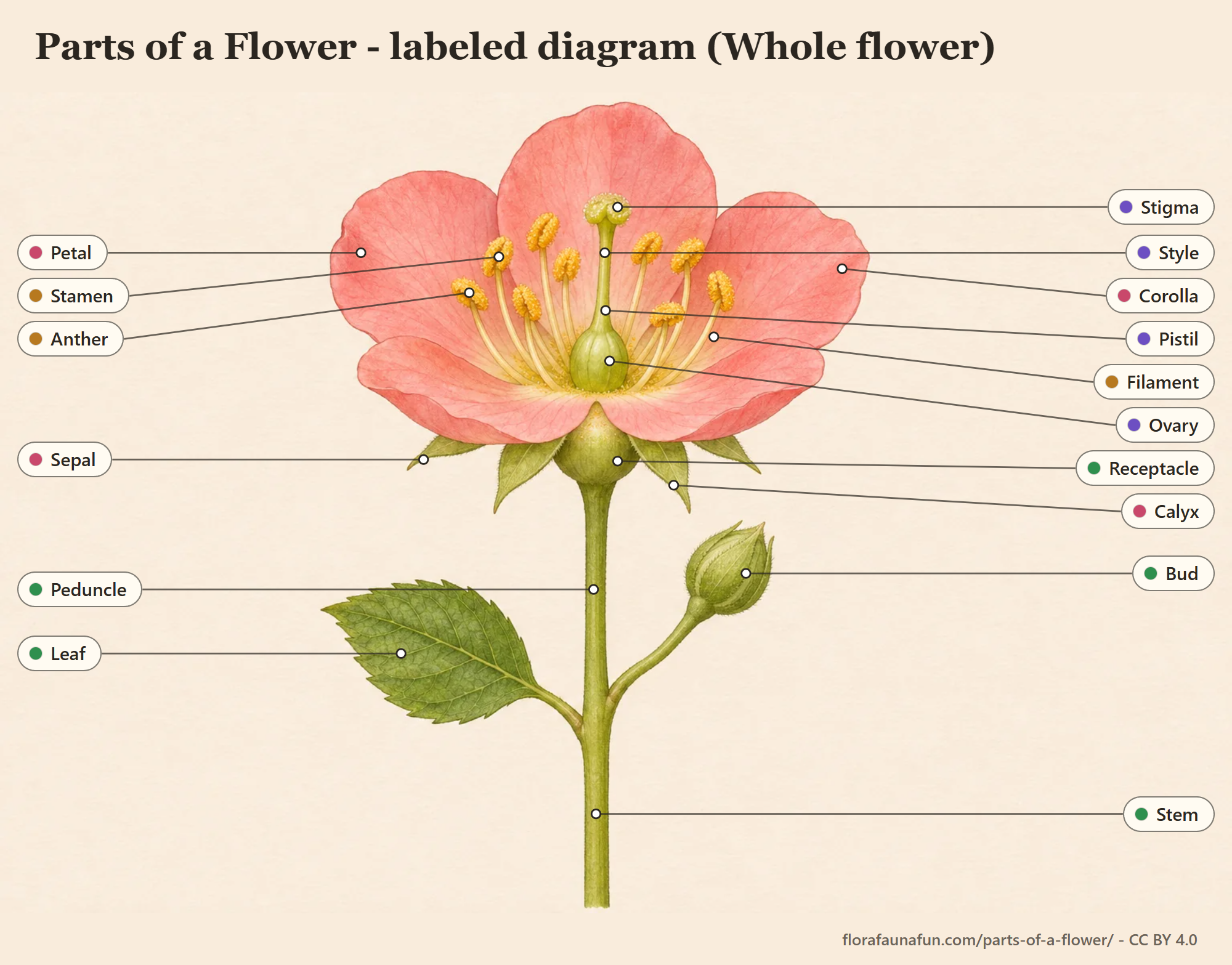
Free for classroom and home use under CC BY 4.0. Credit FloraFaunaFun.
How to use this diagram in class
- Label quiz. Turn the labels off in the diagram and have students name each part, then tap to check.
- Print and cover. Print the PDF, cover the names with sticky notes and have students rewrite them from memory.
- Flower dissection. Take a real lily or tulip apart: peel off the sepals and petals, find the stamens and the pistil, then have an adult slice the ovary across. Compare what you see with the cross-section view. A hand lens shows the anthers and stigma clearly.
- Sort and count. Collect different flowers, count their parts in threes or fives and decide which are complete and which are perfect.
Frequently asked questions
The four main parts are the sepals, petals, stamens and pistil. Sepals protect the bud, petals attract pollinators, stamens make pollen and the pistil holds the ovules that can become seeds. Together they form four rings, called whorls, from the outside in.
The male part is the stamen, made of an anther that makes pollen and a filament that holds it up. The female part is the pistil, made of a stigma that catches pollen, a style and an ovary that holds the ovules. A flower with both is called perfect.
After fertilization the ovary grows into the fruit, and the ovules inside it become the seeds. Fruit here means the botanical kind, so pea pods, tomatoes, cucumbers, grains and nuts all count, not only sweet fruit. The fruit protects the seeds and often helps spread them.
A carpel is one unit of the female part, made of a stigma, style and ovary. A pistil is either one carpel or several carpels joined together. They mean the same thing only when the pistil has a single carpel, as in a pea flower.
No. Many wind-pollinated flowers, such as grasses, have no showy petals because they do not need to attract animals. Some flowers also have showy sepals that look like petals, as in the hellebore, and tulips and lilies have tepals instead.
Color, scent and markings on the petals attract pollinators such as bees and butterflies. Some petals have ultraviolet patterns that insects can see and people cannot. Flowers that rely on wind, like grasses, usually skip the showy display, since the wind does the carrying.
The receptacle is the widened tip of the flower stalk. The sepals, petals, stamens and pistil all attach to it, which makes it the base the whole flower sits on. It is not the same as the stalk itself, which is the peduncle.
No. Pollination is pollen landing on the stigma. Fertilization comes later, when a sperm inside the pollen tube joins the egg cell in the ovule. The pollen tube has to grow down the style first, which takes hours to days.