The birds of Argentina add up to more than 1,000 recorded species, according to eBird’s national checklist, and around 20 of them live nowhere else. That range comes from geography. The country runs from subtropical marshes near Paraguay to sub-Antarctic forest on Tierra del Fuego, and from Atlantic cliffs to Andean salt lakes above 3,500 meters.
Most lists sort those birds alphabetically or by taxonomic family. That’s useful for ticking boxes and useless for planning a trip. This guide goes by habitat instead: 20 species that are icons of their region, with a one-line ID, where to look, and the months that work.
The national bird sets the tone. The Rufous Hornero is brown, plain and everywhere, and Argentines love it for exactly that reason.
Table of contents
- How Argentina’s habitats split the birds
- Pampas and central Argentina
- Iberá wetlands
- Yungas, Puna and the high Andes
- Monte, Chaco and the dry west
- Patagonia and Tierra del Fuego
- Species by region at a glance
- Where to see birds of Argentina and when to go
- FAQ
- Where to start
How Argentina’s habitats split the birds
Five zones account for nearly everything on this list.
- Pampas and central Argentina: flat grassland and scattered woodland around Buenos Aires. Open-country birds, many of them common.
- Iberá wetlands: a huge marsh system in Corrientes province in the northeast, with the country’s best mix of waders and grassland specialists.
- Yungas, Puna and the Andes: cloud forest in the northwest, rising to high-altitude salt lakes and bare peaks.
- Monte, Chaco and the dry west: thorny scrub and desert, quieter and less visited.
- Patagonia and Tierra del Fuego: steppe, southern beech forest and a long Atlantic coast.
Pampas and central Argentina
You don’t need to leave the capital region to see good birds. Four of the country’s best-known species turn up here.
1. Rufous Hornero (Furnarius rufus)
- ID: Plain cinnamon-brown songbird, about 18 cm, walking on the ground with an upright, confident stance.
- Where: Parks, fence lines and city plazas across most of the country.
- Best months: Year-round.
Hornero means “baker.” The bird builds a domed clay nest the shape of a wood-fired oven, usually on a fence post or utility pole, and the mated pair sings loud duets. If you’re looking at a brown bird making a racket on a lawn in Buenos Aires, it’s this one. It’s also the national bird of Argentina.
2. Greater Rhea (Rhea americana)
- ID: Flightless, gray-brown, up to 1.5 m tall, often in loose groups.
- Where: Open grassland and ranchland in Buenos Aires province, the Iberá marshes and the Chaco.
- Best months: Year-round; September to December for males guarding nests.
One male can end up incubating the eggs of several females, sometimes more than twenty eggs in a single nest. Roadside views from a car window are common on estancia visits. The species is Near Threatened because of habitat loss.
3. Red-crested Cardinal (Paroaria coronata)
- ID: Gray back, white underparts, a bright red head and a pointed red crest.
- Where: Gardens, marsh edges and the Costanera Sur reserve in Buenos Aires.
- Best months: Year-round; males sing most from spring into summer.
Despite the name, it isn’t a true cardinal. It belongs to the tanager family. It’s tame around people and easy to photograph, which makes it a good first lifer.
4. Monk Parakeet (Myiopsitta monachus)
- ID: Green with a pale gray face and chest, noisy and gregarious.
- Where: Parks and tall trees in Buenos Aires and across the pampas.
- Best months: Year-round.
This is the only parrot that builds its own stick nest. Whole colonies share one enormous apartment-block structure, often wedged into a utility pole or a palm. In Argentina it’s a native. In the United States and Europe it’s an escaped-pet success story.
Iberá wetlands
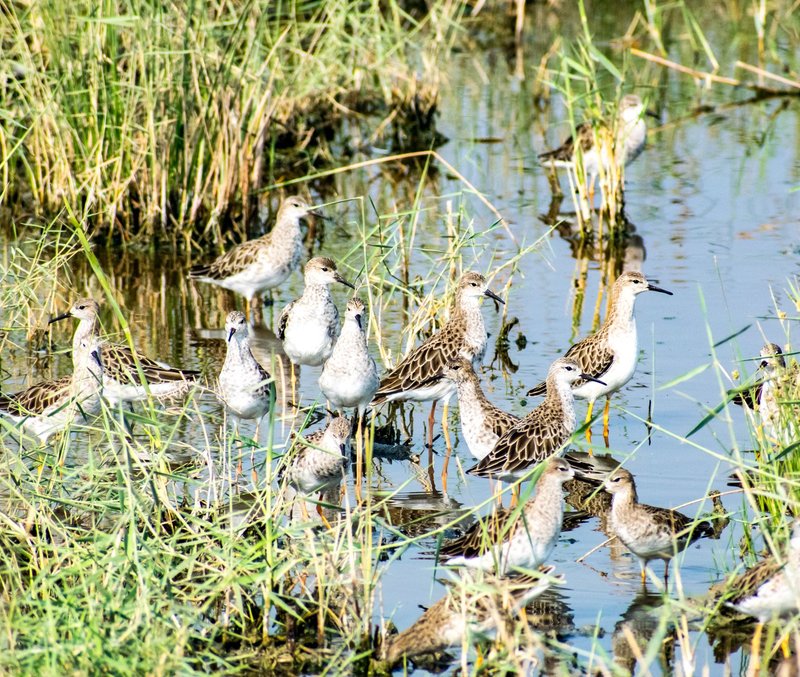
The Iberá marshes in Corrientes are the single best birding destination in the northeast. Colonia Carlos Pellegrini is the usual base, and boat trips across the lagoons put you at eye level with the waders. Conservation groups such as Rewilding Argentina have spent years restoring wildlife here, including birds that had disappeared.
5. Jabiru (Jabiru mycteria)
- ID: Huge white stork with a bare black head and a red band at the base of the neck.
- Where: Open marsh and flooded grassland in Iberá and other northeastern wetlands.
- Best months: Year-round, easiest on the dry-season water edges.
It’s the tallest flying bird in South America, up to 1.4 m, with a bill like a black dagger. It stalks the shallows slowly and doesn’t bother hiding.
6. Southern Screamer (Chauna torquata)
- ID: Large, gray, chicken-shaped, with a short crest and a black collar.
- Where: Wet pastures and lagoon margins in Iberá and the Río de la Plata region.
- Best months: Year-round.
Locals call it the chajá. The call is a loud, carrying three-note shout that gives the bird its name. Its wings carry sharp bony spurs, which is not what you’d expect from something that looks like a heavy goose.
7. Strange-tailed Tyrant (Alectrurus risora)
- ID: Small black-and-white flycatcher; the male has two long, ribbon-like tail feathers.
- Where: Tall grassland near Colonia Carlos Pellegrini and other Corrientes reserves.
- Best months: October to December, during display flights.
It’s listed as Vulnerable by the IUCN Red List, and Iberá is one of its strongholds. Males hop and flutter above the grass with their tails streaming behind them. It’s a small bird with big theatrics.
8. Red-and-green Macaw (Ara chloropterus)
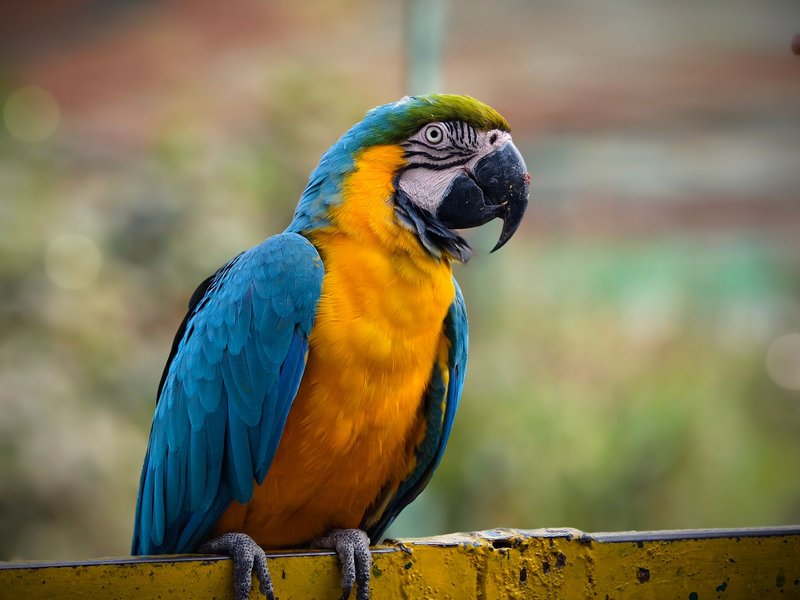
- ID: Big, red parrot with green-and-blue wing stripes and bare white facial skin lined with red feathers.
- Where: Forest edges and gallery woods in Iberá, near Colonia Carlos Pellegrini.
- Best months: Year-round.
This one isn’t a natural comeback. Macaws vanished from Argentina’s northeast roughly a century ago, and a reintroduction program run by Rewilding Argentina has released captive-bred birds since 2015. They now fly free and have bred in the wild. It’s the strongest “conservation actually worked” bird on this list.
Yungas, Puna and the high Andes
The northwest changes in elevation faster than it changes in distance. A few hours separate warm cloud forest from bare plateau lakes.
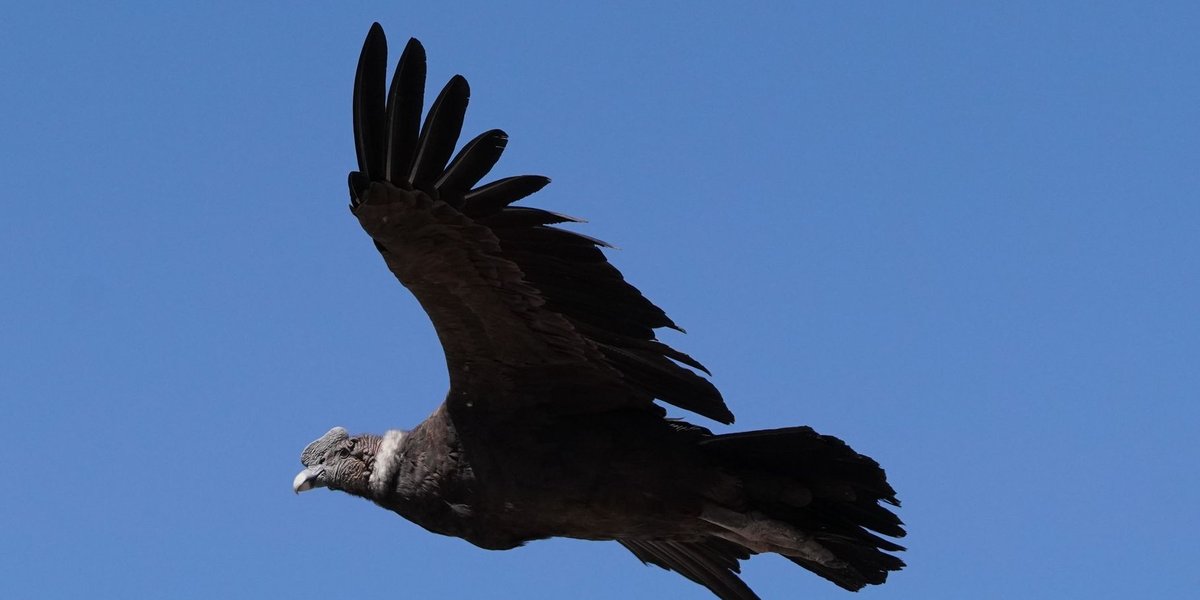
9. Andean Condor (Vultur gryphus)
- ID: Black with a white collar and white wing patches; the male has a fleshy comb. Wingspan up to 3.3 m.
- Where: Cliffs and ridgelines along the whole Andes, and in Patagonia down to the coast. Quebrada del Condorito National Park in Córdoba is a reliable site outside the main range.
- Best months: Year-round; early mornings, when thermals start.
It’s one of the heaviest flying birds on Earth, and it barely flaps. A condor on a good thermal can cover long distances without a single wingbeat. The IUCN lists it as Vulnerable.
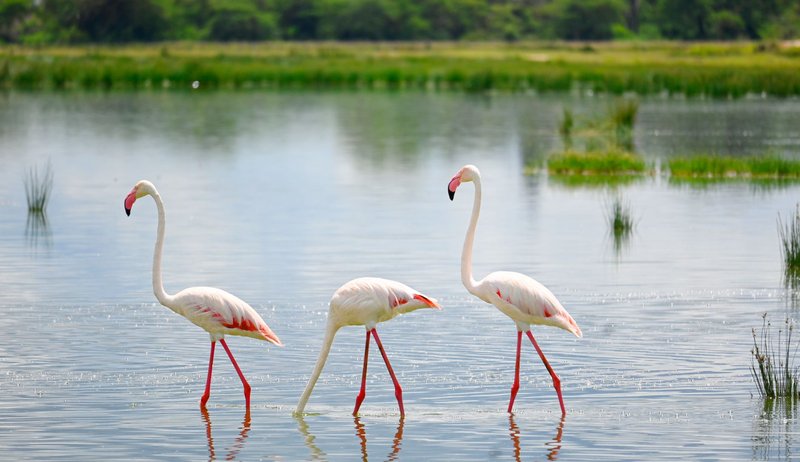
10. Andean Flamingo (Phoenicoparrus andinus)
- ID: Pale pink with yellow legs, a yellow bill tipped in black, and a slim neck.
- Where: High-altitude saline lakes in Jujuy, Salta and Catamarca, such as Laguna de los Pozuelos.
- Best months: November to March for breeding season; some birds move lower in winter.
These are flamingos living above 3,500 m, in thin air and freezing nights. They’re also Vulnerable, and flamingo colonies in the Puna are sensitive to disturbance and mining pressure on the salt flats.
11. Tucumán Amazon (Amazona tucumana)
- ID: Mostly green parrot with a red forehead and red patches on the bend of the wing.
- Where: Yungas cloud forest at Calilegua National Park (Jujuy) and El Rey National Park (Salta).
- Best months: September to January, early morning.
It lives in a narrow band of montane forest in northwestern Argentina and neighboring Bolivia. Logging and the pet trade cut its numbers, part of a wider pattern across South America’s endangered wildlife, and it’s one of the species that justifies the long drive to the Yungas.
Monte, Chaco and the dry west
The dry scrublands are where Argentina’s more secretive birds live. They’re harder to find, which is exactly why birders go.
12. Crested Gallito (Rhinocrypta lanceolata)
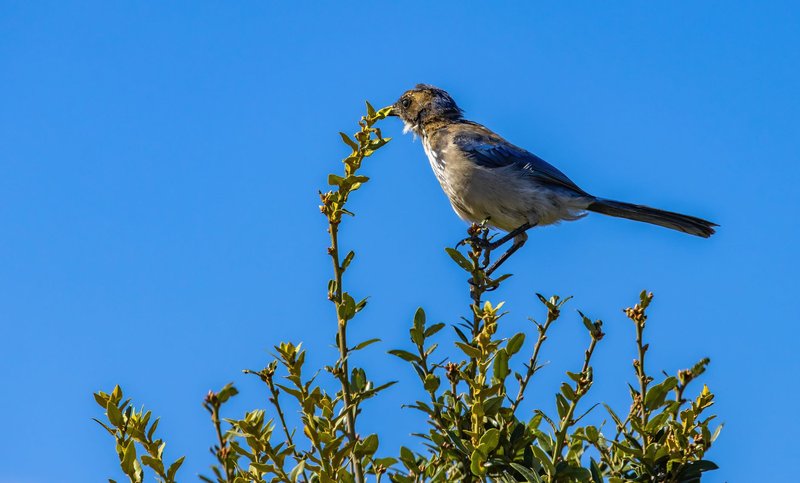
- ID: Gray-brown, long-legged ground bird with a spiky crest and a cocked tail.
- Where: Dry scrub in La Pampa, San Luis, Mendoza and the Chaco. Lihué Calel National Park in La Pampa is a good site.
- Best months: September to January.
It runs rather than flies, and you’ll usually see it dashing across a track between bushes. Look for it near the ground at dawn. Slow walking beats driving.
13. Burrowing Parrot (Cyanoliseus patagonus)
- ID: Olive-green parrot with a pale belly patch, a white eye ring and a yellow-orange tail base.
- Where: Cliffs at El Cóndor, Río Negro, home to one of the largest colonies of the species in the world.
- Best months: September to February, when the colony is breeding.
It digs tunnel nests straight into soft sea cliffs, thousands of pairs wide. At dusk the whole colony comes back at once, and the cliff face turns into a noisy parrot apartment block.
Patagonia and Tierra del Fuego
Patagonia is the region most people picture when they think about the birds of Patagonia: wind, steppe, ocean, and penguins at the water’s edge.
14. Magellanic Penguin (Spheniscus magellanicus)
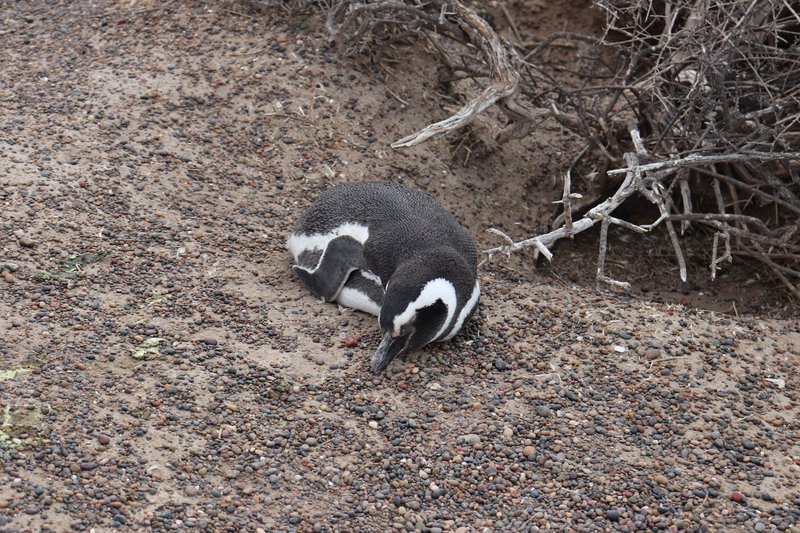
- ID: Black back, white belly, two black bands across the chest and a pink patch around the face.
- Where: Punta Tombo and Cabo Dos Bahías (Chubut), and the Península Valdés coast.
- Best months: September to March; chicks are visible from about December.
Punta Tombo is among the largest breeding colonies on the continent. Penguins arrive in September, nest in burrows or under bushes, and head out to sea by April. You can walk on boardwalks within a few meters of them.
15. Hooded Grebe (Podiceps gallardoi)
- ID: Slim gray-and-black grebe with a black crest that flares over the head and a red eye.
- Where: A handful of remote lakes on the basalt plateaus of Santa Cruz province. It winters on Atlantic coast estuaries.
- Best months: November to March, in the breeding season.
It lives only in Argentina, and it’s Critically Endangered. The population has fallen steeply since the 1980s, helped along by introduced American mink that prey on the nests. The breeding lakes are remote enough that most birders need a guide. Seeing one is an achievement, not an afternoon activity.
16. Magellanic Woodpecker (Campephilus magellanicus)
- ID: Huge black woodpecker. Males have a vivid red head and crest; females are all black with a short crest.
- Where: Old southern beech forest in Tierra del Fuego National Park, and in Nahuel Huapi, Lanín and Los Glaciares parks.
- Best months: Year-round; calmer, drier months from October to March are easier on the trails.
It’s the biggest woodpecker in South America, close to the size of a crow. You’ll hear the hammering before you see it, a deep drum on dead trunks.
17. Lesser Rhea (Rhea pennata)
- ID: Smaller than the Greater Rhea, brownish with white-tipped feathers, standing up to 1 m tall.
- Where: Patagonian steppe, including Península Valdés and the roads to Punta Tombo.
- Best months: Year-round; chicks from October to January.
Also called Darwin’s rhea, it’s known locally as the choique. Charles Darwin ate one before he realized it was a separate species from the northern one. It also runs fast enough to keep pace with a car on a gravel road.
18. Magellanic Plover (Pluvianellus socialis)
- ID: Pale gray wader with pink legs and a red eye; chunky and plover-like.
- Where: Gravelly shores of lakes and lagoons in southern Santa Cruz and Tierra del Fuego.
- Best months: November to February.
It’s the only member of its family and is not closely related to the true plovers. It’s unusual for a wader in one more way: it feeds its chicks regurgitated food, like a pigeon. Listed as Near Threatened.
19. Kelp Goose (Chloephaga hybrida)
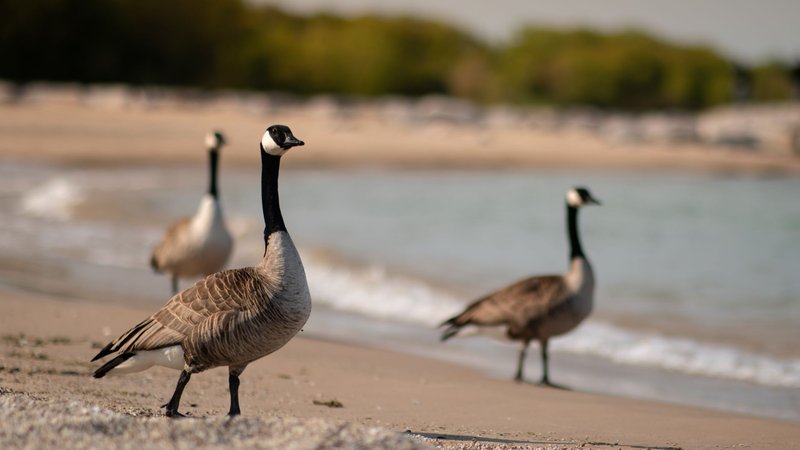
- ID: The male is bright white; the female is dark brown with fine barring.
- Where: Rocky Atlantic and Beagle Channel shorelines in Tierra del Fuego.
- Best months: Year-round.
A goose that eats seaweed on rocky tidal flats. It’s one of the easiest ways to tell a Tierra del Fuego beach from any other, because the pairs are so visible: a white goose, a dark goose, side by side on wet rocks.
20. Snowy Sheathbill (Chionis albus)
- ID: All white, stocky, chicken-like, with a pale pink face and a short, thick bill.
- Where: Patagonian coast and penguin or sea lion colonies in winter.
- Best months: April to September, when birds move north from their sub-Antarctic breeding grounds.
It’s the only Argentine bird here that arrives for the cold months. It scavenges around colonies and tidal flats, and it makes a good consolation prize if you visit in winter.
Species by region at a glance
| # | Species | Region | Best months |
|---|---|---|---|
| 1 | Rufous Hornero | Pampas and central | Year-round |
| 2 | Greater Rhea | Pampas, Iberá, Chaco | Year-round |
| 3 | Red-crested Cardinal | Pampas and central | Year-round |
| 4 | Monk Parakeet | Pampas and central | Year-round |
| 5 | Jabiru | Iberá | Year-round |
| 6 | Southern Screamer | Iberá | Year-round |
| 7 | Strange-tailed Tyrant | Iberá | Oct to Dec |
| 8 | Red-and-green Macaw | Iberá | Year-round |
| 9 | Andean Condor | Andes and Patagonia | Year-round |
| 10 | Andean Flamingo | Puna | Nov to Mar |
| 11 | Tucumán Amazon | Yungas | Sep to Jan |
| 12 | Crested Gallito | Monte and Chaco | Sep to Jan |
| 13 | Burrowing Parrot | Monte coast | Sep to Feb |
| 14 | Magellanic Penguin | Patagonian coast | Sep to Mar |
| 15 | Hooded Grebe | Santa Cruz plateau | Nov to Mar |
| 16 | Magellanic Woodpecker | Patagonian forest | Year-round |
| 17 | Lesser Rhea | Patagonian steppe | Year-round |
| 18 | Magellanic Plover | Southern Patagonia | Nov to Feb |
| 19 | Kelp Goose | Tierra del Fuego | Year-round |
| 20 | Snowy Sheathbill | Patagonian coast | Apr to Sep |
Where to see birds of Argentina and when to go
Spring and early summer, October to January, is the best window for the largest number of species. Resident birds are singing, many species are nesting or displaying, and migrants from the north have arrived. Penguins, grebes, tyrants and parrots all line up in this period.
Winter, roughly June to August, thins out the north but isn’t a write-off. Snowy Sheathbills are present, the Andean Condor is as easy as ever, and the Iberá wetlands stay mild enough for most residents.
A sensible first trip combines two regions rather than five. A few options:
- Buenos Aires plus Iberá: about a week, gives you species 1 to 8 and many more waders.
- Patagonia coast: Península Valdés and Punta Tombo in a single loop, for penguins, rheas and the sheathbill.
- Northwest: Jujuy and Salta, for flamingos, condors and the Yungas parrots.
Distances are large and some of the best sites are poorly served by public transport. Renting a car or booking a local guide is worth it. For identification and range maps, the Cornell Lab’s Birds of the World has detailed species accounts.
FAQ
What is the national bird of Argentina?
The Rufous Hornero, known as hornero in Spanish. It’s named for the oven-shaped clay nests it builds.
How many bird species live in Argentina?
More than 1,000 species have been recorded, and roughly 20 are endemic, including the Hooded Grebe.
What is the best time for birdwatching in Argentina?
October to January, during the southern spring and early summer. Penguin colonies are active from September to March.
Which birds live in Patagonia?
The headline species are Magellanic Penguin, Magellanic Woodpecker, Lesser Rhea, Hooded Grebe, Andean Condor and Kelp Goose.
Where are the best Iberá wetlands birds?
Colonia Carlos Pellegrini in Corrientes is the main base. Jabiru, Southern Screamer, Strange-tailed Tyrant and the reintroduced Red-and-green Macaw are all found here.
Where to start
If you only have time for one region, choose by the bird you most want to see. Penguins mean Chubut. Flamingos mean Jujuy. Tyrants and macaws mean Iberá. And if you’re just landing in Buenos Aires, the first of the birds of Argentina you’ll notice is the brown one on the lawn, building an oven on a fence post. That’s the Rufous Hornero, and it’s worth stopping for.