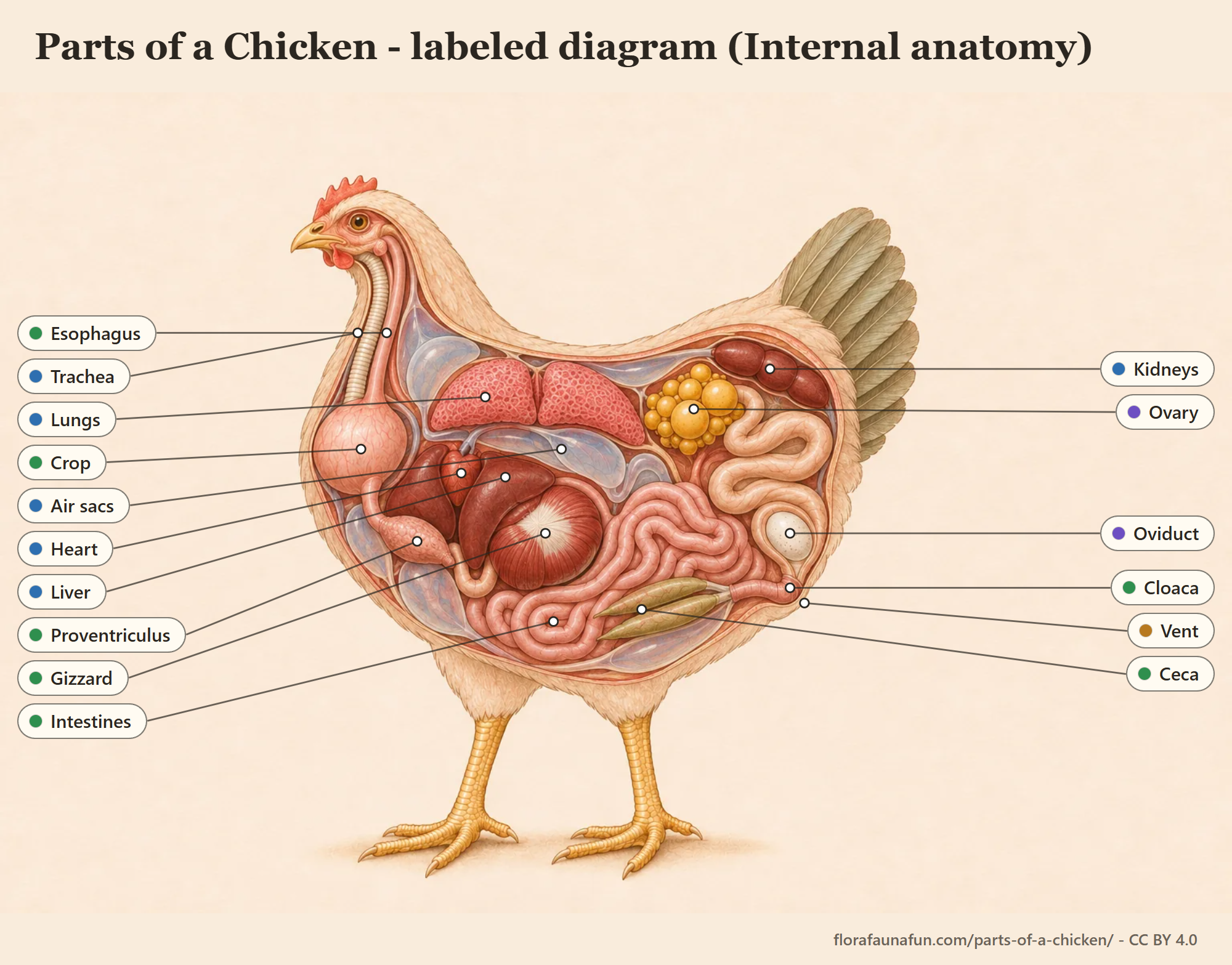
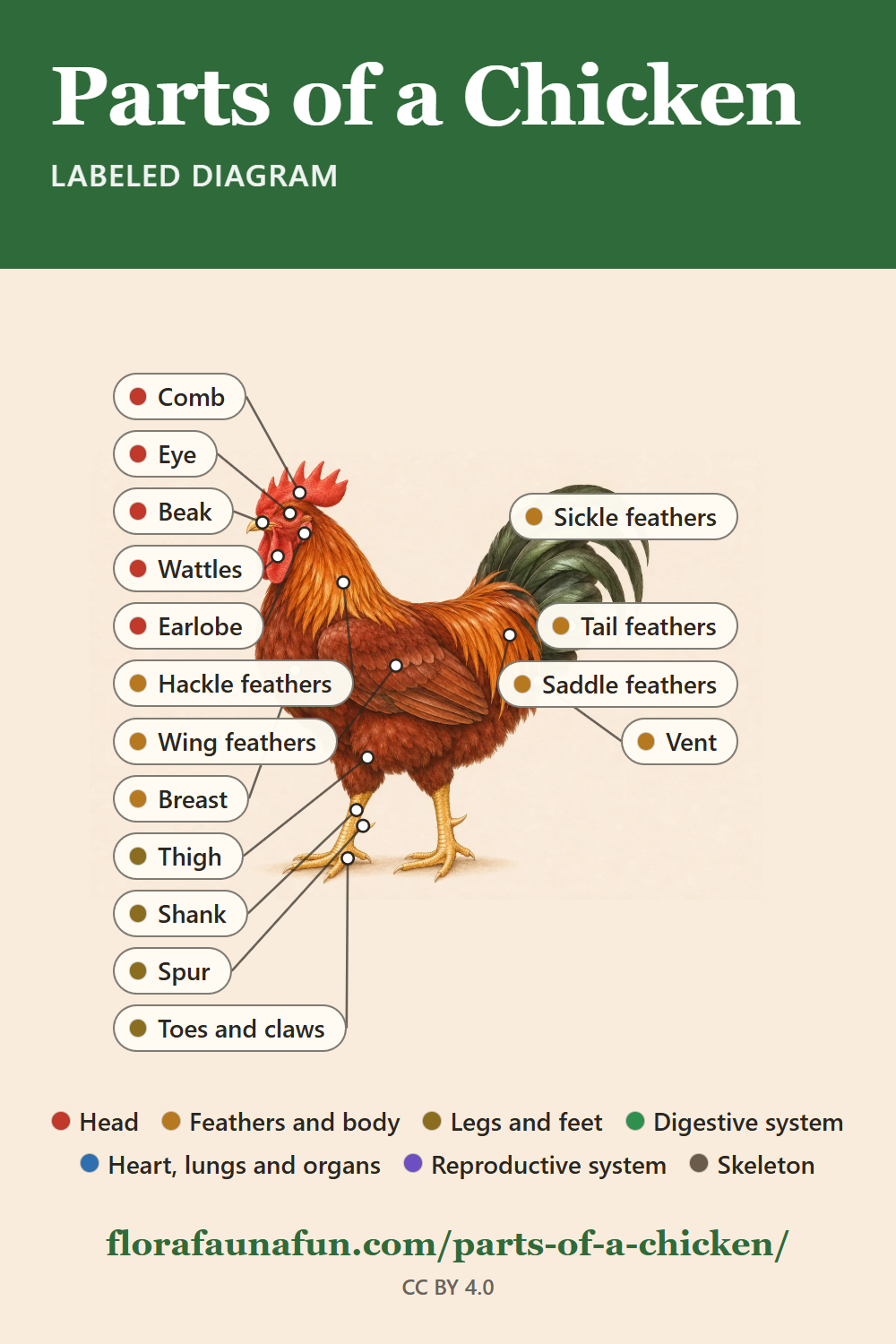
Short answer: Chicken anatomy has an outside and an inside. Outside, a chicken has a beak, comb, wattles and earlobes on the head, feathers on the wings, neck, back and tail, and scaly legs with spurs and four toes. Inside, food passes through the crop and gizzard, while the heart, lungs and air sacs handle blood and breathing.
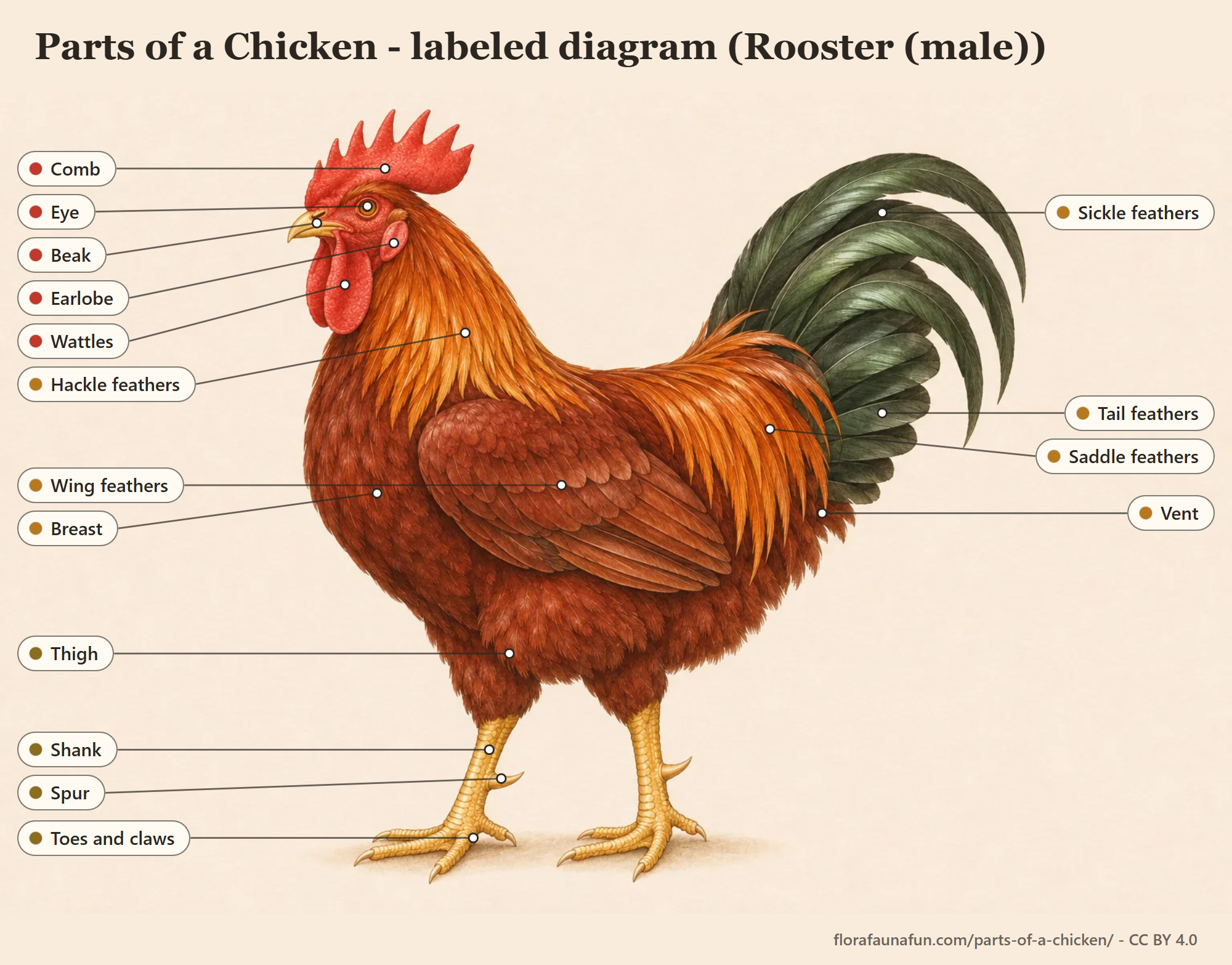
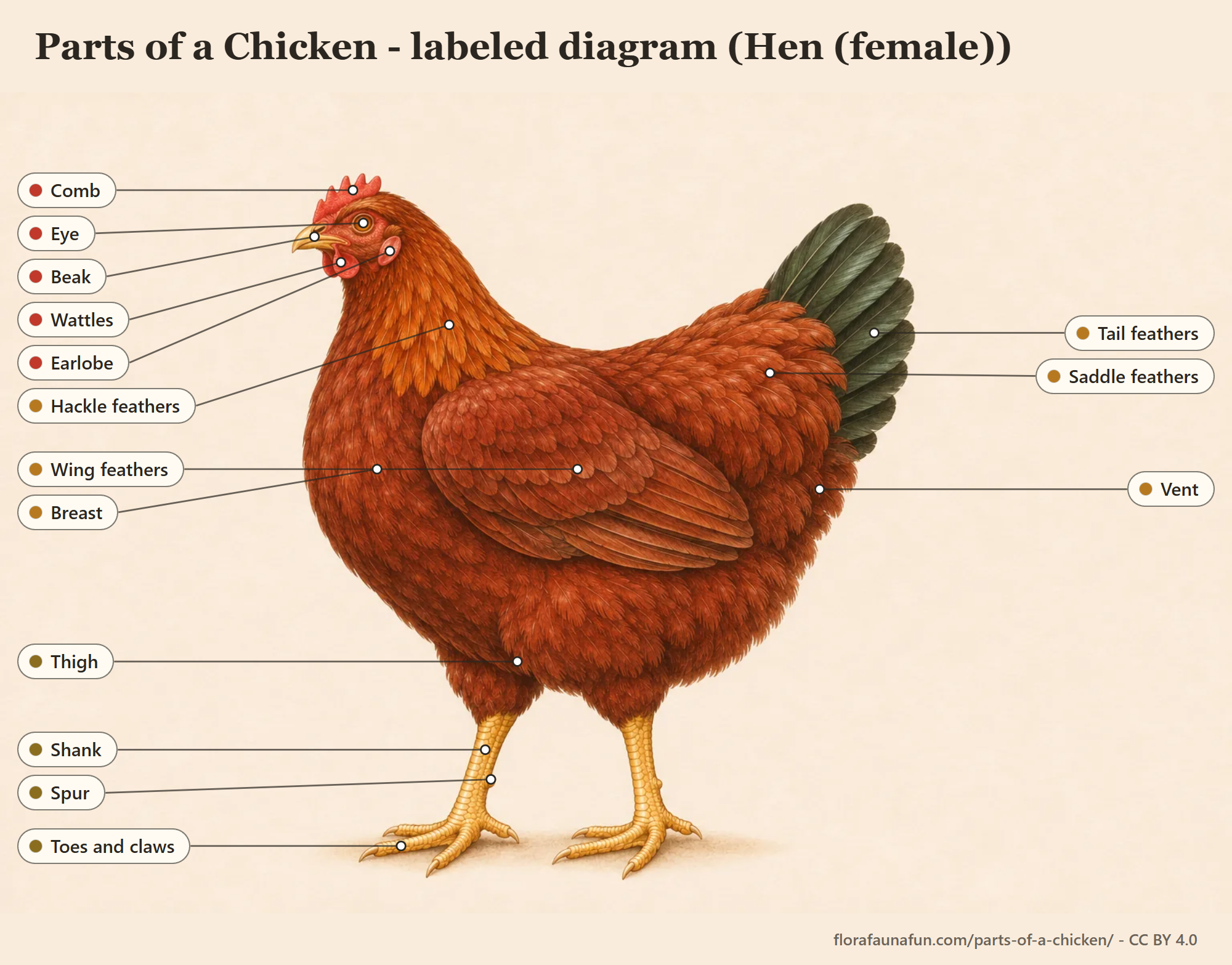
This page covers the living bird, not the cuts sold at a butcher. Tap any label in the diagram above to see what the part does, and switch views.
The hard, horn-covered beak picks up food, pecks and preens feathers. Chickens have no teeth.
Comb
The red crown
The fleshy comb on top of the head comes in several shapes. It is usually larger on a rooster and is thought to help shed heat.
Wattles
The chin flaps
Two soft red flaps of skin hang under the chin. Like the comb, wattles are usually bigger on a rooster.
Earlobe
The ear patch
Chickens have no outer ear. The earlobe is a bare patch of skin below the ear opening, red or white in most breeds.
Eye
Wide-angle vision
An eye on each side of the head gives a very wide field of view.
Feathers and body: hackle, saddle, tail and wings
Hackle feathers
The neck feathers
A rooster’s hackle feathers are long with pointed ends. A hen’s are shorter and rounded.
Saddle feathers
The lower back
These grow on the back just in front of the tail. They are long and pointed on a rooster. A hen’s fluffy patch is often called her cushion.
Tail feathers
The fan at the back
A hen’s tail is a short, plain fan. A rooster’s also carries sickle feathers, the long curved arching feathers hens do not have.
Wing feathers
Flight feathers
The big flight feathers of the wing are primaries on the outer part and secondaries on the inner part.
Breast
The chest
The breast holds the big muscles that pull the wings down.
Vent
The one exit
The vent is the single opening under the tail. Droppings leave through it, and so does an egg.
Legs and feet: thigh, shank, spur and toes
The joint that bends backward in a chicken’s leg is its ankle. The true knee is hidden under the feathers.
Thigh
The upper leg
The feathered thigh holds the muscles for walking and scratching.
Shank
The lower leg
The shank runs from the ankle to the toes. Most breeds have bare, scaly shanks. A few have feathered ones.
Spur
The leg spike
A sharp, horn-covered spur grows on the back of the shank. Roosters grow larger ones as they age, and some older hens grow small ones.
Toes and claws
Three forward, one back
Most chickens have four toes per foot, each with a claw for scratching. Dorkings and Silkies have five.
Inside a chicken: the digestive system
Chickens have no teeth, so the inside of the body does the chewing. The gizzard is a thick muscle that grinds food, helped by small stones the bird swallows.
Gizzard
The grinding stomach
The gizzard has two sets of strong muscles that mash seeds and grain, the way teeth would. Birds on commercial feed do not need extra grit, but birds eating whole grains do.
Esophagus and crop
The food tube and pouch
The esophagus carries food down the neck. The crop is a stretchy pouch off it that stores food and water. It is not a second stomach, since little digestion happens there.
Proventriculus
The glandular stomach
The proventriculus adds acid and enzymes such as pepsin before the food reaches the gizzard.
Intestines
Where nutrients are absorbed
The small intestine finishes digestion and absorbs most nutrients. The large intestine is shorter and takes back water.
Ceca
Two side pouches
The two ceca are dead-end pouches where the intestines meet. They take back water and ferment tough plant material.
Cloaca
The shared chamber
The intestine, kidney ducts and oviduct all empty into the cloaca.
The kidneys sit in hollows of the backbone. They filter waste out as white uric acid, the white cap on a dropping.
Reproductive system
A hen normally has one working ovary, on the left.
Ovary
Where yolks grow
The ovary looks like a cluster of yolks at different stages of growth. A full-grown yolk is released into the oviduct.
Oviduct
The egg tube
The oviduct is a coiled tube about 25 to 27 inches long in a laying hen. As the yolk travels along it, the egg white, shell membranes and shell are added.
Making an egg takes about 25 hours, and the time varies by hen. A hen lays eggs with or without a rooster. An egg is fertile only if a rooster’s sperm reached the yolk early in the oviduct. A rooster has two testes inside his body, near the kidneys.
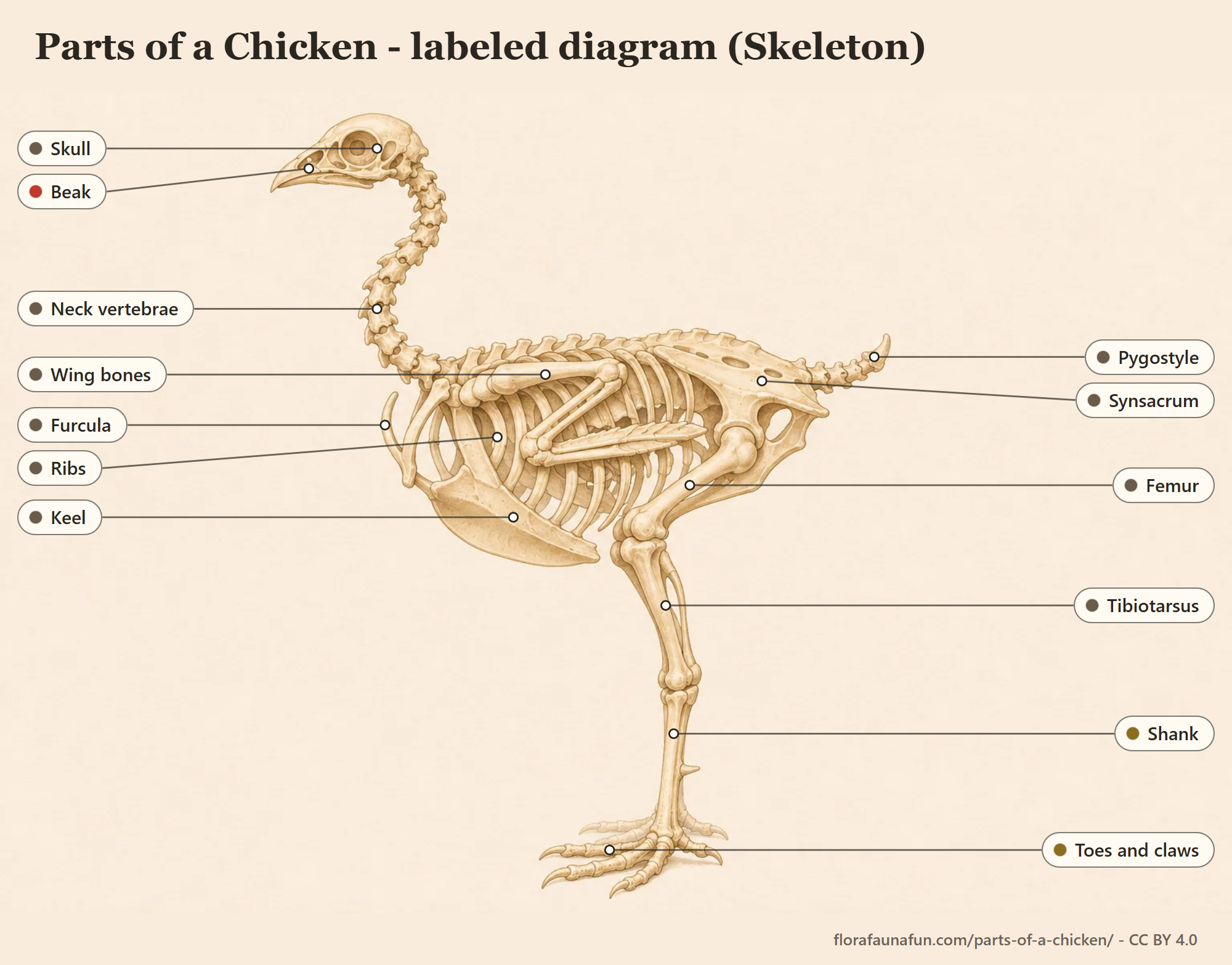
Chicken skeleton: bones from skull to toes
The skeleton view shows a light frame. Only some bones are hollow and linked to the air sacs. The leg bones are not.
Skull and neck
Head and flexible neck
A small skull sits on a neck of more than a dozen vertebrae, flexible enough to reach the tail feathers when preening.
Furcula and keel
Wishbone and breastbone
The wishbone is two collarbones joined into a springy V. The keel is the ridge of the breastbone that anchors the flight muscles.
Ribs, synsacrum and pygostyle
Body frame
Overlapping ribs form the cage. The synsacrum is a fused section of backbone joined to the hips. The pygostyle is the stubby tail bone.
Wing and leg bones
Same plan as an arm and leg
A wing has an upper arm, two forearm bones and fused hand bones. The leg has a short femur and a long drumstick bone, the tibiotarsus.
Parts of a chicken and their functions
Part
Group
Function
Beak
Head
Picks up food, pecks and preens
Comb and wattles
Head
Red skin that helps shed heat
Spur
Legs
Sharp point on the back of the shank
Toes
Legs
Scratching and perching
Crop
Digestive
Stores food and water
Gizzard
Digestive
Grinds food with grit
Intestines and ceca
Digestive
Absorb nutrients and water
Cloaca and vent
Digestive
Shared exit for waste and eggs
Liver
Organs
Makes bile to digest fat
Heart
Organs
Pumps blood
Lungs and air sacs
Organs
Breathing; air sacs move the air
Ovary and oviduct
Reproductive
Grow the yolk and build the egg
Furcula
Skeleton
Wishbone that braces the shoulders
Keel
Skeleton
Anchors the breast muscles
Male vs female chicken anatomy
Roosters and hens share the same parts, but several differ in size or shape. Compare the rooster view with the hen view.
To tell a rooster from a hen, check the tail first: sickle feathers mean a rooster. Then look at the neck and saddle feathers and the comb. Breeds vary, so no single trait settles it.
The path of food through a chicken
Food follows one route through the chicken digestive system.
Free for classroom and home use under CC BY 4.0. Credit FloraFaunaFun.
How to use this diagram in class
Label quiz. Turn the labels off in the diagram, have students name each part, then tap to check.
Print and cover. Cover the names on the printed PDF with sticky notes and have students rewrite them.
Rooster or hen. Have students list every difference between the two external views, then check the comparison table.
Follow the food. Trace a grain from beak to vent in the internal view and say what each stop does.
Frequently asked questions
What are the main parts of a chicken?
Outside, a chicken has a beak, comb, wattles, earlobes, feathers, wings, tail, legs with spurs, and toes. Inside are the crop, gizzard, intestines, liver, heart, lungs and air sacs, plus the ovary and oviduct in a hen.
What is chicken anatomy?
Chicken anatomy is the study of a chicken’s body parts, inside and out: the comb and feathers, the digestive, breathing and reproductive organs, and the skeleton.
How can you tell a male chicken from a female?
Look at the tail and neck. A rooster has long curved sickle feathers, pointed neck and saddle feathers, and usually a larger comb. A hen has a shorter plain tail and rounded feathers. Breeds vary, so compare several traits.
Do chickens have teeth?
No. Chickens have a hard beak and no teeth, so they cannot chew. The gizzard, a thick muscle, grinds food with small stones instead.
What does the gizzard do?
The gizzard is the muscular stomach. Its thick walls grind seeds and grain into small pieces, helped by grit the bird swallows. It does the job that teeth do in other animals.
What does a chicken skeleton look like?
A chicken skeleton has a small skull, a long flexible neck, a wishbone, a breastbone with a deep keel, ribs, a fused backbone and hips, a stubby tail bone, and wing and leg bones.
Do hens have spurs?
Sometimes. Spurs are usually larger on roosters, but some hens grow small ones, mostly older birds or certain breeds. Spurs alone do not show a chicken’s sex.
Wildlife biologist with a PhD in Wildlife Biology and over ten years of fieldwork across Latin America and Southeast Asia. Specializes in animal behavior, habitats, and conservation ecology. Started in jaguar conservation and broadened into general wildlife science. Writes because public understanding of wildlife is the first step to protecting it.