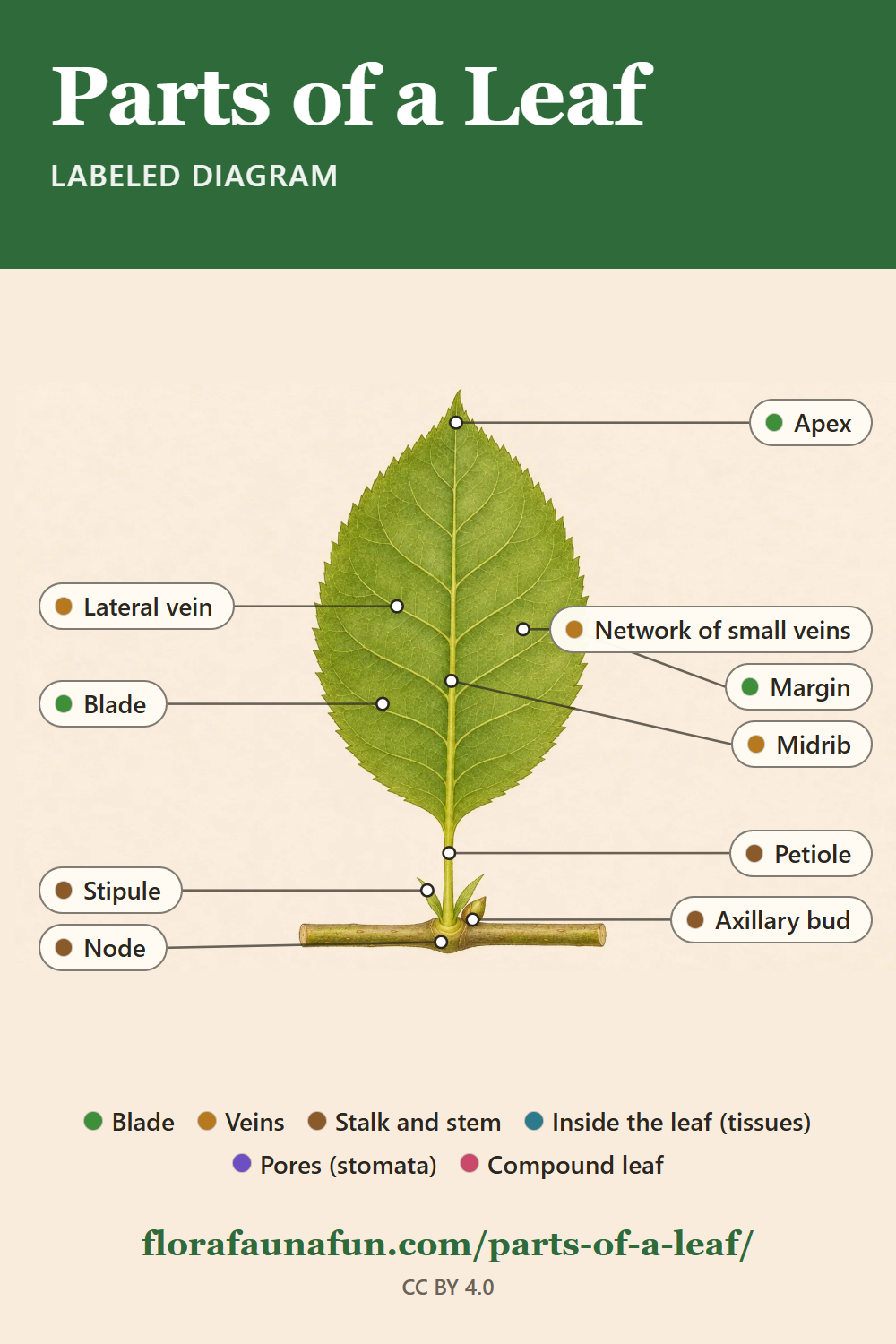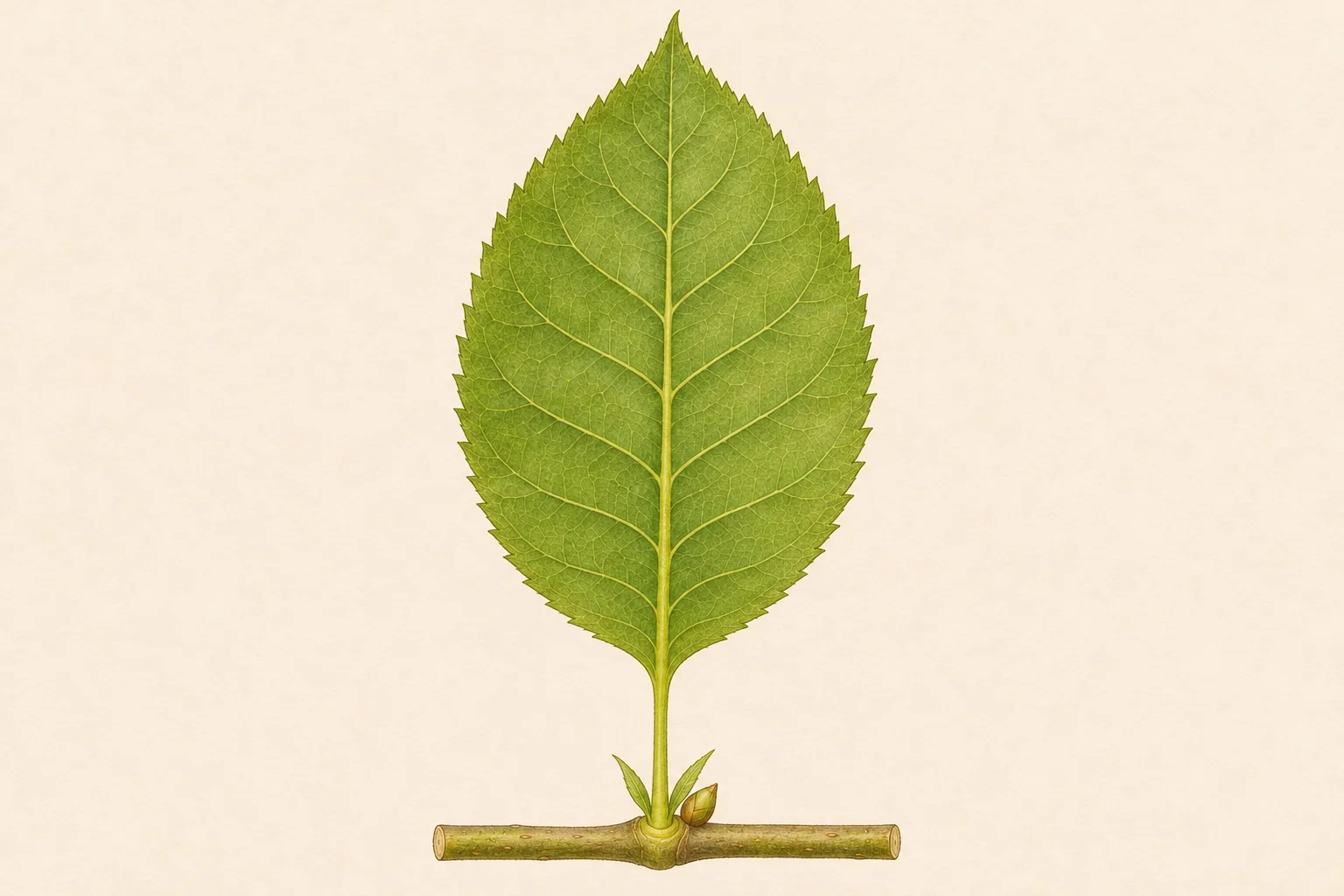
Short answer: Leaf structure has a few main parts: the flat blade, the petiole that joins it to the stem, and the veins, including a thick central midrib. Inside the blade, layers of cells and tiny pores called stomata take in light and air to make sugar.
Tap any label in the diagram above to see what the part does. Switch views to see the whole leaf, a cross section of the blade and a compound leaf.
This article contains Amazon affiliate links. Florafaunafun earns a commission on qualifying purchases. See our affiliate disclosure.
Parts of a leaf diagram: blade, apex, margin and base
Blade shape, tip, edge and base are the main clues for identifying a plant.
Leaf veins: midrib, lateral veins and the vein network
Veins are bundles of conducting tissue. They are not blood vessels, and there is no pump.
How a leaf attaches: petiole, stipule and axillary bud
Leaves are one part of the plant. To see how they fit with the roots and stem, see the parts of a plant diagram. For the parts that make seeds, see the parts of a flower guide.
Leaf anatomy: the layers in a leaf cross section
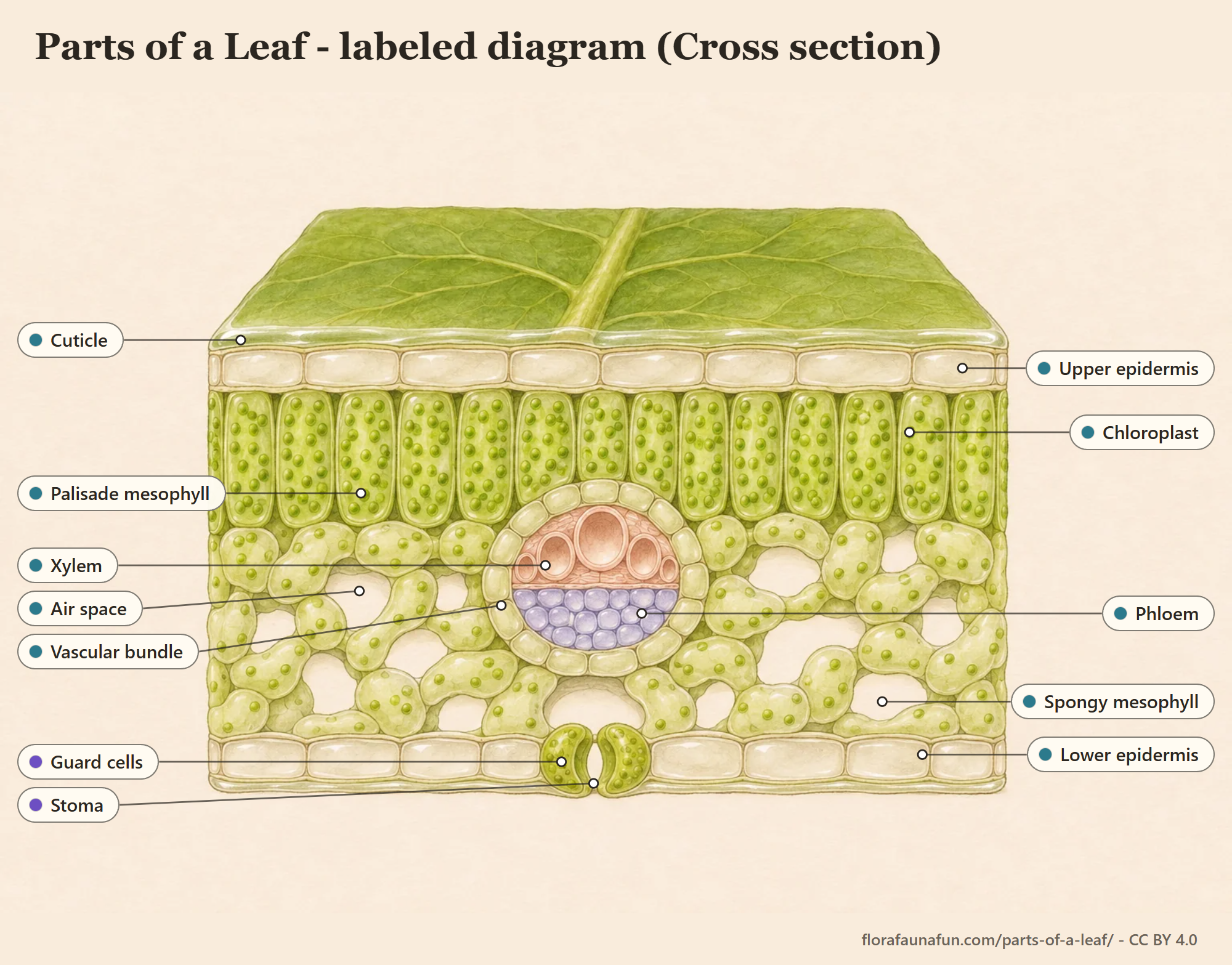
From top to bottom, a cross section shows the cuticle, upper epidermis, palisade layer, spongy layer and lower epidermis, with veins through the middle. Open the Cross section tab for the 3D view.
Parts of a compound leaf: leaflet, rachis and petiolule
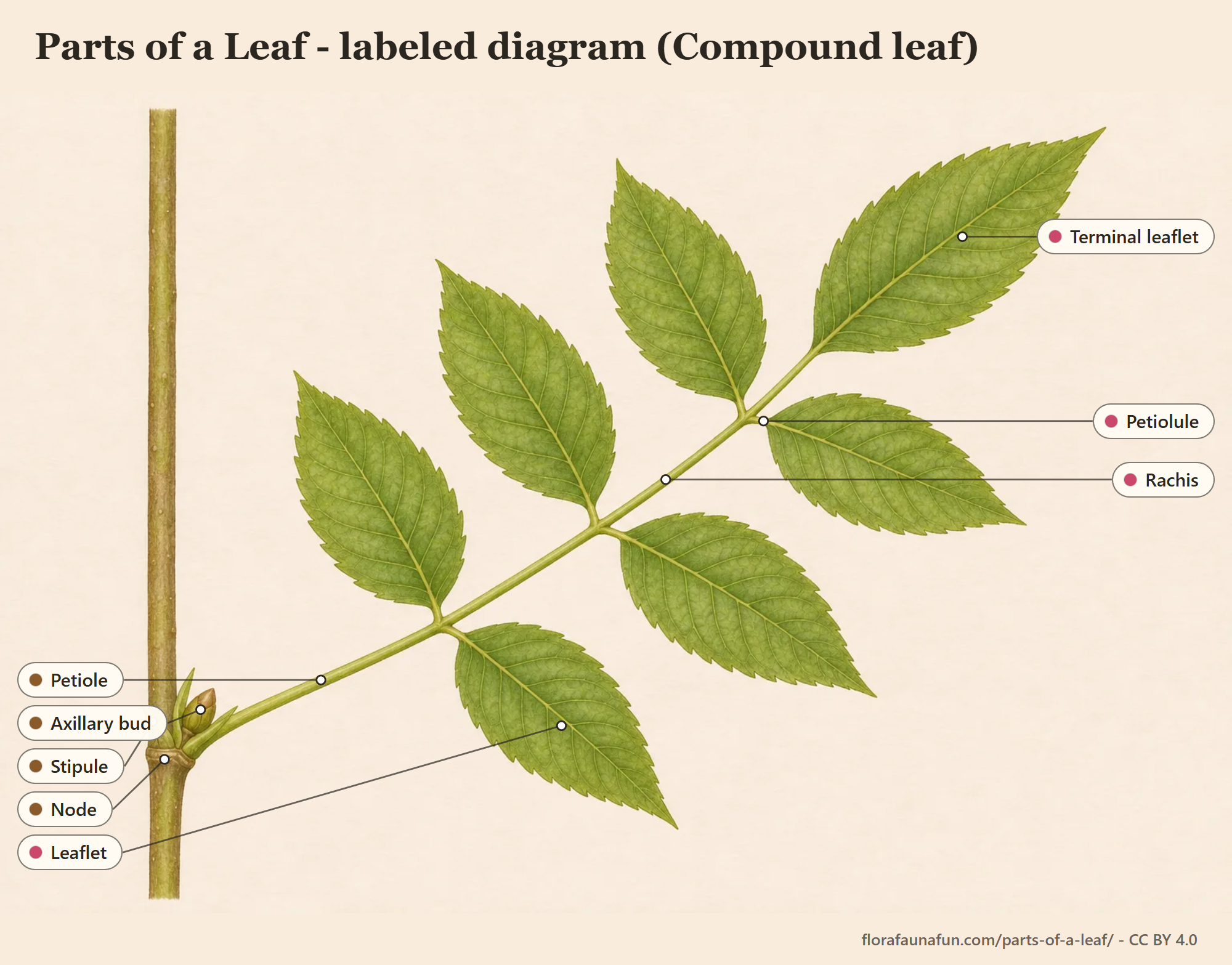
A compound leaf has a blade divided into separate leaflets. In a pinnately compound leaf, as in the diagram, the leaflets line up along a central axis. In a palmately compound leaf, they spread from one point.
Parts of a leaf and their functions
| Part | Group | Function |
|---|---|---|
| Blade | Blade | Catches light; most photosynthesis |
| Margin | Blade | Edge of the blade: smooth, toothed or lobed |
| Midrib | Veins | Thick central vein that branches into the rest |
| Petiole | Attachment | Holds the blade to the light; joins it to the stem |
| Axillary bud | Attachment | Can grow into a branch or flower |
| Cuticle | Tissue | Waxy coat that slows water loss |
| Palisade mesophyll | Tissue | Tall packed cells full of chloroplasts |
| Spongy mesophyll | Tissue | Loose cells with air spaces for gas movement |
| Xylem | Tissue | Carries water and minerals up into the leaf |
| Phloem | Tissue | Carries sugar out of the leaf |
| Stoma and guard cells | Pore | Let carbon dioxide in and water vapor out |
| Rachis | Compound | Central axis the leaflets attach to |
Simple and compound leaves
Deep lobes can fool you: an oak leaf is lobed but simple, because the lobes do not reach the midrib. See more in simple vs compound leaves.
| Feature | Monocot leaf | Dicot leaf |
|---|---|---|
| Veins | Usually parallel | Usually a net (as in the diagram) |
| Stomata | Usually on both sides | Usually more on the underside |
These are tendencies. Ginkgo leaves have forking veins, neither net nor parallel.
How a leaf works: photosynthesis through its parts
Key facts about leaf parts
Free printable labeled leaf diagram
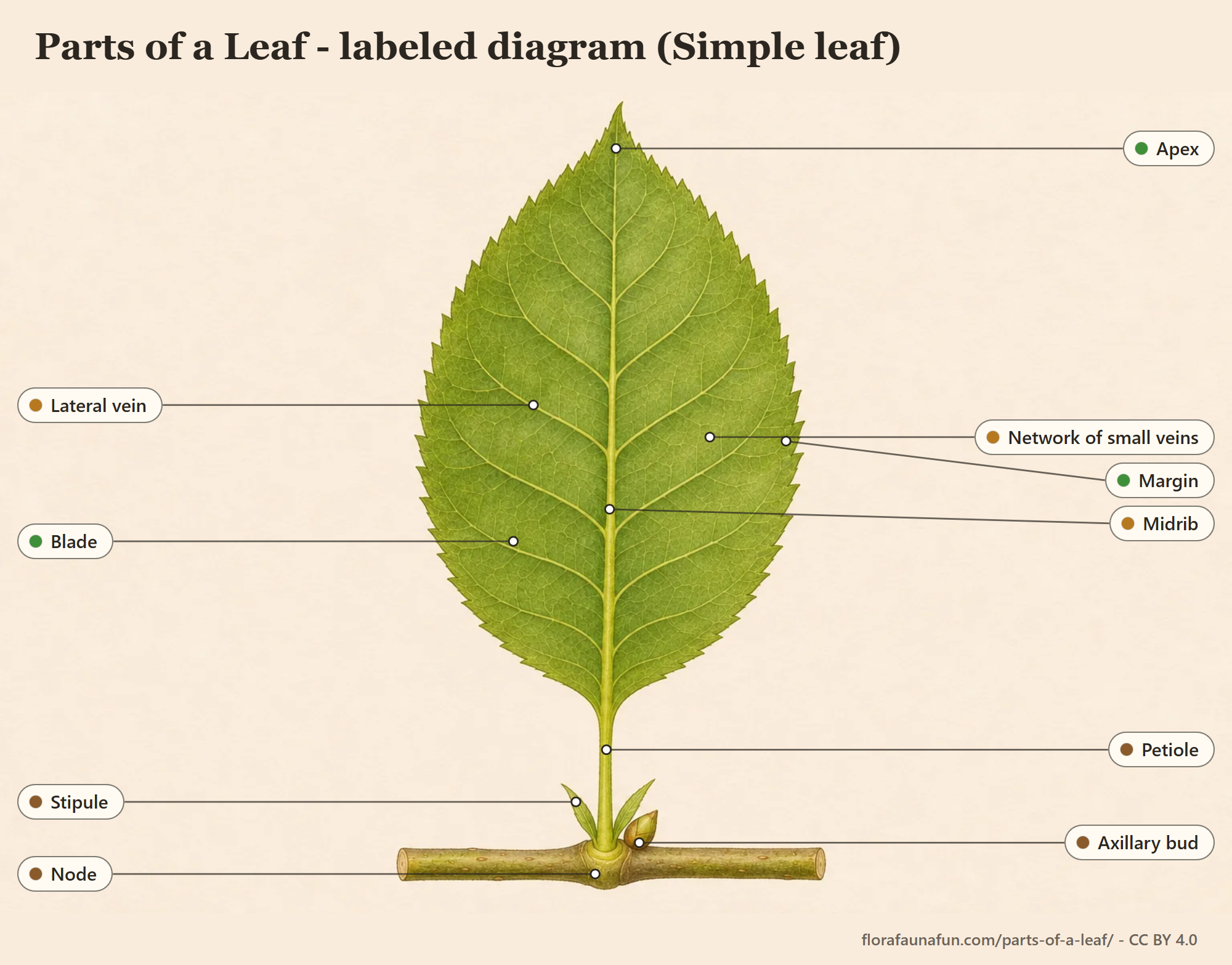
Free for classroom and home use under CC BY 4.0. Credit FloraFaunaFun.
How to use this diagram in class
- Label quiz. Turn the labels off in the diagram and have students name each part, then tap to check.
- Print and cover. Print the PDF, cover the names with sticky notes and have students rewrite them from memory.
- Leaf walk. Collect leaves outside. Sort them into simple and compound with the bud test, then note each margin (smooth, toothed or lobed) and vein pattern (net or parallel).
- Look inside. A prepared cross-section slide under a student microscope shows the layers, and students can match them to the Cross section view.
Frequently asked questions
The main parts are the blade, the petiole and the veins. The blade is the flat part that catches light, the petiole is the stalk that joins it to the stem, and the veins, led by the central midrib, carry water and sugar. Tiny pores called stomata let gases in and out.
The petiole holds the blade out to the light and carries water and sugars between the blade and the stem. Leaves with no petiole, such as those of grasses and many succulents, are called sessile and attach directly to the stem.
The leaf blade, or lamina, is the broad, flat part of the leaf. Its large surface catches sunlight, and most photosynthesis happens inside it.
From top to bottom: the waxy cuticle, the upper epidermis, the palisade mesophyll, the spongy mesophyll and the lower epidermis, with a thin cuticle on the underside too. Veins holding xylem and phloem run through the middle, and stomata open through the epidermis.
Stomata are tiny pores, often more numerous on the underside of a leaf, that let carbon dioxide in and water vapor out. A pair of guard cells around each stoma opens and closes it in response to light, water status and carbon dioxide. Stoma is the singular and stomata the plural.
A simple leaf has one undivided blade. A compound leaf has a blade split into separate leaflets. To tell them apart, find the bud: a compound leaf has one bud at the base of its petiole and none at the bases of the leaflets.
Leaf veins carry water and minerals into the blade through xylem, and carry sugar out of it through phloem. Every vein bundle holds both tissues. Veins are not blood vessels, because the plant has no heart or pump.
Sources
- OpenStax Biology 2e. Leaves
- OpenStax Biology 2e. Transport of Water and Solutes in Plants
- OpenStax Biology 2e. Overview of Photosynthesis
- LibreTexts, Morrow. Leaf Parts and Arrangement
- Visible Body. Leaves
- BioNumbers. Stomatal density
- Harvard Forest. Leaf color process
- University of Wisconsin Extension. Leaf color change in autumn