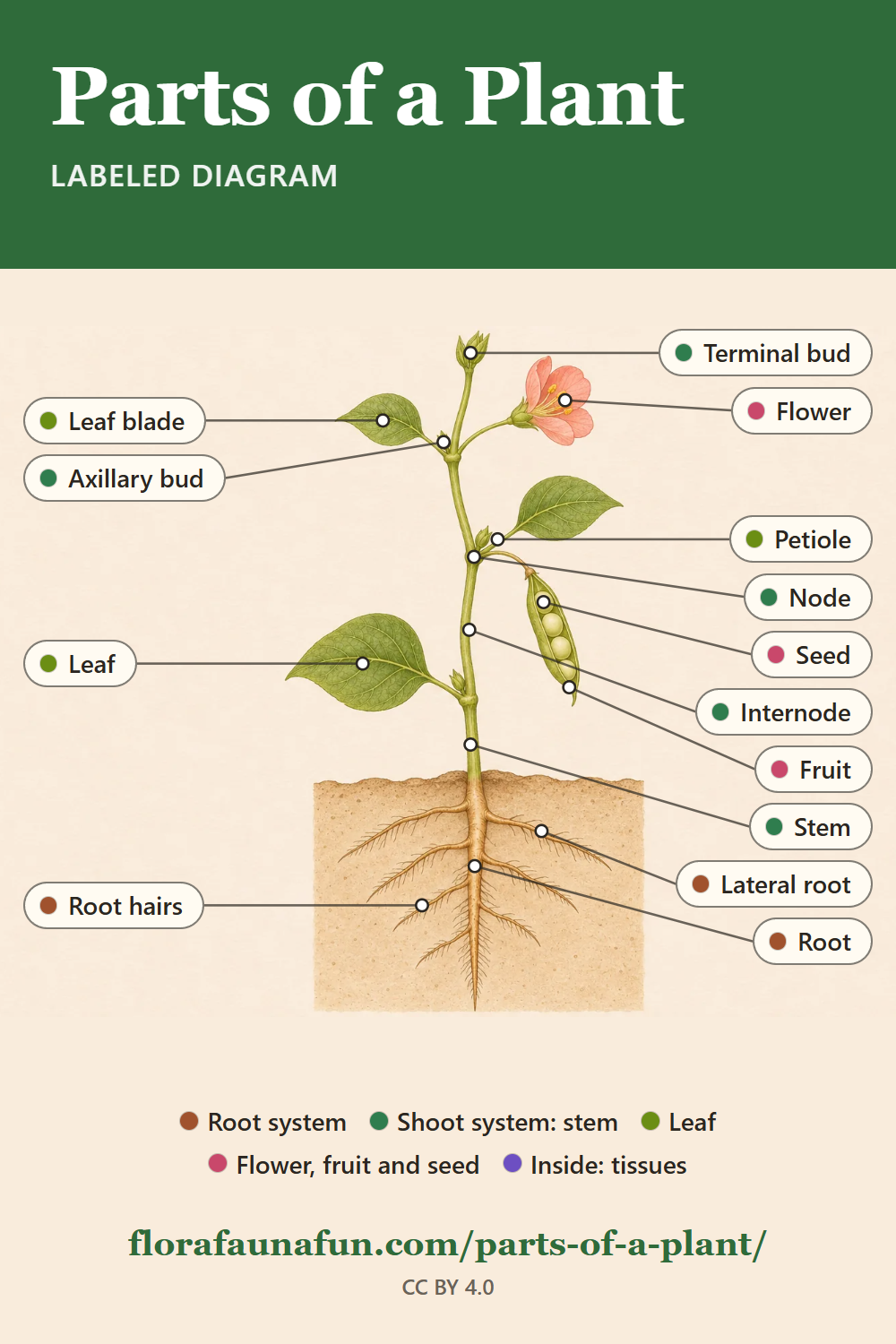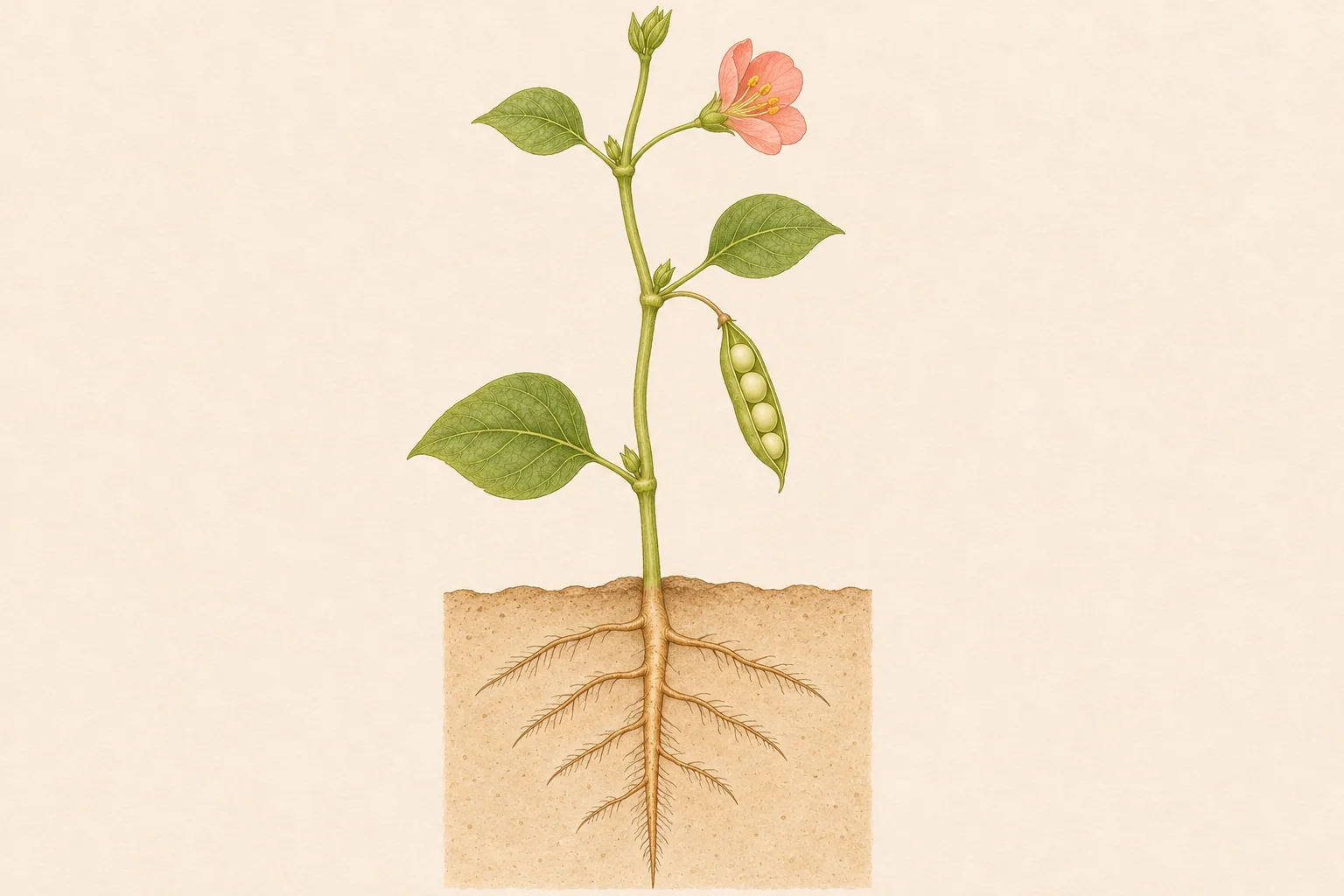
Short answer: The main parts of a plant are the roots, stem, leaves, flower, fruit and seed. Roots anchor the plant and take in water and minerals. The stem holds the leaves up and carries water and sugar. Leaves make food by photosynthesis, and the flower, fruit and seed handle reproduction.
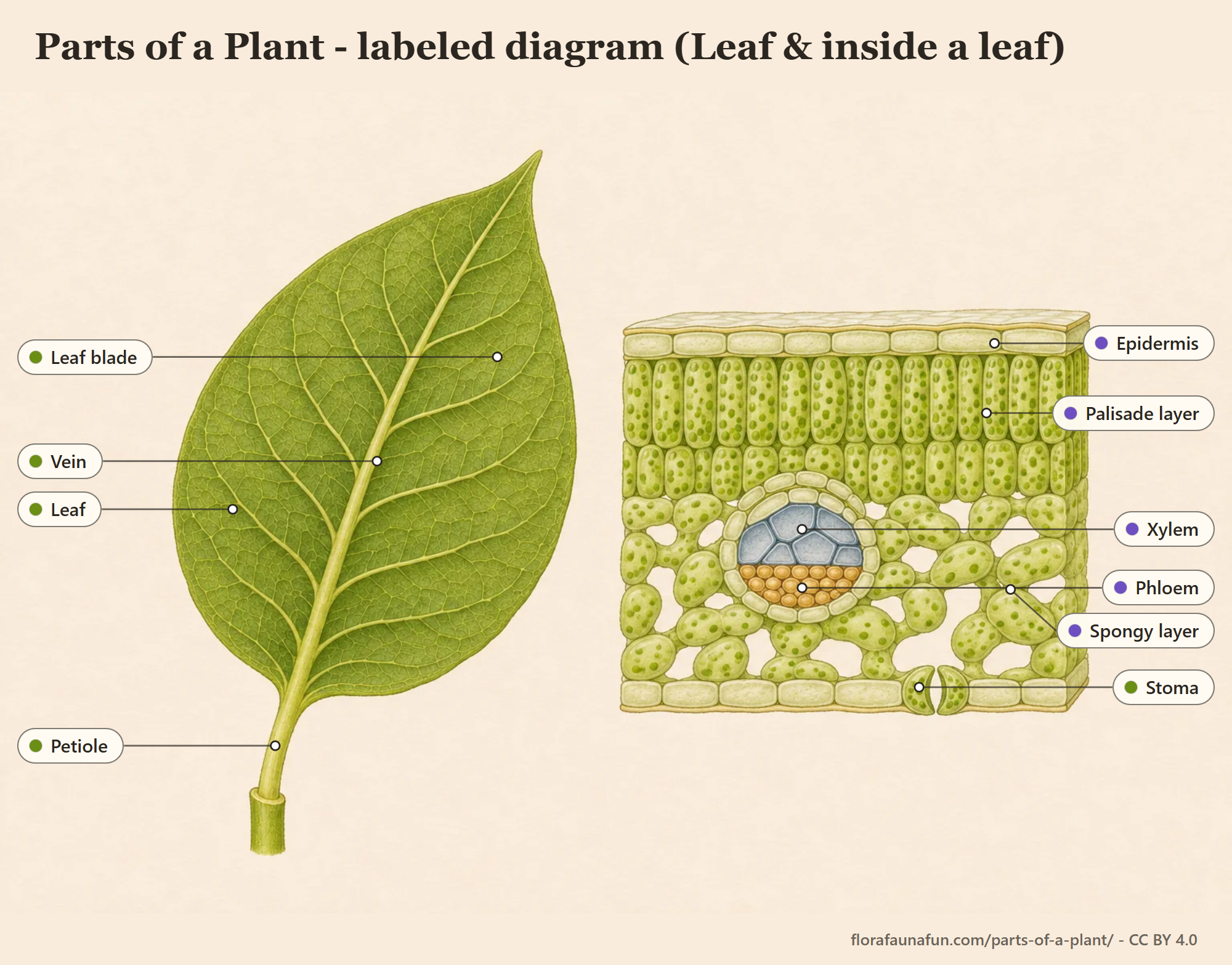
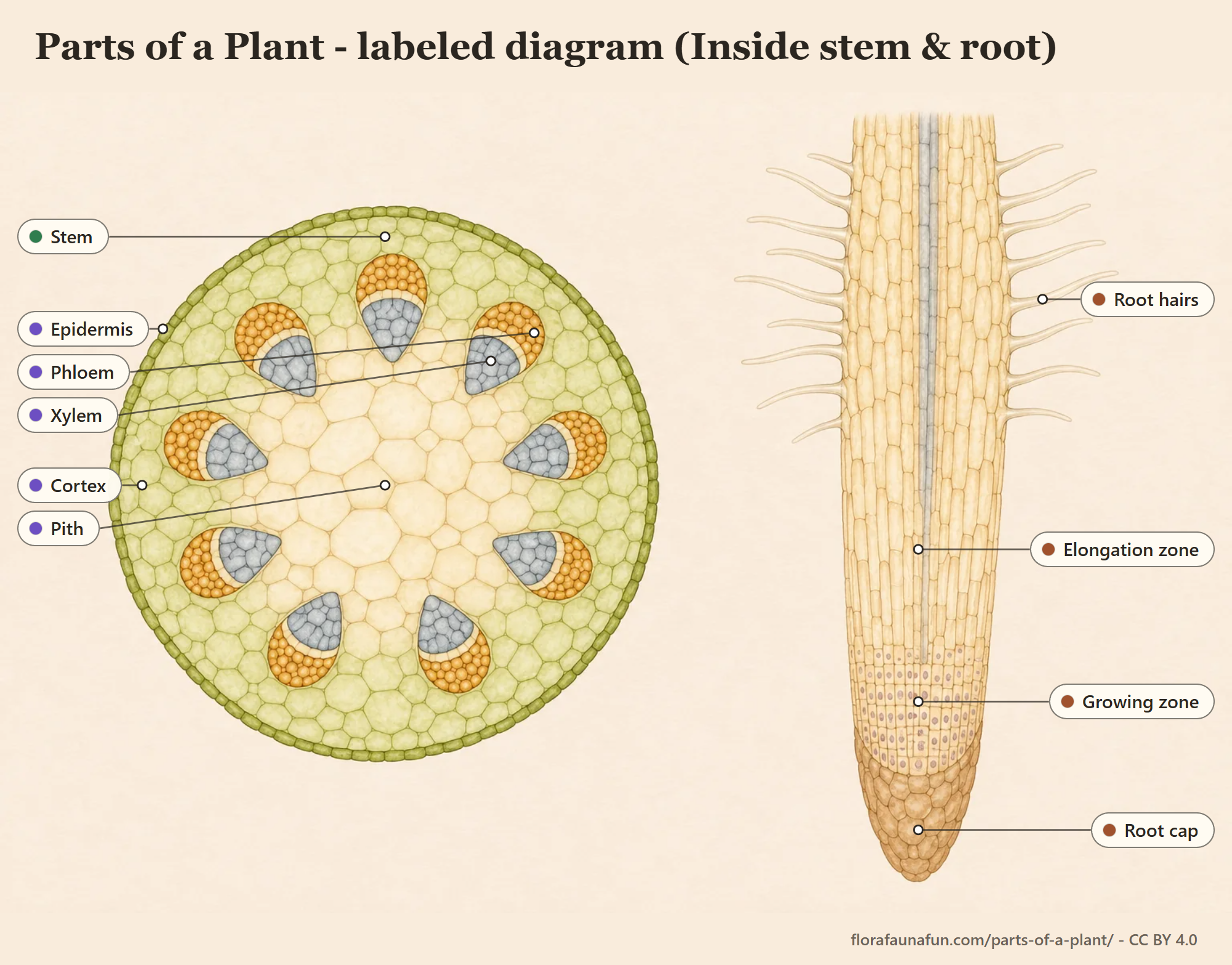
Tap any label in the plant diagram above to see what the part does. Switch views to see the whole plant with its roots in the soil, a leaf next to a magnified cross-section, and the inside of a stem and a root tip.
Root system: roots, root hairs and lateral roots
The root system is usually underground. It anchors the plant, takes in water and minerals, and in some plants stores food.
Shoot system: stem, nodes and buds
The shoot system is everything above ground: the stem, leaves, flowers and fruit. The stem supports the leaves, flowers and buds, and carries water, minerals and sugar between roots and leaves. Green stems also photosynthesize, although leaves do most of it.
Parts of a leaf: blade, petiole and veins
The leaf is the main site of photosynthesis, the process that turns light, water and carbon dioxide into sugar. The leaf shown is a simple leaf with one undivided blade. Compound leaves split the blade into leaflets.
Flower, fruit and seed: the reproductive parts
The flower, fruit and seed are the reproductive parts of the shoot system. Not every plant has them: ferns and conifers do not flower.
Plant anatomy: inside the stem and root
Plant anatomy looks at the tissues inside each part. The inside view shows a dicot stem cut across, with its vascular bundles in a ring.
Parts of a plant and their functions
| Part | Group | Function |
|---|---|---|
| Root | Root system | Anchors; takes in water and minerals |
| Root hairs | Root system | Add surface area for water and mineral uptake |
| Stem | Shoot system | Supports the plant; carries water and sugar |
| Node | Shoot system | Where a leaf attaches to the stem |
| Terminal bud | Shoot system | Growing tip that extends the stem |
| Leaf | Shoot system | Main site of photosynthesis |
| Stoma | Shoot system | Pore for gas exchange; water vapor leaves here |
| Xylem | Vascular tissue | Carries water and minerals upward |
| Phloem | Vascular tissue | Carries sugar from leaves to where it is needed |
| Flower | Reproductive | Makes seeds through sexual reproduction |
| Fruit | Reproductive | Ripened ovary that protects and spreads seeds |
| Seed | Reproductive | Holds the embryo and a food store |
Root system vs shoot system, and monocot vs dicot
Flowering plants also split into two groups, monocots and dicots (the modern name for most dicots is eudicots). The diagram plant is a dicot. These differences are tendencies, not strict rules.
| Feature | Monocot | Dicot |
|---|---|---|
| Seed leaves (cotyledons) | One | Two |
| Leaf veins | Parallel | Net-like |
| Stem vascular bundles | Scattered through the stem | Arranged in a ring |
| Root system | Usually fibrous | Often a taproot |
How water and sugar move through a plant
Water takes one route and sugar takes another. The water path runs from soil to leaf in four steps.
The sugar path starts at the leaf and goes wherever sugar is needed.
Key facts about plant parts
Free printable parts of a plant diagram and worksheet
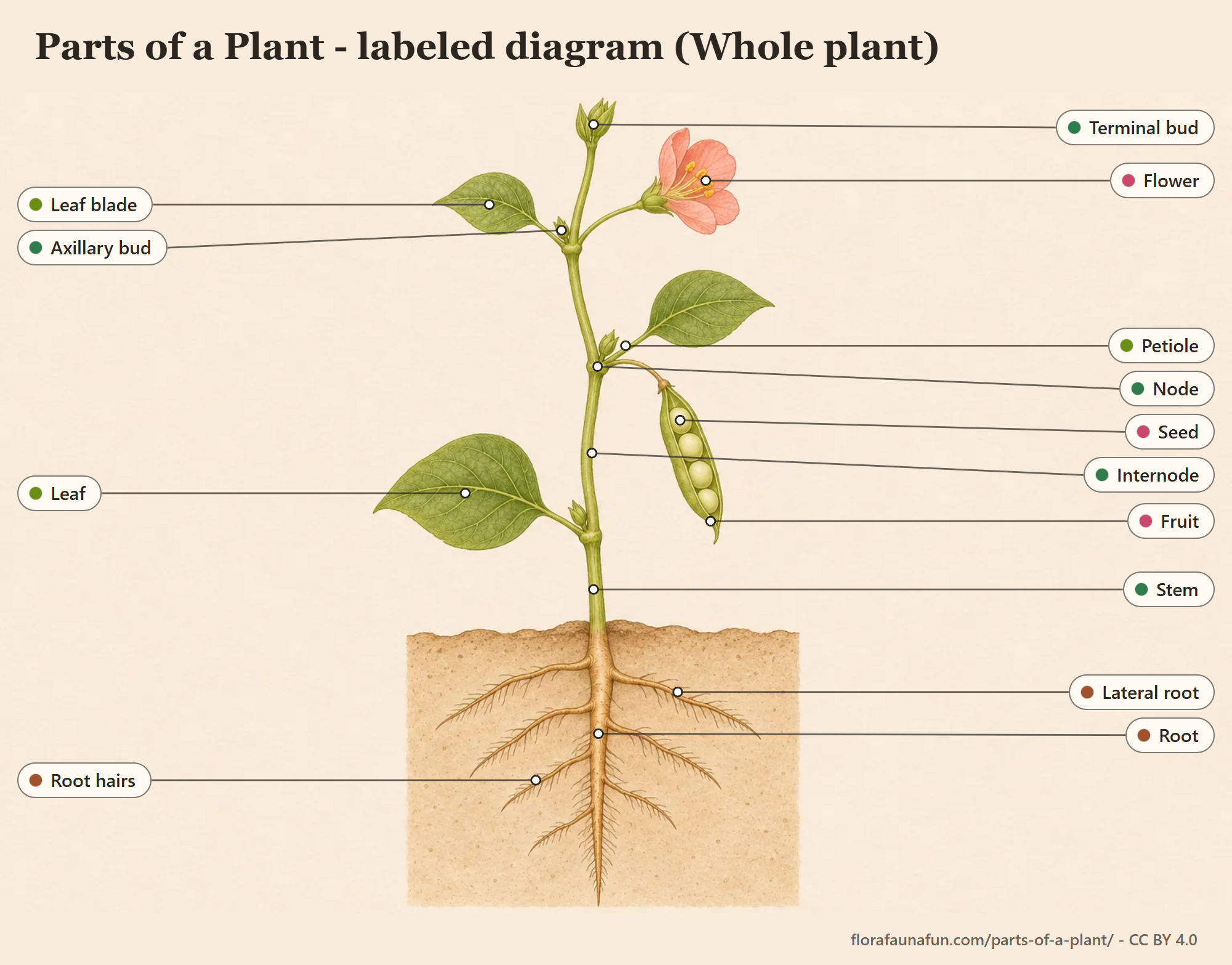
Free for classroom and home use under CC BY 4.0. Credit FloraFaunaFun.
How to use this diagram in class
- Label quiz. Turn the labels off in the diagram and have students name each part, then tap to check.
- Print and cover. Print the PDF as a parts of a plant worksheet, cover the names with sticky notes and have students rewrite them from memory.
- Split a bean. Soak dry beans overnight, open one and find the two cotyledons and the embryo. Compare it with the seed in the whole-plant view.
- Leaf vein sort. Collect leaves outside and sort them by parallel or net-like veins. Then guess whether each plant is a monocot or a dicot and check against the table above.
For younger kids, start with the whole-plant view: roots drink, the stem holds up and carries, leaves make food, flowers make seeds.
Frequently asked questions
The main parts of a plant are the roots, stem, leaves, flower, fruit and seed. The roots and stem anchor and support the plant, leaves make food, and the flower, fruit and seed reproduce it. Together they form two systems, the root system below ground and the shoot system above ground.
Roots anchor the plant and take in water and minerals. The stem supports the plant and carries water and sugar. Leaves make food by photosynthesis. Flowers make seeds, fruit protects the seeds and helps spread them, and seeds hold the embryo that can grow into a new plant.
Roots anchor the plant in the soil, take in water and minerals, and in some plants store food. Root hairs, which are tiny outgrowths of single skin cells, add surface area and do much of the water uptake. Carrots and beets are roots that store food.
The stem holds the leaves, flowers and buds up toward the light. It also carries water and minerals up from the roots and sugar to the parts that need it, through xylem and phloem. Green stems can make some food by photosynthesis as well.
Xylem carries water and minerals upward from the roots to the leaves. Phloem carries sugar made in the leaves to growing and storing parts such as roots, buds, flowers and fruit. A vascular bundle always holds both, with xylem toward the inside of a dicot stem and phloem toward the outside.
Photosynthesis happens mainly in the leaves, in the palisade and spongy layers, whose cells hold many chloroplasts. Green stems photosynthesize too. Roots that sit underground in the dark do not, since photosynthesis needs light.
For kids the parts are the roots, stem, leaves, flower, fruit and seed. Roots drink water from the soil, the stem holds the plant up, leaves make food from sunlight, flowers make seeds, and fruit protects the seeds. Each seed can grow into a new plant.
Sources
- OpenStax Biology 2e. The Plant Body
- OpenStax Biology 2e. Stems
- OpenStax Biology 2e. Roots
- OpenStax Biology 2e. Leaves
- OpenStax Biology 2e. Transport of Water and Solutes in Plants
- OpenStax Biology 2e. Pollination and Fertilization
- Oregon State University Extension. Reproductive plant parts
- Visible Body. Monocot and dicot leaves
- LibreTexts. Monocots vs. Eudicots