Ireland has three amphibians: the common frog, the smooth newt and the natterjack toad. That’s the full list. No tree frogs, no salamanders, no common toad. If you’ve found something damp, small and wriggly in your garden, it’s almost certainly one of these three, and most likely a frog.
Contents
- TLDR: the three species at a glance
- Common frog
- Smooth newt
- Natterjack toad
- Frog, toad or newt? How to tell them apart
- Frogspawn, toadspawn and newt eggs
- Why Ireland has so few amphibians
- Is the common frog native?
- Found one in the garden?
- How to build a pond they will use
- Threats
TLDR: the three species at a glance
| Common frog | Smooth newt | Natterjack toad | |
|---|---|---|---|
| Size | 6-9 cm | 7-11 cm | 6-8 cm |
| Skin | Smooth, moist | Fine, velvety, moist | Warty, dry-looking |
| Markings | Dark patch behind the eye; colour ranges from brown to yellow to red | Orange belly with dark spots; males grow a wavy crest in spring | Thin yellow stripe down the back |
| Range | Nationwide | Nationwide | Kerry, plus an introduced population in Wexford |
| Breeding | January to March | March to June | April to July |
| Irish Red List status | Least Concern | Least Concern | Endangered |
All three are legally protected in Ireland, and you can read the national picture on the National Parks and Wildlife Service site.
Common frog
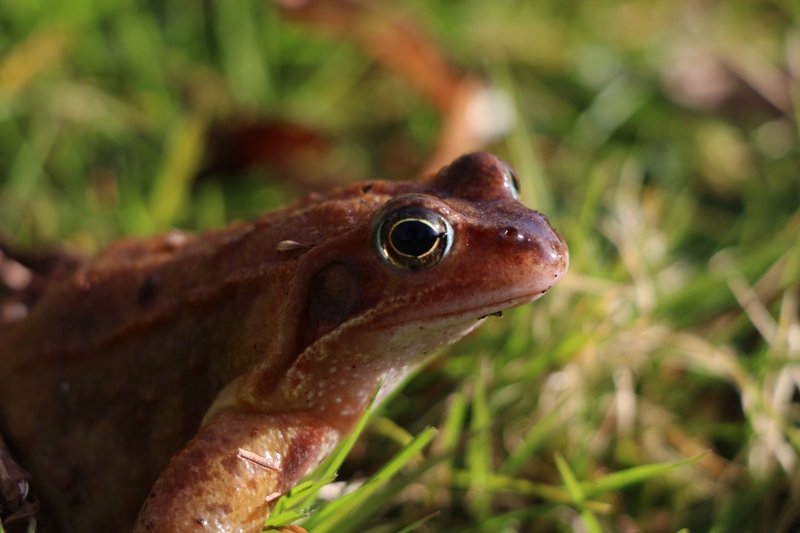
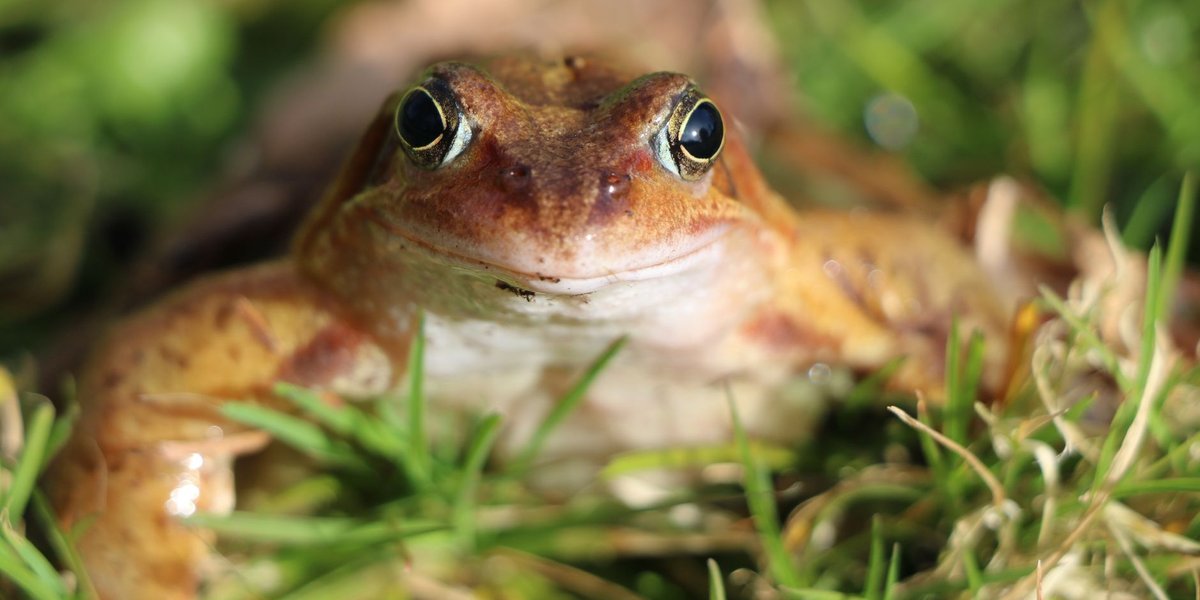
The common frog (Rana temporaria) is the one you’ll actually see. It lives in every county, in gardens, bogs, ditches, wet fields and uplands, and it’s the only Irish amphibian that people regularly confuse with nothing else.
Irish frogs are variable. Brown is standard, but yellow, olive and brick-red animals turn up often enough that people report them as “new species”. They aren’t. The reliable marks are a dark patch running back from the eye and a smooth, damp skin. Adults sit at 6-9 cm.
Frogs head to water early. Spawning can start in late December in mild winters and usually peaks between January and March, which means a hard frost after the spawn is down can kill the lot. Outside breeding time, they spend their days in long grass, compost heaps and under logs, hunting slugs, snails and insects. The frog you find under a flowerpot in July is a working garden employee.
Smooth newt
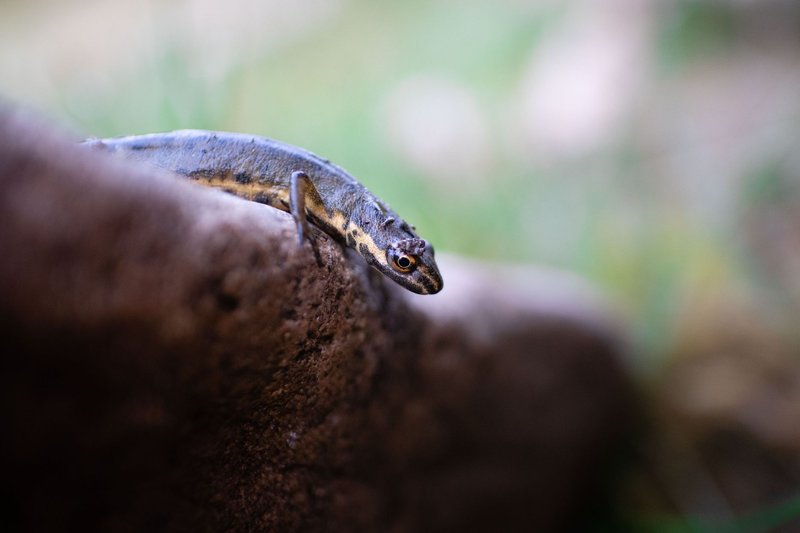
The smooth newt (Lissotriton vulgaris) is Ireland’s only newt, and the amphibian most people never realise they have. It’s secretive, mostly nocturnal and spends much of the year on land under stones and deadwood.
Adults reach 7-11 cm, tail included. Both sexes have an orange or yellow belly with dark spots. In spring, males put on a show: a wavy crest along the back and tail, spotted flanks and a flash of colour that makes them look like a miniature dragon. The crest is gone again by summer.
Breeding runs from about March to June. Females lay eggs one at a time, folding each into a leaf of pond weed with their back feet. Nobody ever finds a newt “clump” because there isn’t one.
Natterjack toad
Ireland’s only toad is the natterjack (Epidalea calamita), and it’s the rarest of the three by a wide margin. The Irish Red List classes it as Endangered.
It’s easy to recognise once you see one. A thin yellow line runs down the middle of its back, the skin is warty, and it moves in short fast runs instead of hops. Adults are 6-8 cm. Males call from shallow pools on warm spring and summer nights, and the chorus carries for a kilometre or more.
The natterjack is a specialist of sandy coasts: dune slacks, machair and shallow, warm, temporary pools that frogs mostly ignore. Its native Irish range is the southwest of Kerry, on the Dingle and Iveragh peninsulas and around Castlemaine. A population in Wexford is the result of a translocation, not a natural remnant. Older sources disagree on how many sites hold natterjacks, and some still list places where they have since disappeared, so check the distribution maps held by the National Biodiversity Data Centre before trusting any single list.
Breeding runs from April to July, later than the frog and newt, because the pools it prefers need sun to warm up.
Frog, toad or newt? How to tell them apart
Start with the tail. A tail means a newt, and no tail means a frog or toad.
- Newt or lizard? Ireland’s only native reptile is the common lizard, and it gets mixed up with newts constantly. Lizards have dry, scaly skin and sit in sunshine. Newts have soft, moist skin and avoid direct heat.
- Frog or toad? Frogs have smooth, wet-looking skin and long back legs built for jumping. A toad has drier, warty skin, shorter legs and a stubbier body.
- Is it a toad at all? In Ireland, almost certainly yes only if you are in Kerry or at the Wexford site. The common toad (Bufo bufo) is abundant in Britain but is not an Irish species. A “toad” in a garden in Cork city or County Mayo is nearly always a frog, a slightly crumpled one.
Frogspawn, toadspawn and newt eggs
- Frogspawn is a floating, jelly-like clump of black-dotted eggs, laid in shallow water between January and March.
- Natterjack spawn comes in thin strings, laid in a single or double row in very shallow pools in late spring.
- Newt eggs are single, tiny and wrapped inside a folded leaf, so they’re easy to miss.
Why Ireland has so few amphibians
Britain has seven native amphibians and mainland Europe has dozens. Ireland has three because it was cut off early. As the ice sheets melted about 15,000 years ago, rising seas flooded the land link to Britain before most amphibians could cross. Species that arrived first, or were carried in later, are the ones we have. It’s the same reason Ireland has one native reptile and no snakes.
Is the common frog native?
Not as straightforwardly as people assume. A tradition holds that frogs were first brought to Trinity College Dublin in 1696, and the earliest written record of the species in Ireland is from that period. That story is probably a neat tidying of something older. Genetic studies of Irish frogs point to ancestors from western France, which could mean a human-assisted arrival or a natural one, and researchers still argue about it.
The one point everyone agrees on is the common toad: it hasn’t established itself in Ireland.
Found one in the garden?
Leave it alone, and move it only if it’s in immediate danger from a road or a lawn mower.
- Don’t carry frogs far. A frog taken more than a few metres from its pond will often try to walk back, usually through traffic.
- Check before you strim or mow. Long grass in spring and summer holds more frogs than you’d guess.
- Check drains and cellar steps. Amphibians fall in and can’t climb out. A plank or a pile of stones gives them an exit.
- Skip the slug pellets. The frogs are doing that job for free.
- Leave a log pile or stones in a quiet corner. That’s winter housing and a hunting ground.
- Don’t move spawn between ponds. It spreads disease and invasive plants as well as tadpoles.
How to build a pond they will use
A pond is the single most useful thing you can add.
- Pick a spot that gets sun for at least part of the day, away from overhanging trees.
- Dig in layers: a shallow shelf at one end, a deeper section of about 60 cm, and one side that slopes gently so amphibians can climb out.
- Fill it with rainwater if you can. Tap water carries nutrients that feed algae.
- Add native plants, not bought goldfish. Fish eat tadpoles and newt larvae, so never stock them.
- Wait. Frogs often find new ponds within a year, and newts can take longer. You don’t need to introduce either.
Threats
The common frog and smooth newt are doing fine at national level, but individual ponds are vanishing: drained farmland, infilled ditches, tidy gardens, and fertiliser run-off that turns pools green. Roads kill huge numbers of frogs on wet spring nights, especially near pond sites.
The natterjack is in a more serious spot. Its dune slack pools dry out, get overgrown with scrub or fill with sand, and the whole Irish population sits at the end of a few Kerry peninsulas. Conservation work, including grazing management and creating new pools, is what keeps them going. If you want to see a natterjack, join a guided night walk on the Dingle or Iveragh coast in May, when the males are calling.