Two volcanic islands in the Gulf of Guinea have more animals found nowhere else than most countries ten times their size. The animals of São Tomé and Príncipe include some of the world’s rarest birds, a frog fauna that is 100% endemic, and beaches where four species of sea turtle come ashore to nest.
This guide runs through the ones worth knowing, island by island and group by group, with where to find them and how threatened they are.
Contents
- Why these islands have so many endemics
- Quick facts
- Endemic birds
- Amphibians and reptiles
- Mammals
- Sea turtles and marine life
- Where and when to look
- Threats
- FAQ
Why these islands have so many endemics
Both islands are volcanic. They rose from the seafloor and have never touched the African mainland, roughly 250 km away. Anything living there descended from an animal that flew, drifted or rafted across open water.
That filter is harsh. Few species make the crossing, and the ones that do settle into a forest with no competitors and evolve to fit it. Birds get bigger or smaller, shrews and frogs split into island-only species, and there are no native land mammals beyond bats and shrews. Príncipe is the older island, with sharper peaks and a longer isolation. São Tomé is bigger and has the higher mountains, so it holds more of the species.
Quick facts
| Group | Standout species | Island | Notes |
|---|---|---|---|
| Birds | São Tomé Grosbeak | São Tomé | Critically Endangered |
| Birds | Dwarf Olive Ibis | São Tomé | Critically Endangered |
| Birds | Giant Sunbird | São Tomé | Vulnerable |
| Birds | Príncipe Scops-Owl | Príncipe | Critically Endangered |
| Amphibians | Seven endemic species | Both | No non-endemic amphibians are native |
| Mammals | São Tomé Shrew | São Tomé | Endemic |
| Marine | Sea turtles, spinner dolphins | Coasts | Nesting roughly October to March |
Endemic birds
Birds are the reason most visitors come. The islands hold dozens of endemic species and subspecies, and BirdLife International treats both as priority conservation sites.
São Tomé Grosbeak
The São Tomé Grosbeak (Neospiza concolor) is a drab brown finch with an enormous bill, the largest bill of any canary. Nobody recorded it between 1888 and 1991, when it turned up again in southern primary forest. It is listed as Critically Endangered by the IUCN, and the population is tiny. Look for it only in the deepest forest of the southwest, with a local guide.
Dwarf Olive Ibis
The Dwarf Olive Ibis (Bostrychia bocagei), often just called the Dwarf Ibis, is the smallest ibis in the world. It’s a dark, glossy bird that forages on the forest floor near streams, and it lives only on São Tomé. It is Critically Endangered. Its loud, ringing calls at dawn are usually how you find it before you see it.
Giant Sunbird
Sunbirds are normally small. The Giant Sunbird (Dreptes thomensis) is the exception: about 20 cm long with a long curved bill and a dark, iridescent body. It lives in São Tomé’s forests, and it’s rated Vulnerable. It feeds on nectar and takes fruit and insects, and it tends to show up in flowering trees.
Príncipe Kingfisher
The Príncipe Kingfisher is a small, bright blue-and-white kingfisher of Príncipe’s forest streams and edges. It’s a good first bird to get on the list: it perches low and holds still. Taxonomists still argue about whether it’s a full species or a race of the Malachite Kingfisher.
Príncipe Thrush
The Príncipe Thrush (Turdus xanthorhynchus) has an orange-yellow bill and a dark head, and it sings from mid-canopy in Príncipe’s forests. It’s a threatened species with a small range, and most birders see it around the island’s southern forest.
The scops-owls
Each island has its own scops-owl. The São Tomé Scops-Owl (Otus hartlaubi) is a small, cryptic owl that roosts in dense foliage and calls at night. On Príncipe, the Príncipe Scops-Owl (Otus bikegila) was found in 2016 and named for local guide Ceciliano do Bom Jesus, known as “Bikegila”. It’s Critically Endangered. It counts as one of the most recent bird discoveries in Africa, and it’s a reminder that these forests still haven’t given up everything.
Amphibians and reptiles
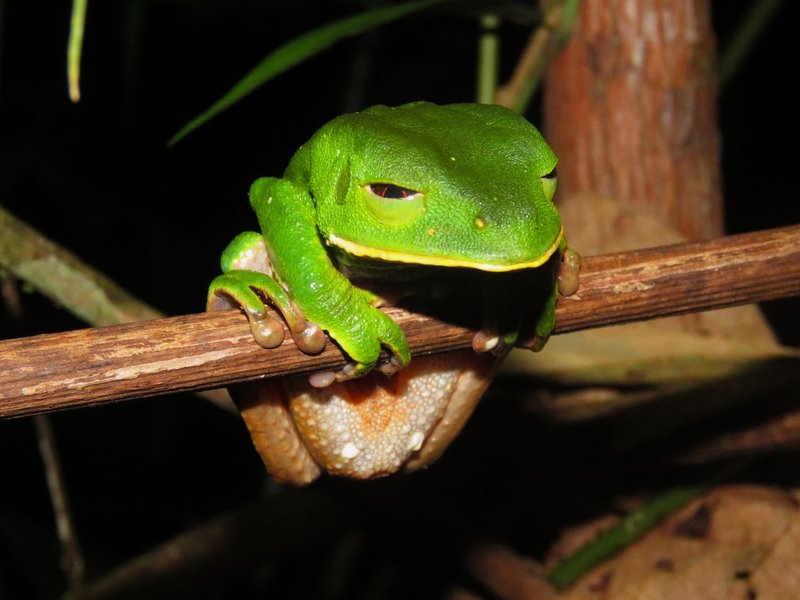
Seven amphibian species live on the islands, and every one of them is endemic. That is remarkable for oceanic islands, since amphibians tolerate saltwater badly. The group includes several Hyperolius reed frogs, a tree frog and the São Tomé caecilian (Schistometopum thomense), a limbless, burrowing amphibian that looks like a fat earthworm with a yellow belly. Most frogs breed in the wet season, roughly September to May, and call loudly after rain.
Reptiles are worth a look too. Geckos are everywhere, including in hotel rooms, and several are endemic. Ask a guide to point out the giant tree-dwelling geckos in the forest.
Mammals
The native mammal list is short: bats and shrews. The São Tomé Shrew (Crocidura thomensis) is found only on São Tomé, and it’s rarely seen. Several fruit bats also live on the islands and are easier to spot at dusk. Larger mammals such as the mona monkey and the civet were brought by people, and they now cause problems for native wildlife.
Sea turtles and marine life
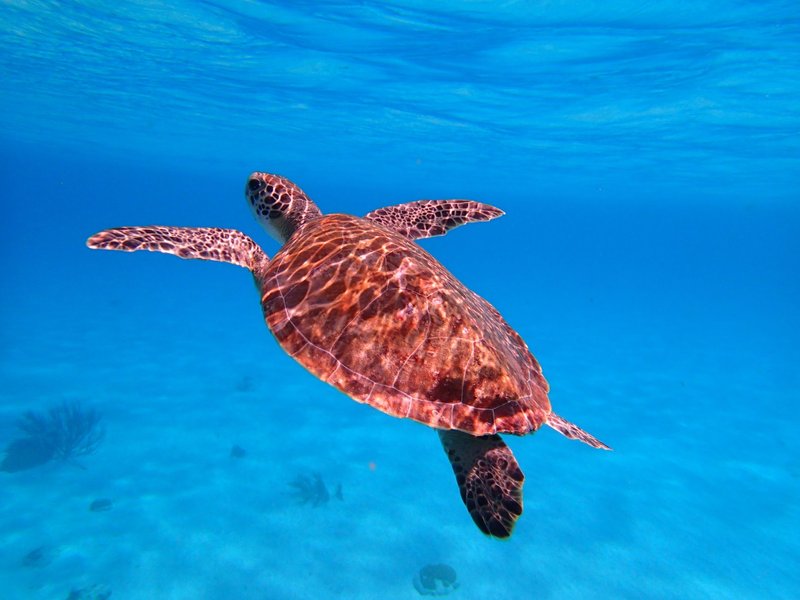
Four sea turtle species nest on the islands’ beaches: green, hawksbill, olive ridley and leatherback. Nesting runs roughly from October to March, with the peak in the middle of the season. The southern beaches of São Tomé and the islets off both islands are the best-known sites. Community-run programs guide night walks, and walking with a ranger is the responsible way to see a female come ashore.
Offshore, spinner dolphins are seen year round, often in bays at dawn. Humpback whales pass through during the southern hemisphere winter, roughly July to October, and boat trips run in that window.
Where and when to look
Obô Natural Park (São Tomé). The park covers the wild, mountainous center and southwest of São Tomé, with the primary forest where the grosbeak, ibis and giant sunbird live. Hire a guide. Trails are steep and muddy, and the rare species are very hard to find on your own.
Príncipe Biosphere Reserve. UNESCO designated the whole island of Príncipe a biosphere reserve in 2012. It’s the place for Príncipe Island birdwatching: the thrush, kingfisher and scops-owl are all here, and the forest sits close to the coast.
When to go. The dry season, roughly June to September, gives easier trails and better visibility. The turtle season falls in the wetter months, so you’ll trade some comfort for nesting. Birds are best at dawn, whatever the month.
Threats
The biggest pressures are introduced predators and habitat loss. Rats, cats, weasels and civets are among the invasive species that prey on nesting birds and eggs, and island species have little defense against them. Farming and logging cut into lowland forest, which is why the rarest birds now cling to the highest and least accessible ground. Turtles face poaching of adults and eggs, though local programs have reduced it in some areas.
FAQ
What animals are only found in São Tomé and Príncipe? Dozens of birds, all seven amphibian species, several reptiles, shrews and other small mammals are found only here. The best-known are the São Tomé Grosbeak, the Dwarf Olive Ibis and the Giant Sunbird.
What is the rarest bird on the islands? The São Tomé Grosbeak and the Dwarf Olive Ibis are both Critically Endangered, as is the recently described Príncipe Scops-Owl.
Are there any dangerous animals? No large predators live on the islands. The animals of São Tomé and Príncipe are mostly small and shy, and the main hazards are the usual tropical ones such as mosquitoes.
When do sea turtles nest? Roughly October to March, with different species peaking at different points in that window.
Do I need a guide? For the rarest forest birds, yes. Local guides know the territories and calls, and hiring one puts money into conservation.