An aquarium calculator turns your tank’s measurements into gallons and liters, then tells you how many fish it can hold. Enter the outside length, width and height (or pick a standard size), add the fish you want, and the calculator shows the real water volume, the filled weight, the heater and filter you need and a stocking percentage based on each species’ adult size.
A standard 55-gallon tank holds about 45.5 gallons (172 L) of water once glass, gravel and the gap below the rim are taken off, and it weighs about 541 lb (245 kg) filled.
How to use the aquarium calculator
- Pick the shape (9 shapes), or pick a standard tank size and the measurements fill in.
- Enter the outside measurements in inches or centimeters. The calculator takes off the glass for you.
- Check the setup details. Glass thickness is estimated from the height. The defaults are a 1 in (2.5 cm) gap below the rim and 1.5 in (4 cm) of gravel (sand for saltwater). Change any of them to match your tank.
- Choose the water type: freshwater, saltwater (with a reef switch) or brackish.
- Add your fish with how many of each. The list covers 191 species: 122 freshwater, 62 saltwater and 7 brackish.
- Read the results: real gallons, weight, heater, filter flow, substrate bags, water change, the stocking gauge and any warnings.
How to measure your aquarium
Measure the outside of the tank, including any plastic trim. Outside sizes are easy to take on a full tank and match the sizes makers publish. The calculator removes the glass for you. If you measured the inside, set the glass thickness to 0.
- Rectangle: length across the front, width from front to back and height from the bottom of the base trim to the top of the rim.
- Cube: one side.
- Bow front: the straight back length, the depth at the center of the bow (from the back glass to the front of the curve) and the depth at the side panels.
- Cylinder: the diameter across the widest point and the height.
- Half cylinder: the width of the flat back panel (this is the diameter) and the height.
- Hexagon: flat-to-flat width, from the outside of one panel straight across to the outside of the panel opposite it.
- Pentagon corner: the length of one of the two back walls, measured along the wall, and the width of the front panel.
- Quarter-circle corner: the length of one flat back wall (this is the radius) and the height.
- L-shape: the outer length of each arm along the long back walls, the depth of the arms and the height.
Aquarium volume formulas for every shape
Each formula gives the volume in cubic inches when you measure in inches. Divide by 231 to get US gallons, or multiply by 0.016387064 to get liters. If you measure in centimeters, the formula gives cubic centimeters; divide by 1,000 to get liters. One US gallon is 3.785 liters.
| Shape | Volume formula |
|---|---|
| Rectangle | length x width x height |
| Cube | side x side x side |
| Bow front | (length x end depth + 2/3 x length x (center depth − end depth)) x height |
| Cylinder | 3.1416 x diameter x diameter ÷ 4 x height |
| Half cylinder | 3.1416 x diameter x diameter ÷ 8 x height |
| Hexagon | 0.866 x flat-to-flat width x flat-to-flat width x height |
| Pentagon corner | (back wall x back wall − front panel x front panel ÷ 4) x height |
| Quarter circle | 3.1416 x radius x radius ÷ 4 x height |
| L-shape | depth x (arm 1 + arm 2 − depth) x height |
The bow front formula treats the curve as a parabola. For a typical bow front this is within about 0.2% of a true circular arc.
Worked example: rectangle
A 30 x 12 x 12 inch tank: 30 x 12 x 12 = 4,320 cubic inches. 4,320 ÷ 231 = 18.7 gallons (70.8 L). After glass, gap and gravel, the calculator gives 14.2 gallons of real water.
Worked example: bow front
A bow front 36 in long, 16 in deep at the center, 12 in deep at the ends and 20 in tall: 36 x 12 + 2/3 x 36 x 4 = 528 square inches of floor. 528 x 20 = 10,560 cubic inches, or 45.7 gallons (173.0 L). Real water: 37.0 gallons.
Worked example: cylinder
A cylinder 18 in across and 24 in tall: 3.1416 x 18 x 18 ÷ 4 = 254.5 square inches. 254.5 x 24 = 6,107 cubic inches, or 26.4 gallons (100.1 L). Real water: 21.4 gallons.
Why your tank holds less water than the label says
The number on the label is close to the volume of the outer box. The water inside is less, for four reasons:
- Glass. The walls and the bottom pane take up space. Standard glass tanks use thicker glass as they get taller: up to 12.6 in tall: 1/8 in; up to 13.5 in tall: 3/16 in; up to 19 in tall: 1/4 in; up to 23.5 in tall: 5/16 in; up to 26 in tall: 3/8 in; up to 30 in tall: 1/2 in; taller than 30 in: 5/8 in.
- The gap below the rim. Most people fill to about 1 in below the top.
- Substrate. Gravel or sand takes space. 1.5 in of gravel in a 55 takes about 3.7 gallons.
- Rocks and decorations. These take more space still. The calculator does not subtract them, so allow a little extra if your tank has a lot of rock.
Example: a 55-gallon tank. A standard 55 measures 48.25 x 12.75 x 21 in (122.6 x 32.4 x 53.3 cm). The outer box holds 55.9 gallons. Inside the 5/16 in glass, filled to the rim, it holds 51.7 gallons. With 1 in left at the top and 1.5 in of gravel, 45.5 gallons (172 L) of water are left: 81% of the box.
| Label size | Outer box | Inside, filled to the rim | Real water | Real vs box |
|---|---|---|---|---|
| 10 gallon | 11.6 gal | 11.0 gal | 8.8 gal (33 L) | 76% |
| 20 gallon long | 20.9 gal | 19.7 gal | 15.8 gal (60 L) | 76% |
| 29 gallon | 30.7 gal | 28.6 gal | 24.7 gal (94 L) | 81% |
| 55 gallon | 55.9 gal | 51.7 gal | 45.5 gal (172 L) | 81% |
| 75 gallon | 82.1 gal | 77.1 gal | 67.8 gal (257 L) | 83% |
| 125 gallon | 134.3 gal | 126.9 gal | 113.0 gal (428 L) | 84% |
Use the real number for anything you dose by volume, such as water conditioner, medicine or salt mix.
Common aquarium sizes
The table lists standard tank sizes with their outside dimensions, the volume of water they really hold and their weight filled. Click a column heading to sort. Dimensions come from the makers’ published size charts and include the plastic trim.
| Tank | Outside size (L × W × H, in) | Outside size (L × W × H, cm) | US gallons | Liters | Filled weight | Try it |
|---|---|---|---|---|---|---|
| 2.5 gallon | 12.19 × 6.13 × 8.13 | 31 × 15.6 × 20.6 | 2.5 | 10 | about 25 lb (11 kg) | Load in calculator |
| 5 gallon | 16.19 × 8.38 × 10.5 | 41.1 × 21.3 × 26.7 | 5.5 | 21 | about 58 lb (26 kg) | Load in calculator |
| 10 gallon | 20.25 × 10.5 × 12.56 | 51.4 × 26.7 × 31.9 | 10 | 38 | about 107 lb (48 kg) | Load in calculator |
| 15 gallon | 24.25 × 12.5 × 12.75 | 61.6 × 31.8 × 32.4 | 15 | 57 | about 157 lb (71 kg) | Load in calculator |
| 20 gallon high | 24.25 × 12.5 × 16.75 | 61.6 × 31.8 × 42.5 | 20 | 76 | about 212 lb (96 kg) | Load in calculator |
| 20 gallon long | 30.25 × 12.5 × 12.75 | 76.8 × 31.8 × 32.4 | 20 | 76 | about 195 lb (89 kg) | Load in calculator |
| 29 gallon | 30.25 × 12.5 × 18.75 | 76.8 × 31.8 × 47.6 | 29 | 110 | about 294 lb (133 kg) | Load in calculator |
| 30 gallon | 36.25 × 12.63 × 16.75 | 92.1 × 32.1 × 42.5 | 30 | 114 | about 317 lb (144 kg) | Load in calculator |
| 37 gallon | 30.25 × 12.5 × 22.75 | 76.8 × 31.8 × 57.8 | 37 | 140 | about 364 lb (165 kg) | Load in calculator |
| 40 gallon breeder | 36.19 × 18.25 × 16.94 | 91.9 × 46.4 × 43 | 40 | 151 | about 455 lb (206 kg) | Load in calculator |
| 40 gallon long | 48.25 × 12.75 × 16.88 | 122.6 × 32.4 × 42.9 | 40 | 151 | about 427 lb (193 kg) | Load in calculator |
| 45 gallon | 36.25 × 12.63 × 23.75 | 92.1 × 32.1 × 60.3 | 45 | 170 | about 467 lb (212 kg) | Load in calculator |
| 55 gallon | 48.25 × 12.75 × 21 | 122.6 × 32.4 × 53.3 | 55 | 208 | about 541 lb (245 kg) | Load in calculator |
| 65 gallon | 36.38 × 18.38 × 25 | 92.4 × 46.7 × 63.5 | 65 | 246 | about 700 lb (318 kg) | Load in calculator |
| 75 gallon | 48.5 × 18.5 × 21.13 | 123.2 × 47 × 53.7 | 75 | 284 | about 778 lb (353 kg) | Load in calculator |
| 90 gallon | 48.5 × 18.5 × 25.13 | 123.2 × 47 × 63.8 | 90 | 341 | about 938 lb (425 kg) | Load in calculator |
| 110 gallon | 48.38 × 18.38 × 31 | 122.9 × 46.7 × 78.7 | 110 | 416 | about 1,213 lb (550 kg) | Load in calculator |
| 120 gallon | 48.5 × 24.5 × 25.5 | 123.2 × 62.2 × 64.8 | 120 | 454 | about 1,244 lb (564 kg) | Load in calculator |
| 125 gallon | 72.5 × 18.5 × 23.13 | 184.2 × 47 × 58.7 | 125 | 473 | about 1,265 lb (574 kg) | Load in calculator |
| 150 gallon | 72.5 × 18.5 × 29.5 | 184.2 × 47 × 74.9 | 150 | 568 | about 1,678 lb (761 kg) | Load in calculator |
| 180 gallon | 72.5 × 24.5 × 25.63 | 184.2 × 62.2 × 65.1 | 180 | 681 | about 1,857 lb (842 kg) | Load in calculator |
| 210 gallon | 72.5 × 24.5 × 29.63 | 184.2 × 62.2 × 75.2 | 210 | 795 | about 2,194 lb (995 kg) | Load in calculator |
| 220 gallon | 72 × 24 × 30 | 182.9 × 61 × 76.2 | 220 | 833 | about 2,163 lb (981 kg) | Load in calculator |
| 300 gallon | 72 × 36 × 27 | 182.9 × 91.4 × 68.6 | 300 | 1,136 | about 2,873 lb (1,303 kg) | Load in calculator |
| Fluval Spec V (5 gallon / 19 L) | 19.5 × 6.5 × 11.5 | 49.5 × 16.5 × 29 | 5 | 19 | about 59 lb (27 kg) | Load in calculator |
| Fluval Spec 16 gallon (60 L) | 21.5 × 11.5 × 17 | 54.6 × 29 × 43 | 16 | 60 | about 177 lb (80 kg) | Load in calculator |
| Waterbox AIO 20 Cube (76 L) | 17.7 × 17.7 × 15.7 | 45 × 45 × 40 | 20 | 76 | about 203 lb (92 kg) | Load in calculator |
| Waterbox Marine X 60.2 (136 L display) | 23.6 × 19.7 × 19.7 | 60 × 50 × 50 | 36 | 136 | about 392 lb (178 kg) | Load in calculator |
| Waterbox Marine X 90.3 (224 L display) | 35.4 × 19.7 × 21.7 | 90 × 50 × 55 | 59.3 | 224 | about 650 lb (295 kg) | Load in calculator |
| ADA Cube Garden 60-P (60 x 30 x 36 cm) | 23.62 × 11.81 × 14.17 | 60 × 30 × 36 | 15.9 | 60 | about 165 lb (75 kg) | Load in calculator |
| ADA Cube Garden 90-P (90 x 45 x 45 cm) | 35.43 × 17.72 × 17.72 | 90 × 45 × 45 | 43.9 | 166 | about 472 lb (214 kg) | Load in calculator |
| ADA Cube Garden 120-P (120 x 50 x 50 cm) | 47.24 × 19.69 × 19.69 | 120 × 50 × 50 | 72.1 | 273 | about 781 lb (354 kg) | Load in calculator |
| ADA Cube Garden 120 (legacy 120 x 45 x 45 cm) | 47.24 × 17.72 × 17.72 | 120 × 45 × 45 | 64.2 | 243 | about 601 lb (272 kg) | Load in calculator |
Two tanks can share a label and differ in shape. A 20 long measures 30.25 x 12.5 x 12.75 in (76.8 x 31.8 x 32.4 cm); a 20 high measures 24.25 x 12.5 x 16.75 in (61.6 x 31.8 x 42.5 cm). Both hold about 16 gallons of real water, but the 20 long gives fish 6 more inches to swim and more water surface. For most fish, length matters more than height.
How many fish can I put in my tank?
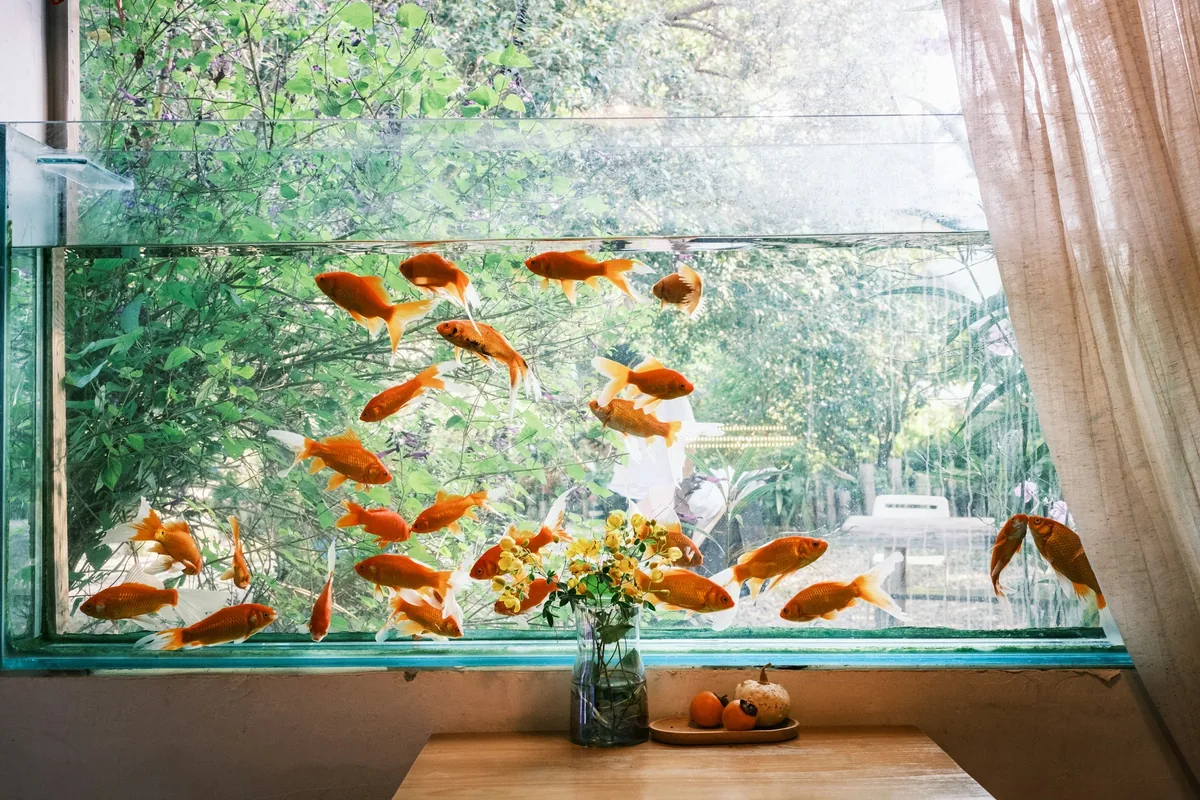
It depends on which fish, not only on the gallons. A tank can hold far more small, slim fish than large, heavy ones, because a big fish eats more and makes more waste per inch than a small one. The calculator adds up the load of every fish at its adult size and compares it with what your tank’s real water and filter can handle. The result is the stocking percentage.
Why the “1 inch of fish per gallon” rule fails
The rule counts every inch of fish the same. But a longer fish is also taller and thicker, so an inch of a big fish carries much more body than an inch of a small one.
Take a 10-gallon tank. 8 neon tetras add up to 9.4 inches of fish. One common goldfish grows to about 9.8 inches. By the rule, both fit. In the calculator:
- 8 neon tetras: 48%
- 1 common goldfish: 406%, about 8 times the load
A goldfish of that length weighs around 300 to 400 grams; a neon tetra weighs about half a gram. The goldfish needs a pond or a very large tank.
The rule also misjudges tiny fish. By inches, a 10-gallon tank “holds” about 8 neon tetras; the calculator turns red after 16. Small fish swim in schools and need open water, so the calculator counts them by crowding as well as by waste.
Learn more about goldfish size and care in our guide to the characteristics of a goldfish.
What the stocking percentage means
- Up to 85% (green): room to spare.
- 86–100% (amber): full. The tank is fully stocked. It works with regular water changes, but don’t add more fish.
- Over 100% (red): overstocked. Expect high nitrate, cloudy water and stressed fish unless you remove fish, add filtration and change water more often.
The gauge measures how much load the fish put on the water. It does not judge behavior or tank shape. A tank can read 40% and still be wrong for a fish that needs more swimming room or a bigger group. That is why the calculator runs separate checks next to the gauge. A single common pleco in a 10-gallon tank reads 761%, and the calculator flags it as needing at least 125 gallons and a tank at least 71 in (180 cm) long.
How many fish in a 10-gallon tank?
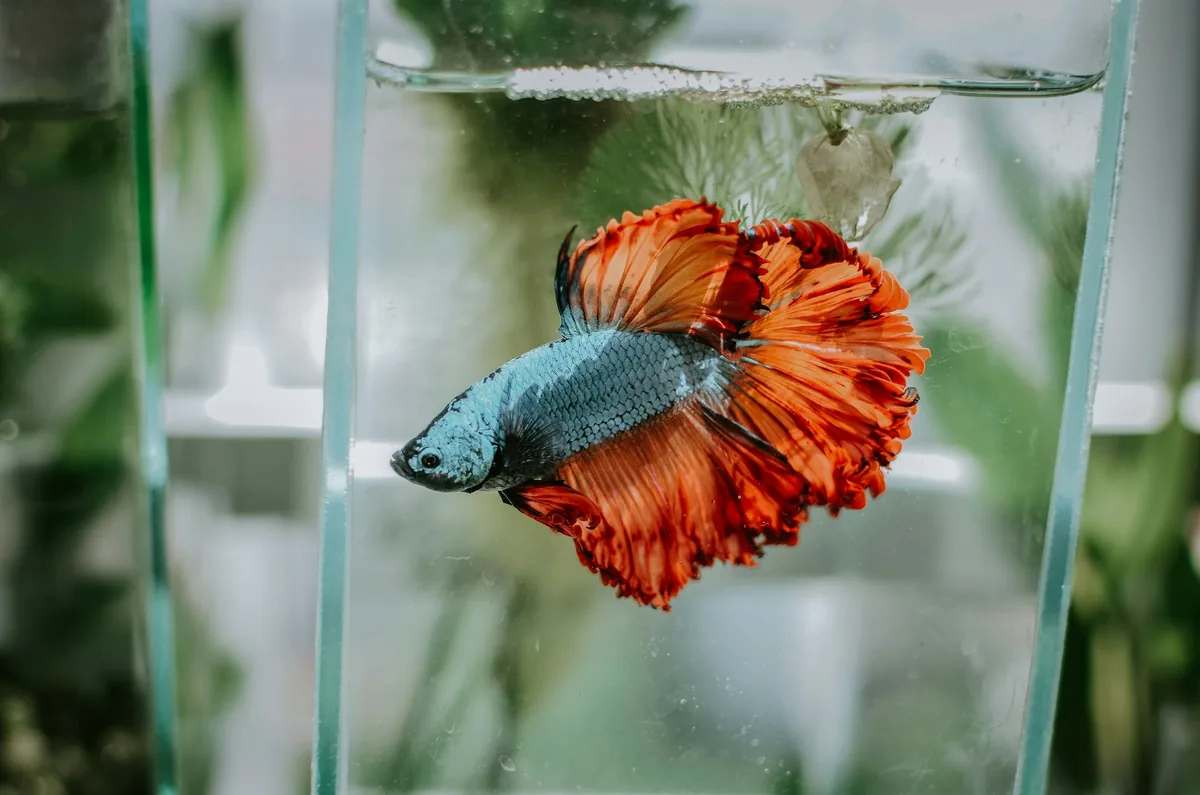
A 10-gallon tank (8.8 gallons of real water) suits one betta or a small group of nano fish. Two setups computed with the calculator:
- 10 ember tetras and 6 pygmy corydoras: 69% (green, room to spare). No warnings.
- 1 male betta, 6 cherry shrimp and 1 mystery snail: 27% (green, room to spare). Warnings: can jump, needs a lid (male betta).
The first few gallons of any tank count a little less in the calculator, because temperature and water quality change faster in a small volume. See our list of the smallest fish for more nano species.
How many fish in a 20-gallon tank?
A 20 long holds 15.8 gallons of real water and gives 30.25 inches of swimming length. Two setups:
- 10 harlequin rasboras and 6 panda corydoras: 82% (green, room to spare). No warnings.
- 8 harlequin rasboras, 6 panda corydoras and 6 otocinclus: 95% (amber, full). No warnings.
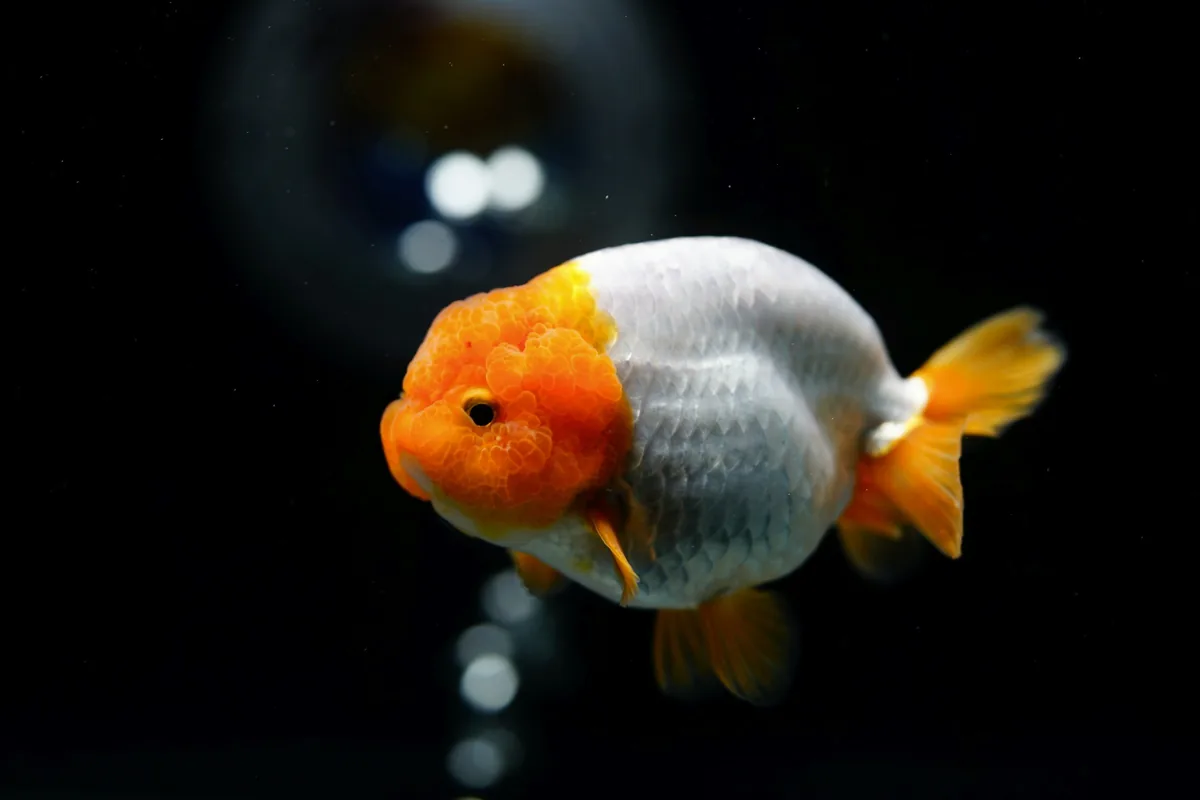
What about one goldfish? One fancy goldfish in a 20 long reads 120% (red, overstocked). Many keepers give 20 gallons as the minimum for one fancy goldfish, and the calculator accepts a 20 long on size. On load, though, an adult fancy goldfish is a heavy, messy fish, and a 20 long is at its limit: with a strong filter it reads 100%. Choose a bigger tank, or plan on a strong filter and large weekly water changes.
How many fish in a 29-gallon tank?
A 29 holds 24.7 gallons of real water. It has the same footprint as a 20 long but is taller, which leaves room for a centerpiece fish and a bottom crew:
- 2 honey gouramis, 10 cardinal tetras, 6 panda corydoras and 1 bristlenose pleco: 71% (green, room to spare). Warnings: can jump, needs a lid (honey gourami).
How many fish in a 55-gallon tank?
A 55 holds 45.5 gallons of real water and is 48.25 inches long, enough for larger schooling fish:
- 6 Boesemani rainbowfish, 12 rummynose tetras and 8 bronze corydoras: 82% (green, room to spare). No warnings.
- 5 angelfish, 12 neon tetras and 8 bronze corydoras: 87% (amber, full). Warnings: predator with prey-sized fish (angelfish).
The second setup shows why the checks matter. It is not overstocked, but the calculator warns that angelfish eat fish as small as neon tetras. Swap the neons for 12 rummynose tetras and the warning goes away (the gauge then reads 99%).
Schooling fish and fish that don’t mix
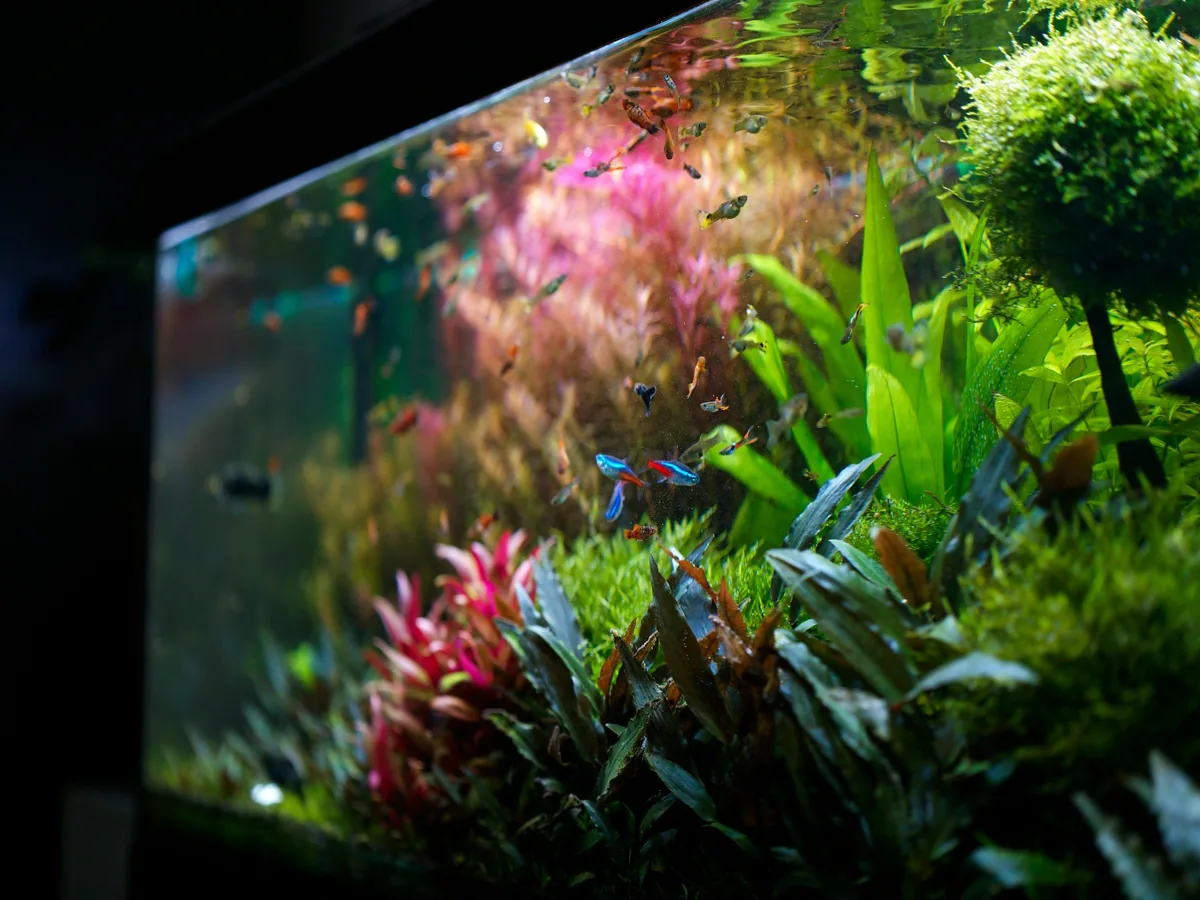
Many small fish live in groups. Kept alone or in twos, they hide, lose color and get stressed. Each species in the calculator has a minimum group size from keeper references, and the calculator warns when you add fewer.
The calculator runs these checks on every setup:
- Water type: freshwater fish in a saltwater tank, or the reverse, and brackish fish in either.
- Temperature, pH and salinity: whether the fish share a range. Cold-water fish such as goldfish are flagged when mixed with tropical fish, or when the range they share is very narrow.
- Group size: schooling fish kept below their minimum group, and fish that must be kept alone (such as male bettas) kept in pairs.
- Tank size and length: fish that need a bigger or longer tank than yours.
- Aggression: aggressive fish mixed with peaceful ones, and fin nippers mixed with long-finned fish.
- Predators: a fish that eats fish is flagged when a tankmate is under a third of the predator’s length, and warned about when a tankmate is under half. For some predators, such as angelfish, the calculator uses a shorter length that matches the prey they actually catch. Fish swallow prey whole. In a study of more than 40 fish-eating reef species, the largest prey reached about half the predator’s length.
- Invertebrates: fish that eat shrimp or crabs, and fish that eat snails.
- Reef safety: fish that eat or damage corals in a reef tank.
- Jumpers: fish that need a tight lid.
Test your fish knowledge with our fish quiz, or browse some of the cutest fish people keep.
Saltwater and reef tanks: what changes
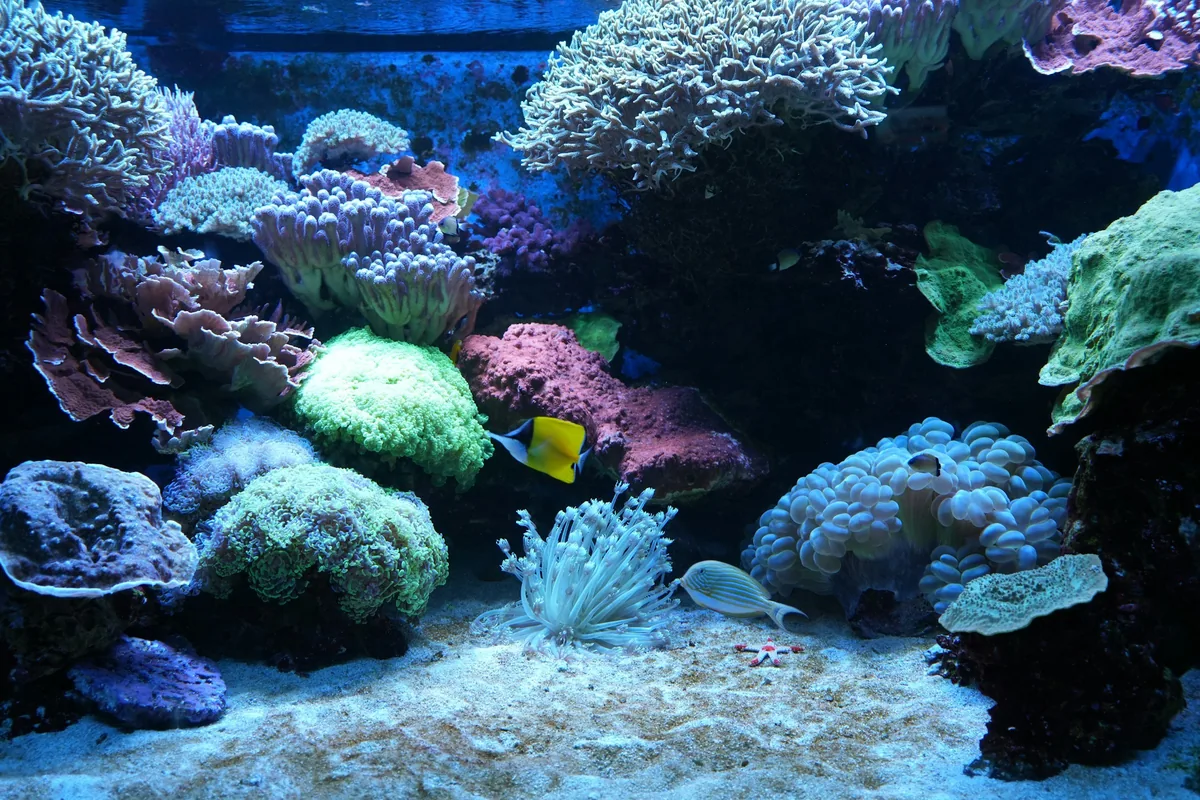
A saltwater tank holds fewer fish than a freshwater tank of the same size. In the calculator, a saltwater tank has 34% of the freshwater capacity, and a brackish tank 75%. Salt water holds about 20% less oxygen, ammonia is more toxic at the higher pH of a reef tank, and marine fish and corals put up with far less nitrate.
- A 29-gallon saltwater tank with 2 ocellaris clownfish, 1 yellow clown goby, 1 tailspot blenny, 4 astrea snails and 1 peppermint shrimp reads 66%.
- A 75-gallon reef with 2 ocellaris clownfish, 1 royal gramma, 1 six-line wrasse, 3 blue-green chromis and 1 yellow watchman goby reads 59%.
- One yellow tang alone in the same 75 reads 46%.
The saltwater version of the inch rule (“1 inch per 4 or 5 gallons”) has the same flaw as the freshwater one. A 6.7 in yellow tang counts about 6 times as much as a 3.1 in ocellaris clownfish, not 2.1 times.
Saltwater tanks also need more water movement. The calculator sizes the return pump at 3–5 times the tank volume per hour, and total flow (return plus powerheads) at 10–20 times for a fish-only tank and 20–40 times for a reef. Saltwater weighs more, and the weight estimate adds 1 lb of rock per gallon instead of 0.5 lb. To meet the animals that live on real reefs, see our guide to coral reef animals.
What size heater and filter do I need?
Heater. A heater replaces the heat the tank loses through its glass and water surface. The calculator works out the watts from the temperature rise over the room and the real gallons. Surface grows more slowly than volume, so big tanks need fewer watts per gallon than small ones. Tanks over 40 gallons of real water get two heaters: if one sticks on, it heats the tank more slowly, and if one fails, the other keeps the tank warm. With fish added, the target temperature is the middle of the range they share.
Filter. Freshwater tanks need a filter that moves 4–6 times the tank’s real volume per hour, or 6–10 times for messy fish (goldfish, big plecos, big cichlids) and tanks over 85% stocked. Filter boxes quote flow with no media inside, and real flow is often 30–50% lower, so pick one rated near the top of the range.
Sizes for freshwater tanks in a 68 °F (20 °C) room heated to 77 °F (25 °C), with 20–30% weekly water changes:
| Tank | Real water | Heat needed | Heater | Filter flow | Weekly water change |
|---|---|---|---|---|---|
| 10 gallon | 8.8 gal (33 L) | 38 W | 1 x 50 W | 35–53 gph | 1.8–2.6 gal |
| 20 gallon long | 15.8 gal (60 L) | 59 W | 1 x 75 W | 63–95 gph | 3.2–4.7 gal |
| 29 gallon | 24.7 gal (94 L) | 83 W | 1 x 100 W | 99–148 gph | 4.9–7.4 gal |
| 40 gallon breeder | 38.9 gal (147 L) | 117 W | 1 x 150 W | 156–233 gph | 7.8–11.7 gal |
| 55 gallon | 45.5 gal (172 L) | 131 W | 2 x 75 W | 182–273 gph | 9.1–13.6 gal |
| 75 gallon | 67.8 gal (257 L) | 177 W | 2 x 100 W | 271–407 gph | 13.6–20.4 gal |
| 125 gallon | 113.0 gal (428 L) | 260 W | 2 x 150 W | 452–678 gph | 22.6–33.9 gal |
A 20 long needs about 59 W, so one 75 W heater. A 55 needs about 131 W, split between two 75 W heaters. A colder room needs more; enter yours in the calculator. For other animals that need warm, humid homes, see our list of tropical rainforest pets.
How much does a fish tank weigh?
A filled aquarium weighs about 10 lb per label gallon once you count glass, gravel and rock. Fresh water alone weighs 8.3 lb per gallon. A standard 55 weighs about 541 lb (245 kg) filled, and Aqueon lists a full weight of 625 lb for its 55.
| Tank | Water | Glass | Gravel | Rock and decor | Total filled | Stand rated for |
|---|---|---|---|---|---|---|
| 10 gallon | 73 lb | 11 lb | 18 lb | 4 lb | 107 lb (48 kg) | 150 lb |
| 20 gallon long | 131 lb | 25 lb | 31 lb | 8 lb | 195 lb (89 kg) | 200 lb |
| 29 gallon | 206 lb | 45 lb | 31 lb | 12 lb | 294 lb (133 kg) | 300 lb |
| 40 gallon breeder | 324 lb | 57 lb | 55 lb | 19 lb | 455 lb (206 kg) | 500 lb |
| 55 gallon | 378 lb | 90 lb | 50 lb | 23 lb | 541 lb (245 kg) | 550 lb |
| 75 gallon | 564 lb | 105 lb | 74 lb | 34 lb | 778 lb (353 kg) | 800 lb |
| 125 gallon | 940 lb | 157 lb | 111 lb | 56 lb | 1,265 lb (574 kg) | 1,300 lb |
The calculator does not subtract the water that rocks push out, so its totals lean high, which is the safe side for a stand.
Where to put a heavy tank
- Stand: use one rated for at least the “stand rated for” number, and make sure it sits level. A tank that rocks or sits unevenly can crack.
- Floor: most homes are built for about 40 lb per square foot spread across a room. A tank puts much more than that on its own footprint (a 55 puts about 127 lb per square foot), so place large tanks across the floor joists and near a load-bearing wall.
- Over 100 gallons or 1,000 lb: ask a builder before you set it up upstairs or on an old floor.
How the calculator works and its sources
Volume
The calculator takes your outside measurements, removes the glass on every side and under the bottom, then subtracts the gap below the rim and the substrate. Left blank, glass thickness comes from the tank’s height, using a table fitted to the empty weights Aqueon and Marineland publish; the calculated glass weight lands within about 20% of those weights. Rimless tanks often use thicker glass, so enter yours if you know it. Water held between gravel grains and the space taken by rocks are not counted.
Weight
Water weight uses the density of fresh water at 25 °C (77 °F), and salt water at a specific gravity of 1.025. Glass is counted at 2.5 g/cm³. Substrate uses typical dry bulk densities: sand 1.45 kg/L, gravel 1.6, aquarium soil 0.95 and crushed coral 1.15. Rock and decorations add 0.5 lb per gallon in freshwater and 1 lb in saltwater.
Stocking
Each fish counts as its adult length to the power 1.5 (length x √length). A fish twice as long counts 2.8 times as much: more than the 2 times of the inch-per-gallon rule, less than the 8 times its weight would suggest.
Why 1.5? The waste a fish makes follows the food it burns, which across fish species grows with weight to the power of about 0.8. On waste alone, that is length to the power of about 2.25. But keepers do not stock by waste alone. Small fish swim in schools, use the whole tank and need open water, so a tank fills up with small fish sooner than their waste predicts. Matched against eleven setups that experienced keepers agree on, the power 1.5 fits much better than 2.25, so the calculator uses it. Two adjustments follow:
- Waste: goldfish, big plecos, oscars, big cichlids, tangs and puffers count 2 times. Most shrimp and snails count 0.7 times.
- Heavy bodies: thick-bodied fish such as goldfish and oscars count 1.4 times. Slim, normal and tall-bodied fish count the same. On top of that, shrimp count 0.3 times and snails and crabs 0.4 times, because a shell or a shrimp’s thin body holds little living tissue.
The tank’s capacity comes from its real gallons. The first few gallons count a little less: the calculator counts gallons x gallons ÷ (gallons + 4). A 10-gallon tank works with about 69% of its real water and a 55 with 92%. A strong filter raises capacity by 20%; a weak one lowers it by 20%. The constants were fitted to those eleven keeper setups and checked against 41 setups known to be good or bad: every good one reads 100% or less, and every bad one still raises a warning. Some keeper targets pull against each other, so six of the eleven land inside their range and the rest miss by a few points.
Limits
- The gauge uses adult sizes. Young fish make less waste, so a new tank of juveniles reads full before it is. The fish will grow.
- The power 1.5 is matched to keepers, not to waste alone. Compared with a pure waste model it is a little generous to big single fish and a little strict on schools of small fish.
- Three waste classes and one heavy-body factor cannot capture every species. A heavily fed fish can make more waste than its class says.
- Live plants, a refugium, a protein skimmer, frequent water changes and light feeding all raise what a tank can carry. Filter strength is the only one you can set.
- Brackish capacity is set at 75% of freshwater by judgment; no brackish setups were used to fit it.
Sources
- Species sizes, temperature, pH and group sizes: FishBase, Seriously Fish, LiveAquaria and SeaLifeBase, cited per species.
- Tank dimensions and empty weights: Aqueon Critical Dimensions chart, Marineland size charts and the published specs of Fluval, Waterbox and ADA.
- Clarke, A. and Johnston, N.M. (1999). Scaling of metabolic rate with body mass and temperature in teleost fish. Journal of Animal Ecology 68: 893–905.
- Froese, R. (2006). Cube law, condition factor and weight-length relationships. Journal of Applied Ichthyology 22: 241–253.
- Mihalitsis, M. and Bellwood, D.R. (2017). A morphological and functional basis for maximum prey size in piscivorous fishes. PLoS ONE 12(9): e0184679.
- hygger, Aquarium Heating Basics Part Two (heater watts by tank size and temperature rise).
- Hakaru, aquarium heater guide (two heaters for tanks over 40 gallons).
- The Aquarium Guide, Filter flow rate guide (4–6 turnovers per hour).
- Bulk Reef Supply, FAQ #19: How much water flow do I need in my reef aquarium.
- Reef Central, Guide to choosing a return pump.
- USGS Water Science School, Water density.
- Engineering ToolBox, Densities of solids (glass).
- Reef Exclusive, reef sand calculator (dry sand density).
- Engineering ToolBox, Dirt and mud densities (gravel).
- CaribSea Florida Crushed Coral product data (density).
- International Residential Code R301.5 (residential floor live load).
- Saltwater Aquarium Blog, How much live rock do I need.
- NIST, unit conversion (1 in = 2.54 cm; 1 US gallon = 231 in³).
More tools for pet owners and students are on our calculators page.
Aquarium calculator FAQ
How do I calculate the volume of my aquarium?
Multiply length x width x height in inches and divide by 231 to get US gallons. For centimeters, multiply the three and divide by 1,000 to get liters. A 30 x 12 x 12 inch tank is 4,320 cubic inches, or 18.7 gallons. Glass, gravel and the gap below the rim reduce this, so that tank holds about 14.2 gallons of real water.
How many gallons is a 48 x 13 x 21 inch tank?
A 48 x 13 x 21 inch tank is 56.7 gallons (215 L) measured on the outside, which is a standard 55-gallon size. After the glass, a 1 inch gap below the rim and 1.5 inches of gravel, it holds about 46.2 gallons (175 L) of real water.
How many fish can I put in a 10-gallon tank?
A 10-gallon tank suits one betta, or a group of about 16 nano fish. In the calculator, 10 ember tetras and 6 pygmy corydoras reads 69%, and 1 male betta, 6 cherry shrimp and 1 mystery snail reads 27%. Skip goldfish, angelfish and big plecos, which need much bigger tanks.
How many fish can I put in a 20-gallon tank?
A 20-gallon long tank holds one or two schools of small fish plus a bottom group. In the calculator, 10 harlequin rasboras and 6 panda corydoras reads 82%, and 8 harlequin rasboras, 6 panda corydoras and 6 otocinclus reads 95% (amber, full). Pick a 20 long over a 20 high for active schooling fish, because it is 6 inches longer.
How many fish can I put in a 55-gallon tank?
A 55-gallon tank holds a community of about 26 small and medium fish. In the calculator, 6 Boesemani rainbowfish, 12 rummynose tetras and 8 bronze corydoras reads 82%. A mix of 5 angelfish, 12 rummynose tetras and 8 bronze corydoras reads 99%, which is full. With neon tetras instead of rummynose, the calculator warns that the angelfish will eat them.
Does the 1 inch per gallon rule work?
No. The rule treats every inch of fish the same, but a long fish is also taller and thicker and makes far more waste per inch. In a 10-gallon tank, 8 neon tetras (9.4 inches of fish) read 48% in the calculator, while one 9.8 inch common goldfish reads 406%. Base stocking on each species' adult size and needs.
How much does a 55-gallon tank weigh full?
A 55-gallon fish tank weighs about 541 lb (245 kg) when full. That is 378 lb of water, 90 lb of glass, 50 lb of gravel and 23 lb of rock and decor. Use a stand rated for at least 550 lb, and place the tank across the floor joists.
What size heater do I need for a 20-gallon tank?
A 20-gallon tank needs a 75 W heater to hold 77 °F (25 °C) in a 68 °F (20 °C) room. The calculator works out about 59 W for a 20 long (15.8 gallons of real water) and 64 W for a 20 high. In a colder room, or with a bigger temperature rise, choose the next size up.
How many liters is a 20-gallon tank?
A 20-gallon tank is 75.7 liters, because one US gallon is 3.785 liters. The water it really holds is less: a 20 long with gravel and a 1 inch gap below the rim holds about 60 liters (15.8 gallons). A UK 20-gallon tank is larger, at 90.9 liters.
Is AqAdvisor still working?
Yes. On November 2, 2026 the AqAdvisor website loaded and its stocking calculator responded. AqAdvisor is an older freshwater stocking tool that works from tank size and a list of filter models. This calculator does the same job, tank volume plus a stocking percentage based on each species, and adds saltwater, reef and brackish tanks, nine tank shapes, weight, heater sizing and its sources.
How do I measure a bow front tank?
Measure a bow front tank in four places: the straight back length, the depth at the center of the bow, the depth at the side panels and the height. Measure on the outside. The calculator treats the bow as a gentle curve, so a 36 x 16 x 12 x 20 inch bow front works out to 45.7 gallons on the outside and 37.0 gallons of real water.
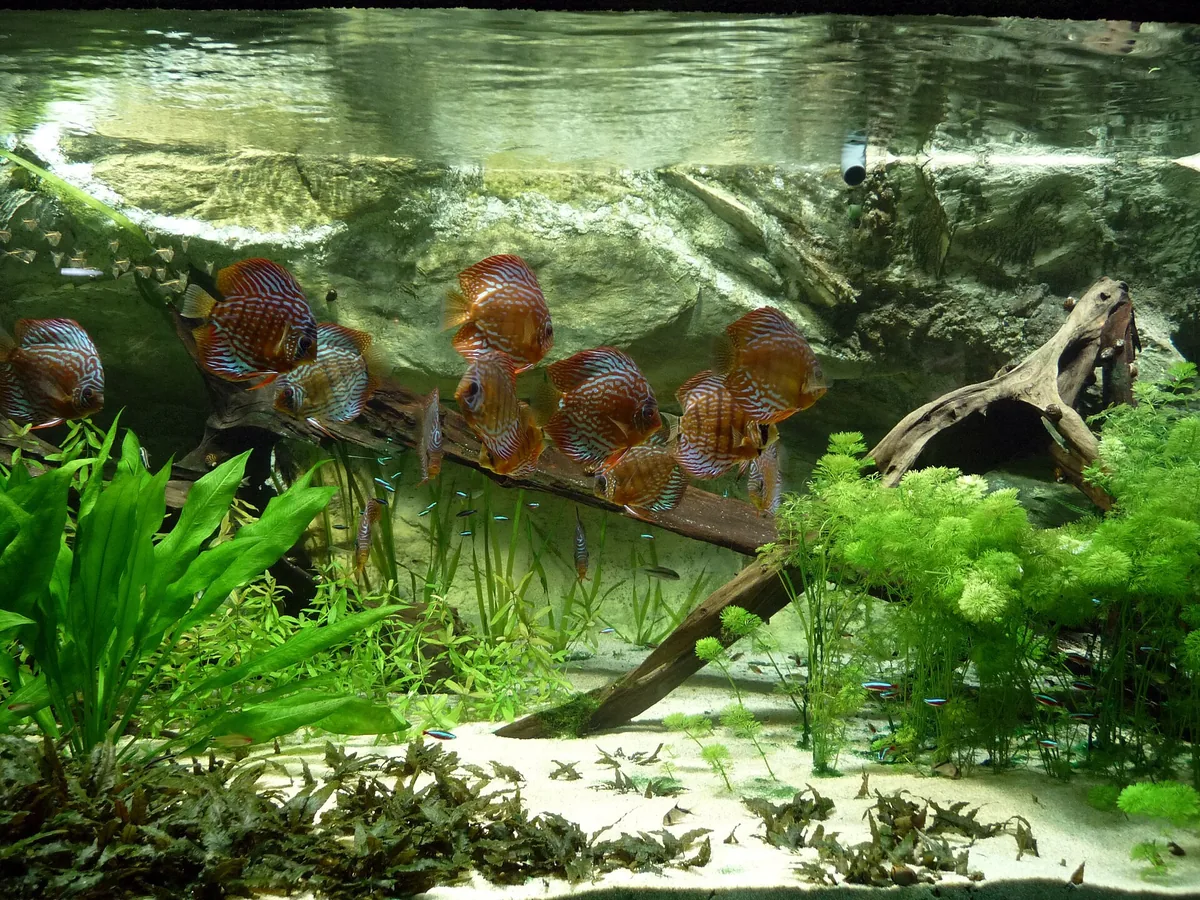
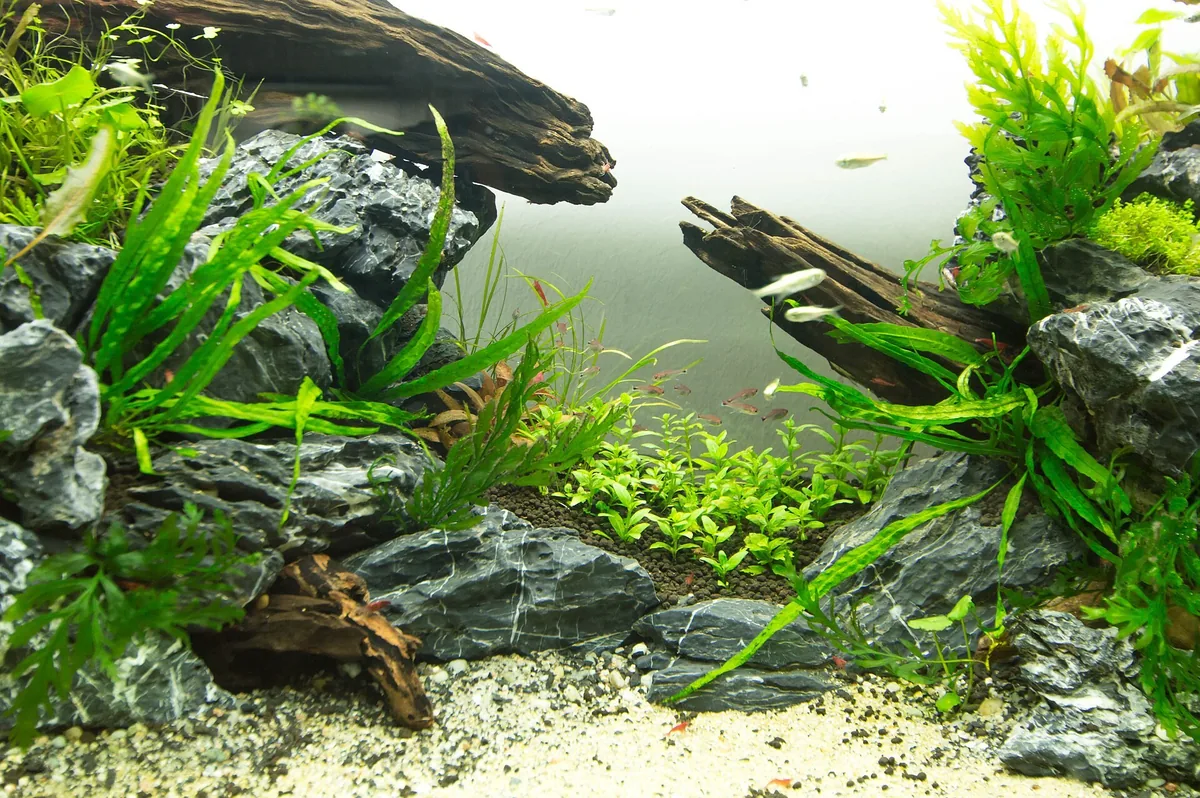
Photo credits: Discus in a planted aquarium: Citron (Wikimedia Commons, CC BY-SA 3.0); Planted aquarium with rocks and driftwood: Gergely Hideg (Wikimedia Commons, CC BY 2.0); Large goldfish aquarium in front of a window: Yue WU (Unsplash, Unsplash License); Ranchu goldfish: Bach Vu (Unsplash, Unsplash License); Betta fish in a small glass tank: Khoa Pham (Unsplash, Unsplash License); Planted aquarium with a school of small fish: Akash Banerjee (Unsplash, Unsplash License); Saltwater reef aquarium with corals and fish: Marina Martum (Unsplash, Unsplash License).