Table of Contents
- TLDR
- Why Equatorial Guinea’s native animals split into three worlds
- Primates
- Big mammals and cats
- Birds
- Reptiles, amphibians and sea turtles
- The endemics: animals found nowhere else
- Conservation status at a glance
- Where to see the animals
- What threatens them
TLDR
Equatorial Guinea’s native animals include roughly 185 mammal species and more than 400 birds. The headline names are the western lowland gorilla, chimpanzee, forest elephant, drill, leopard and African golden cat. The mainland (Río Muni) holds the big forest mammals. The islands of Bioko and Annobón hold the species you can’t find anywhere else, including the Bioko red colobus, Bioko Allen’s bushbaby, Annobón Scops Owl and Annobón White-eye.
Why Equatorial Guinea’s native animals split into three worlds
The country is three different habitats wearing one flag.
Río Muni is the mainland slab between Cameroon and Gabon, covered in Congo Basin rainforest. It has the gorillas, elephants and leopards you’d expect from central Africa.
Bioko sits about 32 km off the Cameroon coast. It was joined to the mainland during the last ice age, until rising seas cut it off roughly 10,000 years ago. Its animals started as mainland populations, then drifted apart. That’s why so many Bioko species are endemic subspecies or close relatives of mainland animals, and why the island has a mountain (Pico Basilé, 3,011 m) with its own cool-forest wildlife.
Annobón is the outlier. It’s a volcanic speck of about 17 square kilometers far out in the Gulf of Guinea, and it was never connected to anything. Whatever lives there arrived by wing or raft. Birds did best, and a few of them evolved into species that exist nowhere else.
Primates
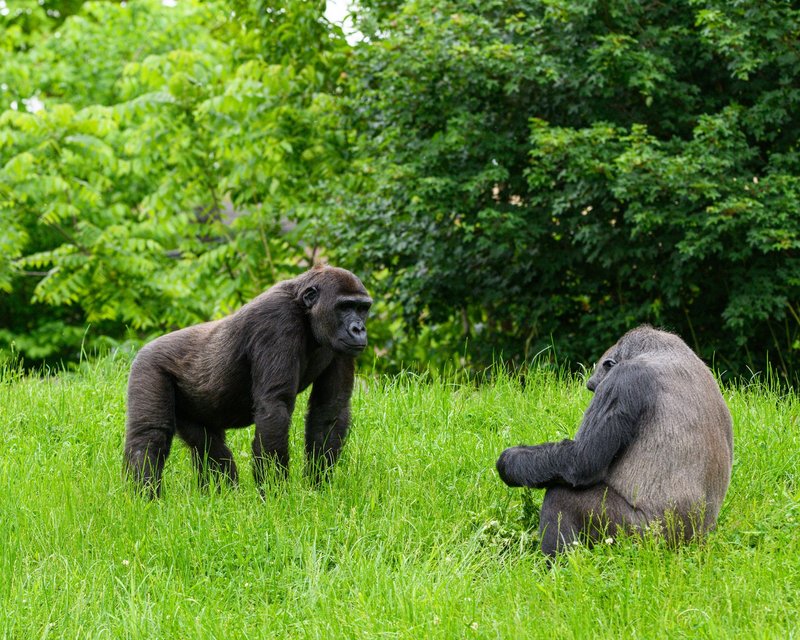
Equatorial Guinea is a primate country. Bioko alone supports 11 primate species on an island smaller than Connecticut, and Río Muni adds the great apes.
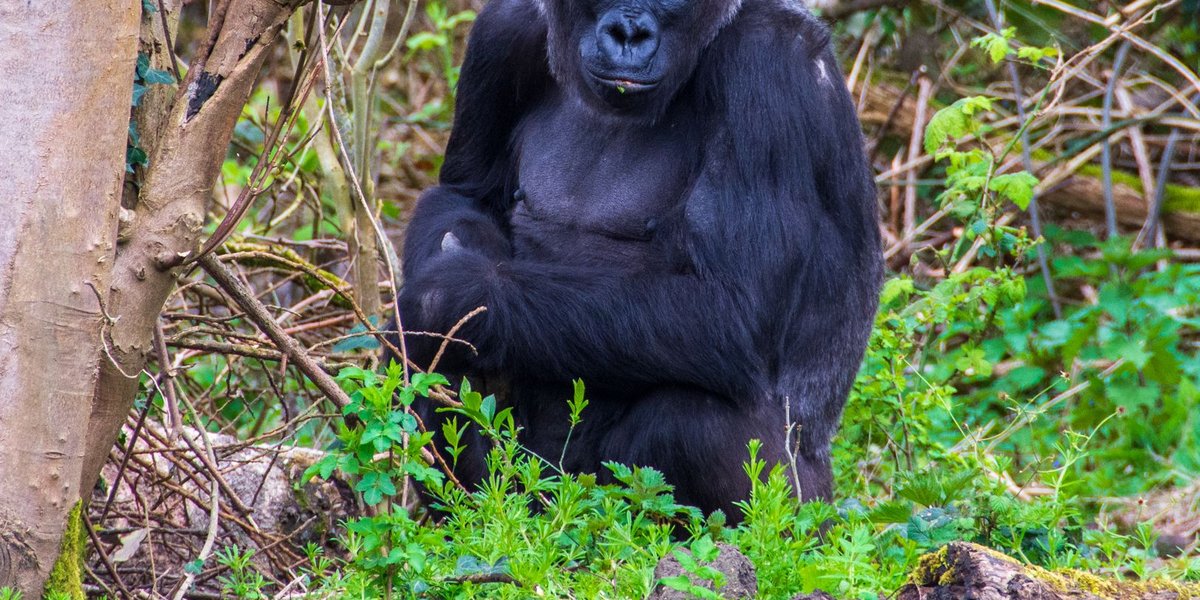
Western lowland gorilla. The largest primate in the country lives in Río Muni’s interior forest, including Monte Alén. Groups follow a silverback and eat mostly fruit and herbs, which is why gorillas are dependable seed dispersers. Critically Endangered.
Chimpanzee. The central chimpanzee shares the mainland forest with gorillas. It’s the species that cracks nuts and fishes for termites with prepared sticks. Endangered.
Mandrill. The one with the painted face. Mandrills move through Río Muni in large troops that can number in the hundreds, foraging on the forest floor. Vulnerable.
Drill. The mandrill’s plainer cousin has a black face and a red lower lip. The Bioko drill population is a distinct subspecies, and drills are often called Africa’s most endangered primate. Endangered.
Preuss’s monkey. A dark guenon with a white throat and a Bioko subspecies of its own. It sticks to high-altitude forest, so Bioko’s mountains are its last stronghold. Endangered.
Bioko red colobus. A leaf-eating monkey with a rust-red crown, found only on Bioko. More on it in the endemics section below.
Bushbabies. The nocturnal primates are easy to miss because you hear them before you see them. Bioko has several, including its own Allen’s bushbaby.
Big mammals and cats
African forest elephant. Smaller than the savanna elephant, with straighter, downward-pointing tusks. Forest elephants build the forest: they eat fruit whole and spread seeds across kilometers. In 2021 the IUCN reclassified the forest elephant as Critically Endangered after finding its population had fallen by more than 86 percent over 31 years. Río Muni’s forests are part of what’s left.
Leopard. The top predator on the mainland. It hunts at night, takes everything from duikers to monkeys, and is rarely seen. Vulnerable.
African golden cat. A medium-sized forest cat that ranges from reddish brown to slate grey, and one of the least-studied cats in the world. Camera traps catch it far more often than people do. Vulnerable.
Hippopotamus. Hippos live in Río Muni’s slow rivers and estuaries. Vulnerable.
Pangolins. The giant, white-bellied and black-bellied pangolins all occur in the mainland forests. These scaly, ant-eating mammals are also some of the most heavily hunted animals in the region.
Forest antelope. Several duiker species fill the understory. They’re the main prey for leopards and the main target of hunters.
Birds
The country’s checklist runs past 400 species. Most are central African forest birds, but two stand out.
Grey parrot. The famously talkative bird still lives wild in Río Muni’s forest, where it gathers in noisy flocks at dusk. Wild populations have collapsed across Africa because of the pet trade. Endangered.
Grey-necked picathartes (rockfowl). A bald-headed, bounding bird that builds mud nests on cave walls and overhanging boulders. Birders travel across continents to see it. Vulnerable.
Bioko adds highland birds found in few other places, and Annobón adds its own set, covered next.
Reptiles, amphibians and sea turtles
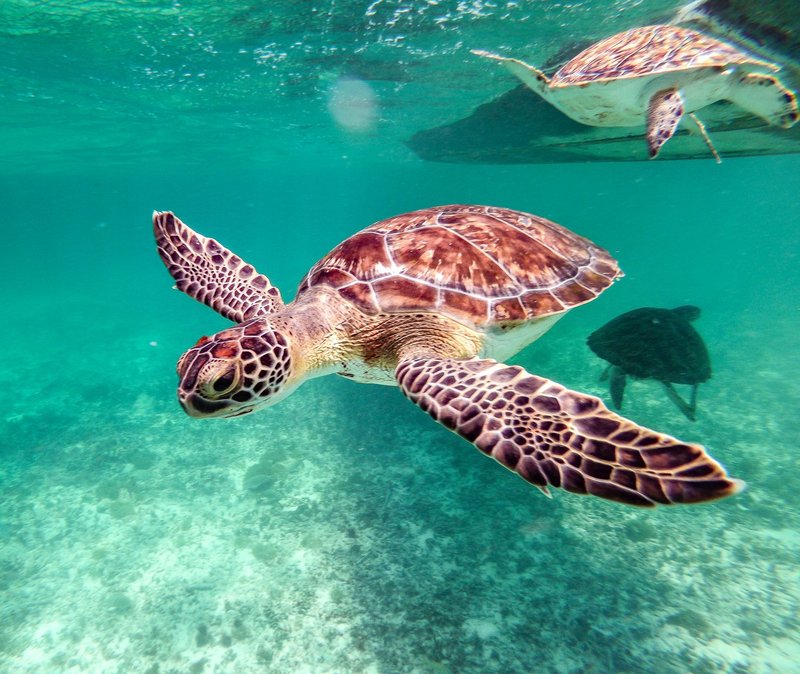
The mainland has crocodiles, vipers, pythons and a long list of frogs. Bioko’s wet forests are especially rich in amphibians and chameleons.
The coast matters just as much. Four sea turtle species come ashore on Bioko’s southern beaches: leatherback, green, olive ridley and hawksbill. The leatherback is the largest sea turtle on Earth and is listed as Vulnerable and protected under US law. Nesting peaks roughly between October and February, and the beaches of the Gran Caldera de Luba area are among the most important in the region.
The endemics: animals found nowhere else
Endemics are the reason to read about Equatorial Guinea’s native animals instead of any other central African country’s. Almost all of them live on the islands, and the cause is isolation. A small, separated population evolves in its own direction without gene flow from the mainland.
Bioko red colobus. Lives only on Bioko, mostly in the southern forests. Troops stay high in the canopy and eat leaves. It’s hunted for bushmeat, and the population is small enough that losing a few troops matters.
Bioko Allen’s bushbaby. A tiny nocturnal primate that moves through the lower forest layers and spends the day hidden in tree holes and dense tangles.
Bioko Montane Chameleon. Lives in Bioko’s cool, cloud-wrapped highlands. A mountain endemic can’t walk to the next mountain, so its range is one island’s upper slopes.
Bioko Squeaker. A tiny frog of the leaf litter on Bioko. Squeakers are named for their calls, which sound like a rubber toy.
Annobón Scops Owl. A small owl known only from Annobón, where the entire population fits on about 17 square kilometers of island.
Annobón White-eye. A small, olive-green songbird found only on Annobón, one of several white-eye species that colonized remote islands in the Gulf of Guinea and evolved separately.
Several of Bioko’s monkeys are also endemic subspecies rather than full species, including the Bioko drill and the island forms of Preuss’s monkey and the red-eared guenon.
Conservation status at a glance
| Animal | Where | IUCN status |
|---|---|---|
| Western lowland gorilla | Río Muni | Critically Endangered |
| African forest elephant | Río Muni | Critically Endangered |
| Chimpanzee | Río Muni | Endangered |
| Drill | Bioko | Endangered |
| Preuss’s monkey | Bioko highlands | Endangered |
| Grey parrot | Río Muni | Endangered |
| Mandrill | Río Muni | Vulnerable |
| Leopard | Río Muni | Vulnerable |
| African golden cat | Río Muni | Vulnerable |
| Hippopotamus | Río Muni | Vulnerable |
| Grey-necked picathartes | Río Muni | Vulnerable |
| Leatherback turtle | Bioko beaches | Vulnerable |
Status comes from the IUCN Red List, which revises assessments regularly, so check it before citing a status in schoolwork or research.
Where to see the animals
Monte Alén National Park (Río Muni). The best place on the mainland. It covers roughly 2,000 square kilometers of rainforest and shelters gorillas, chimpanzees, elephants, mandrills and picathartes. You won’t see most of them on a day walk. Plan on a guide, several days and patience.
Pico Basilé (Bioko). The volcano rising behind Malabo. The cooler upper forest is where you look for montane birds, the montane chameleon and highland monkeys.
Southern Bioko beaches. Between roughly October and February, turtles nest here at night. Conservation teams monitor the beaches, so ask local programs about visiting rather than turning up alone with a torch.
Annobón. Reaching it is a logistics project of its own, so most people will meet the Annobón Scops Owl and White-eye in books rather than binoculars.
What threatens them
Bushmeat hunting is the biggest threat. Monkeys, duikers and pangolins end up in markets in Malabo and Bata, and slow-breeding animals like gorillas and drills can’t absorb the loss.
Logging comes second. Roads cut into a forest give hunters access to areas that used to be remote, so the damage goes beyond the trees removed.
On islands, small ranges multiply the risk. A species that lives on 17 square kilometers has one landslide, one fire or one introduced predator between it and extinction. Annobón’s endemics are small populations with nowhere to go, and Bioko’s mountain species are squeezed from below by hunting and from above by the summit.