TLDR
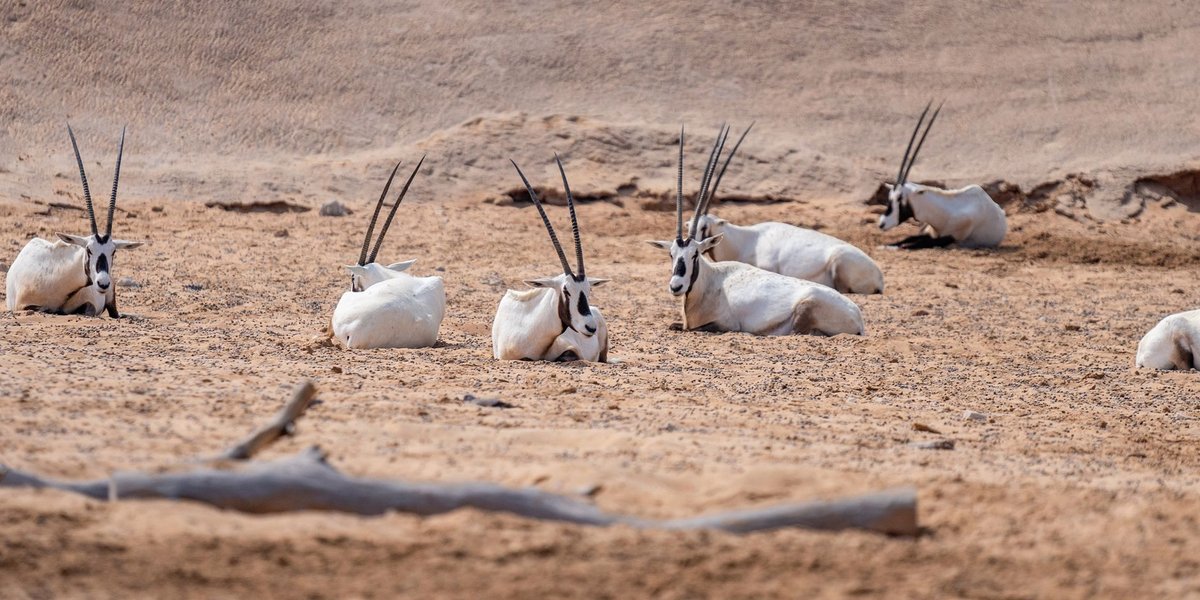
- National animal: the Arabian oryx, a white antelope with long straight horns that was extinct in the wild by 1972 and is now back, rated Vulnerable by the IUCN.
- Biggest surprise: Qatar’s land is mostly flat limestone desert, but its sea is the richer half. Whale sharks, dugongs, hawksbill turtles and dolphins all use Qatari waters.
- Best time to look: October to March for flamingos and migrating birds, March to June for nesting turtles, May to September for whale sharks.
- Only real hazards: horned vipers, saw-scaled vipers and fat-tailed scorpions. All of them avoid you if you give them room.
Table of contents
- Desert mammals
- Reptiles and snakes
- Birds and falcons
- Marine life of the Arabian Gulf
- Quick reference table
- Staying safe around snakes and scorpions
- Where and when to see animals of Qatar
Most lists of animals of Qatar give you a flat run of species with a stock photo each. This one is sorted by habitat, because that’s how you’ll actually meet them: oryx on gravel plains, geckos under rocks, flamingos on mudflats, turtles on one specific beach for a few weeks a year. Each entry has its IUCN status and, where it matters, a note on timing.
Desert mammals
Qatar is a thumb of land poking into the Gulf, roughly 160 km long, with almost no surface water. The mammals that live here have worked out how to get through summer heat above 45°C without drinking much at all.
Arabian oryx (Oryx leucoryx)
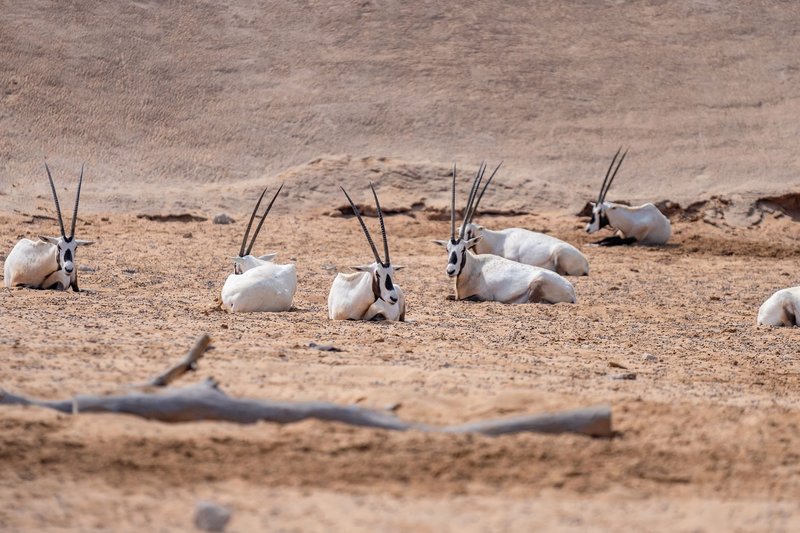
The national animal, and the poster child for conservation success in the region. Hunting wiped out the last wild oryx in Arabia in 1972. Captive herds kept alive in zoos and private collections supplied the animals for reintroduction programs that began in Oman in 1982, and the species has since been rebuilt in several Gulf countries, Qatar included. The IUCN moved it from Endangered to Vulnerable in 2011, one of the few times a species has been downlisted that far after being declared extinct in the wild. You can check current assessments on the IUCN Red List.
An oryx is pale cream with dark leg markings and two near-straight horns that can reach a metre. It can go long stretches without drinking, drawing moisture from desert plants and morning dew. In profile, the horns line up and look like a single horn, which is probably where the unicorn stories came from.
Sand gazelle, or rheem (Gazella marica)
Locals call it the rheem, and the Al Reem Biosphere Reserve on the northwest coast is named after it. It’s smaller and more delicate than the oryx, sandy-coloured with a pale belly and slim, ringed horns. It grazes at dawn and dusk, shelters under desert trees such as acacia in the midday heat, and bolts at the sound of an engine. The IUCN lists it as Vulnerable. Don’t expect to walk up to one: the best views come from a respectful distance with binoculars.
The small and nocturnal
Most of Qatar’s mammals only come out after dark, which is why people assume the desert is empty.
- Sand cat (Felis margarita). A small, broad-faced cat with furred paws that keep it on top of loose sand. Rarely seen. Least Concern, but almost nobody has a photo.
- Red fox and Rüppell’s fox. The red fox is the one you’ll most likely catch in headlights near farms and outskirts. Rüppell’s fox is paler and has a white-tipped tail.
- Honey badger (ratel). Stocky and fearless, and tough enough to raid beehives. It’s scarce here but present.
- Cape hare and lesser jerboa. The hare lives in open ground, and the jerboa is a hopping, long-tailed rodent that uses burrows to stay out of the heat.
- Dromedary camel. Not wild in Qatar, but the animal that shaped the country’s history. Camels roam desert farms and race on purpose-built tracks.
Reptiles and snakes
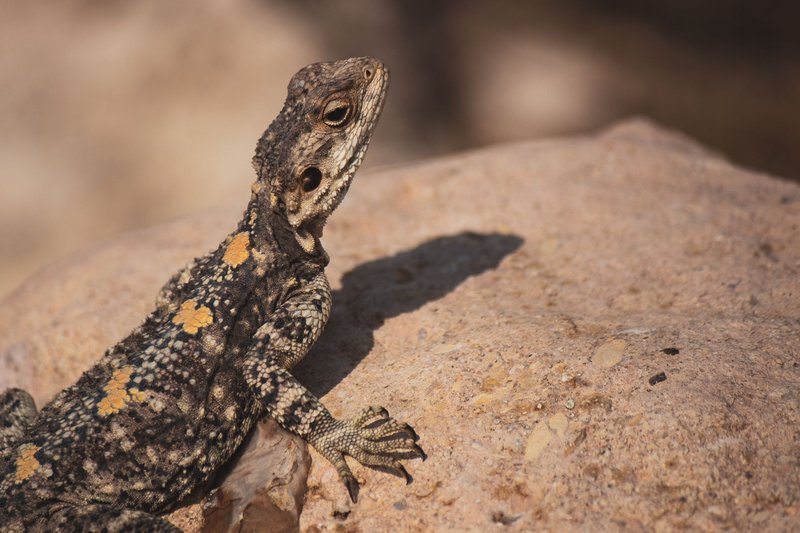
Reptiles are the part of Qatari wildlife most visitors underestimate. The lizards and snakes thrive in the heat, and they’re easy to find if you know where to look: rocky ground, shrubby wadis and the edges of sabkha (salt flats). Bahrain, a short hop across the water, shares many of these desert reptiles, and the complete list of reptiles of Bahrain catalogs them.
Spiny-tailed lizard, or dhab (Uromastyx aegyptia)
A heavy, tan lizard up to about 70 cm with a thick, spiked tail it uses to plug its burrow entrance. Dhab is the Arabic name, and the animal appears in traditional desert lore. It feeds almost entirely on plants, which sets it apart from most desert lizards. The IUCN rates it Vulnerable, mainly because of habitat loss and collection.
Desert monitor (Varanus griseus)
Long, slim and quick, with a forked tongue that flicks constantly. It hunts other lizards, rodents and eggs. If you see one, it’s probably running away from you. Least Concern.
Horned viper (Cerastes gasperettii)
The Arabian horned viper has two small hornlike scales above its eyes and buries itself in sand with only the eyes showing. It moves with a sideways, looping motion. Its venom is medically significant, but bites are rare and almost always happen when someone steps on it or reaches for it.
Saw-scaled viper (Echis carinatus)
Smaller and more irritable. When threatened it rubs its scales together to make a rasping sound. It’s active mostly at night.
Sand boa (Eryx jayakari)
A harmless burrowing snake that spends most of its life underground. Mentioned here because people often mistake it for something dangerous.
Geckos are everywhere, including on the walls of Doha buildings. They aren’t a hazard, and they keep the insects down.
Birds and falcons
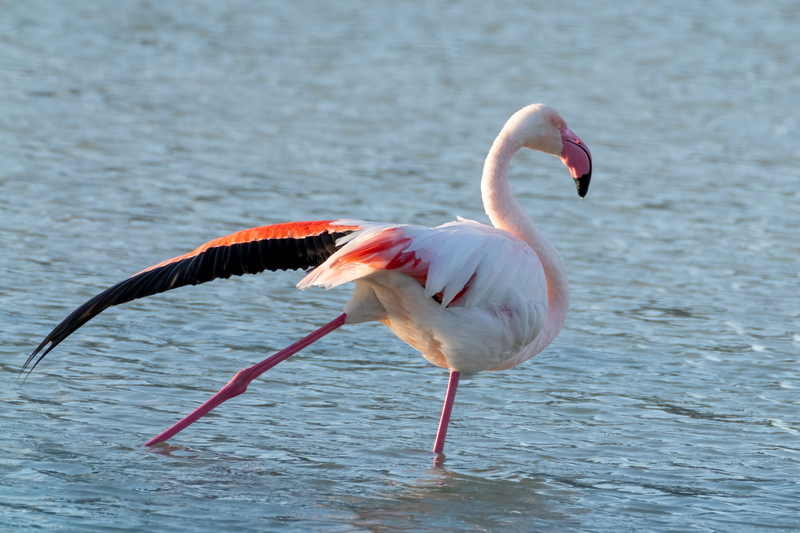
Qatar sits on a major flyway between Europe, Asia and Africa. Over the year the checklist of birds is longer than the checklist of every other animal group put together, mostly because of migration. The best birding is October to March.
Saker falcon (Falco cherrug)
The falcon is a cultural emblem, and falconry is still practised as a heritage sport. The saker is the most prized of the hunting falcons. In the wild it’s Endangered (IUCN), and the trade in captive-bred birds is regulated. You can see falcons at close range at the Falcon Souq in Souq Waqif in Doha, and the nearby Falcon Hospital treats them.
Houbara bustard (Chlamydotis macqueenii)
A large, sandy bird that relies on camouflage rather than flight. It’s the traditional quarry of falconers across the Arabian Peninsula, and wild populations have fallen a long way. The IUCN lists it as Vulnerable. Breeding and release programs now operate across the Gulf.
Greater flamingo (Phoenicopterus roseus)
Flamingos gather on tidal mudflats and shallow lagoons around Al Khor, where the water is rich in brine shrimp and algae that give the birds their colour. Peak numbers arrive in winter. The IUCN rates it Least Concern, but the Qatari flocks are among the easiest big-bird sightings in the country.
Other birds to watch for
- Osprey. Fishing along the coast, especially in winter.
- Crab-plover. A black-and-white wader that nests in burrows and feeds on crabs at low tide.
- Herons and egrets. Common in the mangroves at Al Khor and Al Thakira.
- Passerine migrants. Spring and autumn bring warblers, wheatears and shrikes that stop over in even the smallest patches of greenery. Parks in Doha become good birding sites for a few weeks.
Marine life of the Arabian Gulf
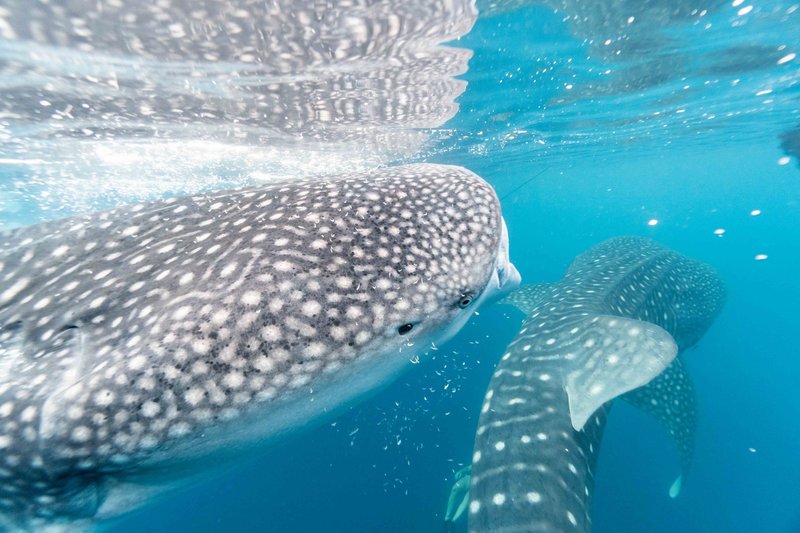
The Gulf is shallow, warm and very salty, and its animals tolerate summer water temperatures that would kill most marine life elsewhere. Qatar’s coast has seagrass meadows, coral patches, mangroves and offshore gas fields, and the sea has a larger share of the country’s headline species than the land does.
Whale shark (Rhincodon typus)
The largest fish in the world. Qatar’s waters host a seasonal aggregation, mainly offshore of the north coast from roughly May to September, when sharks gather to feed on fish eggs and plankton. According to National Geographic, adult whale sharks measure up to about 10 metres and feed mostly on plankton and small fish. The IUCN lists the species as Endangered. Trips to see them are offshore and depend on conditions, so book through a licensed operator.
Dugong (Dugong dugon)
The Arabian Gulf holds the second-largest dugong population in the world, behind northern Australia. Dugongs are grey, slow marine mammals related to manatees that graze on seagrass beds in shallow water. The National Geographic profile of the dugong puts their weight at up to 1,100 pounds and their lifespan at around 70 years. They’re rated Vulnerable. Seagrass loss, boat strikes and fishing nets are the main threats, and sightings are most likely in calm, shallow bays on the west and north coasts.
Hawksbill turtle (Eretmochelys imbricata)
Hawksbills nest on a small number of Qatari beaches, with Fuwairit on the northeast coast and the islands off Ras Laffan the best known. Females come ashore at night between about March and June. Hatchlings emerge in early summer. Per National Geographic, the species is Critically Endangered, hunted historically for its shell and still hit by bycatch and reef decline. Fuwairit is protected and has restrictions during nesting season, so check the rules before you go and never use flash or lights near a nesting turtle.
Dolphins
The Indian Ocean humpback dolphin (Endangered) lives in coastal shallows. The Indo-Pacific bottlenose dolphin is also present, along with spinner dolphins further offshore. Boat trips from Doha and the north coast sometimes catch pods.
Hamour and the fish people eat
The orange-spotted grouper, called hamour in Qatar, is the fish on most menus, and it’s heavily fished. Its status is Least Concern globally, but local stocks have drawn regulatory attention for years. Spangled emperor (shaari) is the other local favorite.
Mangroves
Mangrove stands at Al Khor and Al Thakira are the nurseries of the coast. Grey mangroves (Avicennia marina) shelter juvenile fish, crabs and mudskippers, and they’re where you’ll find roosting herons. A kayak tour is the easiest way in.
Quick reference table
| Species | IUCN status | Best place to see | When |
|---|---|---|---|
| Arabian oryx | Vulnerable | Protected desert reserves, Zekreet area | Year-round (early morning) |
| Sand gazelle (rheem) | Vulnerable | Al Reem Biosphere Reserve (restricted) | Dawn and dusk |
| Sand cat | Least Concern | Remote desert (rarely seen) | Night |
| Spiny-tailed lizard (dhab) | Vulnerable | Rocky desert ground | Spring to autumn, mornings |
| Desert monitor | Least Concern | Open sandy plains | Warm months |
| Arabian horned viper | Least Concern | Sand dunes, desert scrub | Night (avoid) |
| Saker falcon | Endangered | Falcon Souq, Souq Waqif, Doha | Year-round (captive) |
| Houbara bustard | Vulnerable | Desert plains | Winter |
| Greater flamingo | Least Concern | Al Khor, Al Thakira | October to March |
| Whale shark | Endangered | Offshore north (boat trip) | May to September |
| Dugong | Vulnerable | Shallow seagrass bays | Calm days, year-round |
| Hawksbill turtle | Critically Endangered | Fuwairit, Ras Laffan area | March to June |
| Indian Ocean humpback dolphin | Endangered | Coastal shallows | Year-round |
| Orange-spotted grouper (hamour) | Least Concern | Reefs, markets | Year-round |
Staying safe around snakes and scorpions
Qatar has no animal that hunts people, and venomous snakebites are rare. The real risk is surprising something at night or on rocky ground.
- Wear closed shoes and long trousers when walking off-road.
- Shake out shoes and bedding if you camp.
- Use a torch after dark. Most snakes and scorpions are nocturnal.
- Don’t lift rocks or reach into crevices with a bare hand.
- Leave snakes alone. Most bites involve someone trying to catch, kill or photograph one.
- Scorpions: the fat-tailed scorpion (Androctonus crassicauda) is the one to respect. A sting is painful, and it can be dangerous to children or people with health problems.
- Camel spiders look fierce and are not venomous in the way their reputation suggests. They aren’t a threat.
If anyone is bitten or stung, keep them still, note the time, and get to a hospital. Don’t cut the wound or apply a tourniquet.
Where and when to see animals of Qatar
A few practical points that most competing guides skip:
- Go early. In summer, desert animals are only active around dawn and after sunset.
- Respect the reserves. Several of the best sites, including Al Reem, are protected and restrict access. Check permits first.
- Time the seasons. Flamingos in winter, turtles in spring, whale sharks in summer.
- Binoculars matter more than a long lens. Most animals keep their distance, and the ones that don’t shouldn’t be approached.
- Don’t buy wildlife. Falcons, houbara and reptiles are regulated. Anyone selling them casually probably isn’t doing it legally.
Qatar’s wildlife is smaller in volume than that of its neighbors with mountains or rivers, but it’s concentrated and distinctive. An oryx at sunrise, flamingos in a lagoon and a hawksbill nesting under the stars make the case for the animals of Qatar better than any species count.