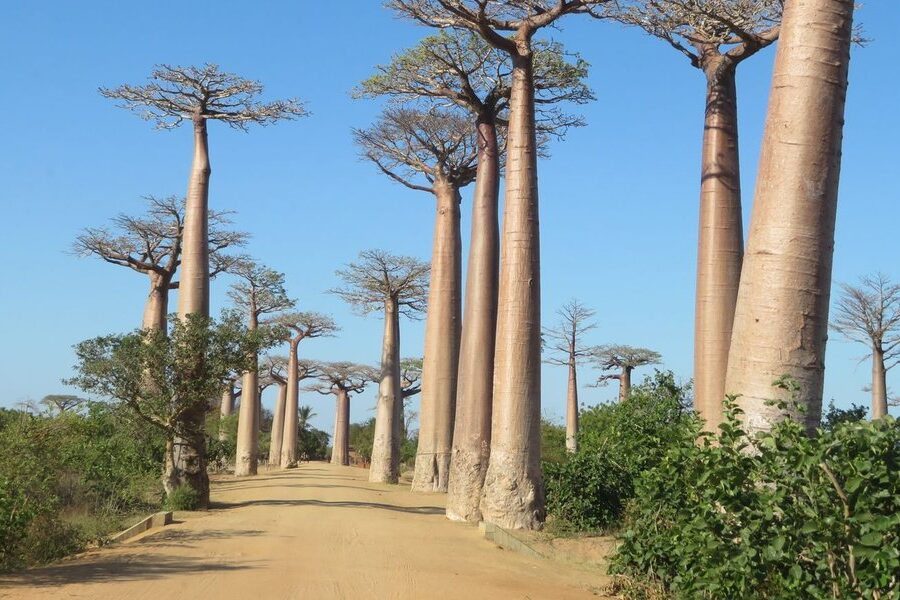
Senegal has somewhere between 1,500 and 2,500 plant species, and which number you get depends on who you ask. Academic checklists built on Jean Berhaut’s Flore du Sénégal and later surveys land near 2,500 vascular species. Online plant databases list closer to 1,500. The gap comes from synonyms, uneven survey coverage and whether cultivated and introduced plants count.
Either way, the pattern is simple. Rain controls everything. Move from the northern border to the southern one and you pass from thorn scrub to open woodland to something close to rainforest, all within a country smaller than South Dakota. This guide follows that gradient north to south, with the species that define each zone and what people do with them.
Contents
- Why rainfall sets the map
- The Sahel and Ferlo steppe
- The Niayes coast
- Sudanian wooded savanna
- The baobab
- The Sudan-Guinea belt and Niokolo-Koba
- Humid Casamance
- Mangroves of the Saloum and Casamance
- Species by zone at a glance
- Protected areas
- Threats
- Summary
Why rainfall sets the map
Senegal has one rainy season, roughly June to October. What changes is how much falls.
| City | Zone | Average annual rainfall |
|---|---|---|
| Saint-Louis | Far north, Sahel | about 300 mm |
| Dakar | Coast, Cape Verde peninsula | about 500 mm |
| Tambacounda | East-central, Sudanian | about 800 mm |
| Ziguinchor | Southwest, Casamance | about 1,500 mm |
That is a fivefold difference over roughly 500 kilometers. The vegetation zones are bands that follow those rainfall lines, running east to west and stacking up from north to south. The big exception is water itself: rivers, estuaries and tidal flats create their own plant communities regardless of the band they cut through.
The Sahel and Ferlo steppe
The north, including the Senegal River valley and the vast Ferlo plain, is the Sahel. Grass dominates, and it is annual grass that germinates with the first rains and dries to straw by November. Trees are scattered and thorny, and 20 Senegal plant species and where to find them shows where many of the common ones grow.
Species to know:
- Vachellia tortilis subsp. raddiana (umbrella thorn). Flat-topped, long-spined, and the signature tree of the Ferlo. Livestock eat the pods.
- Senegalia senegal (gum acacia). Source of gum arabic. Saint-Louis was a hub of the European gum trade in the 1700s and 1800s, and “Senegal gum” was a trade name for the product. Today it is also planted in the Great Green Wall restoration effort across the Sahel.
- Balanites aegyptiaca (desert date). Drought-proof, with a fruit that has a sticky sweet pulp. The seed oil and bark have long been used in traditional medicine.
- Cenchrus biflorus (cram-cram). The grass whose burrs end up in your socks. It is also the main dry-season fodder grass for Ferlo herders. Bring boots.
- Ziziphus mauritiana (jujube). A thorny shrub with small apple-flavored fruits sold at roadside stalls.
Pastoralist Fulani communities live by this vegetation. Herds follow the new grass in the rainy season and retreat to boreholes in the dry months, and the tree cover is lopped for browse. The Sahel flora is built to survive being eaten, burned and parched, and it still does, but only up to a limit.
The Niayes coast
A narrow strip of coast between Dakar and Saint-Louis gets its own mention. The Niayes are depressions between old sand dunes where the water table sits close to the surface. Wild oil palms (Elaeis guineensis), normally a southern species, survive here as relics of a wetter climate, hundreds of kilometers from the humid south. Market gardeners now grow much of Dakar’s vegetables in these hollows. Along the dunes, planted rows of Casuarina equisetifolia act as windbreaks to hold the sand.
Sudanian wooded savanna
South of the Ferlo, with rainfall climbing past 600 mm, the grass gets taller and the trees get denser. This is Sudanian savanna, and it covers a large share of central and eastern Senegal. In the dry season the whole landscape turns tan, then flushes green within weeks of the first storms. The same layout of continuous grass with scattered trees appears across the continent, and African savanna flora: trees, grasses and survival tricks explains how these plants cope with it.
Species to know:
- Combretum glutinosum and Guiera senegalensis. The workhorse shrubs and small trees of the savanna. Guiera, called nguer in Wolof, is used for coughs, fever and stomach complaints.
- Combretum micranthum (kinkeliba). Its leaves make a bitter tea drunk across Senegal, often at breakfast and as a traditional remedy for digestion and fever.
- Parkia biglobosa (néré, African locust bean). The seeds are fermented into a pungent condiment known in Senegal as netetou, which flavors sauces.
- Tamarindus indica (tamarind). Called daxaar in Wolof, it supplies the tart pulp for the country’s best-known sweet-sour juice.
- Faidherbia albida (kad). An oddball: it drops its leaves in the rainy season and grows them in the dry season, the reverse of nearly every other tree. Farmers in the groundnut basin leave it standing in their fields because the leaf fall feeds the soil under crops, and the dry-season foliage feeds livestock.
The peanut basin, centered on Diourbel and Kaolack, has converted much of this zone to farmland. What remains is a patchwork of fields with scattered “parkland” trees that farmers chose to keep.
The baobab
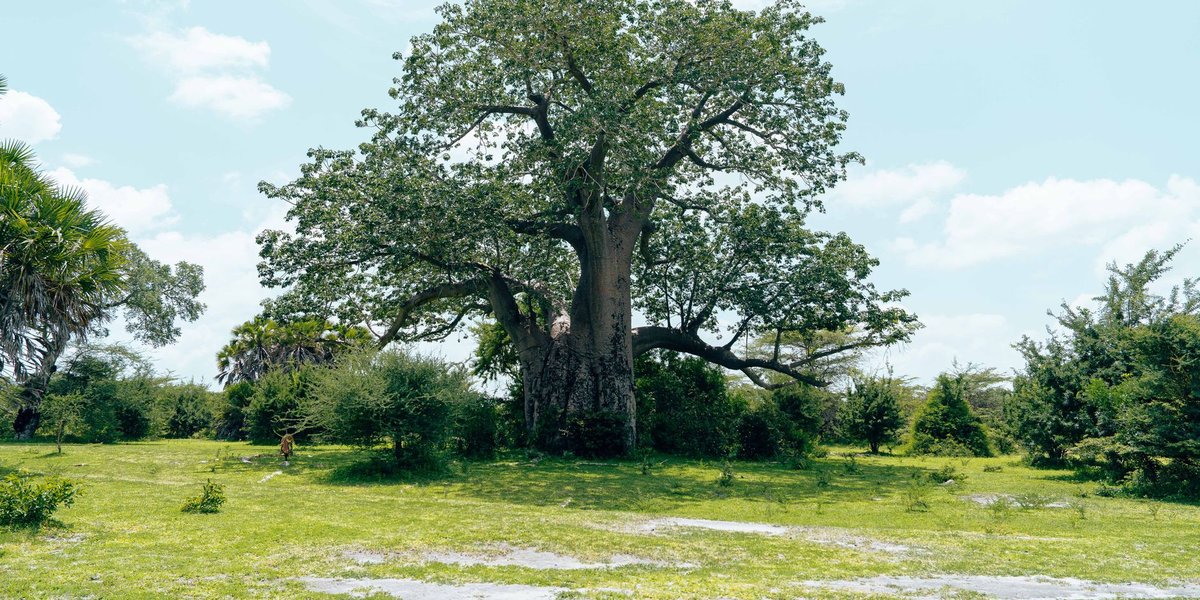
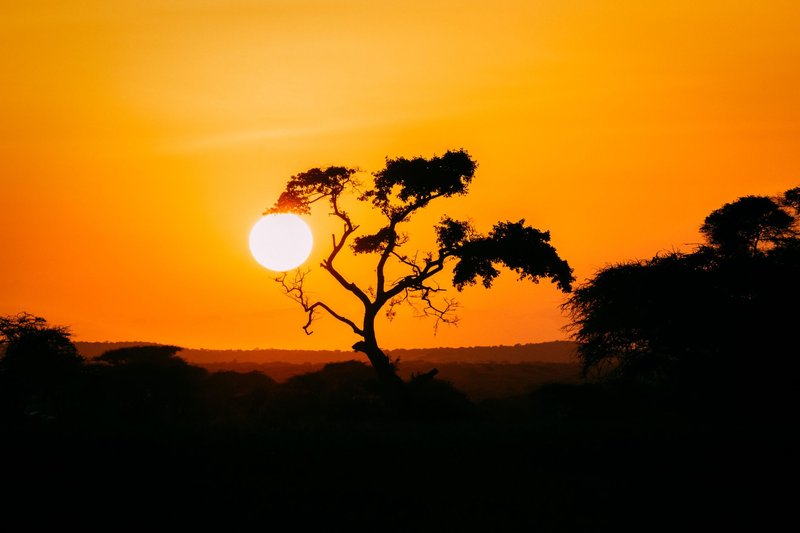
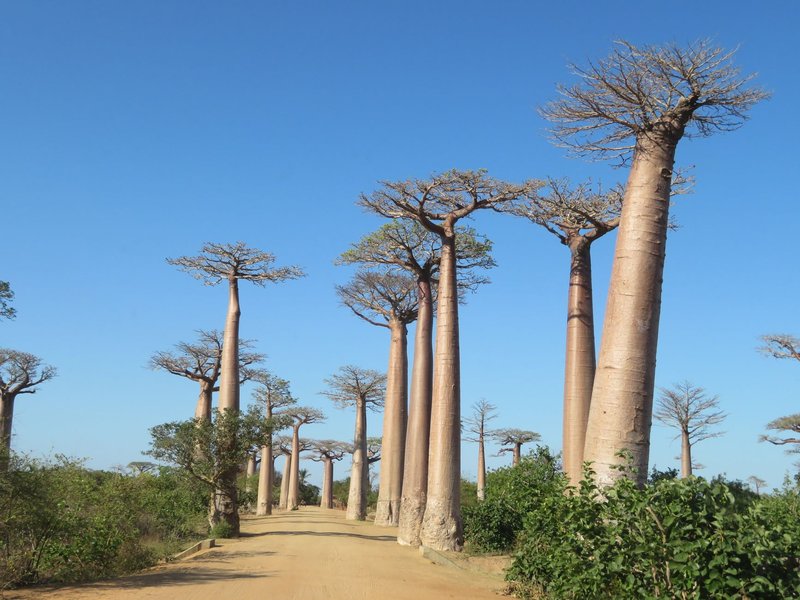
Adansonia digitata gets its own section because it earns it. The baobab is on Senegal’s coat of arms, and you can spot one from a long way off: a barrel trunk, stubby branches that resemble roots, and no leaves for most of the dry season.
It grows across the Sahel and Sudanian zones, and you will see the most in the Sudanian belt, in the Saloum region and around the Bandia reserve near Dakar. A big trunk stores thousands of liters of water in spongy wood, which is why the tree survives dry seasons that kill its neighbors.
Almost every part is used:
- Leaves are dried and ground into lalo, a powder that thickens sauces.
- Fruit pulp is mixed with water and sugar into bouye, a tangy, creamy juice sold in plastic bags across Dakar.
- Bark fiber is twisted into rope.
- Hollow trunks have historically served as burial chambers for griots, the West African hereditary poets and musicians, who were traditionally denied ground burial.
Old baobabs can be many centuries old, though dating them is hard because the trunks hollow out and lack clear growth rings.
The Sudan-Guinea belt and Niokolo-Koba
In the far southeast, rainfall tops 1,000 mm and the savanna thickens into dry forest, with evergreen gallery forest lining the rivers. This transition is called the Sudan-Guinea zone, and it is the botanical heartland of Niokolo-Koba National Park, a UNESCO World Heritage Site of roughly 913,000 hectares along the Gambia River.
Species to know:
- Pterocarpus erinaceus (African rosewood, venn). A hardwood and the most heavily poached tree in the country. More on that in the threats section.
- Khaya senegalensis (African mahogany, caïlcédrat). A big shade tree whose bark is a standard traditional remedy for fever and stomach ailments. It lines avenues in Dakar and Saint-Louis.
- Oxytenanthera abyssinica (savanna bamboo). Forms thick thickets in the southeast and is used for fencing and construction.
- Lophira lanceolata. A fire-resistant tree with corky bark, an adaptation to the annual burns that sweep this zone.
- Mitragyna inermis. A tree of seasonally flooded ground, common along streams and wet depressions.
- Borassus aethiopum (African fan palm, rônier). Tall, smooth-trunked and unmistakable. The wood is termite-resistant and prized for roofing beams.
Fire shapes this zone more than any other. Grass fires burn here every dry season, set by farmers, hunters and honey collectors. Species that survive are thick-barked, resprout from the base or both.
Humid Casamance
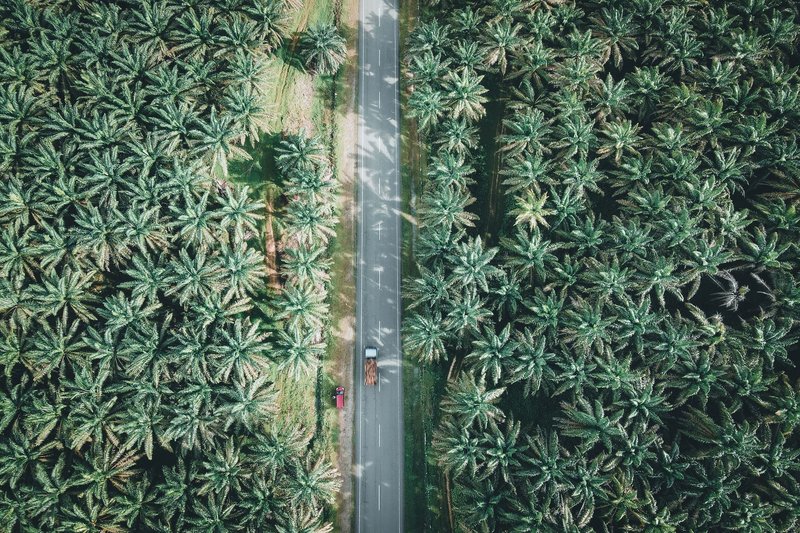
Below the Gambia, the Casamance region gets up to 1,500 mm of rain a year and holds the closest thing Senegal has to rainforest. Remnant patches of dense semi-deciduous forest survive, alongside oil palm groves, orchards and flooded rice fields.
Species to know:
- Elaeis guineensis (oil palm). Provides palm oil, and the sap is tapped for palm wine, a staple of village social life.
- Ceiba pentandra (kapok, silk-cotton tree). A towering buttressed tree that often marks village squares and sacred sites.
- Parinari excelsa. A large forest tree of the humid south, typical of the dense forests of the Basse Casamance.
- Oryza glaberrima and Oryza sativa (rice). The Diola people built dikes and channels to turn mangrove swamp into rice paddies, a system that took generations. The African species, O. glaberrima, is traditionally grown here alongside the Asian one.
- Anacardium occidentale (cashew). Introduced from Brazil, now one of the region’s main cash crops, often planted where forest and fallow used to stand.
Sacred forests are a quiet feature of southern Senegal. Villages protect some stands for initiation rites and burials, which has kept patches of forest standing that would otherwise have been cleared.
Mangroves of the Saloum and Casamance
Senegal’s coast has two major mangrove systems: the Saloum Delta in the center and the Casamance estuary in the south. They look similar from a boat but sit in very different climates, and the Saloum mangroves are some of the most salt-stressed in West Africa because the delta is an “inverse estuary,” saltier upstream than at the sea mouth.
The mangrove community consists of just a handful of species:
- Rhizophora racemosa and Rhizophora harrisonii. The red mangroves, with arching stilt roots. Women harvest oysters by hand from these roots at low tide and smoke them for sale.
- Avicennia germinans (black mangrove). Salt-tolerant, with pencil-like breathing roots poking from the mud. It colonizes the higher, saltier ground.
- Laguncularia racemosa (white mangrove). Found on the drier edges.
- Conocarpus erectus (button mangrove). A fringe species on the landward side.
- Sesuvium portulacastrum (sea purslane). Not a mangrove, but a low, fleshy succulent that colonizes the bare salt flats called tannes.
The Saloum Delta, a UNESCO World Heritage Site, protects one of the largest of these systems, with islands, tidal channels and ancient shell mounds that carry baobabs and palms.
Mangroves here took a beating during the long Sahel drought from the early 1970s onward, when rainfall fell and salinity rose. Large areas died. Since then, village groups have replanted Rhizophora propagules by hand, and surveys show mangrove cover recovering in parts of the Saloum and Casamance. Recovery varies by site, and the numbers depend on which satellite survey you read.
Species by zone at a glance
| Zone | Rainfall | Signature species | Typical use |
|---|---|---|---|
| Sahel and Ferlo | 200 to 500 mm | Vachellia tortilis, Senegalia senegal, Balanites aegyptiaca, Cenchrus biflorus | Fodder, gum arabic, medicine |
| Niayes coast | about 400 to 500 mm | Elaeis guineensis, Casuarina equisetifolia | Palm products, dune fixation |
| Sudanian savanna | 600 to 1,000 mm | Adansonia digitata, Combretum micranthum, Parkia biglobosa, Faidherbia albida | Food, tea, fodder |
| Sudan-Guinea belt | 1,000 to 1,200 mm | Pterocarpus erinaceus, Khaya senegalensis, Borassus aethiopum | Timber, medicine, construction |
| Humid Casamance | 1,200 to 1,600 mm | Elaeis guineensis, Ceiba pentandra, Parinari excelsa, rice | Oil, palm wine, food crops |
| Mangroves | varies | Rhizophora spp., Avicennia germinans | Oysters, fuelwood, fish nurseries |
Protected areas
Senegal protects a mix of national parks, reserves and wetland sites. The ones that matter most for plants:
- Niokolo-Koba National Park. The largest, with the country’s richest mix of Sudan-Guinea flora and gallery forest.
- Djoudj National Bird Sanctuary. In the Senegal River delta. It is a Sahel wetland of channels, reedbeds and tamarisk, best known for migratory birds, but the plants shape the habitat. Cattail (Typha australis) spread across much of it after the Diama dam changed the river’s salinity in the 1980s.
- Saloum Delta National Park. Part of the UNESCO-listed delta, centered on mangrove islands and salt flats.
- Basse Casamance National Park. A small park of roughly 5,000 hectares protecting some of the last dense forest in the south.
- Ferlo-Nord Special Faunal Reserve. Nearly half a million hectares of Sahel steppe, where researchers track how the vegetation recovers with grazing pressure.
Threats
Several pressures hit the flora of Senegal at once.
Drought and climate shift. The Sahel dried out from the late 1960s, and the vegetation bands shifted southward. Trees in the north died faster than they were replaced.
Illegal logging. Pterocarpus erinaceus is the clearest case. Demand from Asian furniture and instrument markets drove heavy cutting across West Africa, and CITES listed it in 2016 to regulate trade. Enforcement in the Casamance and the southeast remains patchy.
Bush fires. Annual burning keeps the Sudanian and Sudan-Guinea zones open, but fires set too early or too hot kill saplings and strip soil cover.
Charcoal and fuelwood. Charcoal for Dakar and other cities is cut mostly from savanna trees, and the harvest radius around cities keeps growing.
Mangrove loss and invasives. Mangroves face salinization, tree-cutting for fuel and conversion to rice or salt pans. Invasive plants such as Typha australis and mesquite (Prosopis juliflora) also crowd out native vegetation in the north.
Summary
The flora of Senegal is a rainfall gradient made visible: thorn acacias and cram-cram grass in the Sahel, baobabs and kinkeliba across the Sudanian savanna, fire-adapted woodland and gallery forest around Niokolo-Koba, oil palms and rice in the Casamance, and mangroves along the Saloum and Casamance estuaries. The total is 1,500 species or 2,500 depending on the source, and the useful way to learn them is by zone, because the zone tells you which plants to expect and why. If you only have time to meet one species, make it the baobab. If you have time to meet one place, make it the Saloum Delta, where tide, salt and trees run the show.