Twenty-one snake species live in the Great Dismal Swamp. Three of them can hurt you. That ratio is the single most useful thing to carry with you onto Washington Ditch or the boardwalk at Lake Drummond, and it’s the thing every “snake-infested swamp” listicle buries under breathless adjectives.
The Cottonmouth, Eastern Copperhead and Timber Rattlesnake are all in our snake identification quiz, along with the harmless watersnakes people confuse them with.
The straight-up botanic facts: the swamp straddles the Virginia–North Carolina line, covers more than 112,000 acres of refuge, and is exactly the warm, wet, prey-rich habitat snakes love. You will probably see one if you spend a few hours there in summer. Most of them want nothing to do with you, and knowing which is which turns a startle into a non-event.
Table of Contents
- The short version
- The three venomous snakes
- Cottonmouth vs. watersnake: the one that matters
- The non-venomous snakes you’ll actually meet
- Quick ID comparison table
- What to do if you see a snake
- When are snakes most active?
The short version {#the-short-version}
Of the 21 snake species recorded in the Great Dismal Swamp, only three are venomous: the cottonmouth (water moccasin), the copperhead, and the canebrake rattlesnake (the coastal form of the timber rattlesnake). All three are pit vipers. The other 18 are harmless to people, and the one you’ll see most often is the northern black racer.
So is the Great Dismal Swamp dangerous? Not really. There has not been a pattern of serious snakebite incidents at the refuge, and the venomous species here are reclusive by nature. The realistic risk is stepping near one you didn’t see, not being chased by one. Watch where you put your feet and hands, and you’ve handled 95% of the problem.
The three venomous snakes {#the-three-venomous-snakes}
All three venomous species in the swamp are pit vipers, which means they share a piece of hardware no other snake here has: a heat-sensing loreal pit, a small opening on each side of the face between the eye and the nostril. These pits detect infrared radiation, letting the snake “see” the body heat of a mouse in total darkness. You won’t be close enough to check for a loreal pit safely, and you shouldn’t try. It’s mentioned because it’s the anatomical reason these three hunt the way they do, ambushing warm prey at the water’s edge and along log lines.
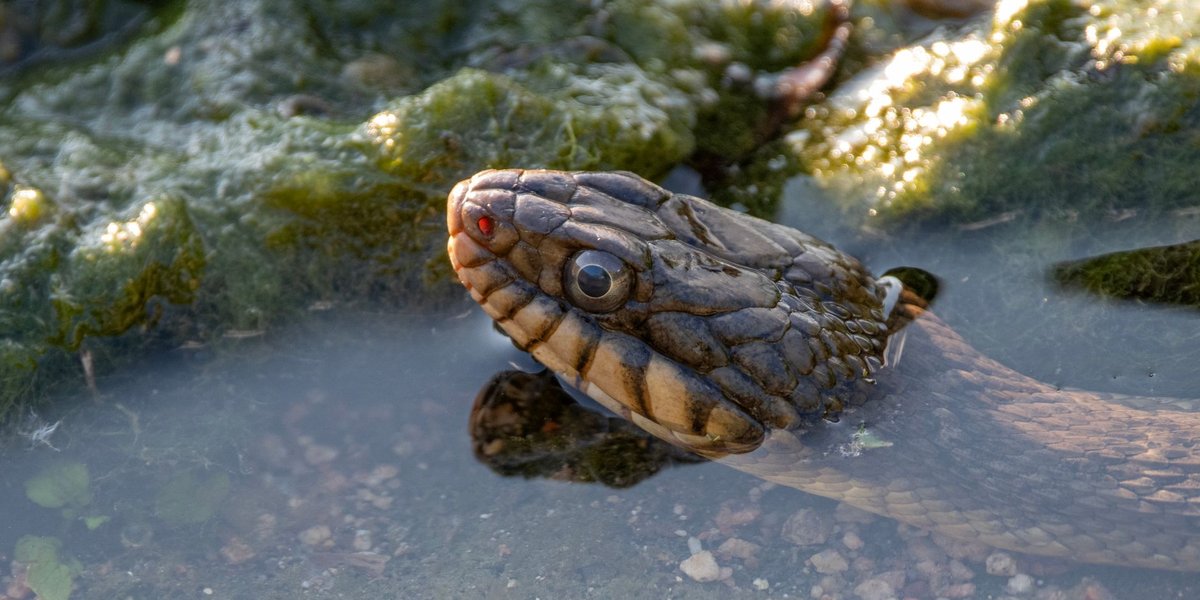
Cottonmouth (Agkistrodon piscivorus). The headliner. Cottonmouths are semi-aquatic, thick-bodied, and dark, often nearly black in older adults, which erases the banding you might expect. The name comes from the threat display: when cornered, it gapes its mouth wide to flash the startling white interior. That display is a warning, not an attack. A cottonmouth swims with its body riding high and buoyant on the surface, and it tends to hold its ground rather than flee, which is exactly why it gets misidentified onto every snake there is.
Copperhead (Agkistrodon contortrix). More of a forest-floor and brushy-edge snake than a water snake. Copperheads are tan to coppery with distinctive hourglass crossbands, narrow across the spine and wide on the flanks. They’re masters of leaf-litter camouflage, which is the whole danger: they freeze rather than flee, so the bites that happen usually come from a hand or foot placed too close. Copperhead venom is the mildest of the three, and dry or defensive bites are common, but it’s still a medical emergency.
Canebrake / timber rattlesnake (Crotalus horridus). The coastal-plain population of the timber rattlesnake is called the canebrake, and it’s a state-listed species of concern in Virginia. It’s the largest of the three, with a pinkish-gray to tan base, dark chevron crossbands, and often a rusty stripe down the spine. And it rattles, the one unmistakable audio cue in the whole swamp. A canebrake is shy and slow to rattle compared to western rattlers, so don’t count on a courtesy warning. If you hear one, you stop, locate it, and back away.
Cottonmouth vs. watersnake: the one that matters {#cottonmouth-vs-watersnake}
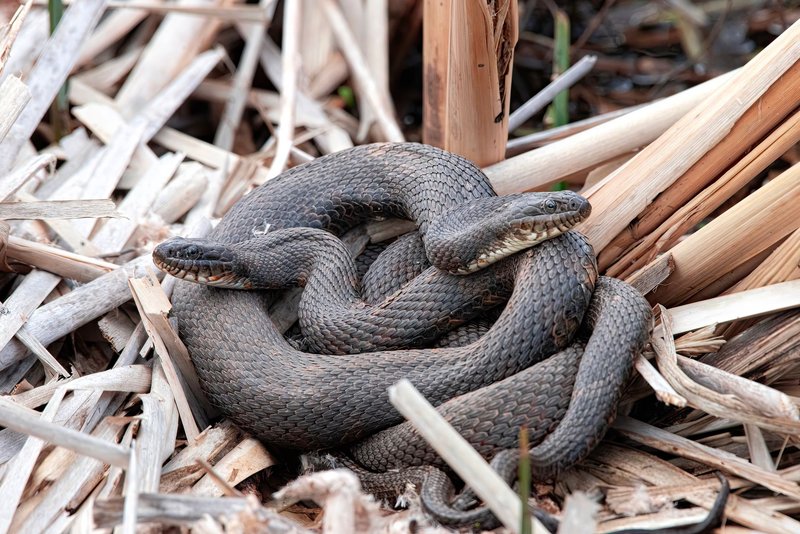
This is the single most useful ID skill for the Great Dismal Swamp, because nearly every “I saw a cottonmouth” report is actually a harmless watersnake. The swamp has three Nerodia watersnakes (northern, brown, and red-bellied), all non-venomous, all common, and all routinely killed on sight by people who think they’re moccasins.
Here’s how to tell them apart from a safe distance:
- Head shape. Cottonmouths have a blocky, triangular head noticeably wider than the neck, with a heavy “angry” brow ridge over the eye. Watersnakes have a slimmer head that flows into the body. (Note: a frightened watersnake can flatten its head to fake the triangle, so don’t rely on this alone.)
- Swimming posture. Cottonmouths float high, body visibly buoyant on the surface. Watersnakes swim low, with mostly just the head and a sliver of back showing.
- Behavior. A cottonmouth gapes to show the white mouth and often stands its ground. A watersnake’s go-to move is to flee fast into the water or drop off a branch with a splash.
- Pupils and pits. Cottonmouths have vertical, cat-like pupils and a loreal pit; watersnakes have round pupils and no pit. True, but only useful in a photo, never in the field.
The honest takeaway: you don’t need a perfect ID. If you can’t tell, treat it as venomous, give it six feet of clearance, and move on. The University of Florida’s wildlife extension has side-by-side photos worth studying before a trip.
The non-venomous snakes you’ll actually meet {#the-non-venomous-snakes}
These are the 18 species that make up the overwhelming majority of swamp snakes. None of them is a threat to you.
- Northern black racer — the most commonly seen snake in the refuge. Long, slender, satiny black with a white chin, and fast. Racers are nervous and bolt the instant they spot you, so most sightings are a black ribbon vanishing into the brush.
- Northern, brown, and red-bellied watersnakes (Nerodia) — the three water snakes covered above. Heavy-bodied, blotched or banded, and constantly mistaken for cottonmouths.
- Eastern ratsnake — a big climber, often found up in trees and around old buildings hunting rodents and birds. Glossy black as an adult, sometimes over five feet.
- Eastern hognose — the swamp’s drama queen. When threatened it flattens its neck like a cobra, hisses, and if that flops, rolls onto its back and plays dead with its tongue lolling out. All bluff, no bite.
- Rainbow snake — a stunning, secretive eel-eater with iridescent blue-black skin striped in red. Rarely seen because it spends most of its life burrowed near water.
- Eastern kingsnake — the one that eats other snakes, including venomous ones, thanks to partial immunity to their venom. Black with thin chain-link yellow bands.
- Eastern wormsnake — tiny, glossy, brown, and earthworm-like. It lives in soil and leaf litter and is completely harmless.
That’s the core of it, with several smaller species (garter, ringneck, and others) rounding out the count. The pattern holds: lots of snakes, almost none worth worrying about.
Quick ID comparison table {#quick-id-comparison-table}
| Snake | Venomous? | Quick ID | Where you’ll see it |
|---|---|---|---|
| Cottonmouth | Yes | Blocky head, dark body, floats high, gapes white mouth | Water’s edge, logs |
| Copperhead | Yes | Tan with hourglass crossbands, leaf-litter camo | Forest floor, brushy edges |
| Canebrake rattlesnake | Yes | Tan-gray, dark chevrons, rusty spine stripe, rattle | Drier woods, cane thickets |
| Northern black racer | No | Slender, satiny black, white chin, very fast | Everywhere; most common |
| Nerodia watersnakes | No | Heavy-bodied, banded/blotched, swim low | In and around water |
| Eastern ratsnake | No | Large, glossy black, climbs | Trees, old structures |
| Eastern hognose | No | Upturned snout, plays dead | Sandy, drier ground |
What to do if you see a snake {#what-to-do-if-you-see-a-snake}
Stop moving. Most bites happen because someone keeps walking and steps closer, or reaches toward a snake to move it or photograph it. Freezing for two seconds to locate the snake is the highest-value thing you can do.
Then back away and go around. Give it at least six feet, more if you can. A snake on the trail is sunning or crossing; it’ll move on, and so should you. Never try to handle, kill, or relocate it. The refuge’s snakes are protected wildlife, and most bites to humans happen during exactly those interactions.
If you’re bitten by a venomous snake, the CDC’s guidance is clear: stay calm, keep the bitten limb still and below heart level, remove rings and watches before swelling starts, and get to a hospital immediately. Do not cut the wound, do not try to suck out venom, do not apply ice or a tourniquet, and do not waste time catching the snake. A description or a phone photo from a safe distance is plenty for the ER. Antivenom works, and the outcomes for treated bites are very good.
For your feet: closed shoes or boots on the trails, and watch your step over and around logs, which are prime ambush spots. Keep dogs leashed, because curious dogs nose into exactly the places snakes hide.
When are snakes most active? {#when-are-snakes-most-active}
Snakes are ectotherms, so their schedule runs on temperature. In the Great Dismal Swamp that means peak activity from roughly April through October, with the highest visibility in the warm months of summer. On very hot midsummer days they shift to dawn, dusk, and night to dodge the heat, so a humid July evening on the boardwalk is prime snake o’clock.
In the cooler months they brumate, the reptile version of dormancy, tucked into burrows, stumps, and root tangles, and you’re far less likely to cross paths with one. Spring is a transitional window: snakes emerging from brumation bask in open, sunny spots to warm up, which puts them on trail edges and atop logs right where hikers walk.
None of this should keep you out of one of the most striking wild places on the East Coast. Twenty-one snake species is a sign of a swamp that’s working, a food web intact enough to support that many predators. You just walk it the way you’d walk any wild place: eyes on the ground, hands out of holes, and a little respect for the three out of twenty-one that have earned it.