Step on a fallen log in a tropical rainforest and you’ll likely disturb both of these animals within the same square meter — and they could not be doing more different jobs. A centipede living under that bark is a predator, venom-loaded and ready to kill. A millipede a few centimeters away is a decomposer, quietly turning last year’s leaf fall into the soil that feeds next year’s canopy. Get the two confused and you’ll misjudge which one might actually hurt you.
The fastest way to tell them apart: count the legs per body segment. One pair means centipede, predator, flattened body built for speed. Two pairs means millipede, detritivore, cylindrical body built for burrowing through litter. Everything else about how these animals live in the rainforest — how they defend themselves, what they eat, how long they live — flows from that one structural difference.
Table of Contents
- The Real Difference: One Pair of Legs vs Two
- How They Fight Back: Venom vs Chemical Warfare
- Rainforest Recyclers: Why Millipedes Do More Than They Look
- Meet the Record Holders: Borneo, Africa, and the Amazon
- Are They Dangerous to Touch?
- Deforestation Is Quietly Emptying the Leaf Litter
- Two Body Plans, One Rainforest
The Real Difference: One Pair of Legs vs Two
Both belong to the myriapod group — “many-legged” arthropods — but they split off into opposite lifestyles millions of years ago. Centipedes (class Chilopoda) hunt. Millipedes (class Diplopoda, literally “double foot”) eat dead plant matter. That’s the whole story in miniature, and it explains the anatomy.
| Trait | Centipede | Millipede |
|---|---|---|
| Legs per body segment | 1 pair | 2 pairs |
| Body shape | Flattened, fast | Cylindrical, built to push through litter |
| Diet | Carnivore — insects, frogs, small vertebrates | Detritivore — dead leaves, decaying wood |
| Primary defense | Venomous forcipules (front fangs) | Curling up, chemical secretions |
| Movement | Fast, darting | Slow, deliberate |
| Rainforest role | Predator, controls invertebrate populations | Decomposer, recycles nutrients into soil |
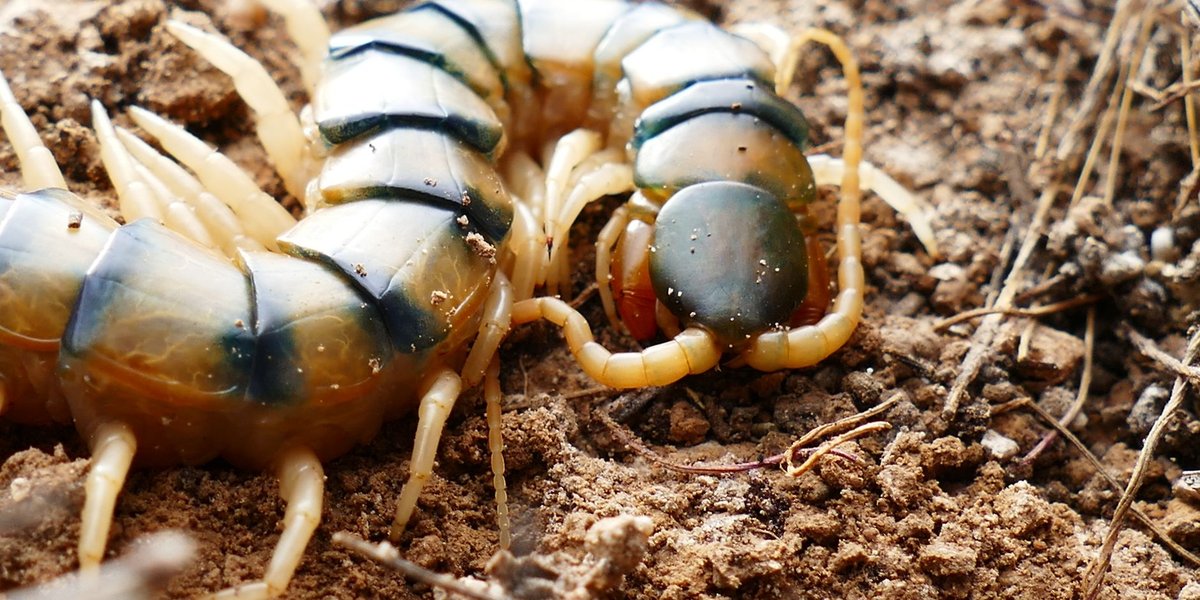
The forcipules are the tell if you get a close look — they’re the modified first pair of legs on a centipede, curved under the head like a pair of fangs, and they’re the only body part that delivers venom. These features are just part of what makes centipedes so distinctive — explore the 10 characteristics that define them. Millipedes have nothing equivalent. They don’t bite, because they have nothing to bite with that matters to a human.
How They Fight Back: Venom vs Chemical Warfare
A hunting centipede needs its venom to work fast, because a struggling meal can do damage. The forcipules pierce prey and inject a cocktail that typically includes serotonin, cytolysins, and compounds that break down cell membranes — enough to drop something many times the centipede’s own body weight. That same venom is what makes a defensive bite from a large rainforest species genuinely painful to a person, even though it’s rarely dangerous to a healthy adult.
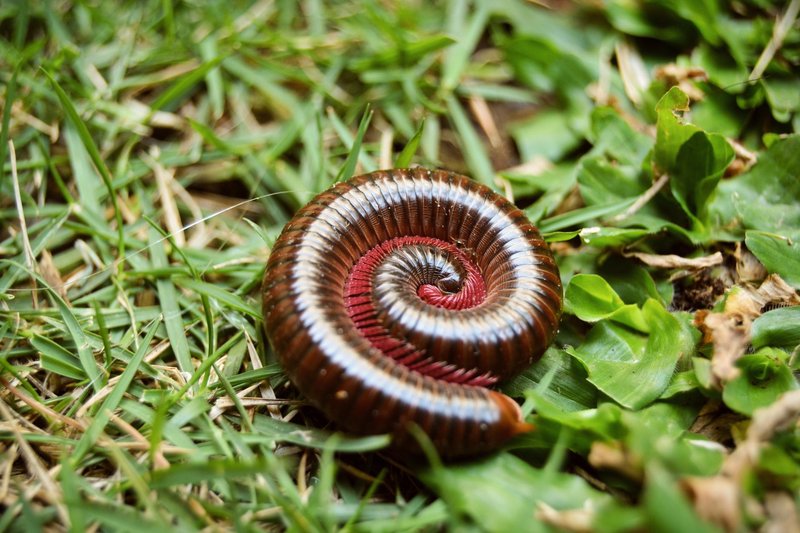
Millipedes skip venom entirely and go chemical instead. Most species have rows of small glands called ozadenes running along their sides, opening through pores called ozopores. When threatened, they secrete a mix of alkaloids, quinones, phenols, and in some species genuinely toxic cyanide-based compounds — foul-tasting or outright poisonous to a bird or lizard, but not something a millipede injects into you. Pair that with curling into a tight spiral, protected coils outward, soft belly tucked in, and most predators move on to easier prey.
The asymmetry is the point. A centipede’s defense is also its hunting weapon — same forcipules, same venom, dual purpose. A millipede’s defense is purely passive. It doesn’t need to be fast or aggressive; it just needs to taste bad and be hard to unroll.
Rainforest Recyclers: Why Millipedes Do More Than They Look
Walk past a fallen log covered in millipedes and it’s easy to write them off as background texture. They’re not. Tropical rainforests generate enormous volumes of leaf litter year-round, and something has to break it down before the nutrients locked inside it are useful to anything else. Millipedes are among the primary shredders doing that work, physically consuming and fragmenting dead leaf material so that fungi and bacteria can finish the job faster than they could on intact leaves alone.
That fragmentation matters more than it sounds. A whole leaf on the forest floor decomposes slowly; a leaf that’s been chewed, gut-processed, and excreted as smaller particles with a different microbial community attached breaks down considerably faster. In some tropical forest studies, millipede activity explains more of the variation in litter decomposition rate than soil microbial biomass does — the animals aren’t just along for the ride, they’re setting the pace.
Centipedes don’t do this work. As predators, their ecological contribution runs the other direction: keeping populations of insects, spiders, and other invertebrates in check. Between the two groups, a healthy patch of rainforest floor gets both nutrient cycling and population control running at the same time, from animals most visitors step over without a second look.
Meet the Record Holders: Borneo, Africa, and the Amazon
Species vary enormously by region, and the extremes are worth knowing.
Borneo hosts some of the densest myriapod diversity anywhere, with giant millipedes working the leaf litter of the lowland dipterocarp forest while equally outsized centipedes hunt through the same layer — recyclers and predators sharing real estate, each ignoring the other’s job.
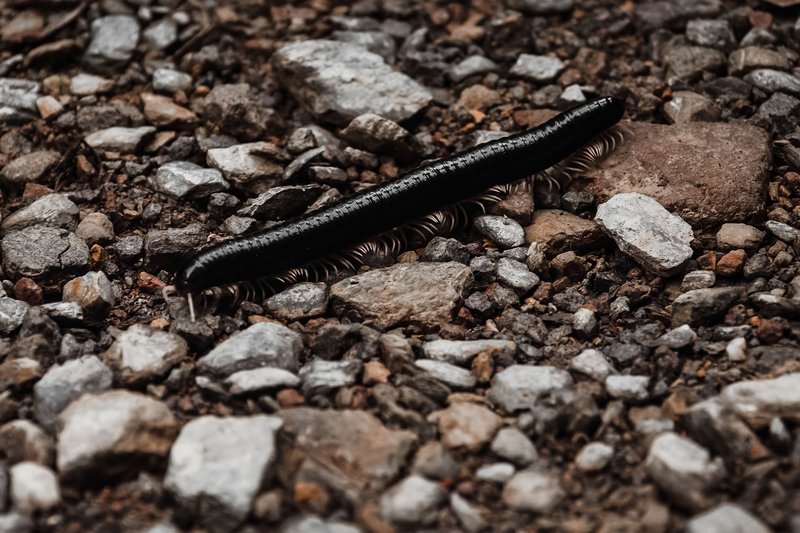
Africa’s giant millipede (Archispirostreptus gigas) is the largest millipede species alive, reaching up to 33.5 centimeters (about 13 inches) and carrying roughly 256 legs that can climb past 400 as the animal molts and adds segments. It lives 7 to 10 years — a long run for an invertebrate — grinding through leaf litter across lowland East Africa from Mozambique up to Kenya.
The Amazon’s giant centipede (Scolopendra gigantea) is the largest centipede on Earth, stretching 26 to 30 centimeters, and it’s the one that upends the assumption that centipedes only eat things smaller than themselves. Documented cave populations in Venezuela hang from ceilings by their rear legs and snatch bats out of the air, holding prey substantially heavier than their own body weight with the front legs while the venom does its work. It’s also known to take lizards, frogs, mice, and small birds — a menu that would be unremarkable for a snake and is startling for an arthropod.
Are They Dangerous to Touch?
For most rainforest species, no — with real caveats attached.
A millipede won’t bite. The worst-case scenario is skin or eye contact with its defensive secretion, which in sensitive individuals can cause localized irritation, blistering, or discoloration that takes days to fade. The fix is straightforward: wash the area with soap and water as soon as possible and avoid touching your eyes afterward. Clinical reviews of millipede exposure note that symptoms are almost always self-limiting and resolve without treatment.
Centipedes are the ones that can actually bite, and size matters. A small forest species delivers something comparable to a wasp sting. A large Scolopendra delivers considerably more — intense localized pain, swelling, and in rare documented cases, systemic symptoms in people with allergic sensitivity or in small children. Bites are essentially never fatal to a healthy adult, but they warrant the same response as a serious insect sting: clean the wound, apply cold compress for the pain, and seek medical attention if swelling spreads well beyond the bite site or breathing becomes difficult.
The practical rule for both: don’t handle either animal barehanded in the field, and if you’re turning over logs or leaf litter, use a stick first.
Deforestation Is Quietly Emptying the Leaf Litter
Both groups depend on the same thing: intact forest floor with deep, stable leaf litter and consistent canopy shade. Strip the canopy and the litter layer dries out fast — myriapods lose water quickly through their exoskeletons and can’t tolerate the temperature swings that come with open sunlight.
The research backs this up directly. Studies on millipede communities across forest-to-open-land gradients find that native, forest-specialist species are tied to a minimum litter-depth threshold — cross below it, through logging, land clearing, or fragmentation, and specialist millipedes disappear even if generalist species move in to replace them. Recovery isn’t quick either: forest that’s regrown after clearing often doesn’t fully recover its original myriapod community even decades later, because the litter structure and microclimate take that long to rebuild.
It’s a quiet kind of loss. Nobody notices a rainforest missing its millipedes the way they’d notice it missing its jaguars. But pull enough of the decomposer layer out of a tropical forest and the nutrient cycling that keeps the whole system running slows down with it.
Two Body Plans, One Rainforest
Centipedes and millipedes look like variations on the same theme from a distance — long, segmented, a lot of legs — and that’s exactly where the resemblance ends. One is a fast, venomous predator that can, in its largest form, pull bats out of the air. The other is a slow-moving recycling plant that keeps a rainforest’s nutrients in circulation. Both need the same thing to keep doing their jobs: an intact forest floor that isn’t losing its shade or its leaf litter to the edges creeping in from cleared land. Tell them apart by the legs, respect them for different reasons, and leave both where you found them.