Search for tropical land animals and you’ll get a wall of jaguars and sloths. That’s fair, but it’s half the story. The tropics also hold savannas, mangrove edges and dry forests, and some of the most distinctive land animals on Earth live there instead of in the rainforest canopy.
This guide sorts them by region, so you can see how the same latitude produces very different animals on different continents.
Table of contents
- What counts as a tropical land animal?
- Amazon Basin
- Congo Basin and Central Africa
- Southeast Asia
- Madagascar
- African savanna
- Australasia
- Quick comparison table
- How tropical land animals adapt
- Why so many are endangered
- FAQ
What counts as a tropical land animal?
“Tropical” means the band between the Tropic of Cancer and the Tropic of Capricorn, roughly 23.5 degrees either side of the equator. Temperatures stay warm all year, and the main seasonal change is wet versus dry rather than summer versus winter.
“Land animal” means a species that lives, feeds and breeds on land or in trees, as opposed to marine animals or animals that spend most of their lives in the air. Tree-dwellers count. So do semi-aquatic animals such as the capybara, which grazes on land and uses water to escape predators.
That definition covers far more than rainforest. This guide includes savanna and dry-forest species because they are tropical too.
Amazon Basin
The Amazon holds the largest rainforest on Earth and a huge share of the world’s species. Most of the animals below spend their lives within a few meters of the ground or within the first few levels of trees.
Jaguar (Panthera onca)
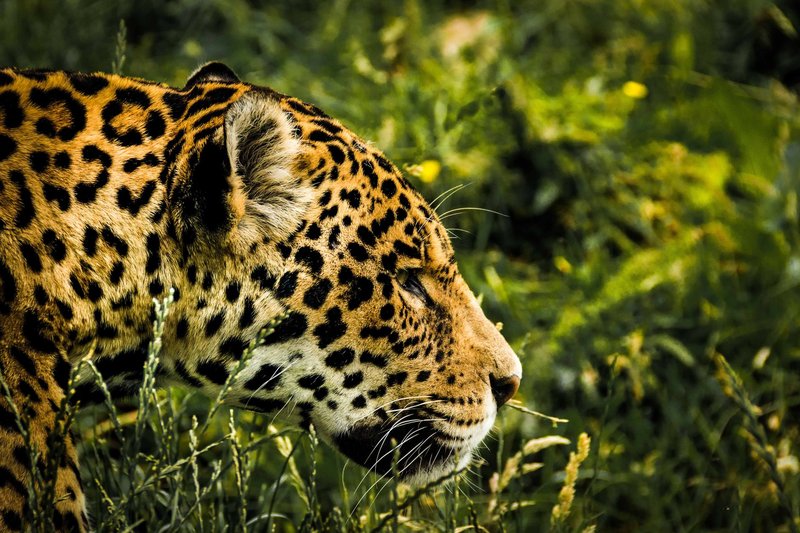
The jaguar is the largest cat in the Americas. Its bite is built for crushing: it often kills by biting through the skull, which lets it take on armored prey like caimans and turtles. It swims readily and hunts along riverbanks. Status: Near Threatened.
Three-toed sloth (Bradypus variegatus)
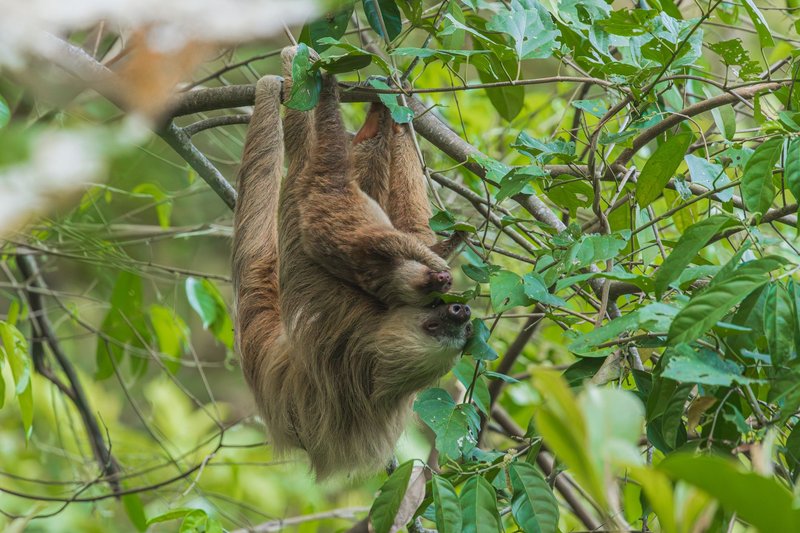
A sloth’s metabolism is so slow that it can take a week or more to digest a single meal. It climbs down from the canopy about once a week to defecate at the base of its tree, which is also when it’s most exposed to predators. Algae grow in its fur, giving it a green tint that helps it blend into the leaves. Status: Least Concern.
Capybara (Hydrochoerus hydrochaeris)
The capybara is the largest living rodent, reaching around 60 kg. It lives in groups near water across much of tropical South America, eats grasses and aquatic plants, and sleeps with its nostrils above the waterline when it has to. Status: Least Concern.
Giant anteater (Myrmecophaga tridactyla)
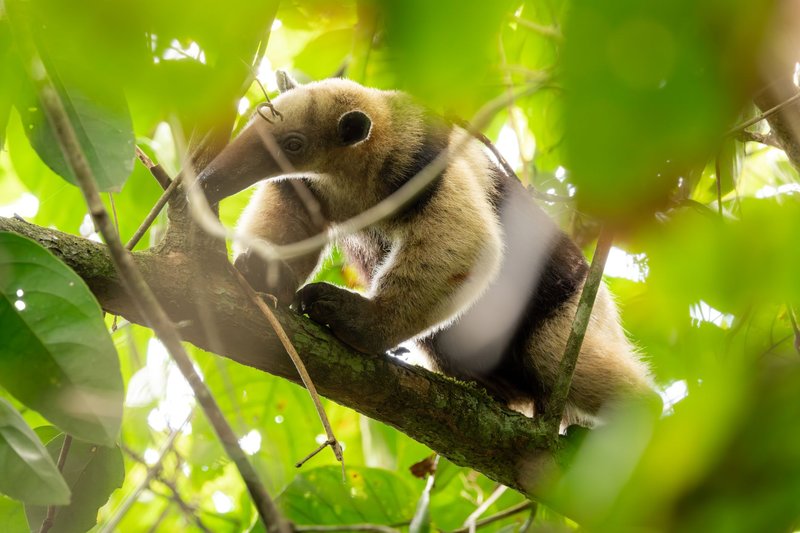
An anteater has no teeth. It uses a tongue that can extend more than half a meter, flicking in and out around 150 times a minute, to collect thousands of ants and termites a day. It lives in rainforest, savanna and wetland, which makes it a good example of an animal that doesn’t fit the “rainforest only” label. Status: Vulnerable.
Golden poison frog (Phyllobates terribilis)
This frog is about the size of a paperclip and carries enough toxin in its skin to be lethal to humans. The poison comes from its diet of small insects, and captive frogs raised on different food are far less toxic. It lives in a small patch of Pacific coast rainforest in Colombia. Status: Endangered.
Green anaconda (Eunectes murinus)
The heaviest snake in the world. Females can pass 5 meters and are much larger than males. It ambushes prey at the water’s edge and spends much of its time half-submerged in swamps and slow rivers. Status: Least Concern.
Congo Basin and Central Africa
The Congo Basin is the second-largest rainforest on the planet. Its animals tend to be big, social and under heavy pressure from hunting and logging.
Western lowland gorilla (Gorilla gorilla gorilla)
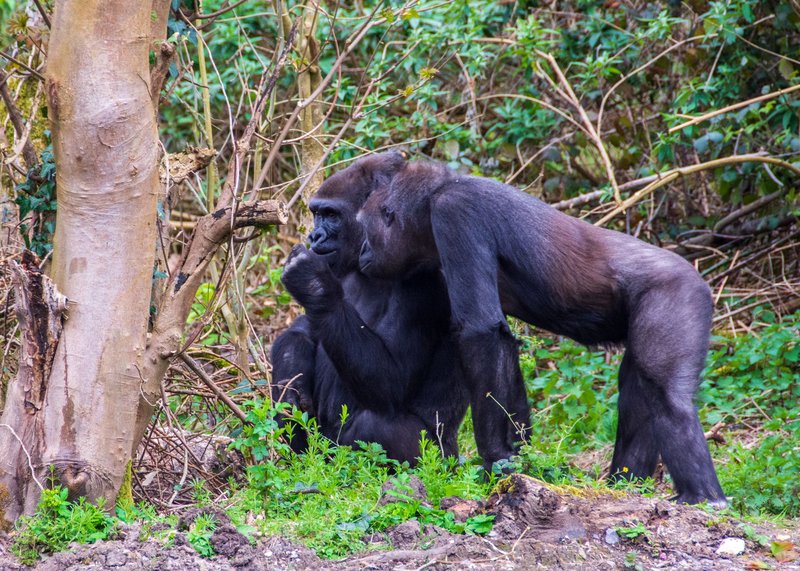
Gorillas live in troops led by a dominant silverback, eat mostly leaves, stems and fruit, and build a fresh nest of bent vegetation each night. The western lowland subspecies is the most numerous gorilla, but disease and poaching have pushed the species to Critically Endangered on the IUCN Red List.
Okapi (Okapia johnstoni)
The okapi looks like a zebra-striped horse, but it’s the giraffe’s only living relative. It has the same long, dark tongue, long enough to wash its own eyelids and ears. It lives only in the northeastern Democratic Republic of the Congo. Status: Endangered.
African forest elephant (Loxodonta cyclotis)
Smaller than the savanna elephant, with straighter, downward-pointing tusks that suit pushing through dense undergrowth. Forest elephants spread the seeds of many large-fruited trees, and some tree species depend heavily on them. Status: Critically Endangered.
Bonobo (Pan paniscus)
Bonobos live only south of the Congo River, and they’re one of our two closest living relatives along with the chimpanzee. Their societies are female-led, and they resolve many conflicts with social contact instead of aggression. Status: Endangered.
Southeast Asia
Island forests and a long history of isolation have given Southeast Asia animals found nowhere else.
Sumatran orangutan (Pongo abelii)
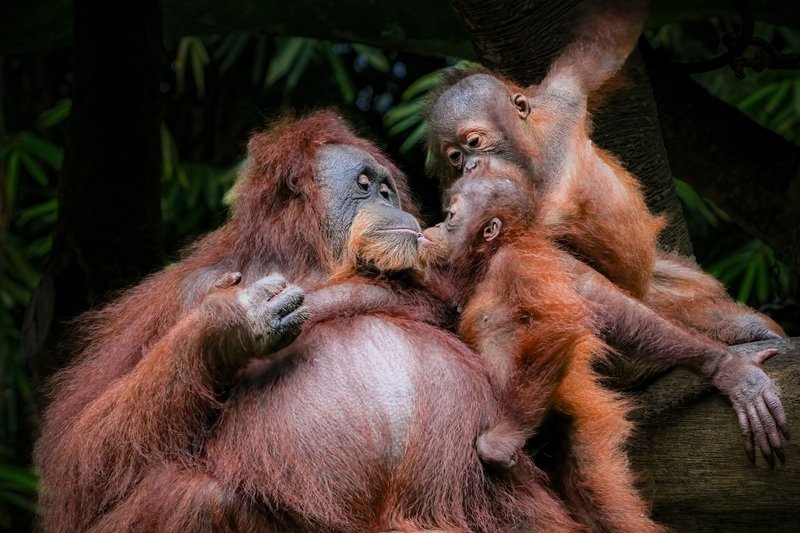
Orangutans spend almost their entire lives in trees and build a new sleeping nest every night. Females raise one young at a time and nurse it for six to eight years, one of the slowest reproductive rates of any mammal, which is why losing even a few adults hurts the population. Status: Critically Endangered.
Sumatran tiger (Panthera tigris sumatrae)
The smallest living tiger subspecies. Its darker coat and closer stripes help it vanish in dense forest. Fewer than a thousand remain in the wild. Status: Critically Endangered.
Malayan tapir (Tapirus indicus)
The black-and-white pattern looks conspicuous in a zoo, but in moonlit forest it breaks up the outline of a sleeping animal so it looks like a rock. Tapirs use a short, flexible snout to grab leaves and fruit. Status: Endangered.
Asian elephant (Elephas maximus)
Smaller ears than African elephants, a single “finger” at the tip of the trunk instead of two, and a domed head. Asian elephants live in forest and grassland from India to Borneo. Status: Endangered.
King cobra (Ophiophagus hannah)
Its scientific name means “snake eater,” and snakes are its main prey. It’s the longest venomous snake and one of the few that builds a nest, with the female guarding her eggs. Status: Vulnerable.
Komodo dragon (Varanus komodoensis)
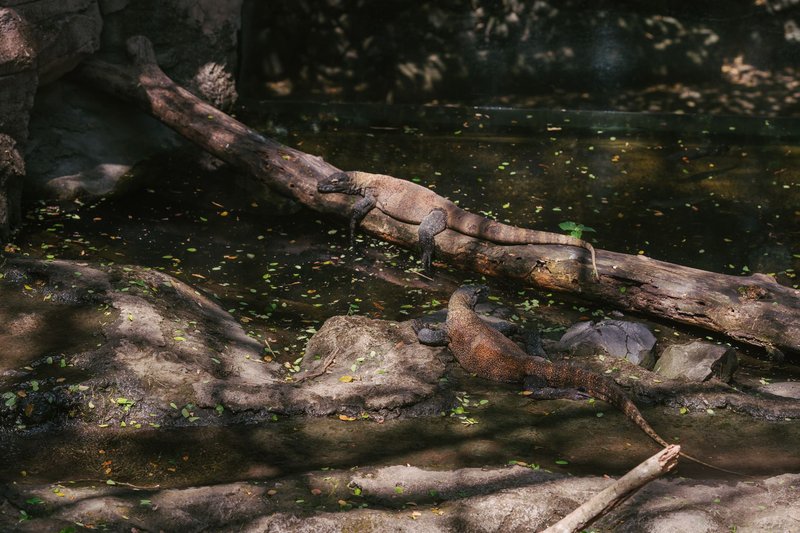
Not a rainforest animal at all. Komodo dragons live on a handful of dry, hot Indonesian islands, where they hunt deer and pigs in savanna and tropical dry forest. At up to roughly 3 meters, they are the largest living lizard. Status: Endangered.
Madagascar
Madagascar split from the African mainland tens of millions of years ago. Like other geographically isolated regions, most of its land animals exist nowhere else.
Ring-tailed lemur (Lemur catta)
Ring-tailed lemurs spend more time on the ground than most lemurs and live in dry forest and scrubland in the south. Females lead the troop. Males scent-mark their tails and wave them at rivals, a behavior known as a “stink fight.” Status: Endangered.
Aye-aye (Daubentonia madagascariensis)
The aye-aye taps on tree trunks with a thin middle finger, listens for hollow tunnels, then gnaws a hole and hooks out grubs. No other primate feeds this way. Local superstition has made it a target of killing. Status: Endangered.
Fossa (Cryptoprocta ferox)
Madagascar’s top predator looks like a cat, but is related to mongooses. It hunts lemurs through the trees, using flexible ankles that let it climb down head first. Status: Vulnerable.
Panther chameleon (Furcifer pardalis)
Males change color to signal to rivals and females, more than to hide. Colors vary strongly by region of the island. Status: Least Concern.
African savanna
Savanna is tropical too, with a long dry season instead of constant rain. These animals handle open ground and heat rather than dense canopy.
African lion (Panthera leo)
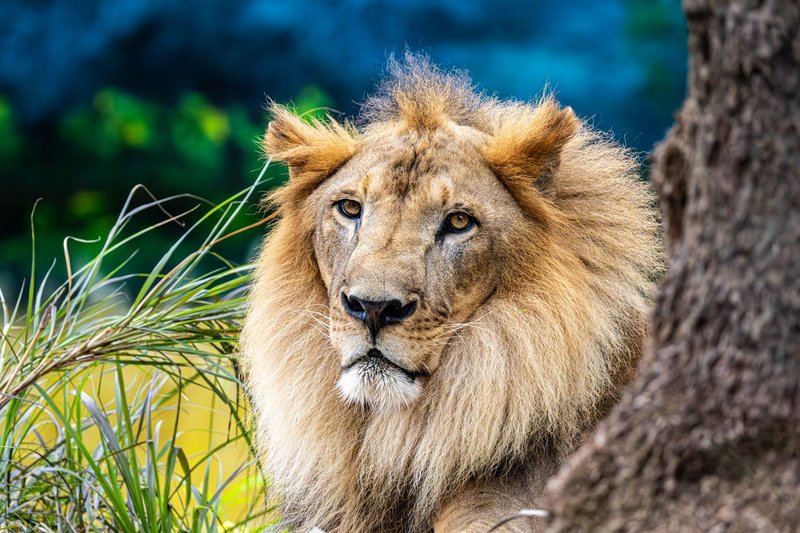
The only cat that lives in true social groups. Prides of related females hunt together, and males defend the territory. Status: Vulnerable.
African bush elephant (Loxodonta africana)
The largest land animal alive, with males reaching around 6 tonnes. Its huge ears work as radiators: blood flows through them and cools as they flap. Status: Endangered.
Giraffe (Giraffa camelopardalis)
A giraffe’s neck has the same seven vertebrae as yours, each one stretched out to over 25 cm. Its heart has to push blood up to the brain against gravity, so its blood pressure is roughly double a human’s. Status: Vulnerable.
Australasia
Southern cassowary (Casuarius casuarius)
A flightless bird up to around 1.7 meters tall with a bony casque on its head, living in the rainforests of northern Queensland and New Guinea. It swallows whole fruits and spreads the seeds of rainforest trees. It also has a dagger-like claw on each foot, and has seriously injured people. Status: Least Concern.
Goodfellow’s tree-kangaroo (Dendrolagus goodfellowi)
Tree kangaroos are kangaroo relatives that moved back into the trees. They use their long tails for balance and can leap to the ground from heights of several meters. This species lives in the mountain forests of New Guinea. Status: Endangered.
Quick comparison table
| Animal | Region | Diet | Size | Status |
|---|---|---|---|---|
| Jaguar | Amazon | Carnivore | Up to ~100 kg | Near Threatened |
| Three-toed sloth | Amazon | Leaves | 3-5 kg | Least Concern |
| Capybara | South America | Grasses, plants | ~60 kg | Least Concern |
| Western lowland gorilla | Congo Basin | Plants, fruit | Males ~170 kg | Critically Endangered |
| Okapi | Congo Basin | Leaves, fruit | ~250 kg | Endangered |
| Sumatran orangutan | Sumatra | Fruit, leaves | Males ~80 kg | Critically Endangered |
| Komodo dragon | Indonesian islands | Carnivore | Up to ~70 kg | Endangered |
| Ring-tailed lemur | Madagascar | Fruit, leaves | 2-3 kg | Endangered |
| African lion | Savanna | Carnivore | Males ~190 kg | Vulnerable |
| African bush elephant | Savanna | Plants | ~6,000 kg | Endangered |
How tropical land animals adapt
Camouflage and warning colors. Dense forest is dim and broken up by leaves, so patterns like the jaguar’s rosettes and the tapir’s two-tone coat help animals blend in. The poison frog does the opposite, using bright color as a warning.
Living in trees. Prehensile tails, gripping hands, and in the sloth’s case, long curved claws allow animals to use the canopy, where the food is. Orangutans and tree kangaroos have both made the forest above the ground their home.
Slow living. In a hot climate with low-calorie food such as leaves, saving energy works. Sloths and orangutans are slow because speed doesn’t pay off for them.
Cooling off. Elephants use their ears, lions rest in shade through the hottest hours, and many forest animals stay nocturnal.
Why so many are endangered
Tropical forests lose ground every year to farming, logging and roads. The animals on this list that are in worst shape tend to need large ranges, reproduce slowly, or live in a single small area, like the okapi, the Sumatran orangutan and the golden poison frog.
The IUCN Red List tracks the status of each species. World Wildlife Fund and the Rainforest Alliance both work on habitat protection and sustainable land use in these regions.
FAQ
What is the difference between rainforest animals and tropical land animals? Rainforest animals are only the tropical land animals that live in rainforest. Tropical land animals also include savanna, dry-forest and mangrove species like the lion, the Komodo dragon and the ring-tailed lemur.
What are the largest tropical land animals? The African bush elephant is the largest land animal of any climate. In the rainforest, the Asian elephant and the African forest elephant are the biggest.
Which tropical land animals are the most endangered? Sumatran orangutans, Sumatran tigers, western lowland gorillas and African forest elephants are all listed as Critically Endangered.
Are all tropical animals found in rainforests? No. The savanna, dry forest and scrubland biomes sit in the tropics too, and many well-known animals such as lions, giraffes and Komodo dragons live there.
Which continent has the most tropical land animals? South America, mostly thanks to the Amazon, holds the greatest overall diversity of species, though Africa and Southeast Asia have the most large mammals and Madagascar has the highest share of species found nowhere else.