TLDR
Leaves make up 68–90% of a white-headed langur’s diet, and young leaves alone can account for more than half of everything it eats in a given month. The rest is fruit, flowers, bark, and seeds, with a handful of favorites — kudzu vines and certain fig species — showing up again and again. What makes this possible is a gut built to handle fiber and tannins that would leave most mammals sick. As forest fragments shrink across their range in Guangxi, China, that diet is getting harder to maintain, and it’s forcing the langurs into food choices that tell you a lot about what’s happening to their habitat.
Table of Contents
- The short answer: this is a leaf-eater
- Why leaves, when almost nothing else can stomach them
- What fills the other third of the plate
- How the menu changes with the seasons
- How they actually eat
- What infants eat before they’re weaned
- How habitat loss is rewriting the diet
- Where this fits with other langur diets
- Why the diet matters for conservation
The short answer: this is a leaf-eater
White-headed langurs (Trachypithecus leucocephalus) are folivores first. Across multiple field studies in the limestone forests of Guangxi’s Chongzuo and Fusui counties, leaves consistently make up 68 to 90% of feeding time, and young, still-unfurling leaves are the preferred cut — sometimes over half the diet by themselves. That’s not a langur nibbling greenery between better meals. That’s the meal.
Fruit, flowers, bark, and seeds round out the rest, and the exact split shifts by season, by forest patch, and by how much undisturbed habitat a given troop still has access to.
Why leaves, when almost nothing else can stomach them
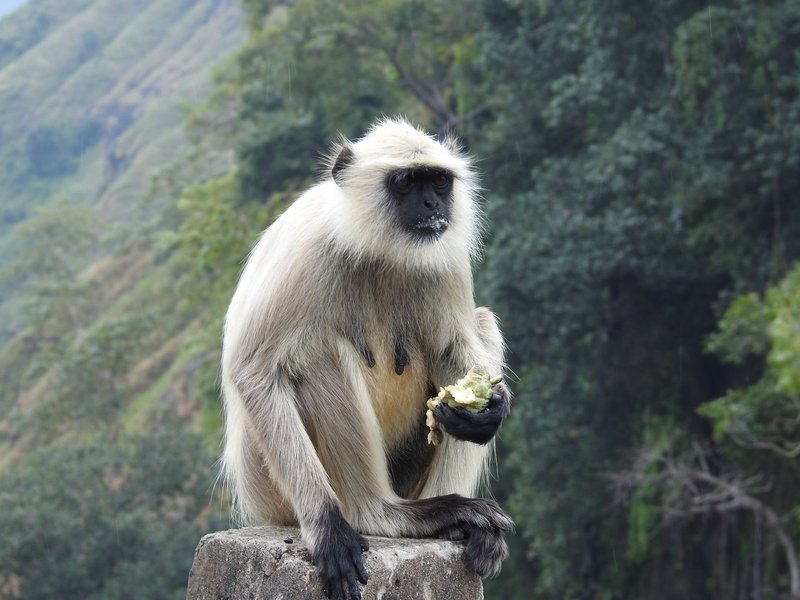
Most mammals avoid a leaf-heavy diet because leaves are a bad deal: low in calories, high in fiber, and often loaded with tannins that bind to proteins and make digestion miserable. Deer, rabbits, and most primates work around this by being selective or by eating leaves as a minor supplement.
Colobine monkeys — the subfamily white-headed langurs belong to — solved the problem differently. They evolved a sacculated, multi-chambered stomach that ferments plant fiber the way a cow’s rumen does, with bacteria breaking down cellulose and neutralizing tannins before the nutrients ever reach the langur’s own digestive enzymes. A study published in Ecology and Evolution documenting feeding behavior in this species found young leaves aren’t just tolerated — they’re actively sought out, likely because they carry more protein and less lignin than mature leaves, without the higher tannin load that older foliage builds up as a defense.
That’s the whole trick. A langur can walk past fruit another primate would fight over and go straight for a shoot of new growth, because its gut can extract more usable energy from that shoot than most other animals could survive eating at all.
What fills the other third of the plate
Leaves dominate, but they’re not the whole story. Fruit, flowers, bark, and seeds fill in the gaps, and a few species show up often enough to count as favorites rather than filler.
Kudzu — the same fast-spreading vine familiar to anyone who’s seen it swallow a fence line in the American South — is a recurring food source where it grows within langur habitat. Several fig species are another mainstay; figs fruit somewhat unpredictably across the year, which makes them a useful stopgap whenever preferred leaves aren’t at the right growth stage.
Bark gets eaten too, mostly as a fallback. It’s low-quality food nutritionally, but it’s available even when almost nothing else is, which matters more than it sounds like in a dry-season forest.
How the menu changes with the seasons
Diet composition tracks the calendar closely. During the rainy season, when new growth flushes out across the canopy, young leaves become easy to find and troops lean into them hard — this is when that 52–65%+ young-leaf share shows up most strongly in feeding records.
The dry season is a different problem. New leaves are scarce, so langurs shift toward mature leaves, seeds, and petioles (the stalks that attach a leaf to its stem) — foods that are more available but generally lower in nutritional value. It’s less a preference than a fallback plan, and it shows in body condition studies that track seasonal weight fluctuation in the population.
How they actually eat
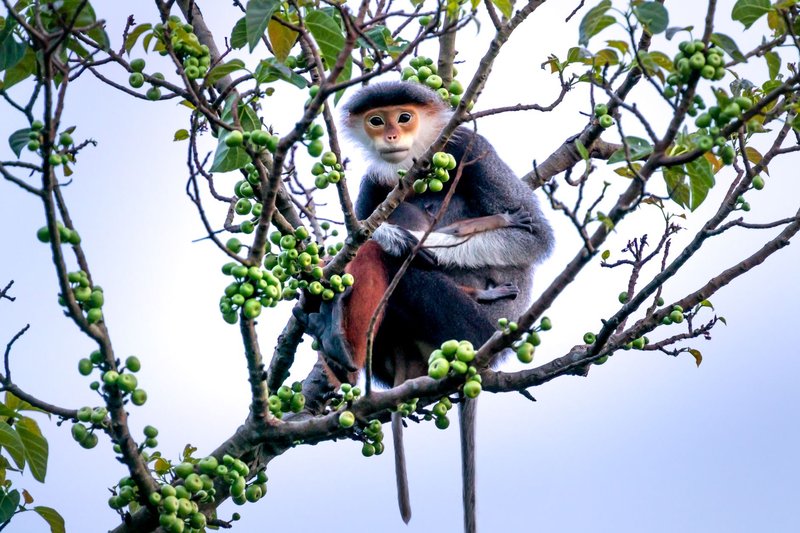
White-headed langurs feed in troops, typically moving through a home range that includes multiple limestone karst formations — the jagged, cave-riddled hills that give this species part of its unusual habitat. Feeding bouts are spread through the day rather than concentrated at dawn and dusk the way some primates operate, and troops will often return to the same productive trees repeatedly across a season, effectively tracking which patches are fruiting or flushing new leaves at any given time.
Group feeding also means shared vigilance — more eyes watching for the clouded leopards and raptors that prey on langurs in this region, which lets individual animals spend more time actually chewing instead of scanning the treeline.
What infants eat before they’re weaned
Infants nurse for their first several months, but they start sampling solid food well before weaning is complete, watching and mimicking older troop members as they select which leaves to pull. This overlap period — nursing plus experimental solid feeding — is standard across colobine monkeys, and it’s how young langurs learn which of the hundreds of plant species in their forest are worth the effort and which aren’t.
Newborn white-headed langurs are also notable for being bright orange at birth, a color that fades to the adult black-and-white pattern over their first few months — a detail unrelated to diet, but one that makes spotting infants in the canopy considerably easier for researchers tracking feeding behavior.
How habitat loss is rewriting the diet
This is where the research gets genuinely useful beyond species trivia. A study examining feeding ecology and habitat fragmentation found that troops confined to smaller, more isolated forest patches don’t simply eat less — they eat differently, drawing on a wider range of plant species and leaning more heavily on lower-quality fallback foods because their preferred young-leaf sources aren’t reliably available within a shrunken range.
That’s a meaningful signal for conservation work: a troop’s diet diversity and food quality can serve as an early indicator of habitat stress, sometimes before population decline shows up in the numbers directly. When forest fragments shrink further, the langurs don’t have the option of ranging farther to find better food — the karst terrain and human land use around Chongzuo and Fusui already box them into isolated pockets.
Where this fits with other langur diets
White-headed langurs sit toward the more strictly folivorous end of the langur spectrum, but they’re not unique in the broader colobine family — most langur species run some version of the same leaf-heavy, fermentation-dependent strategy. What sets T. leucocephalus apart is less the diet itself and more the environment it’s paired with: limestone karst forest is a patchier, more fragmented habitat type than the continuous lowland or montane forest other langur species often occupy, which puts more pressure on a diet that already depends on finding the right leaf at the right growth stage.
Why the diet matters for conservation
White-headed langurs are classified as Endangered, with a wild population confined entirely to a small region of Guangxi, China — nowhere else on Earth. Their status is tracked through the IUCN Red List, and feeding ecology data feeds directly into how conservationists assess whether remaining forest patches can actually support existing troops long-term.
A specialist gut is a strength until the specific food it’s built around disappears. That’s the real story behind the diet of the white-headed langur — not just what’s on the menu, but what happens to an animal this finely tuned to one kind of forest when that forest keeps shrinking.