Table of Contents
- TLDR
- The five species at a glance
- Common frog (Rana temporaria)
- Moor frog (Rana arvalis)
- Common toad (Bufo bufo)
- Smooth newt (Lissotriton vulgaris)
- Northern crested newt (Triturus cristatus)
- When they breed
- The law: why you can’t touch any of them
- Where to actually find them
TLDR
Finland has five native amphibian species: the common frog, moor frog, common toad, smooth newt, and northern crested newt. No salamanders, no tree frogs, nothing exotic. The common frog is by far the most widespread, found from the southern coast into Lapland. The northern crested newt is the rarity — it clings on in a handful of ponds in eastern Finland and is the one species most people will never see. All five are protected under Finland’s Nature Conservation Act, which means their spawn, tadpoles, and adults can’t be collected or disturbed.
The five species at a glance
| Species | Length | Key ID feature | Finland range | Status |
|---|---|---|---|---|
| Common frog | 6–9 cm | Rounded snout, brown mask stripe | Nationwide, into Lapland | Common |
| Moor frog | 5.5–7 cm | Pointed snout, males turn blue in spring | South and central Finland | Common but patchy |
| Common toad | Up to 13 cm (females) | Warty skin, horizontal pupil, walks instead of hops | South and central Finland | Common, declining locally |
| Smooth newt | 7–11 cm | Orange belly with black spots, wavy crest on breeding males | South and central Finland | Locally common |
| Northern crested newt | 12–16 cm | Black, warty skin, jagged crest, orange belly with black blotches | A few sites in eastern Finland | Critically endangered nationally |
Common frog (Rana temporaria)
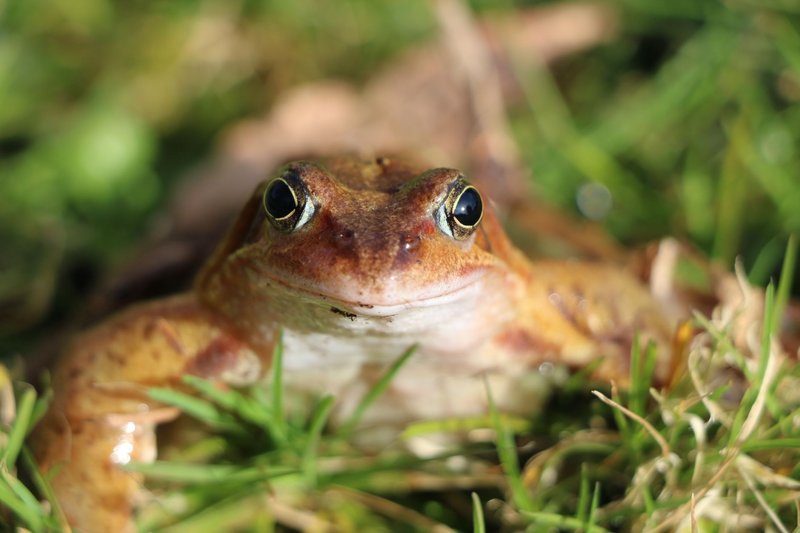
This is the amphibian most people in Finland have actually held, usually as a kid scooping tadpoles out of a roadside ditch. It’s the most widespread species in the country, turning up from the archipelago all the way into Lapland, which none of the other four manage.
Adults run 6 to 9 centimeters, plump-bodied with a rounded snout. Coloring is variable — brown, olive, sometimes reddish — but look for the dark mask running back from the eye and a pale patch on the throat. Where it overlaps with the moor frog, the giveaway is the metatarsal tubercle, a small spur on the hind foot next to the innermost toe. On a common frog that spur is soft and short, under a third the length of the toe next to it.
Common frogs wake from hibernation and head for water as soon as ice starts breaking up, sometimes spawning under a thin skin of ice still on the pond’s edge. The spawn itself is a loose, floating clump rather than strings, usually laid in the shallowest, sun-warmed part of a pond.
Moor frog (Rana arvalis)
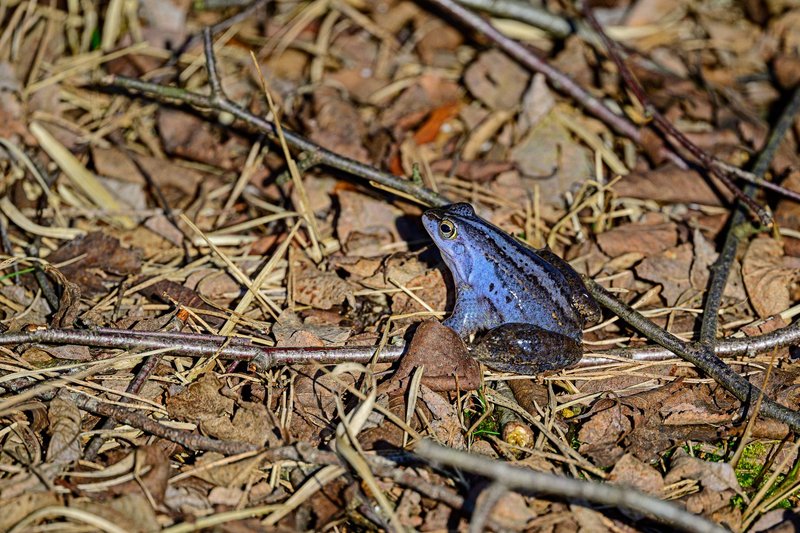
The moor frog looks close enough to the common frog that most people never notice they’re two different animals. It’s slightly smaller on average and has a more tapered, pointed snout rather than the common frog’s rounded one. The metatarsal tubercle test works here too — on a moor frog that heel spur is hard and roughly half the length of the adjacent toe, noticeably bigger than the common frog’s.
The real tell only shows up for about two weeks a year. During the breeding frenzy, male moor frogs turn a startling powder blue, a color shift driven by structural changes in their skin rather than pigment. Common frog males at most get a faint blush of blue. If you see a genuinely sky-blue frog in a Finnish bog in spring, it’s a moor frog.
True to its name, the moor frog favors bogs, wet meadows, and peatland pools over the tidier garden ponds common frogs will happily use. Its range in Finland is more patchy than the common frog’s, concentrated in the south and center.
Common toad (Bufo bufo)
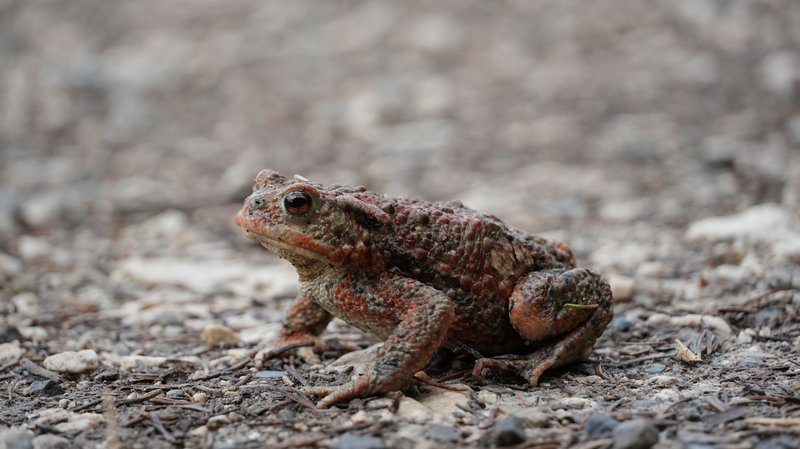
Toads get mistaken for “just ugly frogs,” which undersells them. The skin is dry and warty rather than smooth and moist, an adaptation that lets a toad wander further from water than a frog would risk. Behind each eye sits a parotoid gland, a raised, kidney-shaped bump that secretes a bitter, toxic compound when the animal is threatened — enough to make most predators think twice, and enough that dogs occasionally end up drooling and unhappy after a mouthful.
The other quick tell is gait. Frogs hop. Toads walk, in a slow, deliberate crawl, and only lunge into a hop when genuinely startled. Pupils are horizontal, unlike the newts’ round ones. Females are considerably larger than males and can reach 13 centimeters, hefty for a Finnish amphibian.
Common toads migrate to breeding ponds later than frogs, often waiting for a run of milder nights before making the trip, and the timing shifts noticeably with how cold the preceding weeks were. Spawn comes as long strings wrapped around submerged plants rather than a floating clump, which is the fastest way to tell toad spawn from frog spawn at a glance.
Smooth newt (Lissotriton vulgaris)
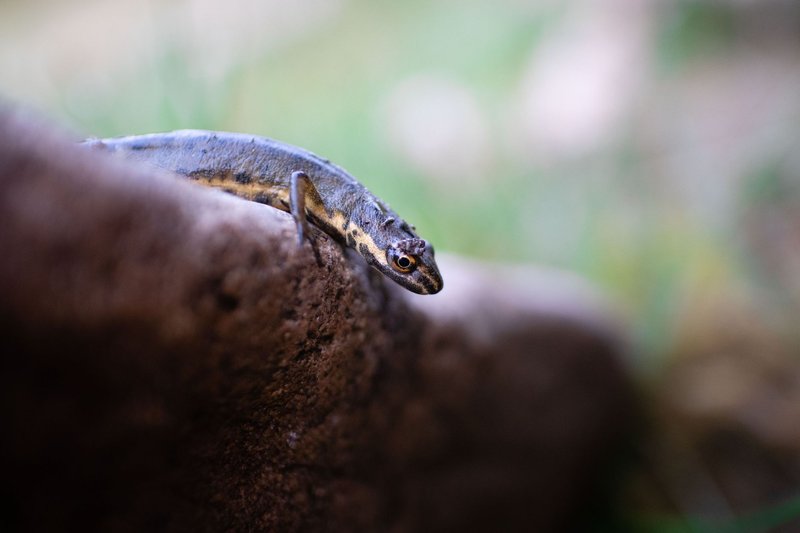
Newts don’t croak, which is probably why they get overlooked next to Finland’s noisy spring frog choruses. The smooth newt is the more common of the country’s two newt species, present across the south and center, generally avoiding the far north.
Coloring runs brownish to olive-green on top with a scatter of dark spots, but the underside is the giveaway: a bright orange belly, sometimes shading to yellow, dotted with black spots. During breeding season males develop a wavy, unbroken crest running from the back of the head down to the tail tip, along with more vivid coloring generally — the closest thing Finland’s amphibians have to a genuine mating display.
Smooth newts spend most of the year on land, hunting invertebrates in damp leaf litter and under logs, and return to still water — ponds, ditches, flooded quarries — to breed in spring.
Northern crested newt (Triturus cristatus)
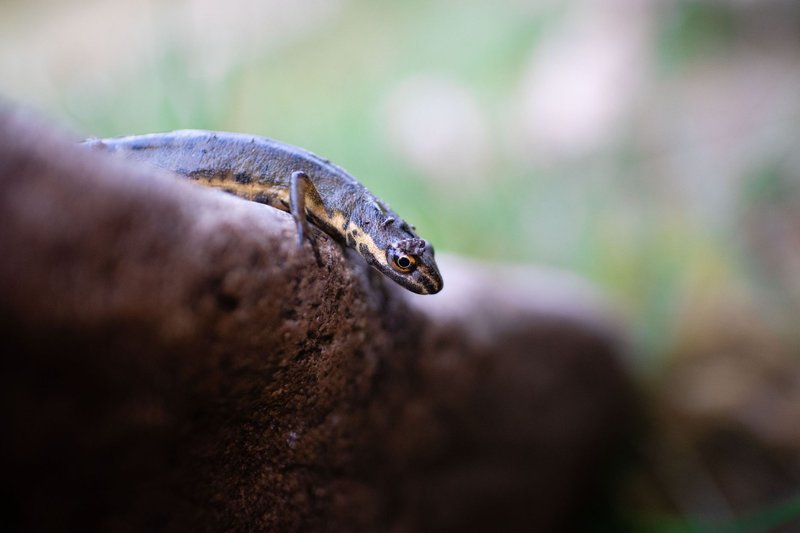
This is the one worth planning a trip for, and also the one you’re least likely to see by accident. In Finland the northern crested newt survives in only a small number of ponds, all in the eastern part of the country, making it the nation’s rarest and most range-restricted amphibian.
Size alone separates it from the smooth newt — crested newts run noticeably larger, up to 16 centimeters, with rough, almost black, warty skin instead of the smooth newt’s smoother texture. Breeding males grow a tall, jagged crest along the back that’s interrupted, not continuous, at the base of the tail, and the belly is orange to yellow with irregular black blotches rather than the smooth newt’s neat spots.
Globally the species is classed as least concern by the IUCN Red List, but that global number hides what’s happening at the northern edge of its range. A species can be doing fine continent-wide and still be circling the drain in the handful of countries where it barely holds on, and Finland is one of them. Population loss and pond drainage—pressures affecting amphibians across Europe—have pushed it to critically endangered status nationally, confined to a shrinking set of breeding sites in the east.
When they breed
Everything kicks off within a tight window once the ice starts going out, typically April into May depending on how far north and how late the thaw arrives. Common frogs are usually first, sometimes spawning in ponds that still have ice at the margins. Moor frogs and common toads follow within a week or two, with toad migration timing especially sensitive to how mild the preceding nights have been. Newts trail last, since they need open water rather than just a thawed surface before courtship starts in earnest.
By early summer the frenzy is over. Adults disperse back into surrounding forest and scrub, and the ponds fill with tadpoles or newt larvae working through the summer toward metamorphosis before the first frosts.
The law: why you can’t touch any of them
All five species are protected under Finland’s Nature Conservation Act, which was reformed and took full effect in June 2023. Protected status covers the whole life cycle, not just the adult animal — that means spawn and tadpoles in a pond are legally off-limits too, not just the frog you might catch by hand.
In practice this rules out taking frogspawn home for a school project, relocating “problem” toads from a garden, or disturbing a known crested newt pond to get a closer look. The northern crested newt carries extra weight here as a species needing special protection under the EU Habitats Directive, which gives its remaining eastern Finland sites a stricter conservation status than the other four species get.
None of this is really about punishing curious kids with a jar. It’s a recognition that Finnish amphibian populations, like most of Europe’s, have been shrinking for decades as small breeding ponds get drained, filled, or fragmented by roads.
Where to actually find them
Common frogs and moor frogs are easiest in spring, right at spawning time, when both species are concentrated and vocal at pond edges — laji.fi, Finland’s national species observation database, is a useful way to check what’s already been logged near a given location before heading out. Toads are more of a summer-evening animal, often turning up on paths and roads after rain as they move between daytime shelter and hunting grounds. Newts require more patience: a slow look along the shallow, sunlit margin of a still pond in May, ideally with polarized sunglasses to cut the glare, is the most reliable method.
The crested newt is a different proposition entirely. Its eastern Finland sites are few, sensitive, and not something to go bushwhacking toward on a hunch — approach it the way you would any critically endangered species, at a distance and ideally through a guided survey or citizen science program rather than solo.