Table of Contents
- TLDR
- What’s actually on the menu
- How a toothless whale catches squid
- The tusk problem
- How we know any of this
- Hunting a kilometer down
- Who eats the whale
- The diet shifts by ocean
TLDR
Strap-toothed whales (Mesoplodon layardii) eat squid — almost exclusively. A landmark stomach-content study found 24 species of deep-sea squid made up 94.8% of everything recovered, led by Histioteuthis and Taonius pavo, with a scattering of fish and crustaceans rounding out the rest. They hunt by suction on dives that push past 1,000 meters, and almost everything we know about this comes from whales that washed up dead — because a living strap-toothed whale is one of the hardest animals on Earth to actually see.
What’s actually on the menu
Forget the idea of a varied diet. Strap-toothed whales are squid specialists, full stop.
The best data comes from a study in the Journal of Zoology that dissected the stomachs of 14 stranded whales from South Africa and New Zealand. Researchers counted 24 different squid species among the contents, together accounting for 94.8% of every identifiable prey item. Two species dominated: Histioteuthis, a bioluminescent “jewel squid,” made up about 25% of prey by number and 21.4% by mass, while Taonius pavo — a soft, gelatinous glass squid — came in at 17.2% by number and nearly 20% by mass. Fish otoliths and a handful of crustacean fragments showed up too, but as a rounding error next to the squid.
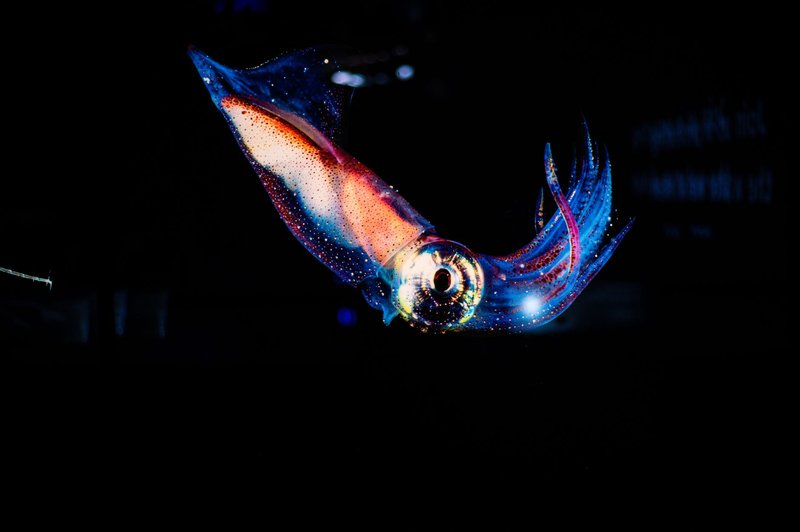
What’s notable is what’s missing: no coastal fish, no reef species, nothing you’d catch off a pier. Every one of these prey species lives in deep, open water. That single fact tells you where this whale spends its life, and it’s nowhere near the surface.
How a toothless whale catches squid
Adult strap-toothed whales don’t have a functional set of teeth to chew with. What they have instead is a retractable tongue and a throat built to generate serious negative pressure — they hunt by suction, flaring their throat open fast enough to pull prey straight in whole. It’s the same trick most beaked whale species rely on, since none of them are built for biting and holding.
Squid, notably, aren’t an easy suction target. They’re fast, and many deep-sea species can jet backward instantly. Catching two dozen species of them consistently means this whale is either very good at ambush or very good at finding squid too far down to have many other predators worth dodging. Probably both.
The tusk problem
Here’s the part that should make suction feeding impossible for males: adult male strap-toothed whales grow two flat, ribbon-like tusks from the lower jaw that curve up and over the top of the snout, sometimes meeting in the middle. Stranded males have been measured with a mouth gape as narrow as 3.2 to 4 centimeters — females and juveniles, who don’t grow tusks, open to about 6.5 centimeters.
A mouth that barely opens wider than a coin slot shouldn’t be able to suction-feed effectively. Yet males show no sign of starving relative to females, and stomach content studies find no major difference in what the sexes eat, just some variation in prey shape. The current thinking is that the restricted gape actually helps: a narrower opening lets a male generate more suction force per gulp, the same way pinching a hose nozzle increases water pressure. The tusks aren’t for eating at all — they’re for jousting other males over mates, evidenced by the raked scars that show up all over adult male bodies. The species just happens to have evolved a feeding style flexible enough to work around them.
How we know any of this
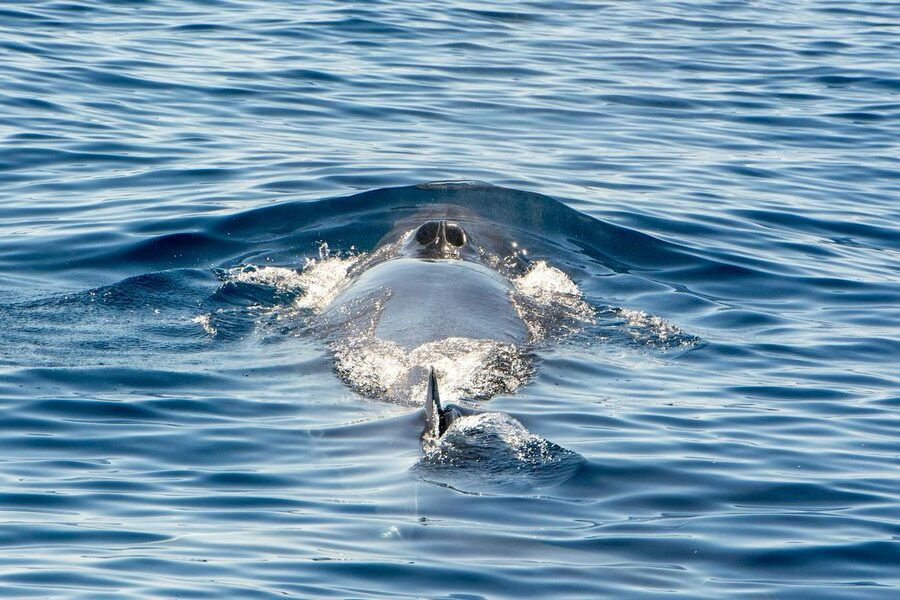
Almost none of it comes from watching a live whale eat. Strap-toothed whales are famously hard to observe at sea — they surface briefly, don’t approach boats, and spend most of their lives far offshore in deep water. Confirmed live sightings are rare enough that researchers have built entire papers around single encounters.
So the diet data comes from a different source: dead whales. When one strands on a beach in South Africa, New Zealand, or occasionally somewhere as unexpected as Myanmar, researchers get a rare chance to open the stomach and see exactly what was eaten in the days before death. It’s not a perfect method — a stranded animal may have been sick, and stomach contents skew toward whatever digests slowest — but across enough strandings, the pattern holds consistently. Every serious paper on this species’ feeding ecology is, in effect, a postmortem.
Hunting a kilometer down
The squid species recovered from stomachs live at serious depth, which means the whale has to go get them. Beaked whales as a family are some of the deepest and longest divers among all marine mammals, and research into related mesoplodont species shows they use echolocation clicks tuned specifically for locating prey in the pitch-black water below where sunlight reaches — past 1,000 meters down, dives that can run the better part of an hour.
That depth is itself a survival strategy. Below the reach of sunlight, there’s far less competition and far fewer predators willing to follow.
Who eats the whale
Deep water doesn’t mean zero risk. Orcas are the one confirmed predator of strap-toothed whales, and the threat is significant enough to shape behavior across the whole beaked whale family. Tagging studies on related species found that beaked whales dive and resurface in unusually tight synchrony with other members of their group, apparently a defense against orca attacks near the surface — the moment they’re most exposed. A whale that spends its life avoiding sunlight to hunt squid also spends it avoiding the one predator patient enough to wait near the top for it to come back up.
The diet shifts by ocean
Diet isn’t identical everywhere the species is found. Squid species recovered from South African and New Zealand strandings included sub-Antarctic species not native to those warmer waters, which points to a seasonal pattern: whales moving north out of colder Southern Ocean water in late summer and autumn, likely following prey migrations rather than water temperature. Strandings in Antarctic and sub-Antarctic waters, by contrast, tend to reflect a more stable year-round deep-sea squid community. The Endangered Wildlife Trust notes the species ranges across the entire Southern Hemisphere’s cooler waters, which is a lot of ocean for tracking exactly where any one population is eating at a given time.
For an animal almost nobody has watched feed in the wild, that’s still a surprisingly detailed picture — squid by squid, stranding by stranding.