Most “birds of Poland” pages are Wikipedia tables with 475 rows and a status code next to each one. Useful if you’re building a spreadsheet. Useless if you’re standing in a reedbed at 6 a.m. trying to figure out what just flew over your head. This is the other kind of list — the birds you’ll actually see, why they matter, and where to point your binoculars.
Table of Contents
- Quick Answer
- Why Poland Punches Above Its Weight for Birding
- 15 Birds of Poland You Should Know
- Best Time to Go
- Where to Go: The Sites That Matter
- Before You Fly Out
Quick Answer
Poland’s headline birds are the white-tailed eagle (Europe’s largest raptor, resident year-round), the white stork (the country holds roughly a quarter of Europe’s breeding pairs), and the common crane (tens of thousands stop at the Biebrza Marshes every autumn). If you only have a few days, go to Biebrza Marshes or Białowieża Forest in May, when migrants and residents overlap and the dawn chorus runs from 4 a.m. to 9 a.m.
Why Poland Punches Above Its Weight for Birding
Poland sits at a crossroads most travelers don’t think about: Baltic coast to the north, the last fragment of Europe’s primeval lowland forest in the east, and a belt of unembanked river valleys running through the middle that industrial farming never got around to draining. That last part is the real story. The Biebrza and Narew valleys still flood every spring the way European wetlands did before the 19th century, which is exactly the kind of habitat that’s vanished everywhere else on the continent.
That combination — old-growth forest, wild river floodplains, and a coastline on a major migratory flyway — is why Poland holds species that have been squeezed out of Western Europe entirely. It’s also why storks nest on rooftops in ordinary villages and nobody blinks: this is a country where big, visible, slightly ridiculous birds are part of the furniture.
15 Birds of Poland You Should Know
1. White-tailed Eagle
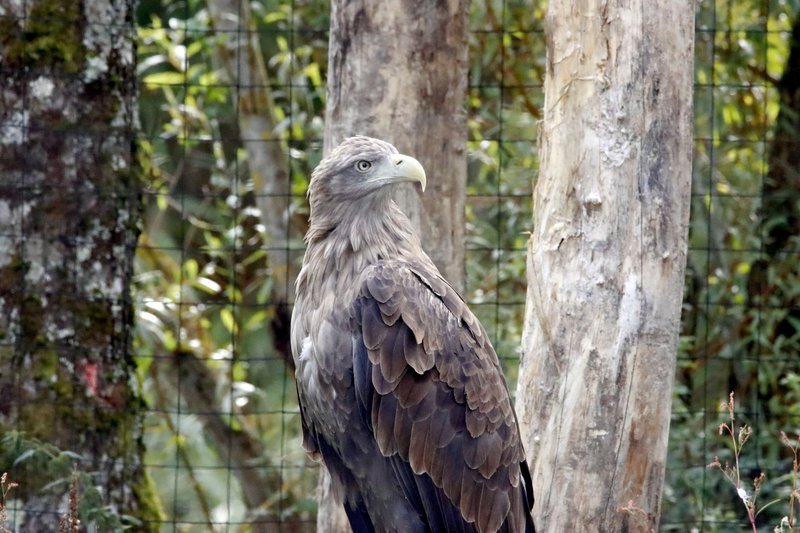
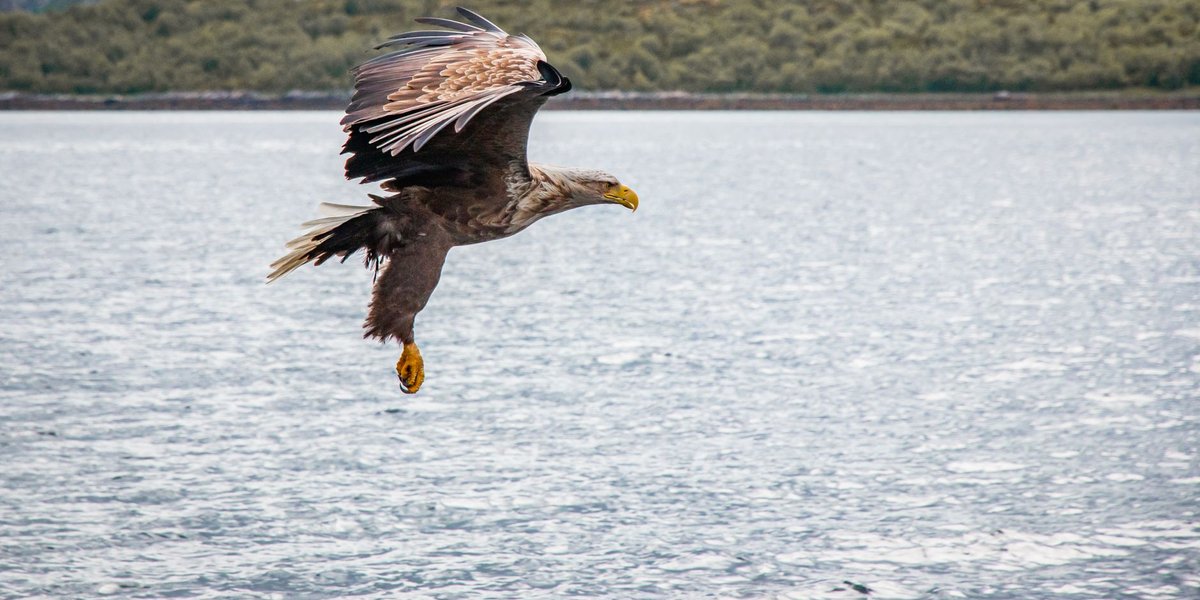
Poland’s national bird by unofficial consensus, and the largest eagle in Europe by wingspan — up to 2.4 meters, broad enough that people mistake it for a small aircraft the first time one banks overhead. It nearly vanished from the country by the 1980s; DDT and shooting did the usual damage. It’s since recovered to several hundred breeding pairs, concentrated around the Baltic coast, the Masurian Lake District, and the Biebrza valley. Look for the pale, almost bleached head against a dark body and that flat, door-like wing profile in flight — it doesn’t soar so much as hang.
2. White Stork
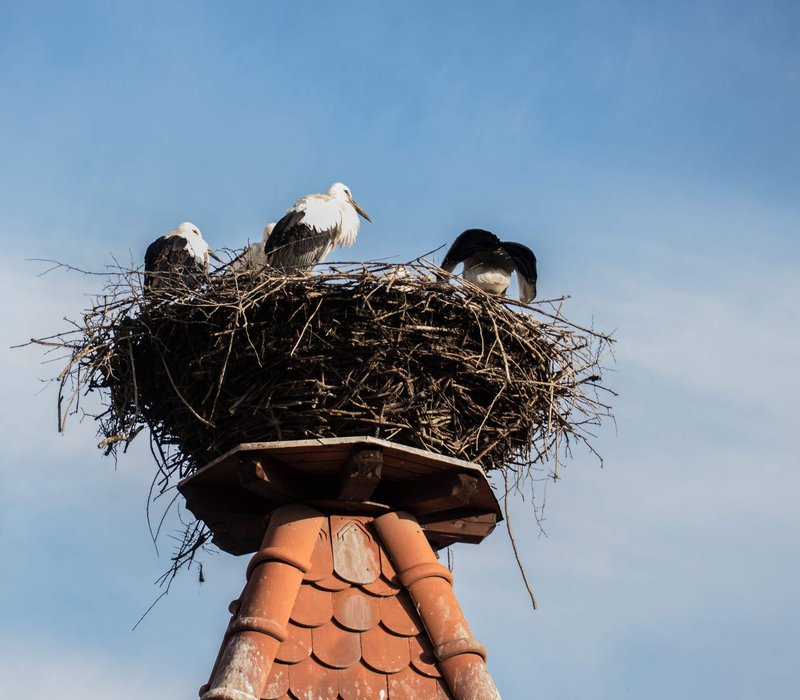
The bird most associated with rural Poland, and for good reason: the country hosts around a quarter of the entire European breeding population, more than any other nation. Villages compete, semi-seriously, over whose rooftop nest is oldest. Storks arrive in late March and leave for sub-Saharan Africa by August, migrating in enormous soaring flocks that ride thermals rather than flap the whole way. If you’re driving through the countryside in summer and see a platform of sticks the size of a bathtub on a chimney or utility pole, that’s not decoration.
3. Eurasian Jay
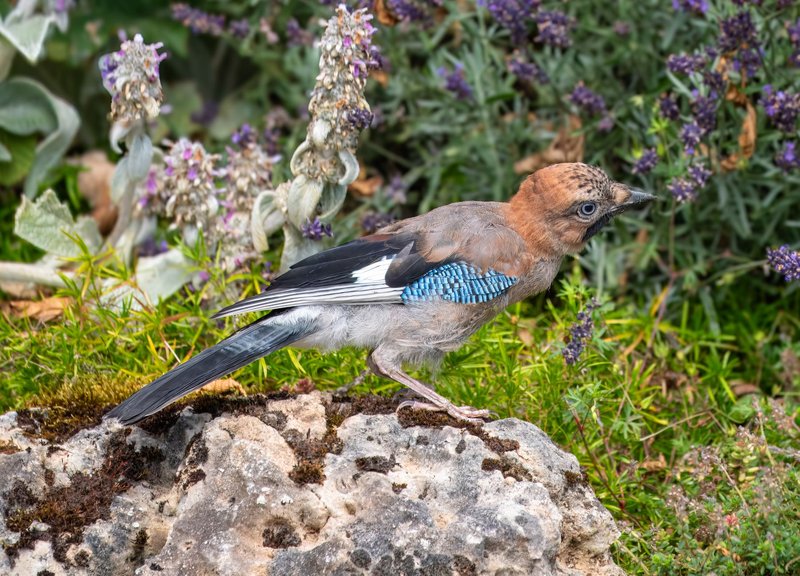
A woodland bird that looks like it wandered out of a more tropical ecosystem — pinkish-brown body, a flash of electric blue on the wing, black moustache stripe. It’s common in Poland’s mixed forests and surprisingly easy to overlook because it’s shy around people, but its harsh, screeching alarm call is often the first sign a bird of prey has entered the area. Jays bury acorns by the thousand each autumn and forget most of them, which makes them one of the more effective (if accidental) oak foresters in the country.
4. Black Stork
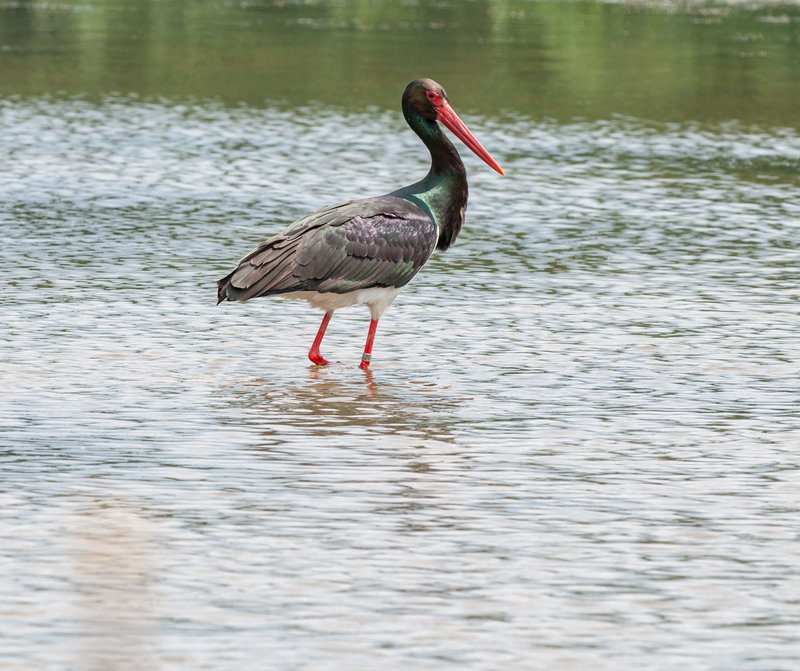
The white stork’s reclusive cousin, and a genuinely different animal in behavior. Where white storks nest on buildings and tolerate people, black storks nest deep in old-growth forest canopy and avoid humans almost entirely. Białowieża Forest is one of the more reliable places to find them, feeding alone in shallow streams rather than in the open fields storks are known for. Dark, iridescent plumage with a red bill and legs — striking, if you’re patient enough to spot one.
5. Ural Owl
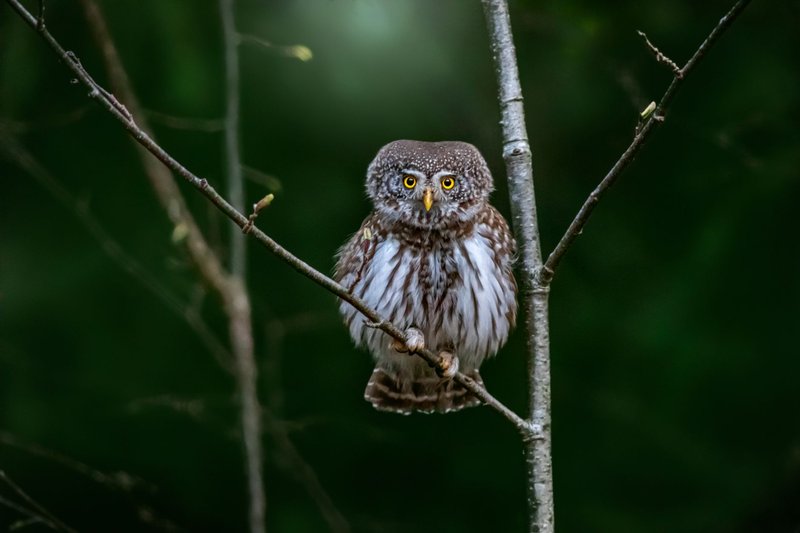
Białowieża Forest is one of the last places in Central Europe where you can reliably find this large, pale, long-tailed owl, which needs the kind of old, cavity-riddled trees that get logged out of most managed forests decades before they’re big enough. Ural owls are also famous among researchers for being aggressively territorial around nests — there are documented cases of them attacking people who get too close. Worth knowing before you get closer for a photo than the bird would like.
6. Eurasian Hoopoe
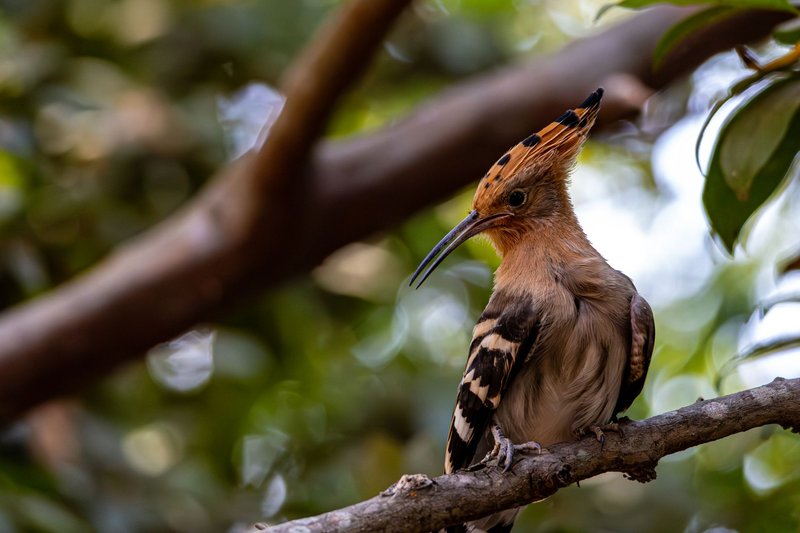
Unmistakable: a fan-shaped crest it raises when alarmed, a long curved bill, and a body pattern of black, white, and cinnamon stripes that looks almost hand-painted. It favors orchards, parkland, and open farmland with short grass, where it probes for insects and grubs. Its call — a soft, repeated “oop-oop-oop” — carries a long way and is often how people notice it before they see it.
7. European Bee-eater
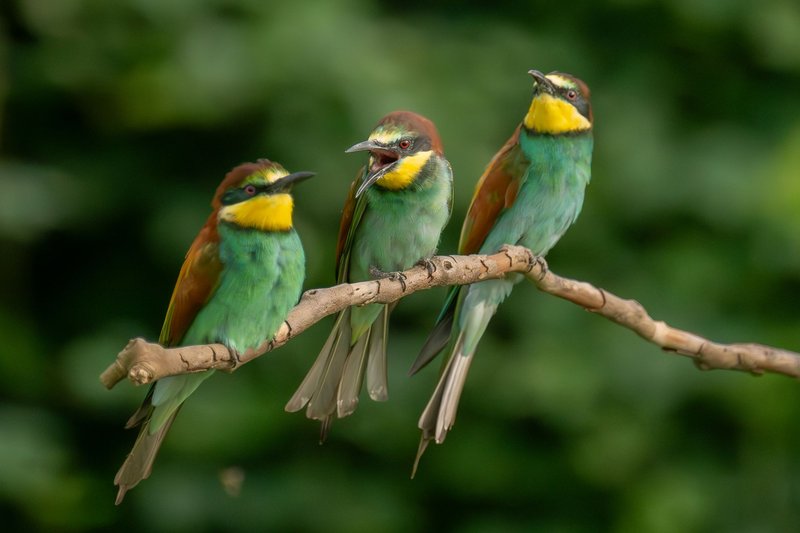
Twenty years ago this was a rare vagrant in Poland. It isn’t anymore. As the climate has warmed, bee-eater colonies have pushed north out of the Mediterranean and established themselves in sandy riverbank cliffs in southern and central Poland, where they excavate nest burrows in loose soil. They’re a genuinely tropical-looking bird — turquoise, yellow, chestnut — and one of the clearest visible markers of how quickly species ranges are shifting.
8. Common Crane
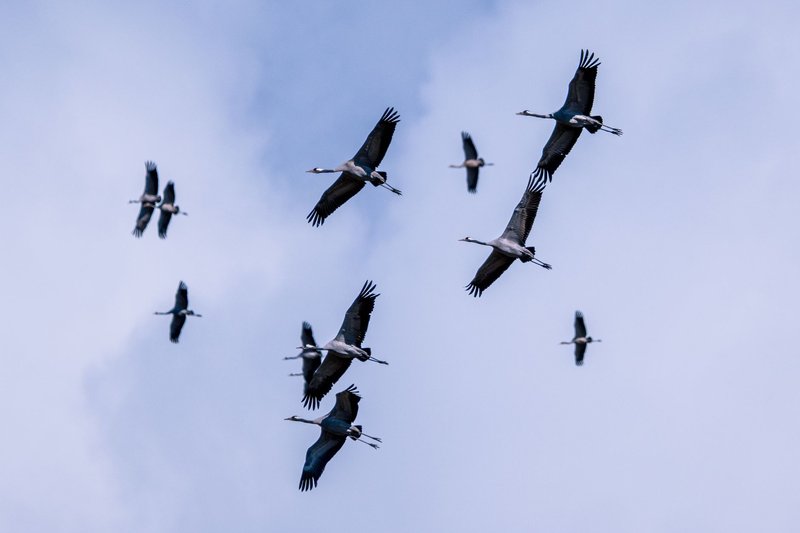
The autumn spectacle. Tens of thousands of common cranes stage in the Biebrza Marshes between September and November before continuing south, gathering in open fields by day and roosting in shallow water at night for safety from predators. The sound before the sight is usually what gets people — a rolling, bugling call audible well over a kilometer away, from birds still invisible in the mist. Cornell’s Lab of Ornithology has good reference recordings if you want to learn the call before you go.
9. Aquatic Warbler
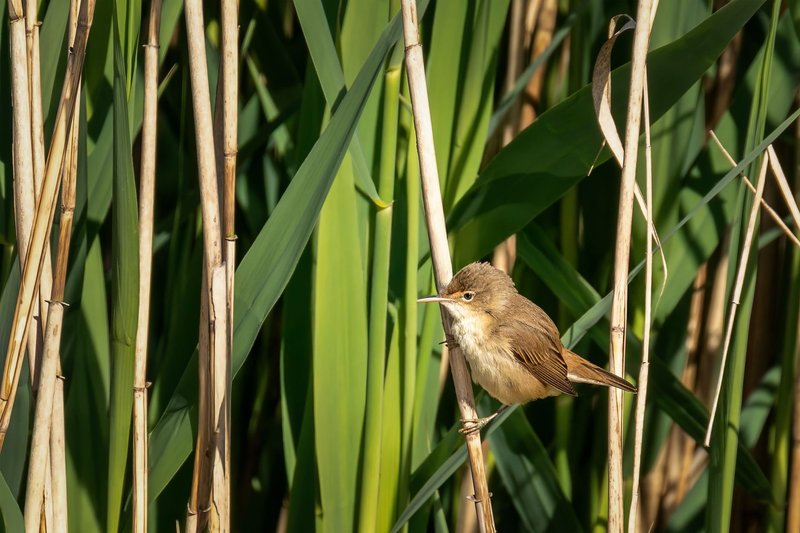
Small, streaky, and easy to dismiss — until you learn that this is Europe’s rarest migratory songbird, and the Biebrza Marshes hold one of its last strongholds anywhere. The IUCN Red List classifies it as globally threatened, and its entire world population depends on a narrow band of unmown, low sedge fen that’s disappearing across the continent as wetlands get drained or overgrown. Hearing one — a dry, insect-like reeling song — in Biebrza is one of the few chances left to encounter it at all.
10. Great Bittern
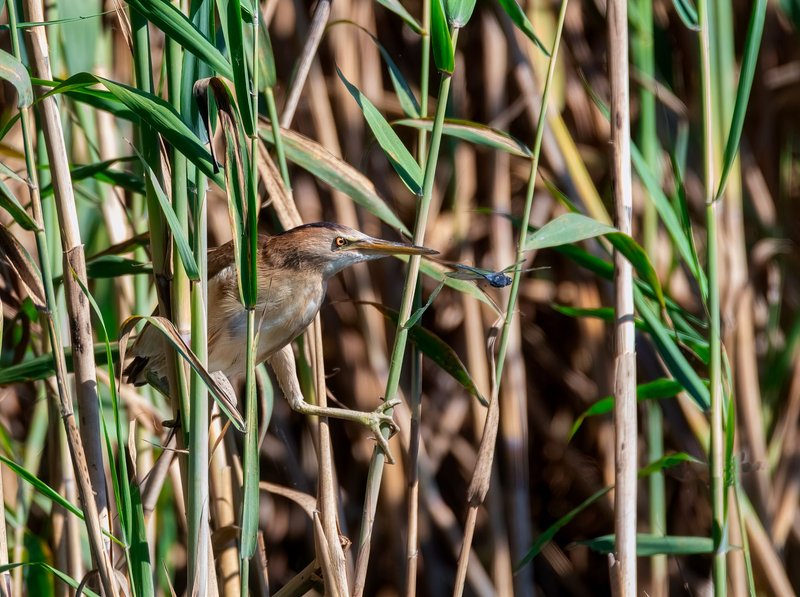
A heron built like a question mark, and one of the best-camouflaged birds in Europe — streaked brown and buff plumage that vanishes against dry reeds, especially when it freezes with its bill pointed straight up. You’ll almost never see one before you hear it: a deep, foghorn-like boom, produced by males in spring, that carries for kilometers across reedbeds and wetlands. Biebrza and the Baltic coast lagoons are both reliable listening spots.
11. European Roller
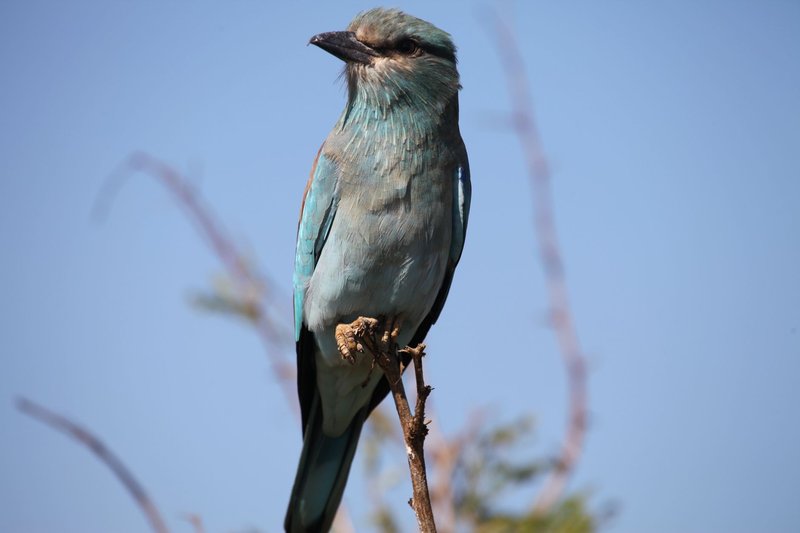
A bird that looks implausible for this latitude — brilliant turquoise body, chestnut back, crow-sized — and one that’s become genuinely rare in Poland as old orchards and hollow trees, its preferred nest sites, have been cleared. It hunts from an exposed perch, dropping onto beetles and grasshoppers in open, dry grassland, and gets its name from the tumbling aerial display males perform in courtship. Seeing one now generally means you’re somewhere specifically managed for it, rather than stumbling across one by chance.
12. Black Woodpecker
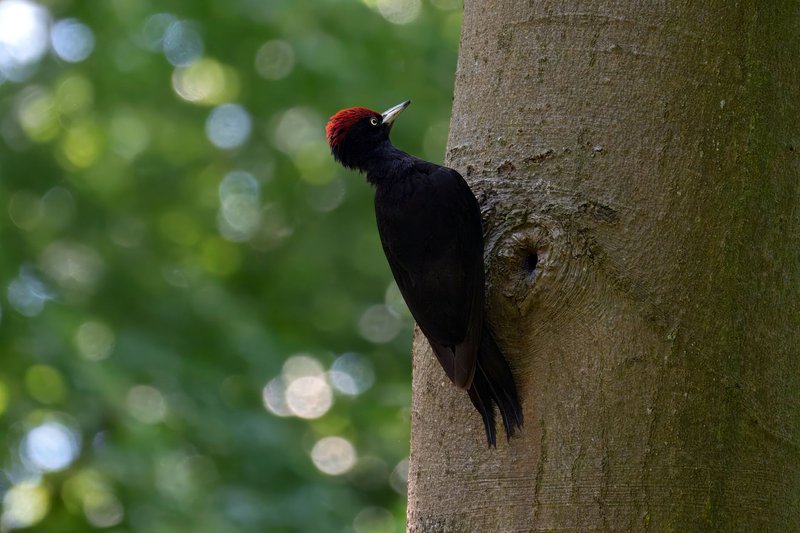
Crow-sized, entirely black except for a red cap, and loud enough that you’ll usually hear the drumming before you see the bird — a deep, resonant hammering distinct from any other European woodpecker. It’s considered an indicator species for old-growth forest health, since it needs large dead trees to excavate nest cavities that are later reused by owls, martens, and other species that can’t make their own. Białowieża has one of the healthiest populations in Central Europe, for the obvious reason that nobody’s been allowed to clear the deadwood.
13. Whooper Swan
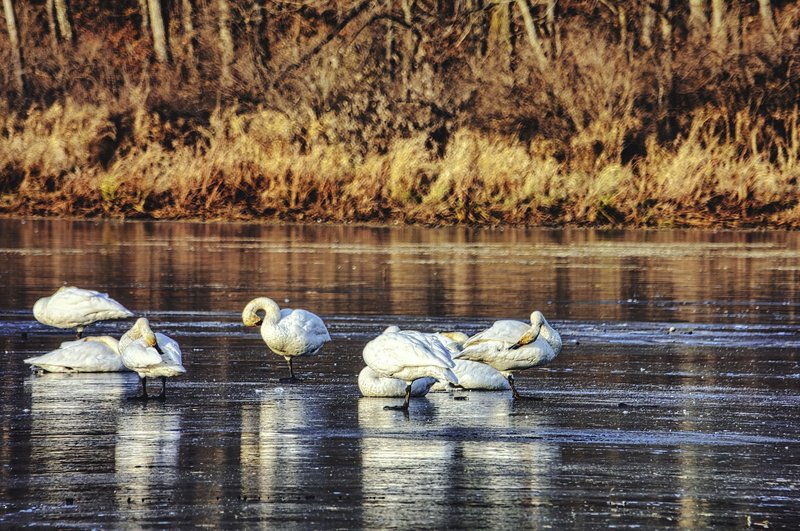
A winter visitor that arrives from Scandinavia and Russia as northern lakes freeze over, gathering in open water and farmland across Poland from November through March. Distinguish it from the resident mute swan by the bill: whooper swans have a yellow-and-black bill rather than the mute swan’s orange-and-black, and they hold their necks straighter rather than in the mute swan’s characteristic curve. Their call — a loud, trumpeting honk, nothing like the mute swan’s near-silence — is usually the faster way to tell them apart at a distance.
14. Eurasian Eagle-Owl
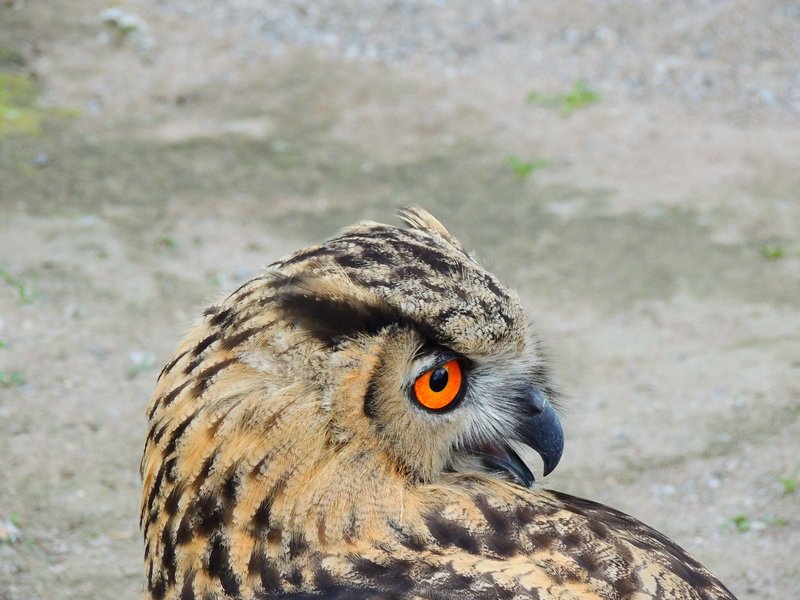
The largest owl species in the world by some measures, with a wingspan that can reach 1.8 meters and orange eyes visible from a genuinely unsettling distance. It nests on cliff ledges and in quarries, and its presence in Poland is a comeback story — the population collapsed through the 20th century and has only recovered through reintroduction programs and legal protection. It’s still uncommon enough that a confirmed sighting is something birders in the country actively chase.
15. Corncrake
Almost never seen, constantly heard: a rasping, mechanical “crex-crex” call (which gives the species its scientific name, Crex crex) repeated for hours on end from deep inside hay meadows. It’s a ground-dwelling rail that would rather run through thick grass than fly, which is exactly why it’s declined so sharply across Western Europe as mechanized, early-season mowing destroys nests before chicks can fledge. Poland’s river valley meadows, mown later and less intensively, still hold some of the healthier populations left on the continent.
Best Time to Go
Late April through May is the strongest window: winter residents are still around, spring migrants are arriving, and breeding birds are singing to establish territory, which makes them far easier to locate by ear. September and October flip the script — this is when common cranes stage in the tens of thousands at Biebrza before heading south, and when Baltic coast watchpoints see heavy raptor and waterbird movement. Winter (December–February) is quieter for variety but is the season for whooper swans, and for owls, which are easier to spot against bare branches.
Where to Go: The Sites That Matter
Biebrza Marshes is the single best area in the country — Europe’s largest intact river wetland, and the reason species like the aquatic warbler still have a foothold on the continent. Białowieża Forest, a UNESCO World Heritage Site, is the place for forest specialists: black storks, Ural owls, black woodpeckers, and the general sense of walking through the last remnant of the forest that once covered most of lowland Europe. Wigry National Park, in the northeast lake district, adds a mix of lake and forest habitat with easier access than Biebrza’s boardwalks. The Baltic coast, particularly around the Vistula Spit and Łebsko Lake, is the migration corridor — best in spring and autumn for volume and variety rather than any single rarity.
Before You Fly Out
None of these sites require a special permit for casual birdwatching, though Białowieża’s strict nature reserve zone does require a licensed guide to enter — arranged easily through operators in the village of Białowieża itself, and worth it for both access and local knowledge of exact nest and roost locations. Biebrza is mostly walked on marked boardwalks and dike-top trails; bring boots that can handle mud regardless of season. A local guide is optional at every one of these sites but genuinely changes what you’ll find in a single day, since the difference between “reedbed with birds in it” and “reedbed with an aquatic warbler in it” is usually local ears, not luck.
You don’t need to travel to a marsh to start noticing any of this, either. Polish towns and gardens run on Eurasian magpies, house sparrows, and common swifts screaming around rooftops in summer — the everyday background noise that makes the rarer stuff, when you finally track it down, feel earned.