Table of Contents
- What an adaptation is (and the two kinds)
- Camouflage and hiding
- Warning colors and mimicry
- Specialized diets
- Moving through a three-dimensional forest
- Night shift: nocturnal adaptations
- Adaptations by forest layer
- Quick-reference table
- FAQ
What an adaptation is (and the two kinds)
An adaptation is a trait that helps an animal survive and reproduce in the place it lives. It builds up over many generations, because animals with the trait leave more offspring than animals without it. No individual animal “decides” to adapt.
Biology classes split adaptations into two groups, and it helps to keep them straight from the start:
- Structural adaptations are physical features of the body: a toucan’s bill, a frog’s toe pads, a jaguar’s skull.
- Behavioral adaptations are things the animal does: sleeping with its eyes covered, descending a tree once a week, hunting only after dark.
Many of the best examples are a pair. A red-eyed tree frog has green skin (structural) and presses itself flat against a leaf all day (behavioral). The skin only works because of the posture.
Rainforests make adaptations pile up for a simple reason. Thousands of species share the same space, food is scattered, and nearly everything is either hunting or being hunted. Small advantages decide who survives.
Camouflage and hiding
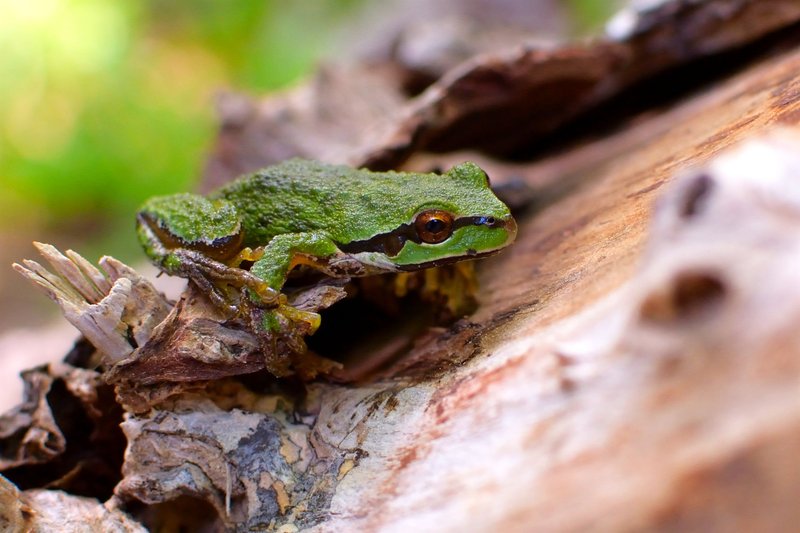
Camouflage is the most common defense in the rainforest, and it comes in more forms than “being green.”
Red-eyed tree frog. Asleep, this frog is a lump of leaf-green. It tucks its legs under its body, hides its orange feet and blue-and-yellow flanks, and closes its eyes behind green-patterned lids. A predator that startles it sees the opposite: bulging red eyes and a flash of color that can buy the frog a half-second to jump away.
Leaf-tailed gecko. Found in the rainforests of Madagascar, these geckos have a flattened body, bark-patterned skin, and a fringe of skin along the flanks that lies against the trunk and erases the shadow a normal body would cast. Shadows give camouflaged animals away. The fringe removes them.
Glasswing butterfly. Parts of its wings are clear, with no colored scales. A predator looking at a transparent patch sees whatever is behind the butterfly, so there is less outline to recognize.
Jaguar. The rosette pattern breaks up the cat’s shape in dappled light. It works best on the forest floor, where sun comes through the canopy in patches.
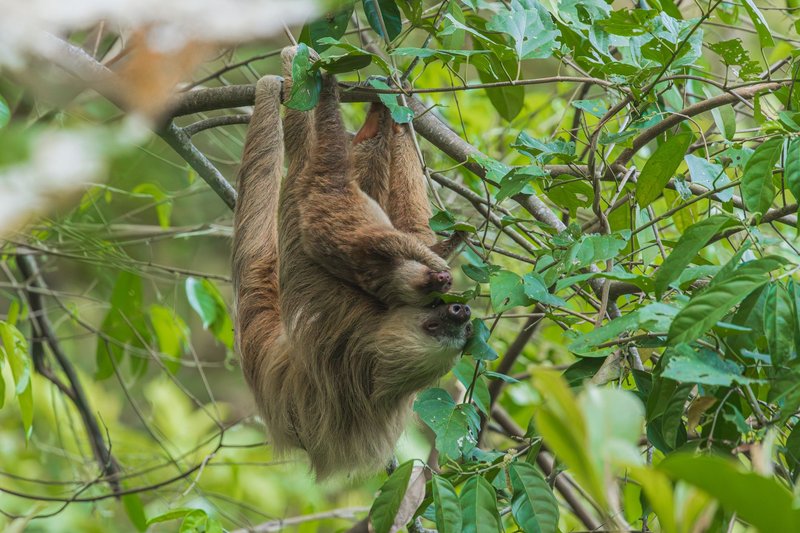
What about sloths? A sloth’s fur does grow green algae, and this is often described as camouflage. The idea is plausible, but researchers who found diverse algae living in sloth hair did not show that the green tint protects the animal from predators. What sloths clearly have is a better defense: they barely move, and their fur blends into a mass of leaves and moss.
Warning colors and mimicry
Some animals skip the hiding and advertise. This is called aposematism: bright colors that tell predators “I’m toxic, leave me alone.”
Poison dart frogs. The tiny frogs of Central and South America are red, yellow, blue or striped. Their skin carries toxic alkaloids, and the frogs don’t make them. They take them from what they eat, mostly ants and mites on the leaf litter. Frogs raised in captivity on crickets aren’t poisonous. The toxin is a diet adaptation that the color then advertises.
Coral snakes and their copycats. Venomous coral snakes carry red, yellow and black bands. Several harmless snakes wear similar patterns, a strategy called Batesian mimicry: look dangerous, even if you aren’t. The mimic gets protection without paying the cost of making venom.
Owl butterflies. The big eyespots on the hindwings look like the eyes of a larger animal. A bird that goes for the butterfly’s wing edge may hit the “eye” instead of the body, and the butterfly escapes with a torn wing.
The pattern in all three: the color works because predators learn. A bird that eats one bad frog remembers the color.
Specialized diets
Rainforest food comes in narrow packages: fruit that ripens unevenly, leaves full of toxins, insects in bark. Many animals specialize.
Toucans. The long bill reaches fruit on thin branches that would break under the bird’s weight, and the bird tosses its head back to swallow. The bill also does a second job. In a study of toco toucans, researchers found the bill acts as a heat radiator, with blood flow to the surface adjusting to release heat when the bird is hot and hold it when the bird is cool. The bill is light because most of it is a honeycomb of keratin rather than solid bone.
Sloths. Leaves are low in calories and hard to digest, so sloths have a slow, multi-chambered stomach and a metabolic rate far below that of similar-sized mammals. Their low-energy lifestyle follows from the diet. They also make a weekly trip to the ground to defecate, a risky behavior that a 2014 study linked to moths that live in their fur and to nutrients in the algae growing there.
Leafcutter ants. These ants don’t eat the leaves they carry. They feed the leaf pieces to a fungus they farm underground, then eat the fungus. A single colony can hold millions of workers divided into specialized sizes: foragers, gardeners, and soldiers.
Giant anteaters. An anteater has no teeth. A tongue longer than its head, covered in sticky saliva, flicks in and out up to 150 times a minute, and strong front claws open termite mounds.
Moving through a three-dimensional forest
The forest is a vertical world. Falling is dangerous, and the food is rarely on the ground.
Spider monkeys. Their prehensile tail has a bare, ridged tip that grips like a fingertip, and the monkey can hang by it with both hands free. Their hands have a very short thumb, which makes a hook for swinging branch to branch.
Harpy eagles. Short, broad wings let this eagle turn between tree trunks at speed, where a long-winged eagle would clip a branch. The hind talons are as long as a grizzly bear’s claws, and the bird takes sloths and monkeys from the canopy.
Flying dragon lizards (Draco). In Southeast Asia, these lizards extend their ribs to open a membrane and glide dozens of meters from one tree to the next. They can’t fly, but they don’t have to climb down.
Tree frogs. Wide toe pads covered in mucus and tiny channels let tree frogs cling to wet leaves. A thin layer of fluid between pad and leaf lets the frog hold on even to a rain-slick surface.
Night shift: nocturnal adaptations
The forest floor receives only a few percent of the sunlight that hits the treetops, so it is dim even in the day. At night it is close to black. Many animals use that.
Tarsiers. Each eye is roughly as big as the whole brain, and the eyes can’t rotate in their sockets. Instead, a tarsier turns its head nearly 180 degrees to look around.
Kinkajous. The kinkajou, a relative of raccoons, feeds at night on fruit and nectar. It has a prehensile tail, a very long tongue for reaching into flowers, and a habit of sleeping in tree hollows by day.
Jaguars. They hunt mostly at dusk, dawn and night. Eyes with a reflective layer behind the retina (the tapetum) make the most of faint light.
Night work also helps with heat. Staying still in the shade by day and moving when it cools saves water and energy.
Adaptations by forest layer
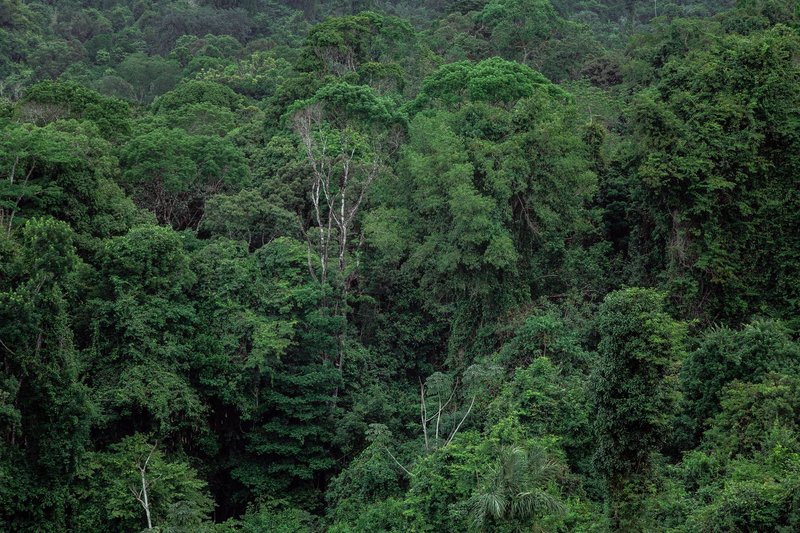
An adaptation makes sense only in context. The same forest has four layers with very different conditions, and animals fit the one they live in.
- Emergent layer (above about 40 meters). Full sun, wind, and long drops. Large birds of prey like the harpy eagle and big-winged butterflies use it. Strong flight and good eyesight matter here.
- Canopy (about 25 to 40 meters). The densest layer, where most fruit, flowers and leaves grow. Toucans, sloths, spider monkeys and many tree frogs live here. Grip, light weight and slow, efficient digestion are common.
- Understory (about 5 to 25 meters). Shady and humid, with less wind. Camouflage dominates: leaf-tailed geckos, red-eyed tree frogs sleeping under leaves, many snakes. Large eyes and nocturnal habits also show up.
- Forest floor. Dim, damp, and covered in leaf litter. Poison dart frogs, leafcutter ants, tapirs and jaguars live here. Sound and smell matter more than sight, and pattern camouflage works best because the light is dappled.
Heights vary by forest, and most animals cross layers. Sloths come to the ground, and jaguars climb. The layers show a general pattern, not walls. For more species from across the forest, see the top 10 rainforest animals.
Quick-reference table
| Animal | Forest layer | Adaptation | What it solves | Type |
|---|---|---|---|---|
| Red-eyed tree frog | Understory | Green skin, hides colors while asleep | Avoiding predators by day | Both |
| Leaf-tailed gecko | Understory | Flattened body, skin fringe | Erasing its shadow on bark | Structural |
| Glasswing butterfly | Understory | Transparent wing patches | Breaking up its outline | Structural |
| Poison dart frog | Forest floor | Bright skin, toxins from diet | Warning predators | Both |
| Owl butterfly | Understory | Eyespots on wings | Redirecting attacks | Structural |
| Toucan | Canopy | Large, light bill | Reaching fruit, shedding heat | Structural |
| Three-toed sloth | Canopy | Slow metabolism, weekly descent | Surviving on low-calorie leaves | Both |
| Leafcutter ant | Forest floor | Fungus farming | Turning leaves into food | Behavioral |
| Spider monkey | Canopy | Prehensile tail | Moving through branches | Structural |
| Harpy eagle | Emergent / canopy | Short, broad wings | Flying between trunks | Structural |
| Tarsier | Understory | Huge eyes | Seeing at night | Structural |
| Jaguar | Forest floor | Rosette coat, strong bite | Stalking prey in dappled light | Structural |
FAQ
What are three adaptations of rainforest animals?
Camouflage (the leaf-tailed gecko’s flat body and shadow-hiding fringe), warning coloration (poison dart frogs), and specialized body parts for climbing (the spider monkey’s prehensile tail). Other common ones include nocturnal vision, gliding, and special diets.
What is the difference between structural and behavioral adaptations?
Structural adaptations are body features, like a toucan’s bill. Behavioral adaptations are actions, like a tree frog sleeping with its eyes covered. Many animals use both together.
How do sloths adapt to the rainforest?
Slow metabolism, a multi-chambered stomach for leaves, strong curved claws for hanging, and fur that hosts algae and moths. They stay almost still, which makes them hard for predators to spot.
Why are so many rainforest animals brightly colored?
Because bright color can be a warning. Poison dart frogs and some butterflies are toxic or bad-tasting, and color helps predators learn to avoid them. Others, like the red-eyed tree frog, use bright color as a surprise flash to startle predators.
Why do rainforest animals live in different layers?
Each layer has different light, food and shelter. An animal’s body and behavior fit the conditions of its layer, which lowers competition between species that would otherwise want the same resources.
Is the sloth’s green fur really camouflage?
It may help, but this hasn’t been proven. Algae grow in the fur, but the studies don’t show that the color protects sloths from predators. Their stillness is the better-documented defense.