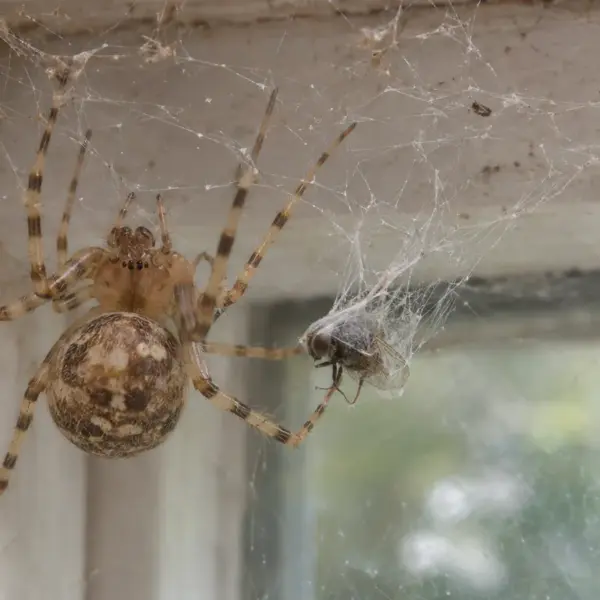
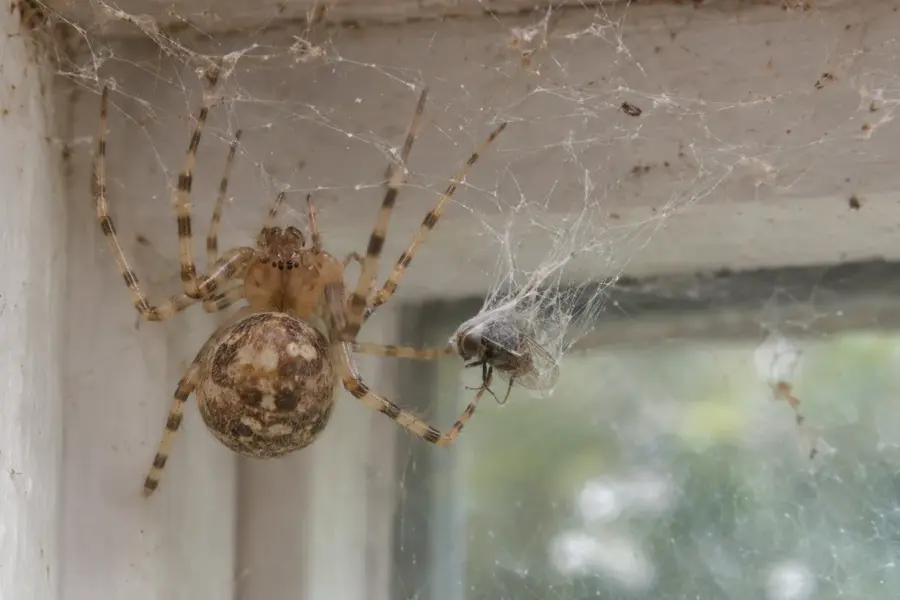
Short answer: wolf spiders eat live insects and other spiders. In the wild they run down or ambush crickets, grasshoppers, beetles, caterpillars, flies and moths, and they eat smaller wolf spiders when they catch them. A pet wolf spider does well on captive-bred crickets or roaches no longer than its own body, one prey item every 5 to 7 days for an adult, plus a shallow dish of water. Never feed it wild-caught bugs, bees, wasps, fireflies, meat or fruit, and never house two together.
The chart below sorts common foods into safe staples, small amounts only and never feed. Search any food to see where it falls. Under the chart are the wild diet, how to set up and offer a meal, a schedule by size from spiderling to adult, molting rules and a printable cheat sheet. If a wolf spider just turned up in your house, start with the box. Feeding numbers come mostly from the European zoo association’s husbandry guidelines for the Desertas wolf spider, the most detailed care document for any wolf spider.
Found a wolf spider indoors?
Can a wolf spider eat it?
Safe staples (4)
- Safe to feed. The standard feeder. Pinheads for small spiderlings, then sizes up to about the spider's front body section. One at a time.From 2 weeks#
- Safe to feed. Zoo wolf spiders live mainly on lobster roaches, and dubias are used too. Pick nymphs no longer than the spider's body.From 2 months#
- Safe to feed. First food for free-roaming spiderlings. Use flightless cultures; a newly dispersed spiderling can take one or two.Ages 2–8 weeks#
- Safe to feed. A bottle-cap dish for juveniles and adults, refilled daily. Spiderlings drink droplets from a light misting instead.From 2 weeks#
Small amounts only (10)
- Small amounts only. Eaten, but they burrow out of reach and live feeders can wound a molting spider. Crush the head and remove leftovers.From 2 months#
- Small amounts only. A zoo favorite for adult wolf spiders, but offered as an extra on top of crickets or roaches, not as the main diet.From 8 months#
- Small amounts only. Strong jaws, and keepers report bitten spiders. Adults only, head crushed, and never when a molt is near.From 8 months#
- Small amounts only. Soft and easy to catch but fatty. An occasional treat, since captive wolf spiders keep eating even when overweight.From 2 months#
- Small amounts only. Natural prey. Hatch them from feeder pupae; don't use swatted or sprayed flies, which may carry poison.From 2 months#
- Small amounts only. Natural prey. Use moths hatched from feeder waxworms or silkworms, not ones caught at a porch light.From 2 months#
- Small amounts only. Common wild prey. Buy captive-bred locusts sized to the spider; field grasshoppers may carry pesticide residue.From 2 months#
- Small amounts only. Spiders eat worms in the wild, but no keeper guide uses them as a staple. A small piece now and then at most.From 2 months#
- Small amounts only. Zoos feed woodlice to wolf spiders and tiny tropical isopods to spiderlings. Some spiders ignore them; remove leftovers.From 2 weeks#
- Small amounts only. A freshly killed cricket or thawed fruit flies, offered on tongs, suit tiny or fussy spiders. Remove what's left within hours.From 2 weeks#
Never feed (11)
- Never feed. Stings, bites and acid can injure or kill a spider. Even wild wolf spiders take these less often than safer prey.
- Never feed. Fireflies carry lucibufagins, defensive toxins that make hungry spiders reject them. Keeper guides say never feed them to any pet.
- Never feed. Bugs from lawns, gardens and farms can carry pesticide residue or parasites. Buy captive-bred feeders instead.
- Never feed. Wolf spiders eat each other, bigger ones eating smaller ones. House one per enclosure and don't feed wild spiders.
- Never feed. Large wolf spiders sometimes catch small frogs or lizards in the wild, but vertebrate prey is not recommended in captivity.
- Never feed. Not prey. Wolf spiders run down whole insects; meat scraps and pet food sit uneaten and spoil in a damp enclosure.
- Never feed. Wolf spiders hunt moving prey and soften it with saliva. Flakes, pellets and dried insects give them nothing to use.
- Never feed. Wolf spiders are predators of insects and other small animals. Fruit, vegetables and greens are not food for them.
- Never feed. Spiders soften animal prey with digestive saliva. Bread, cereal, rice and crackers are useless to them.
- Never feed. Spiders drink plain water. Milk, cheese and yogurt are not food for them and go sour in the enclosure.
- Never feed. Not part of a wolf spider's diet, which is live prey plus plain water. Skip honey, juice, soda and sugar water.
Sources
- Wolf Spiders (Steve Jacobs) — Penn State Extension
- Wolf Spiders (field guide) — Missouri Department of Conservation
- Little Wolves of Missouri (David Bruns) — Missouri Department of Conservation (Missouri Conservationist)
- Wolf Spiders and Nursery Web Spiders (Dellinger, Day) — Virginia Cooperative Extension, Virginia Tech
- Wolf Spiders (Blake Newton, Kentucky Critter Files) — University of Kentucky Department of Entomology
- Common Spiders Found Around Homes and Buildings (ENTFACT-622) — University of Kentucky Entomology
- Wolf Spider (Rabidosa rabida) — Illinois Department of Natural Resources
- Best Practice Guidelines for Desertas Wolf Spiders (Hogna ingens), v1.4 — EAZA Terrestrial Invertebrate TAG (Bristol Zoo Gardens et al.)
- Spiders as frog-eaters: a global perspective (Nyffeler, Altig 2020) — Journal of Arachnology
- Feeding Behaviour and Niche Overlap of Two Species of Wolf Spiders (Williams 2004) — University of Mississippi honors thesis
- Size dependent intraguild predation and cannibalism in coexisting wolf spiders (Rypstra, Samu 2005) — Journal of Arachnology
- Lured and liquidated: fireflies supply femmes fatales with a lifesaving chemical (Eisner et al., PNAS 1997) — Cornell Chronicle
- Basic guide to keeping tarantulas (Richard C. Gallon) — British Tarantula Society
- Two-toned Wolf Spider Care Guide — Bug Frenzy (invertebrate seller)
- Wolf Spiders (Animal Health Guide) — Furry Critter Network (hobby site)
- Foods to Avoid (invertebrates) — Furry Critter Network (hobby site)
- What Do Wolf Spiders Eat? (Nicole Cosgrove) — The Vet Desk (pet site, not vet-written)
- Do Wolf Spiders Make Good Pets? (Nicole Cosgrove) — The Vet Desk (pet site, not vet-written)
- Wolf Spider Info and Tips? (keeper thread, 2023) — Arachnoboards (forum)
- Are super worms dangerous? (keeper thread, 2013) — Arachnoboards (forum)
- How do you care for a Hogna carolinensis? (keeper thread, 2025) — Arachnoboards (forum)
- Nutrition in Reptiles (gut loading feeder insects) — Merck Veterinary Manual
- Wolf Spider Caresheet (keeper thread, 2006) — Arachnoboards (forum)
What wolf spiders eat in the wild
“Ground-dwelling insects and other spiders make up the bulk of their diet,” according to the Missouri Department of Conservation. Wolf spiders don’t build webs to catch food. They patrol the ground at night or sit still near a burrow or hiding spot, then rush out and grab whatever walks close enough. They soften the prey with digestive saliva and usually consume the whole insect.
- Insects: crickets, grasshoppers, beetles, caterpillars, earwigs, flies and moths. Small meadow species take springtails and other tiny insects, the University of Kentucky notes.
- Other spiders: Illinois DNR describes the diet of the rabid wolf spider as “mainly insects and other, smaller wolf spiders.” Size decides who eats whom.
- Stinging prey: a University of Mississippi study of two Rabidosa species found very broad diets, but ants, bees, wasps and other spiders turned up less often than expected.
- Small vertebrates, rarely: large wolf spiders, including the Carolina wolf spider, have been recorded eating small frogs. A 2020 review in the Journal of Arachnology calls frogs “probably only marginal food” for the family.
That wild menu explains the captive one: live, moving insects sized to the spider, with nothing that stings.
Setting up a feeding routine for a pet wolf spider
A wolf spider eats when it is settled, has water and is not about to molt. Get those three right before worrying about the menu.
1. One spider per enclosure
Wolf spiders eat each other. The Desertas wolf spider guidelines report that communally reared spiderlings cannibalize each other “no matter how much groups are fed.” Keep each spider alone in its own cup, bin or small terrarium with a tight, ventilated lid.
2. Give it a place to hide and dig
Use coconut fiber substrate, mixed with some sand for larger spiders, and a piece of cork bark. Burrowing species such as the Carolina wolf spider need 4 to 6 inches of substrate and a hide with an open bottom so they can still dig.
3. Add a water dish
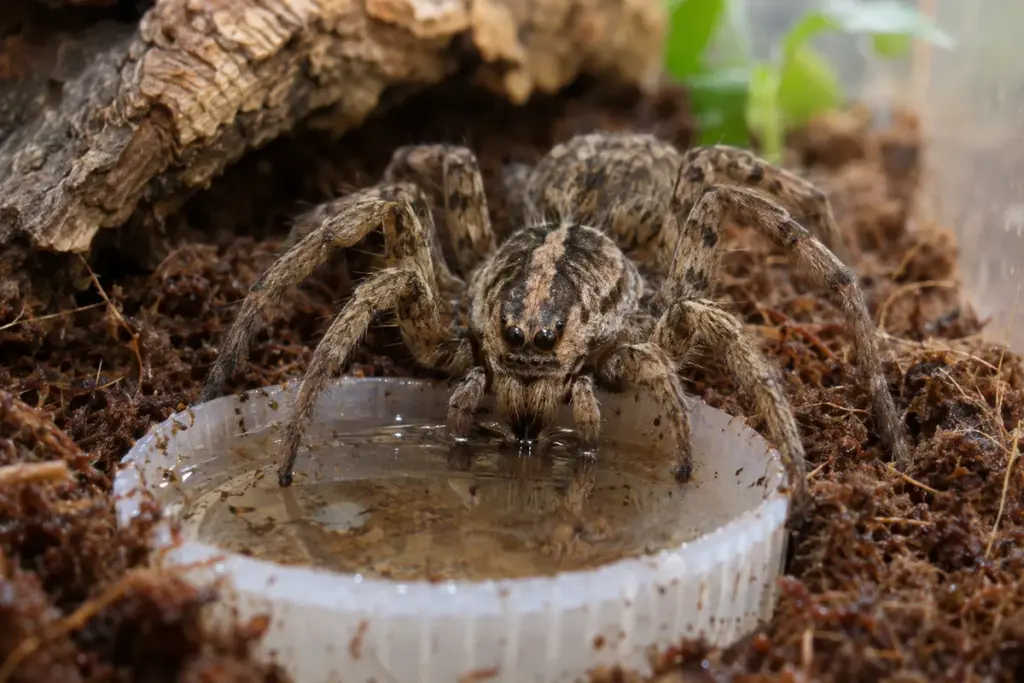
A clean plastic bottle cap, about 30 mm across, makes the right size of dish for juveniles and adults. Check it daily and wash it weekly. Spiderlings are too small for a dish: mist one side of the enclosure lightly so they can drink droplets.
4. Pick a feeding day and log it
Write down the date, the prey and whether the spider ate. A spider that refuses two meals in a row and then seals its burrow is usually getting ready to molt, and the log makes that easy to spot.
What to feed a pet wolf spider: live, captive-bred insects
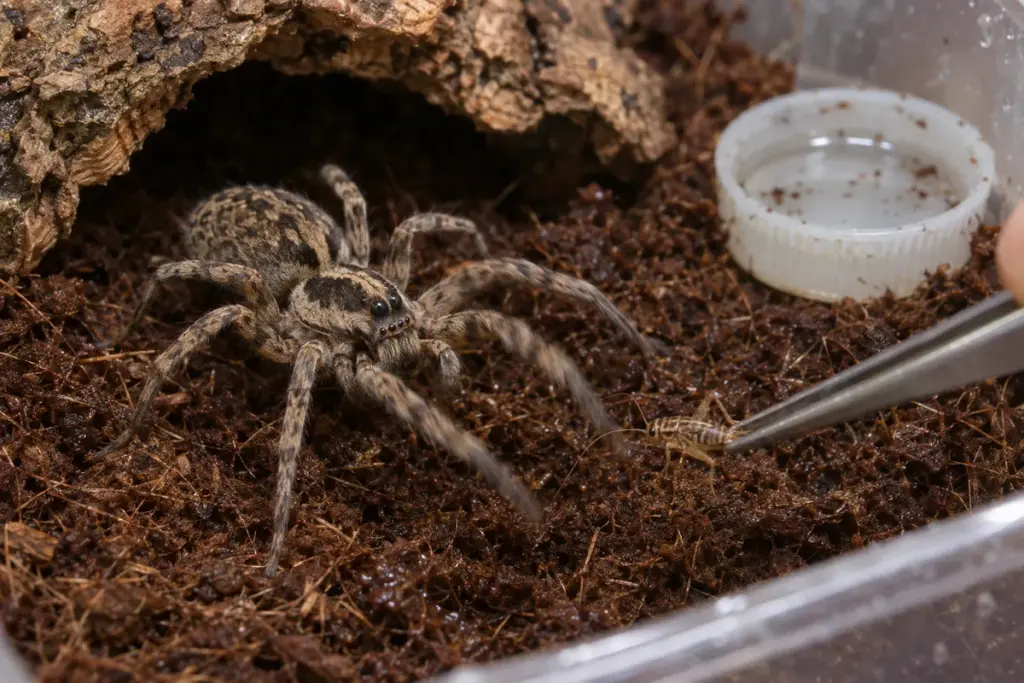
The staple is a cricket or a roach nymph. The zoos that keep Desertas wolf spiders feed adults one cricket or cockroach about the size of the front body section (the cephalothorax). Three rules decide the meal:
- Captive-bred, not caught outside. Buy crickets, dubia or lobster roaches and flightless fruit flies from a pet store or feeder supplier. Wild insects can carry pesticide residue and parasites.
- Sized to the spider. Never longer than the spider’s body. For adults, aim for about the size of the front body section. Spiderlings take flightless fruit flies or pinhead crickets.
- One item per meal. Daily feeding “potentially leads to obesity,” the zoo guidelines warn, and wolf spiders keep eating even when fat.
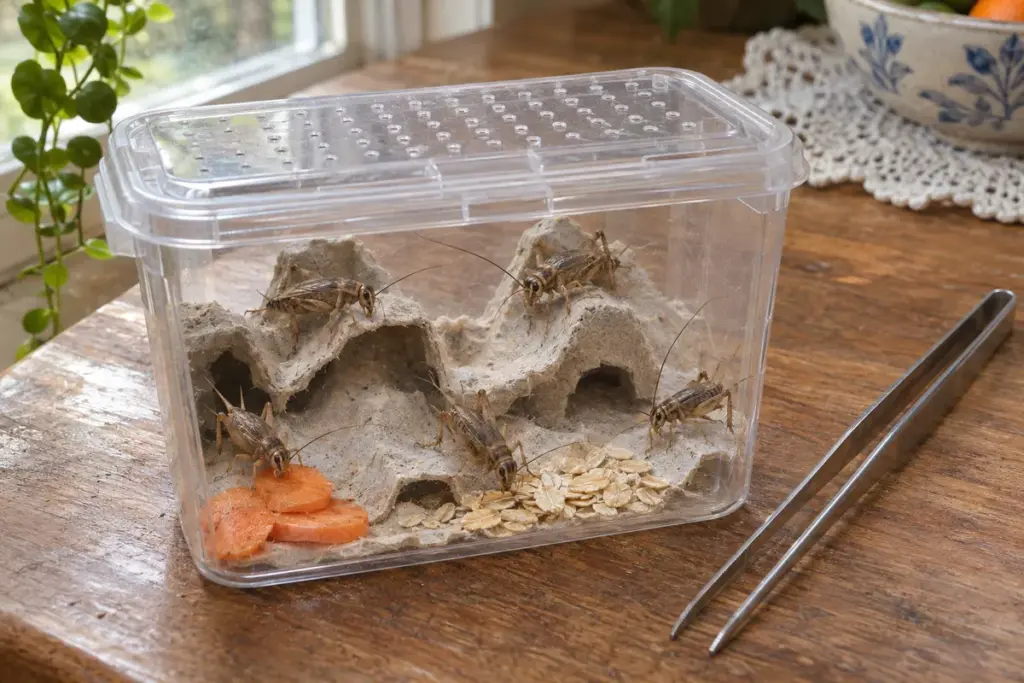
Keep feeder crickets in their own ventilated bin with egg crate and fresh food. The Merck Veterinary Manual recommends gut-loading feeder insects for about 72 hours before they are fed to reptiles, and the same practice puts a better meal in front of your spider.
Foods that harm wolf spiders
- Bees, wasps, ants, centipedes and scorpions. They sting or bite back and can kill a spider. Wild wolf spiders take them less often than they meet them.
- Fireflies. Some fireflies carry defensive toxins called lucibufagins. Cornell researchers found that hungry spiders reject them, and fireflies have killed pet lizards.
- Bugs from the yard or porch light. Pesticide residue from treated lawns and gardens can poison a spider. Swatted or sprayed flies are the same risk.
- Another spider. Including a second wolf spider. One of them will be eaten.
- Pinky mice, lizards and frogs. Rare, marginal food in the wild. The British Tarantula Society calls vertebrate prey “not recommended in captivity.”
- Meat, hamburger and pet food. Not prey. It goes off quickly in a damp enclosure.
- Fish flakes and dried insects. A wolf spider hunts moving prey and digests it with saliva. Dry food gives it nothing to work with.
- Fruit, vegetables, bread, milk, honey and sugar water. Wolf spiders eat only animal prey and drink plain water.
How to feed a wolf spider
- Check that it isn’t in pre-molt. A spider that has sealed its burrow, looks dull or refused the last meal should be left alone. Skip feeding until after the molt.
- Pick one prey item of the right size. No longer than the spider’s body, about the size of the front body section for adults.
- Offer it with tongs or drop it in. Feeding from long tongs lets you see that the spider ate. A shy spider may wait until you leave, so step away for a few minutes.
- Remove anything not eaten after about 4 hours. The zoo guidelines remove uneaten prey after 4 hours and try again the next day. Never leave crickets loose overnight: tarantula keepers warn that crickets can wound or kill a molting spider.
- Clear away the leftovers. Take out prey remains and any dead food with tongs within a day.
- Top up the water. Put a pebble in the dish so a stray cricket can climb out.
Wolf spider feeding schedule by age
Wolf spiders grow by size, not by the calendar, and wild Hogna can take about a year to mature. The ages below are rough guides: feed by body size and by the abdomen. A healthy adult’s abdomen is a little under twice the size of its front body section. Sources disagree on frequency, from twice a day on pet sites to once a week in the zoo guidelines. The table follows the zoo guidelines, the only institutional source and the one that tracked obesity.
| Age | What it looks like | Food | Amount | How often | Notes |
|---|---|---|---|---|---|
| 0–2 weeks | Tiny spiderlings riding in a mass on the mother's abdomen | Nothing. The mother doesn't feed them | None | Leave them on the mother | They ride for several days to a few weeks, then scatter. Separate any you keep once they leave her, or they eat each other. |
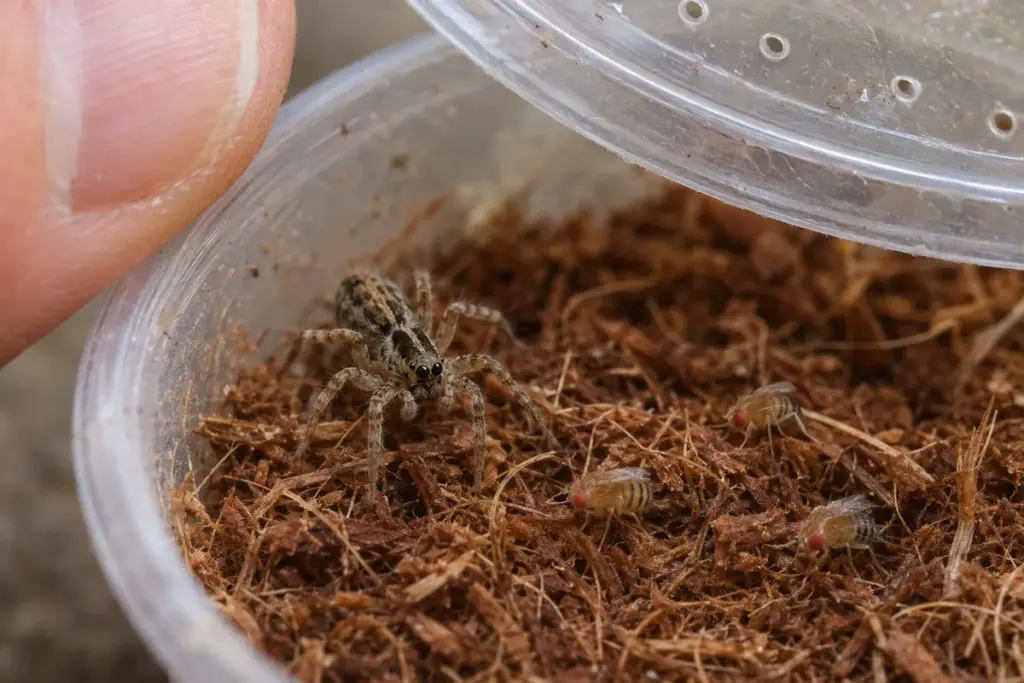
| 2–8 weeks | Free-roaming spiderling a few millimeters long | Flightless fruit flies, pinhead crickets or tiny isopods | 1–3 fruit flies or one pinhead cricket | 1–2 times a week; check 2 days later and feed again if it ate | Mist one side lightly so it can drink droplets. Keep each spiderling in its own small cup. |
| 2–8 months | Juvenile; body roughly 1/4 to 1/2 inch | Small crickets or roach nymphs | One prey item no longer than the spider's body | Every 4–7 days, going by abdomen size | Skip a meal when the abdomen looks plump. Remove uneaten live prey after about 4 hours. |
| 8 months and up | Subadult or adult; large Hogna females reach about 1 to 1 3/8 inches of body | Adult crickets or roaches; mealworm beetles as an extra | One prey item about the size of the front body section | Every 5–7 days | A healthy abdomen is a little under twice the size of the front body. They eat even when fat, so don't overfeed. |
| Around a molt | Refuses food and hides or seals itself in its burrow | Nothing | Take out all live prey | Wait about a week after the molt before feeding (a few days for spiderlings) | Live crickets and worms can wound or kill a soft, freshly molted spider. Keep water available. |
| Gravid or egg-sac females | Swollen abdomen, then a round silk egg sac on her spinnerets | Crickets or roaches | One prey item, as for other adults | About twice as often as other adults | Leave her undisturbed. One sac can hold dozens to hundreds of eggs, so plan where the spiderlings will go. |
Skip a meal whenever the abdomen looks plump and round. A thin, wrinkled abdomen means the spider needs food or water sooner.
Molting, egg sacs and changes with age
- Before a molt: the spider stops eating and often hides or seals its burrow. Remove all live prey and keep the water dish full.
- After a molt: wait until the fangs have darkened and hardened before the next meal. Tarantula keepers give about a week for adults and a few days for spiderlings.
- Adult females stop molting and eat less, unless they are producing egg sacs.
- Gravid females get about twice as many feedings as other adults, according to the zoo guidelines.
- Spiderlings ride on the mother for several days to a few weeks. She carries them but does not feed them, the Missouri Department of Conservation notes. Separate any you keep once they leave her.
Can wolf spiders eat mealworms?
Yes, now and then. Mealworms are slow, some wolf spiders ignore them, and an uneaten mealworm burrows into the substrate where it can bite a molting spider. Crush the head before offering one. Superworms have stronger jaws and suit only adults, also with the head crushed. Mealworm beetles were a favorite of the zoo’s Desertas wolf spiders, as an extra rather than the main diet.
Signs something is wrong
- Refuses food and hides: usually a coming molt. Remove prey, keep water in the dish and wait.
- Shriveled or wrinkled abdomen: dehydration or hunger. Check the water dish and the humidity, and offer a meal.
- Very swollen abdomen in a spider that is not gravid: overfeeding. Skip meals until it slims down.
- Stuck in its old skin or missing legs after a molt: a bad molt. The zoo guidelines link most molt deaths to humidity, so keep the substrate slightly damp and the water dish full.
- Refuses food for weeks with no molt and keeps losing condition: check the water and enclosure first, then ask an exotic animal vet. Remove any wild-caught food.
Printable wolf spider feeding chart
The cheat sheet fits on one page. It has the safe, small amounts only and never food lists, the schedule by size and the found-indoors steps. Print it in color or black and white and keep it beside the enclosure.
Supplies for feeding a wolf spider
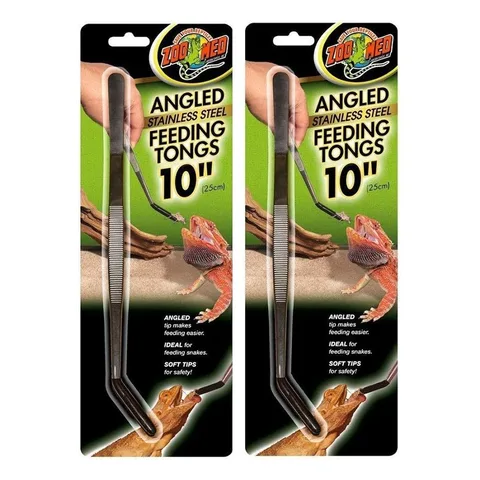
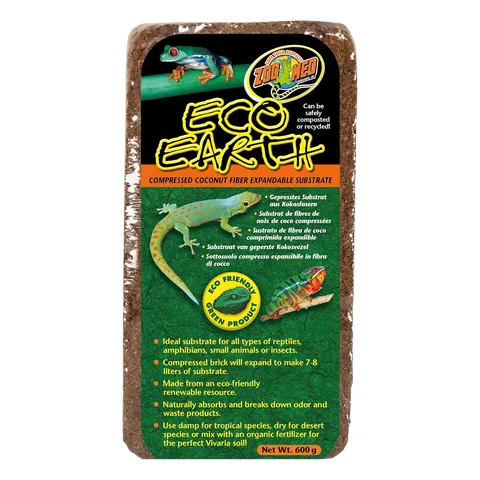
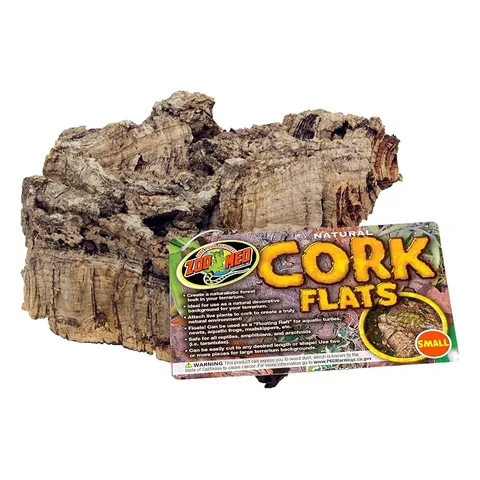
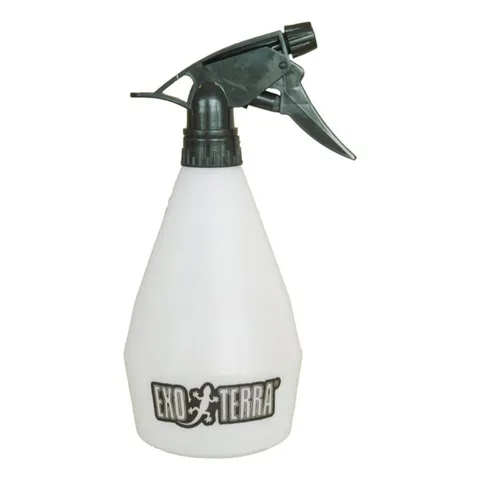
These are the items the zoo and keeper guides name: long tongs for feeding and removing leftovers, coconut fiber substrate, cork bark for a hide and a mister for spiderlings. Live feeder insects come from a pet store or feeder supplier.
More about spiders
The Carolina wolf spider and the rustic wolf spider are both in our list of forest spiders, and burrowing wolf spiders appear among the desert arachnids. For how spiders compare with other arachnids, see eight-legged animals beyond spiders, and for the species that can actually hurt people, the most dangerous arachnids, ranked by risk. Tropical relatives are in tropical rainforest spiders. For another predator fed on whole prey, see what to feed a baby snake. All our spider articles are in the spiders section.
Frequently asked questions
What do wolf spiders eat?
Wolf spiders eat live insects and other spiders. In the wild that means crickets, grasshoppers, beetles, caterpillars, flies, moths and smaller wolf spiders, caught by running them down or ambushing them rather than with a web. Large species occasionally take a small frog.
What should I feed a pet wolf spider?
Feed captive-bred crickets or roach nymphs no longer than the spider's body, one item per meal. Spiderlings take flightless fruit flies or pinhead crickets. Add a shallow water dish, such as a clean bottle cap, and never feed wild-caught insects.
How often do you feed a wolf spider?
Adults eat one prey item every 5 to 7 days, juveniles every 4 to 7 days depending on how full the abdomen looks, and spiderlings 1 to 2 times a week. Zoo guidelines warn that daily feeding leads to obesity, and wolf spiders keep eating even when fat.
What size cricket should I feed a wolf spider?
Pick prey no longer than the spider's body. For adults, zoo keepers aim for a cricket or roach about the size of the front body section (the cephalothorax). Spiderlings start on flightless fruit flies or pinhead crickets.
Do wolf spiders drink water?
Yes. Juveniles and adults drink from a small, shallow dish about 30 mm across; a clean plastic bottle cap is the right size. Spiderlings drink droplets, so mist one side of their cup lightly instead.
Can wolf spiders eat mealworms?
Yes, in small amounts. Crush the head first, because a live mealworm can burrow into the substrate and bite a spider while it molts. Crickets and roaches make a better staple.
Can I feed my wolf spider bugs from outside?
No. Wild-caught insects can carry pesticide residue from lawns and gardens and parasites. Bees, wasps, ants and fireflies are dangerous to spiders even when they are pesticide-free. Buy captive-bred feeders instead.
Can wolf spiders eat dead insects?
Freshly killed prey offered on tongs is fine, and it lets you see the spider eat. Dried-out dead bugs and fish food are not. Remove any dead food the spider ignores within a day.
Why is my wolf spider not eating?
The most common reason is an upcoming molt. The spider stops eating and often hides or seals its burrow. Remove live prey, keep water available and wait until a week or so after the molt before offering food again.
What do baby wolf spiders eat?
Newly hatched spiderlings ride on their mother's back for several days to a few weeks and don't eat. She carries them but does not feed them. Once they leave her, they eat flightless fruit flies or pinhead crickets 1 to 2 times a week.
Can two wolf spiders live together?
No. Wolf spiders eat each other, siblings included, and even well-fed groups of spiderlings cannibalize each other. Keep each spider in its own enclosure.
Are wolf spiders dangerous to people?
No. Wolf spiders bite only when handled or trapped against skin, and Penn State Extension reports that the pain, redness and swelling usually fade within 24 hours. Move one outside with a cup and a card instead of your hands.
Sources
- Best Practice Guidelines for Desertas Wolf Spiders (Hogna ingens), EAZA Terrestrial Invertebrate TAG
- Wolf Spiders, Penn State Extension
- Wolf Spiders and Little Wolves of Missouri, Missouri Department of Conservation
- Wolf Spiders and Nursery Web Spiders, Virginia Cooperative Extension
- Wolf Spiders, University of Kentucky Department of Entomology
- Wolf Spider (Rabidosa rabida), Illinois Department of Natural Resources
- Spiders as frog-eaters: a global perspective, Journal of Arachnology
- Size dependent intraguild predation and cannibalism in coexisting wolf spiders, Journal of Arachnology
- Lured and liquidated: fireflies and spiders, Cornell Chronicle
- Basic guide to keeping tarantulas, British Tarantula Society