Short answer: feed a baby water turtle every day, in warm water, on a mix of small commercial turtle pellets, protein such as cut earthworms, bloodworms or crickets, and dark leafy greens such as romaine and dandelion. Give about what it eats in 5 to 10 minutes, with pellets about the size of its head, and take out leftovers. Never feed iceberg lettuce, raw hamburger or chicken, bread, dairy, or bugs and fish caught outdoors. Hatchlings eat more protein than adults: from about 1 year old, aquatic turtles shift toward plants and eat their main meal every 2 to 3 days. Box turtles eat on land and stay mostly carnivorous for longer.
The chart below sorts common foods into safe staples, small amounts only and never feed. Search any food to see where it falls. Under the chart are setup steps, how to feed a hatchling, a schedule by age, notes for box turtles and a printable cheat sheet. This guide covers pet turtles. A turtle that stops eating, has swollen eyes or a soft shell needs a reptile vet. If you found a baby turtle outside, start with the box.
Found a wild baby turtle?
Can a baby turtle eat it?
Safe staples (8)
- Safe to feed. A complete aquatic turtle pellet supplies vitamin A and calcium that worms and greens lack. Offer a head-sized portion, never pellets alone.All ages#
- Safe to feed. Romaine, collard, mustard and turnip greens. Float them for aquatic turtles to graze, chop them for box turtles. The bulk of the adult diet.All ages#
- Safe to feed. Leaves and flowers are on vet lists for aquatic and box turtles and supply vitamin A. Use store-bought or unsprayed plants, rinsed well.All ages#
- Safe to feed. Duckweed, anacharis (elodea), water hyacinth and water lilies are safe tank plants that aquatic turtles can graze on all day.All ages#
- Safe to feed. Shredded red bell pepper is rich in vitamin A, which guards against the swollen eyes of vitamin A deficiency.All ages#
- Safe to feed. Top protein for hatchlings and box turtles. Cut to bite size and buy from a bait or pet shop; yard worms can carry pesticides.All ages#
- Safe to feed. Gut-loaded crickets or dubia roaches, small enough to swallow. Drop them in the water for aquatic turtles; box turtles hunt them on land.All ages#
- Safe to feed. Aquatic turtles must eat underwater to swallow, so feed in warm water. Box turtles need a shallow dish to soak and drink, changed daily.All ages#
Small amounts only (12)
- Small amounts only. Shredded, mixed in with greens. A good vitamin A source, but VCA ranks them below leafy greens, so they stay a side dish.All ages#
- Small amounts only. Safe but mostly water and low in nutrients. VCA lists it among the lesser vegetables, so offer a thin slice now and then.All ages#
- Small amounts only. Fine in a mixed salad, not every day. Spinach and chard carry oxalates that block calcium; kale and cabbage carry goitrogens.All ages#
- Small amounts only. NC State lists calcium oxalate crystals in it, and it is invasive in many states. Use duckweed or anacharis first.All ages#
- Small amounts only. Frozen bloodworms and tubifex tempt fussy hatchlings. Thaw them and use them as part of a varied diet, not on their own.All ages#
- Small amounts only. On VCA's protein lists, but RVC vets treat insects as occasional extras. Rotate them with earthworms and pellets.All ages#
- Small amounts only. Whole small fish add calcium from bones, but feeder fish can carry parasites. Offer store guppies or mollies only now and then.All ages#
- Small amounts only. A treat turtles love but a poor vitamin A source. Turtles kept on dried shrimp or turtle flakes can develop vitamin A deficiency.All ages#
- Small amounts only. A soft, sugary treat. Keep all fruit under about 5% of the diet (vets give 5 to 10%) and offer it mainly to turtles over a year old.From 1 year#
- Small amounts only. Berries and grapes are on vet fruit lists. Cut them small and offer a few pieces as an occasional treat.From 1 year#
- Small amounts only. Finely chopped or skinned apple is on PetMD and ReptiFiles treat lists. Offer a few small pieces, not a daily meal.From 1 year#
- Small amounts only. Melon is on vet treat lists. It is mostly water and sugar, so one small cube is plenty.From 1 year#
Never feed (12)
- Never feed. VCA vets advise against raw meat, chicken or fish from the store, and PetMD lists raw chicken and ground beef as foods to avoid.
- Never feed. VCA vets say processed foods such as hot dogs and lunch meat should never be fed to any turtle species.
- Never feed. VCA lists bread among the processed foods never to feed any turtle. Crackers, cereal, rice and pasta belong in the same group.
- Never feed. Turtles never drink milk in the wild and can't digest dairy. Cheese is also high in fat.
- Never feed. Cat and dog foods can be high in fat and vitamin D3. VCA calls them a poor food for box turtles; use turtle pellets instead.
- Never feed. Insects, worms, fish and frogs caught outdoors can carry parasites, pesticides or fertilizer. Buy feeders from a pet or bait shop.
- Never feed. Fireflies carry toxins that kill reptiles, sometimes after just one. Chewy and ReptiFiles list them as never for turtles.
- Never feed. These feeders carry thiaminase, which destroys vitamin B1, and are high in fat. Fish-heavy diets can cause B1 deficiency.
- Never feed. Avocado is on the PetMD, Chewy and ReptiFiles avoid lists, onion and garlic on Chewy's and ReptiFiles', and rhubarb on ReptiFiles'.
- Never feed. ReptiFiles lists tomatoes and citrus as foods to avoid. PetMD includes oranges among fruits, so sources split; skip them.
- Never feed. Mostly water with little nutrition. Turtles fed iceberg lettuce are among the most likely to develop vitamin A deficiency.
- Never feed. Sweets, salty snacks and nuts are processed human foods. VCA says processed foods should never be fed to any turtle.
Sources
- Feeding Aquatic Turtles (Rich, Hess, Axelson) — VCA Animal Hospitals
- Feeding Box Turtles (Rich, Hess, Axelson) — VCA Animal Hospitals
- Common Diseases of Aquatic Turtles — VCA Animal Hospitals
- Housing Box Turtles — VCA Animal Hospitals
- Aquatic Turtle Care Sheet (Melissa Witherell, DVM) — PetMD
- What Do Turtles Eat? (Lauren Jones, VMD) — PetMD
- Nutritional, Metabolic, and Endocrine Diseases of Reptiles — Merck Veterinary Manual
- Nutrition in Reptiles — Merck Veterinary Manual
- Nutrition in Tortoises — Merck Veterinary Manual
- Feeding Terrapins (PDF, reviewed 2024) — Royal Veterinary College, Beaumont Sainsbury Animal Hospital
- Hypovitaminosis A in Terrapins (PDF, reviewed 2024) — Royal Veterinary College, Beaumont Sainsbury Animal Hospital
- Aquatic Turtle Care Guide (PDF) — MedVet
- How should I care for my turtles? — RSPCA Australia
- What should I feed my reptile? — RSPCA Australia
- Healthy Pets: Reptiles and Amphibians — Centers for Disease Control and Prevention
- Tiny turtles, illegal to sell as pets, causing Salmonella illnesses again in young kids (2024) — Centers for Disease Control and Prevention
- Aquatic Turtle Care Sheet (reviewed by Ivan Alfonso, DVM) — Chewy (retailer)
- What Do Red-Eared Sliders Eat? Diet and Feeding Guide — ReptiFiles
- Diet of Aquatic Turtles — Tortoise Trust
- Can Turtles Eat Cheese? (reviewed by Karyn Kanowski, BVSc) — The Vet Desk
- Are fireflies poisonous to reptiles? — Pet Poison Helpline
- Pistia stratiotes (Water Lettuce) — NC State Extension Plant Toolbox
- Hatchling Tips — RedEarSlider.com
- Box Turtle Care — Long Island Turtle Rescue
- Eastern Box Turtle Care Sheet (Joe Myers) — Reptiles Magazine
- What Do I Do With Hatching Turtles? (Brian MacGowan) — Purdue University Extension, Forestry and Natural Resources
- 8 Tips to Protect Baby Turtles in Your Yard — National Wildlife Federation
- Tips for helping a turtle cross the road — U.S. Fish and Wildlife Service
- Turtles — Virginia Department of Wildlife Resources
- Native turtles cannot be kept as pets (news release, 2021) — Oregon Department of Fish and Wildlife
- What To Do If You Found a Sick or Injured Turtle — Tufts Wildlife Clinic, Cummings School of Veterinary Medicine
- Report a Stranded or Injured Marine Animal — NOAA Fisheries
- Sea Turtle Stranding and Salvage Network — NOAA Fisheries
- What Can You Do to Help Sea Turtles? — NOAA Fisheries
- Find A Vet — Association of Reptile and Amphibian Veterinarians
Setting up a feeding routine for a baby turtle
A hatchling eats well when its water is warm, its light is right and its food is small enough to swallow. Get those in place before worrying about the menu.
1. Warm the water
Turtles are cold-blooded, and cool water dulls their appetite. PetMD advises feeding turtles of all ages in water in the upper 70s °F. MedVet’s care guide keeps hatchling water warmer, at 82 to 85 °F, with a basking spot of 85 to 90 °F. Check both with a thermometer rather than by hand.
2. Give it UVB light
Turtles need ultraviolet light to use calcium, and RSPCA Australia calls them “very reliant on ultraviolet light for the health of their bones.” Run a UVB bulb over the basking spot 10 to 12 hours a day, PetMD advises, and replace it every 6 months. UVB does not pass through glass or plastic, so the bulb must shine directly on the turtle.
3. Expect a slow start
A turtle fresh out of the egg may still carry a yolk sac or a scar on its belly and may not eat for its first days, according to hatchling notes on RedEarSlider.com. A new turtle in an unfamiliar tank can also skip a few meals. A turtle that keeps refusing food in warm, clean water needs a reptile vet.
What to feed a baby turtle: pellets, protein and greens
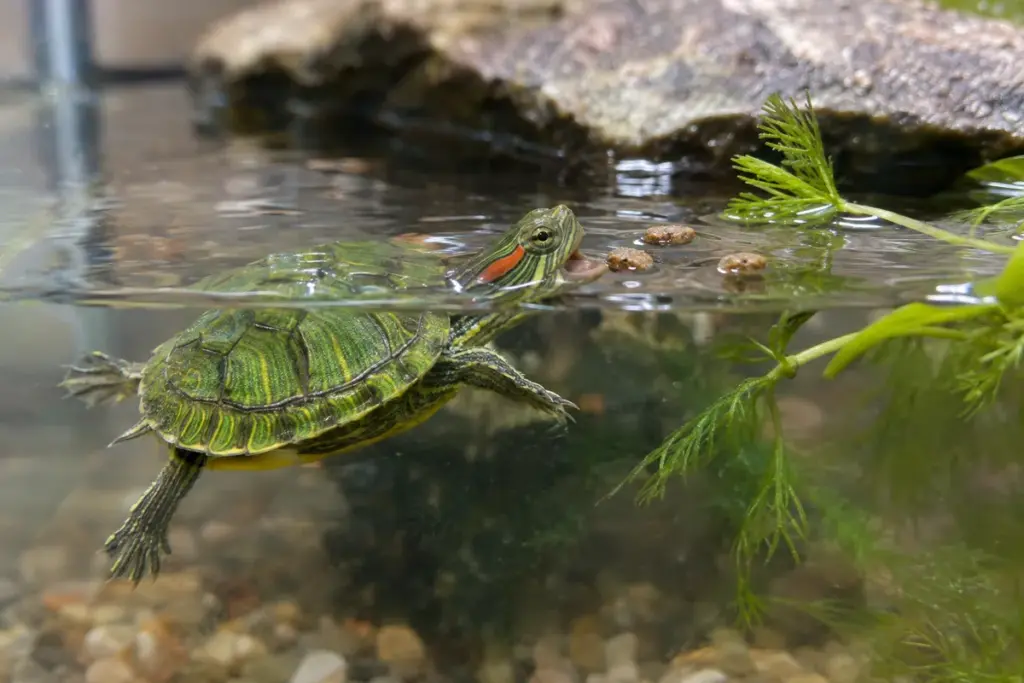
Most pet water turtles (red-eared sliders, cooters, painted, map, musk and mud turtles) are omnivores. VCA Animal Hospitals notes they are “mainly carnivorous” as juveniles and eat more plants with age. A hatchling’s diet has three parts:
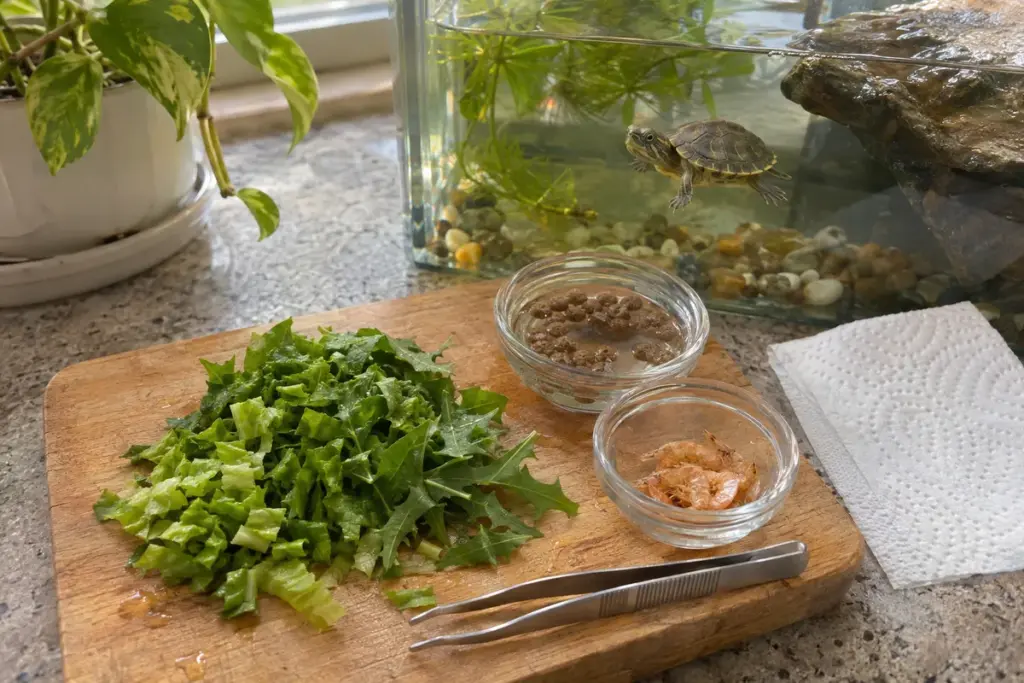
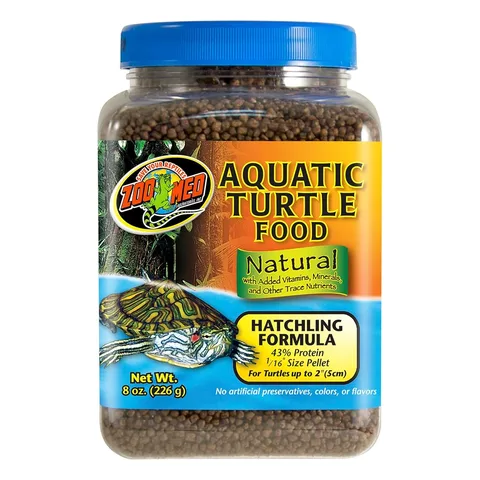
- Commercial turtle pellets. Small pellets made for juveniles. VCA names Fluker’s, Mazuri and Zoo Med as vet-recommended brands. Pellets carry vitamin A and calcium that a worm-and-greens diet lacks, the Royal Veterinary College notes. Vets disagree on how much of the diet they should be: PetMD caps them at about 25%, while MedVet makes them the majority. A pellet portion about the size of the turtle’s head, alongside the foods below, fits both.
- Animal protein, about half the diet. Cut earthworms or nightcrawlers, gut-loaded crickets or roaches, and bloodworms. VCA allows up to two thirds animal food for juveniles; Chewy’s vet-reviewed care sheet and ReptiFiles use half.
- Greens and water plants. Romaine, collard, mustard and turnip greens, dandelion greens and shredded red bell pepper. Duckweed and anacharis (elodea) can float in the tank so the turtle grazes all day, as VCA suggests.
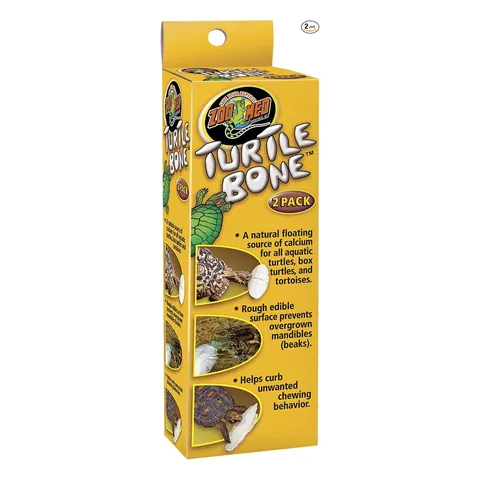
Aquatic turtles get calcium from their pellets and from a cuttlebone left floating in the tank. Powders wash off in water, ReptiFiles points out, so dusting food does little for them. Box turtles are different: VCA advises a light dusting of calcium powder on their greens 2 to 3 times a week. Don’t add a multivitamin or vitamin D3 unless a vet tells you to, because VCA warns that over-supplementing D3 is a common problem.
Foods that harm baby turtles
- Iceberg lettuce and celery. Mostly water. VCA lists turtles fed iceberg lettuce, an all-meat diet or a poor commercial diet as the most likely to develop vitamin A deficiency.
- Raw hamburger, chicken and other store meat. VCA says raw meat, fish or chicken from the grocery store is not recommended, and PetMD lists raw chicken and ground beef among foods to avoid.
- Hot dogs, deli meat, bread, chips and crackers. “Processed foods… should never be fed to any turtle species,” VCA writes.
- Milk and cheese. Turtles can’t digest dairy and never drink milk in the wild.
- Dog and cat food. RSPCA Australia warns these can be high in fat and vitamin D3. Use turtle pellets instead.
- Bugs, worms and fish caught outdoors. VCA links wild-caught food to parasites, and the pesticides and fertilizers on yard insects can be toxic. Buy feeders from a pet store or bait shop.
- Fireflies. Pet Poison Helpline reports firefly chemicals cause reptile deaths every year, sometimes after a single firefly.
- Goldfish and rosy red minnows. High in fat and in thiaminase, an enzyme that destroys vitamin B1. The Merck Veterinary Manual says B1 deficiency is common in turtles fed thiaminase-rich fish. Guppies and other livebearers are the better feeder fish.
- Dried shrimp and turtle flakes as a staple. The Royal Veterinary College calls shrimp and dried turtle mixes “poor sources of vitamin A.” A few shrimp make a treat, not a meal.
- Avocado, onion, garlic and rhubarb. All appear on vet and keeper avoid lists.
How to feed a baby turtle
Water turtles eat with their heads underwater. VCA says they “will not eat out of the water,” so a food dish on the basking dock doesn’t work.
- Wash your hands, then prepare the food. Chop worms and greens into pieces smaller than the turtle’s head. Shred carrots and squash.
- Drop food into the water. Pellets float or sink depending on the brand. Feeding tongs or tweezers help with worms and crickets.
- Feed what it eats in 5 to 10 minutes. That is the guide in Chewy’s care sheet and ReptiFiles, and it keeps meals small. Overfeeding protein is easy, the Tortoise Trust warns.
- Remove leftovers. Scoop out uneaten pellets and protein before they foul the water. Greens and water plants can stay in to graze.
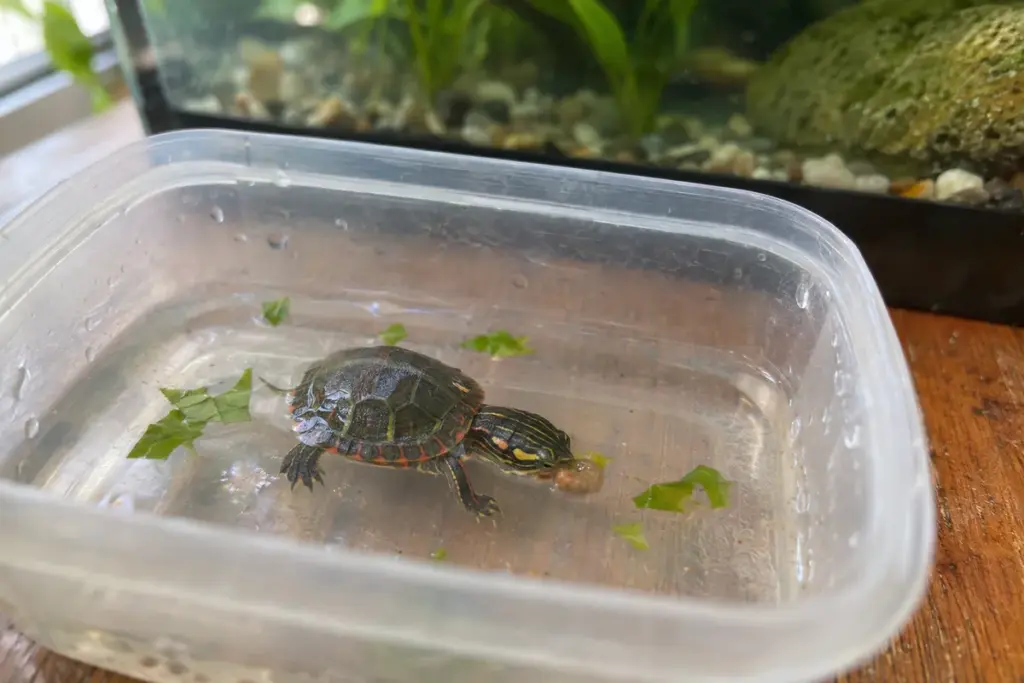
- Consider a feeding tub. VCA and MedVet suggest feeding in a separate small container of warm water so the turtle soils that instead of its tank. Use enough water to cover the turtle’s back. The Royal Veterinary College notes that the extra handling stresses some turtles, so skip the tub if yours won’t eat in it.
- Wash up away from the kitchen. The CDC advises cleaning turtle gear outside or in a laundry sink or bathtub, then disinfecting it.
Baby turtle feeding schedule by age
The schedule follows red-eared sliders, the most common pet water turtle, with box turtle differences in each row. US and UK vet sources agree on daily meals for hatchlings. After the first year, sources split between every 2 to 3 days and daily until age 2; the table uses PetMD’s care sheet figure of every 2 to 3 days, with greens daily, to avoid overfeeding. Ages are approximate: go by size, growth and a vet check.
| Age | What it looks like | Food | Amount | How often | Notes |
|---|---|---|---|---|---|
| 0–6 months | Hatchling; may still have a yolk sac or scar on its belly in the first days | Aquatic: small pellets, bloodworms, chopped earthworms, floating greens. Box: chopped earthworms and insects plus greens | What it eats in about 5–10 minutes; pellets about the size of its head; remove leftovers | Daily | Protein about half the diet (VCA allows up to two thirds). A hatchling still absorbing its yolk may skip food for a few days. Cool water dulls appetite. |
| 6–12 months | Juvenile; growing fast and eating eagerly | Same mix: protein about half, greens daily, pellets daily or every other day | Protein and pellets eaten in 5–10 minutes; greens can stay in the water to graze | Daily | Aquatic turtles: keep a cuttlebone in the tank for calcium. Box turtles: dust greens lightly with calcium 2–3 times a week. UVB light every day. |
| 1–3 years | Subadult; aquatic turtles start eating more plants | Aquatic: greens daily, pellets 2–3 times a week, protein 1–2 times a week. Box: still mostly worms and insects, more greens | Protein eaten in 5–10 minutes; pellets about head-sized; greens freely | Aquatic: main meal every 2–3 days, greens daily. Box: daily | Fruit can start as a small treat, under about 5% of the diet. It is easy to overfeed protein, so don't add extra meals. |
| 3 years and up | Adult; sliders and cooters are mostly plant eaters | Aquatic: greens and water plants 50% or more, about 25% pellets, about 25% protein. Box: about half plants, half animal food | Pellets about the size of the head plus greens to graze | Aquatic: every 2–3 days (greens can stay daily). Box: daily or every other day | Some species stay meat-heavy as adults; ask a reptile vet about yours. Tortoises are herbivores and need a different diet. |
Weigh a young turtle every few weeks on a kitchen scale and note its shell length. Steady growth with a hard, smooth shell means the diet is working. A soft shell or weight loss means a vet visit.
How a baby turtle’s diet changes with age
- Under 1 year: protein about half the diet, pellets daily or every other day, greens every day.
- 1 to 3 years: greens daily, pellets 2 to 3 times a week and protein once or twice a week, the split ReptiFiles uses.
- Adults: PetMD puts omnivorous water turtles at more than 50% plants, about 25% pellets and about 25% animal protein. Soft-shelled turtles stay mostly carnivorous.
- Fruit: a small treat for turtles over about a year old, under about 5% of the diet, PetMD advises.
Can baby turtles eat fruit like bananas, strawberries and grapes?
Yes, as an occasional treat once the turtle is about a year old. Cut banana, strawberries, blueberries, grapes, apple or melon into pieces smaller than its head, and give a few pieces at most. PetMD caps treats, fruit included, at 5% of an adult’s diet. Fruit fills a hatchling up without the protein and calcium it needs to grow, so skip it in the first year. Tomatoes and citrus appear on keeper avoid lists and are best left out.
Feeding a baby box turtle
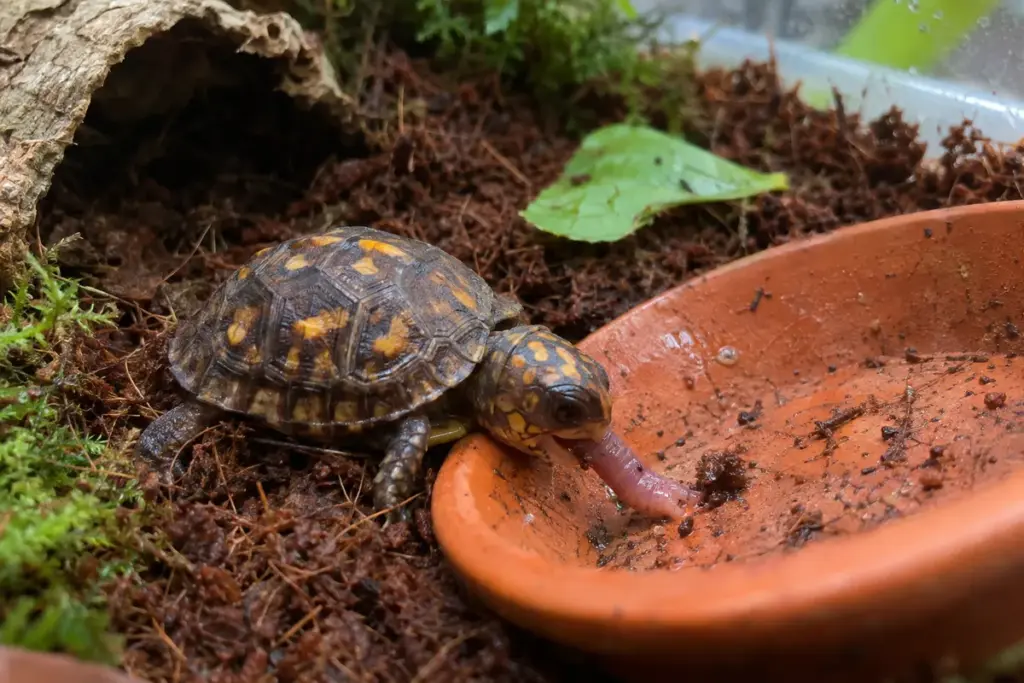
Box turtles live on land and eat out of a shallow dish, not in water. VCA describes young box turtles, up to 4 to 6 years old, as “primarily carnivores,” while adults eat about half plants and half animal food.
- Protein: cut earthworms and nightcrawlers, crickets, roaches and the occasional mealworm or waxworm, all store-bought.
- Plants: dark leafy greens, shredded squash and carrots, with a light calcium dusting 2 to 3 times a week.
- Water and humidity: a shallow dish with a ramp to soak and drink, cleaned daily, and damp substrate, per VCA’s housing guide.
- Pellets: VCA counts reptile pellets as a good protein source, but Long Island Turtle Rescue advises against pet-store box turtle pellets. Treat them as one part of the menu.
Tortoises are a separate case. The Merck Veterinary Manual describes them as herbivores that must eat plant material, so a tortoise should not get the worms and pellets on this page.
Baby turtles, Salmonella and the 4-inch rule
Turtles can carry Salmonella without looking sick. Since 1975, federal law has banned selling turtles with shells under 4 inches as pets, and the CDC still traces outbreaks among young children to these small turtles. The CDC does not recommend pet turtles for homes with children under 5, adults 65 and older or people with weakened immune systems. If you already have a baby turtle:
- Wash your hands with soap and running water after touching the turtle, its food or its tank.
- Don’t kiss the turtle or hold it close to your face.
- Keep the turtle, its food and its gear out of the kitchen.
- Never release a pet turtle outdoors.
Signs something is wrong
- Won’t eat: check the water temperature first. A turtle that keeps refusing food in warm, clean water needs a vet.
- Swollen or closed eyes, often with discharge: the classic sign of vitamin A deficiency, VCA says, usually from iceberg lettuce, an all-meat diet or a poor diet. See a vet rather than adding vitamins yourself.
- Soft shell or soft spots: often a calcium and UVB problem. VCA describes metabolic bone disease as “a misshapen shell or deformed bones.” Check the UVB bulb’s age and see a vet.
- Lumpy, pyramid-shaped shell growth: in tortoises the Merck Veterinary Manual links this to fast growth on high-protein diets. Have a vet look at any turtle whose shell grows unevenly.
- Floats lopsided, has a runny nose or struggles to breathe: Chewy’s vet-reviewed care sheet says a turtle floating unevenly needs a vet right away, and the Royal Veterinary College lists a runny nose and breathing problems among the signs of vitamin A deficiency.
The Association of Reptile and Amphibian Veterinarians keeps a directory of reptile vets.
Printable baby turtle feeding chart
The cheat sheet fits on one page. It has the safe, small amounts only and never food lists, the schedule by age and the wild baby turtle steps. Print it in color or black and white and keep it beside the tank.
Supplies for feeding a baby turtle
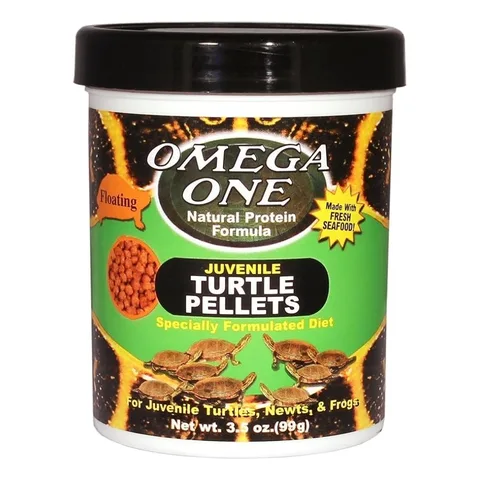
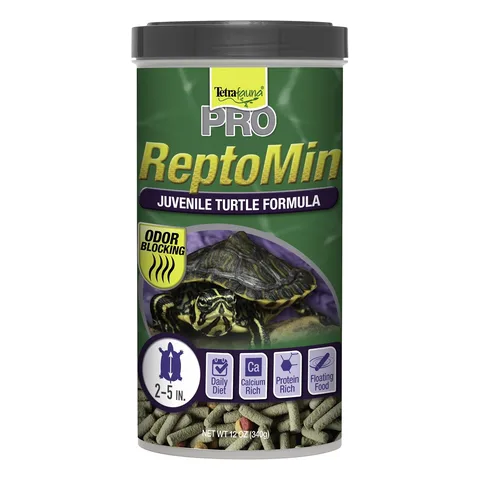
These are the foods and tools vet and keeper guides name: hatchling pellets from brands vets recommend, a cuttlebone for calcium and a temperature gun to check the water and basking spot. Rotating two or three pellet brands, as ReptiFiles advises, evens out their differences.

More about turtles
A hatchling grows fast, so plan its home around the adult size with the best turtle tank guide and its size calculator. See how young turtles fit into the wild food web in wetland omnivores and swamp herbivores, and how tortoises differ in the characteristics of a tortoise. For other young reptiles and pets, see what to feed a baby snake and what to feed a baby duck. All our turtle articles are in the turtles and tortoises section.
Frequently asked questions
What do baby turtles eat?
Pet baby water turtles eat small commercial turtle pellets, animal protein such as cut earthworms, bloodworms and crickets, and dark leafy greens such as romaine and dandelion. Protein makes up about half of a hatchling's diet. Baby box turtles eat mostly worms and insects with some greens, from a dish on land.
How often should I feed a baby turtle?
Feed a hatchling every day. From about 1 year old, PetMD feeds aquatic turtles their main meal every 2 to 3 days, with greens left in the water daily. Box turtles eat daily when young and daily or every other day as adults.
How much should I feed a baby turtle?
Give about what it eats in 5 to 10 minutes, with a pellet portion about the size of its head. Scoop out uneaten pellets and protein afterward so they don't foul the water. Greens and water plants can stay in for grazing.
Can baby turtles eat lettuce?
Romaine and other dark leafy greens are good daily foods. Iceberg lettuce is not: it is mostly water, and VCA lists turtles fed iceberg lettuce among the most likely to develop vitamin A deficiency, which causes swollen eyes.
Can baby turtles eat bananas or strawberries?
Only as a small treat, and only once the turtle is about a year old. Cut the fruit into pieces smaller than its head and keep all fruit under about 5% of the diet. Hatchlings need the protein and calcium that fruit doesn't supply.
Can turtles eat bread or cheese?
No. VCA says processed foods such as bread, hot dogs and lunch meat should never be fed to any turtle. Turtles also can't digest dairy, so milk and cheese are off the menu.
Can baby turtles eat dried shrimp or turtle flakes?
As a treat only. The Royal Veterinary College calls shrimp and dried turtle mixes poor sources of vitamin A, and turtles living on them can develop swollen eyes. Use a complete pellet as the base and add live or fresh protein and greens.
Can baby turtles eat goldfish or feeder fish?
Skip goldfish and rosy red minnows: they are high in fat and in thiaminase, which destroys vitamin B1. Guppies, platies and other livebearers are the better choice, given now and then. Never use fish caught outdoors, which can carry parasites.
Do baby turtles need to eat in water?
Aquatic turtles do. VCA says they swallow with their heads underwater and will not eat out of the water. Box turtles are land turtles and eat from a shallow dish.
Why is my baby turtle not eating?
Check the water and basking temperatures first: PetMD notes that warm water stimulates a turtle's appetite. A hatchling may also skip its first days while it absorbs its yolk. A turtle that keeps refusing food in warm, clean water, or has swollen eyes or a soft shell, needs a reptile vet.
Do baby turtles need calcium?
Yes, plus UVB light to use it. Aquatic turtles get calcium from their pellets and a cuttlebone floating in the tank, since powders wash off in water. Box turtles get a light dusting of calcium powder on their greens 2 to 3 times a week.
What should I do if I find a wild baby turtle?
Leave a healthy hatchling where it is: baby turtles get no parental care and find their own food. Help one across a road in the direction it was heading. Never take a sea turtle hatchling; call your state's stranding hotline. Keeping a wild turtle usually needs a permit, and an injured one should go to a wildlife rehabilitator.
Sources
- Feeding Aquatic Turtles, Feeding Box Turtles and Common Diseases of Aquatic Turtles, VCA Animal Hospitals
- Aquatic Turtle Care Sheet and What Do Turtles Eat?, PetMD
- Nutritional, Metabolic, and Endocrine Diseases of Reptiles, Merck Veterinary Manual
- Feeding Terrapins and Hypovitaminosis A in Terrapins, Royal Veterinary College
- Aquatic Turtle Care Guide, MedVet
- How should I care for my turtles?, RSPCA Australia
- Healthy Pets: Reptiles and Amphibians, Centers for Disease Control and Prevention
- What Do Red-Eared Sliders Eat?, ReptiFiles
- What To Do If You Found a Sick or Injured Turtle, Tufts Wildlife Clinic
- What Do I Do With Hatching Turtles?, Purdue University Extension