Contents
- TLDR
- Wombat fact box
- Body: a bulldozer on four short legs
- The armored rump
- Teeth that never stop growing
- The backward-facing pouch
- Cube-shaped droppings
- Senses and speed
- Burrows
- Common vs hairy-nosed wombats
- Relatives: koalas and a giant ancestor
- FAQ
TLDR
A wombat is a stocky, burrowing marsupial from Australia that weighs 19 to 39 kg. Three species exist: the common wombat and two hairy-nosed wombats. The main characteristics of a wombat are short, powerful legs with flat digging claws, a rump made of tough cartilage that works as a burrow plug, rodent-like front teeth that never stop growing, a pouch that opens backward, and cube-shaped droppings. Every one of those traits traces back to living underground.
Wombat fact box
| Trait | Detail |
|---|---|
| Group | Marsupial (pouched mammal) |
| Species | Common (bare-nosed), southern hairy-nosed, northern hairy-nosed |
| Weight | About 19 to 39 kg, depending on species |
| Length | Roughly 70 cm to 1.2 m |
| Diet | Grasses, sedges, roots, bark and moss |
| Active | Mostly at night |
| Top speed | Around 40 km/h in short bursts |
| Lifespan | Around 15 years in the wild, longer in captivity |
Body: a bulldozer on four short legs
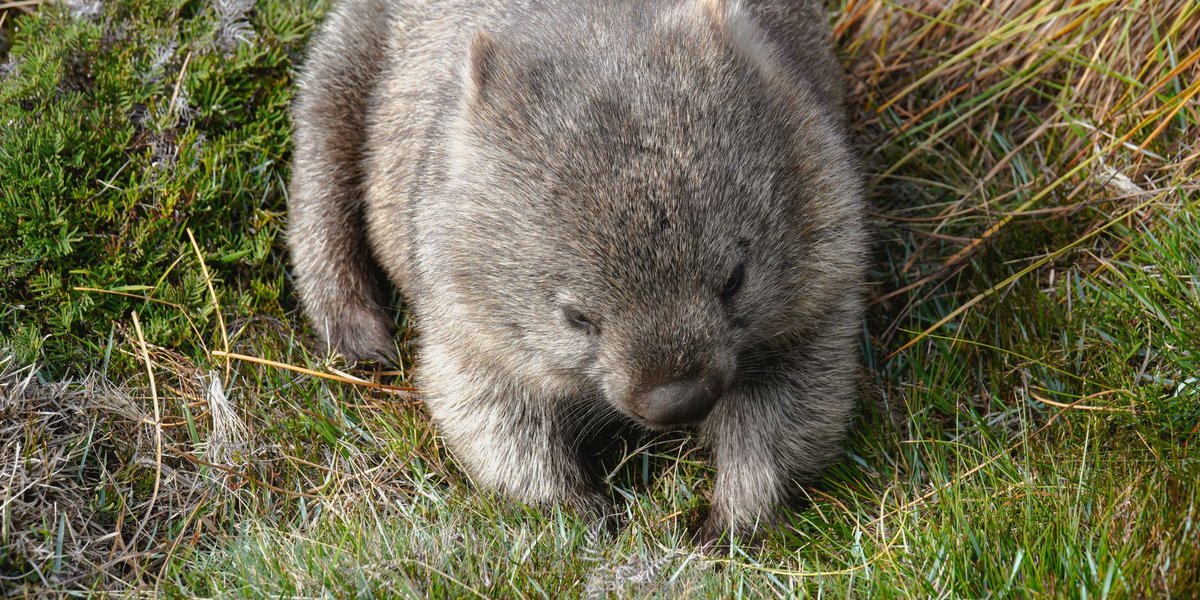
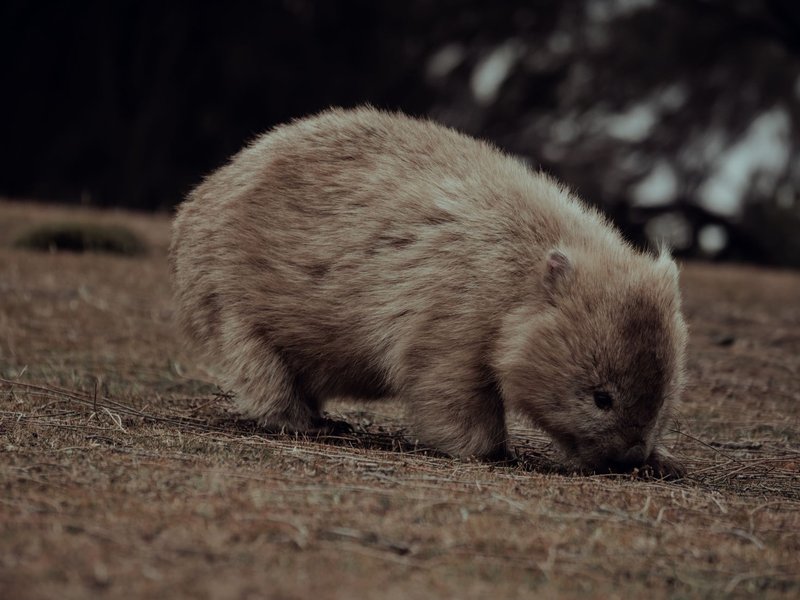
A wombat looks like someone built a small bear with the proportions of a footstool. The body is barrel-shaped, the head is broad and flat, the neck is thick, and the legs are short enough that the belly nearly brushes the ground.
That build is a digging machine. The forelimbs are thick with muscle, and each paw ends in five heavy claws that are flat and shovel-like rather than curved like a cat’s. A wombat digs by raking soil underneath its body and kicking it out behind. The same low center of gravity that makes it look comical makes it hard to knock over or drag out of a tunnel.
Fur differs by species. Common wombats have coarse, thick coats in brown, black or sandy grey, and a bare, leathery nose pad. Hairy-nosed wombats have softer, silkier grey fur and, as the name says, fine hair covering the muzzle.
The armored rump
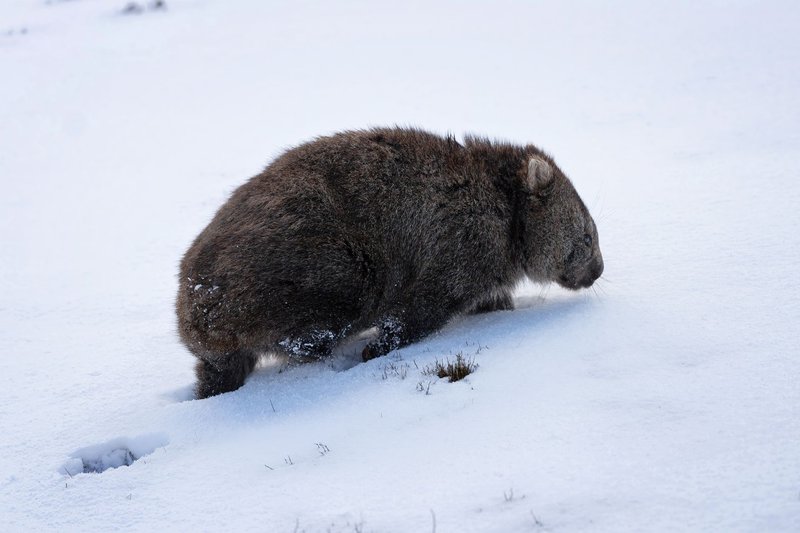
The back end of a wombat is a defensive weapon. The rump is covered by a thick plate of cartilage and tough skin, with very little nerve sensitivity, topped with dense fur.
When something follows a wombat into its burrow, the wombat doesn’t turn and fight. It dives into the tunnel head first and presents the rump. Anything trying to bite it hits armor. A wombat can also wedge itself against the roof of the tunnel and crush a predator’s skull between its rump and the ceiling, which is a hazard for dingoes and Tasmanian devils. According to National Geographic, wombats use this rump-first defense to block the burrow entrance, leaving a pursuer facing a wall of cartilage.
Teeth that never stop growing
Open a wombat’s mouth and you’ll find a set of chisel-shaped incisors that look like a rodent’s. The resemblance isn’t a coincidence of ancestry (wombats are marsupials, not rodents), it’s a case of two groups arriving at the same solution.
Wombat teeth are rootless and grow continuously. The diet is the reason: tough, gritty grasses and roots wear teeth down fast, and soil gets into everything when you eat while living underground. If the teeth stopped growing, a wombat would run out of tooth in a few years. Constant chewing keeps them filed to length.
Wombats also have an unusually slow gut. Food can take around two weeks to pass through, which squeezes the maximum nutrition out of low-quality fiber. Their water needs are low as well, a useful trait on dry Australian plains.
The backward-facing pouch
Like all marsupials, female wombats raise their young in a pouch. The wombat pouch opens toward the rear rather than the head, which is the opposite of a kangaroo’s.
The reason is dirt. A wombat digs by throwing soil backward. If the pouch opened forward, every dig would shower the joey in dust and gravel. Facing back, the opening is sheltered by the body and stays clear.
A single joey is born after a gestation of roughly a month. It is about the size of a jellybean, climbs into the pouch and stays there for around six to ten months. It keeps nursing for a long time after that, and stays close to its mother for well over a year.
Cube-shaped droppings
This is the trait that gets wombats on social media. Wombats are the only known animal that produces cube-shaped droppings, and they leave them in stacks.
The shape forms in the last stretch of the intestine. The tissue there has stiffer and softer regions, so as the waste dries and compresses, it gets squared off rather than rounded. A wombat can produce around 80 to 100 of these cubes in a single night.
Why the cubes? The leading explanation is territory marking. Wombats place droppings on rocks, logs and raised tufts of grass to signal their presence, and a cube doesn’t roll away. Their poor eyesight makes smell the primary language, so a stack of scent-heavy cubes on a log works like a sign on a fence.
Senses and speed
A wombat’s eyes are small and its eyesight is weak. It doesn’t need much: it spends the day underground and forages in the dark. Smell and hearing do the heavy lifting. The nose finds food and other wombats, and the ears pick up approaching trouble.
Don’t let the build fool you about speed. A wombat can run at roughly 40 km/h for short stretches, which is faster than most people can sprint. It won’t keep that up for long, but it’s enough to reach a burrow before a predator reaches it.
Burrows
Wombats are tunnelers, and a wombat burrow is serious engineering. A common wombat’s system can run more than 20 meters, with several chambers and entrances. The southern hairy-nosed wombat is the social digger of the group, living in warrens where multiple animals share linked tunnels.
The burrow is a climate-controlled shelter. Inside, temperature and humidity stay stable while the surface swings between hot days and cold nights. Wombats usually leave at dusk to graze and return before dawn. Other animals take advantage: rabbits, lizards and snakes have all been found sharing wombat tunnels.
Common vs hairy-nosed wombats
Three species make up the whole family. The common wombat is the one you’re most likely to see in photos and in the wild. The two hairy-nosed species live in drier country and look softer around the face.
| Common wombat | Southern hairy-nosed | Northern hairy-nosed | |
|---|---|---|---|
| Scientific name | Vombatus ursinus | Lasiorhinus latifrons | Lasiorhinus krefftii |
| Weight | About 20 to 39 kg | About 19 to 32 kg | About 31 to 40 kg |
| Nose | Bare, leathery pad | Hairy | Hairy |
| Fur | Coarse | Soft, silky grey | Soft, silky grey |
| Range | Southeastern Australia and Tasmania | Semi-arid South Australia and nearby areas | A tiny area of Queensland |
| Habits | Mostly solitary | Lives in shared warrens | Lives in shared warrens |
| Conservation status | Least Concern | Least Concern | Critically Endangered |
The northern hairy-nosed wombat is one of the rarest large mammals on Earth, with only a few hundred individuals left. Its fate rests on a small number of protected sites, which is why it carries the Critically Endangered label from the IUCN.
Relatives: koalas and a giant ancestor
Wombats and koalas look nothing alike, but they are each other’s closest living relatives, according to the Animal Diversity Web from the University of Michigan. Both belong to the group Vombatiformes. The shared features aren’t obvious from the outside, but the koala’s pouch also opens backward, a family trait.
The family tree once had much larger members. Diprotodon, a relative that lived in Australia during the Ice Age, grew to roughly the size of a hippo, around 2.5 tonnes. It’s the largest marsupial known. When people say “giant wombat,” this is usually the animal they mean, though strictly speaking it was a distant cousin and not a wombat itself.
FAQ
How big is a wombat? Adults range from about 19 to 39 kg and 70 cm to 1.2 m long, with the northern hairy-nosed wombat reaching the top of the weight range.
Why do wombats have cube-shaped poop? The final part of the intestine has regions that stretch differently, which shapes the dry waste into cubes. The cubes stack well and probably help wombats mark territory.
What do wombats eat? Mostly native grasses, along with sedges, roots, moss and bark. Their incisors keep growing to cope with the wear.
Do wombats have pouches? Yes. The pouch faces backward so that dirt kicked up during digging doesn’t get inside.
Are wombats dangerous? They’re shy and avoid people, but they are heavy, muscular and have strong claws. Keep your distance in the wild, especially from a mother with a joey.
How long do wombats live? Around 15 years in the wild, and longer in captivity.