This guide covers the U.S. state of Georgia. If you meant the country in the Caucasus, that’s a different list: brown bears, Caucasian lynx, tur, and the Persian leopard live there, and none of them live in Peach State forests.
Georgia’s native animals are easiest to sort by geography. The state runs from Appalachian cold-water streams at the top to salt marsh and barrier islands at the bottom, and almost every species has a home range that fits one of those zones. Below is a region-by-region list of what actually lives here, how to recognize it, where to see it, and how it’s doing. Native status is spelled out too, because the animals people assume are Georgia natives (armadillos, feral hogs) often aren’t.
Table of contents
- Georgia’s state animals
- Blue Ridge and Ridge and Valley (north Georgia)
- The Piedmont
- The Coastal Plain and the Okefenokee
- The coast and barrier islands
- Snakes: six venomous species out of 46
- Protected species snapshot
- Native, introduced, or gone
- Where and when to see Georgia wildlife
- FAQ
- Summary
Georgia’s state animals
The official symbols are a decent shortlist of the animals Georgians care about. Two of them, the gopher tortoise and the right whale, are also among the state’s most protected.
| Category | Animal | Scientific name |
|---|---|---|
| State mammal | White-tailed deer | Odocoileus virginianus |
| State bird | Brown thrasher | Toxostoma rufum |
| State reptile | Gopher tortoise | Gopherus polyphemus |
| State amphibian | Green tree frog | Dryophytes cinereus |
| State fish | Largemouth bass | Micropterus nigricans |
| State marine mammal | North Atlantic right whale | Eubalaena glacialis |
| State game bird | Northern bobwhite | Colinus virginianus |
| State insect | Honeybee | Apis mellifera |
One footnote: the honeybee is a symbol, not a native. Honeybees came over with European settlers. Georgia’s native bees (bumble bees, mason bees, sweat bees) are a separate and much larger group.
Blue Ridge and Ridge and Valley (north Georgia)
The mountains hold the coolest, wettest habitat in the state, and the animals reflect it. This is salamander country: the southern Appalachians have more salamander species than anywhere else on Earth.
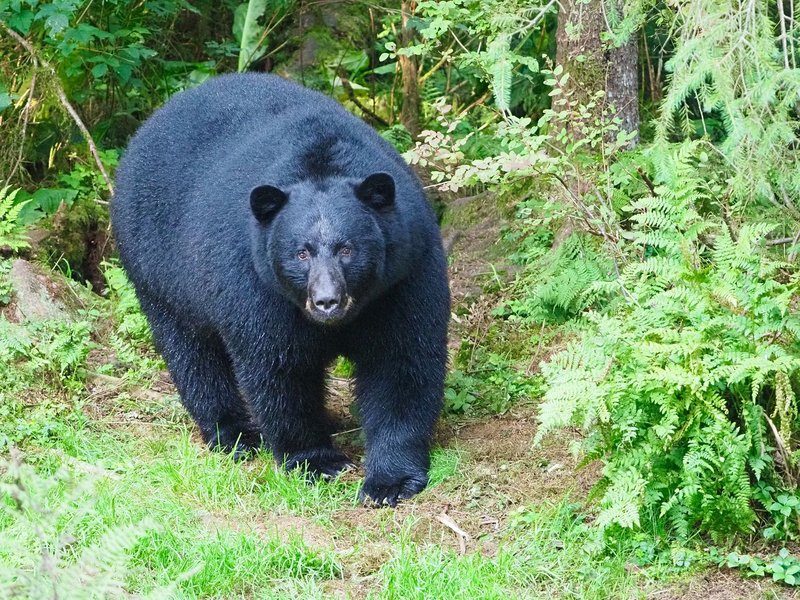
Black bear (Ursus americanus). Black fur, often with a brown muzzle, and a body that looks bigger in the woods than it is on paper. Adults commonly weigh 150 to 300 pounds. Georgia has three separate populations: north Georgia, the central Ocmulgee area, and the Okefenokee region in the south. The mountains hold the largest. You’ll find them in the Chattahoochee National Forest, mostly at dawn and dusk. Status: stable, and not listed.
Eastern hellbender (Cryptobranchus alleganiensis). A flat, wrinkled, brown salamander that can top two feet, which makes it the largest salamander in North America. It lives under big rocks in fast, clear mountain streams and is almost never seen. Status: declining everywhere, protected in Georgia. Silt from development is the main threat, since it breathes through its skin.
Brook trout (Salvelinus fontinalis). Georgia’s only native trout. Look for the white-edged orange fins and the pale worm-like markings on the back. Rainbow and brown trout, the ones most anglers catch, were introduced and have pushed brook trout up into the highest, coldest headwaters. Status: reduced to small mountain streams within its southern range.
Ruffed grouse (Bonasa umbellus). A chicken-sized, fan-tailed bird in mottled brown. Georgia is near the southern edge of its range. Males drum in spring by beating their wings against the air, a sound you feel in your chest before you place it. Status: present, but much less common than farther north.
Timber rattlesnake (Crotalus horridus). A heavy, dark-banded snake with a thin neck and a buzzing rattle. It suns on rocky ridges and tends to ignore people who give it room. Status: uncommon and sensitive to habitat loss.
Peregrine falcon (Falco peregrinus). The world’s fastest bird, slate gray above with a dark “helmet” on its face. Peregrines nest on sheer cliffs, including the gorge walls around Tallulah Gorge. Status: recovered from the pesticide crash of the mid-20th century.
The Piedmont
The rolling middle of the state, where Atlanta, Athens, and Macon sit, has lost a lot of its original forest to farms and suburbs. The animals that remain are the adaptable ones.
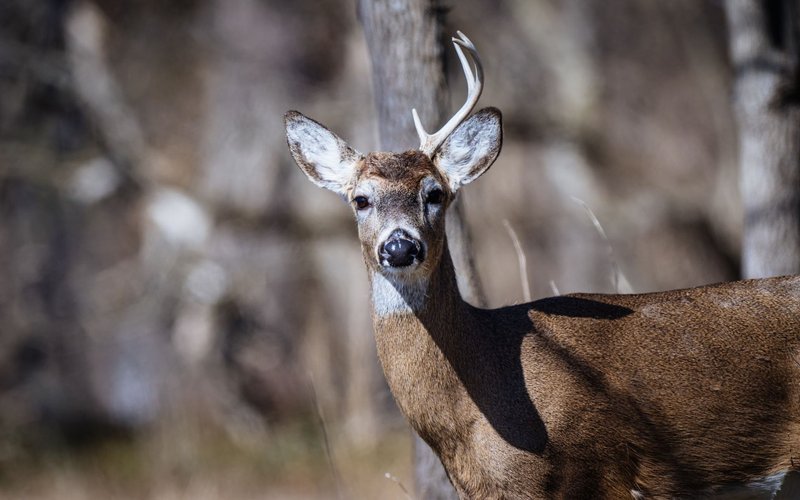
White-tailed deer (Odocoileus virginianus). The state mammal, and the animal you’re statistically most likely to hit on a Georgia road. The tail flashes white when the deer bolts. Status: abundant, managed for hunting.
Bobcat (Lynx rufus). About twice the size of a housecat, with a tail that looks cut off at four to six inches, tufted ears, and a spotted coat. It hunts rabbits, squirrels, and rodents at night and is far more common than anyone sees. Status: common statewide.
Gray fox (Urocyon cinereoargenteus). Gray back, rusty sides, and a black stripe down the tail. It’s one of the few canids that climbs trees, using semi-retractable claws to get up after fruit or to escape a coyote. Status: common.
River otter (Lontra canadensis). Long, dark, and whiskered, with a thick tapered tail. Otters live along creeks, lakes, and rivers statewide, and they’re easiest to spot where a stream meets a quiet pool in early morning. Status: recovered and widespread.
Eastern box turtle (Terrapene carolina). A domed shell patterned in yellow and orange, with a hinge on the bottom that lets it shut itself in like a lunchbox. Box turtles crawl across roads after rain and can live for decades, often returning to the same few acres. Status: Vulnerable on the IUCN Red List, mostly from road deaths and collection.
Brown thrasher (Toxostoma rufum). The state bird. Rufous above, streaked below, with a long curved bill and yellow eyes. It sings each phrase twice, and its song repertoire is among the largest of any North American bird. Status: common, but declining over decades.
Red-cockaded woodpecker (Dryobates borealis). A small black-and-white woodpecker that excavates nest cavities in living old pines, a slow job that takes a pair years. Piedmont National Wildlife Refuge protects a population. Status: federally listed as threatened since a 2024 downlisting from endangered.
The Coastal Plain and the Okefenokee
Flat, sandy, and historically covered by longleaf pine, this is the largest region by area. It also holds the Okefenokee, a blackwater swamp of roughly 400,000 acres managed as a national wildlife refuge by the U.S. Fish and Wildlife Service.
Gopher tortoise (Gopherus polyphemus). The state reptile. A tan, stump-legged tortoise with shovel-like front feet. It digs burrows up to roughly 40 feet long, and hundreds of other species use them, from indigo snakes to frogs to burrowing owls elsewhere in its range. That makes it a keystone species: lose the tortoise and the whole neighborhood goes with it. Status: threatened in Georgia. You can see them at Reed Bingham State Park near Adel.
Eastern indigo snake (Drymarchon couperi). The longest native snake in North America, reaching about eight feet. It’s glossy blue-black with a reddish chin and eats other snakes, including venomous ones. It often shelters in gopher tortoise burrows. Status: federally threatened, and rarely seen, even in southeast Georgia sandhills where it still holds on.
Eastern diamondback rattlesnake (Crotalus adamanteus). The heaviest venomous snake in North America. Look for dark diamonds outlined in cream down a thick body that can reach six feet or more. It depends on longleaf pine and gopher tortoise burrows. Status: declining as longleaf habitat shrinks.
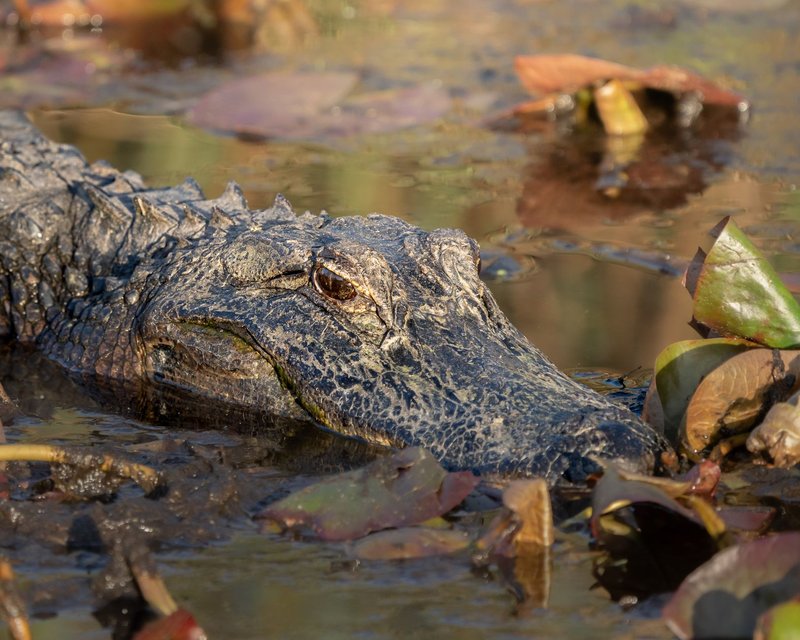
American alligator (Alligator mississippiensis). A dark, armored predator of swamps, ponds, and slow rivers. Juveniles show yellow bands. Alligators were federally endangered until the late 1980s and recovered completely. You’ll see them in the Okefenokee on warm days from spring through early fall, and they’re largely inactive in cold weather.
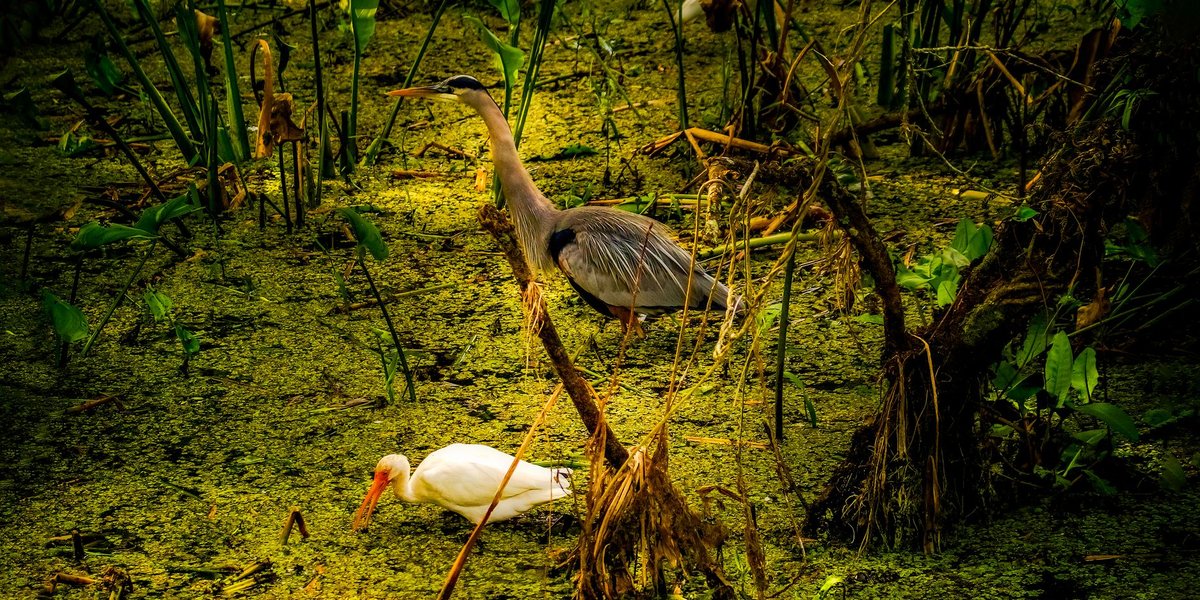
Wood stork (Mycteria americana). A tall white wading bird with black wingtips and a bald, dark, scaly-looking head. It’s the only stork that breeds in the United States. Status: federally threatened, downlisted from endangered in 2014.
Florida sandhill crane (Antigone canadensis pratensis). A tall gray crane with a red forehead patch, known for a rolling, rattling call that carries across open wetlands. Okefenokee’s prairies are good habitat. Status: resident and stable.
Northern bobwhite (Colinus virginianus). The state game bird, a small, round quail whose name is its call. Bobwhites need open pine woods and weedy field edges. Status: sharply down across the Southeast as clean-farmed fields and dense woods replaced that habitat.
The coast and barrier islands
Georgia’s coast is about 100 miles of tidal marsh, barrier islands, and estuaries that form one of the largest salt marsh systems on the East Coast. Most of the headline animals here are seasonal.
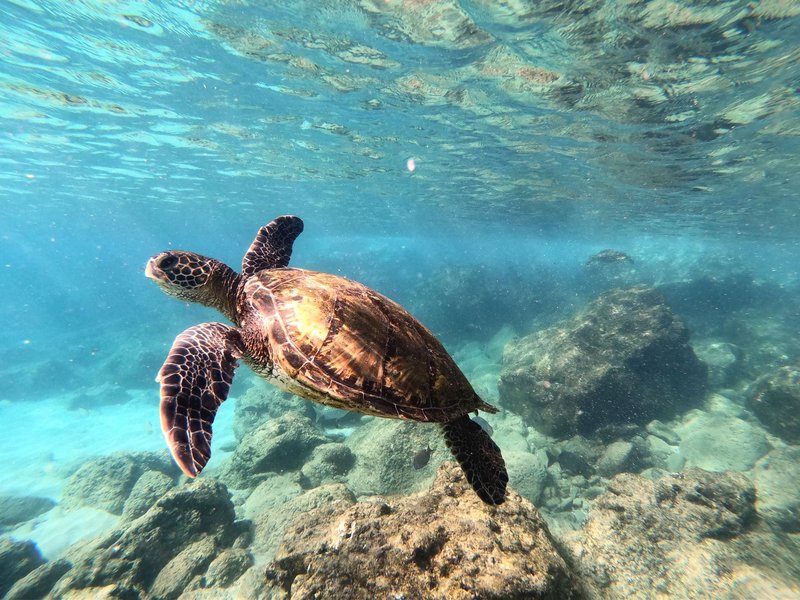
Loggerhead sea turtle (Caretta caretta). A reddish-brown turtle with a block-shaped head. Females crawl onto Georgia beaches from May through August to lay eggs at night, and hatchlings emerge through the fall. Status: federally threatened. Georgia’s beaches are among the most important loggerhead nesting sites in the Northwest Atlantic.
North Atlantic right whale (Eubalaena glacialis). A black, rough-skinned whale with no dorsal fin and white patches (callosities) on the head. Right whales are among the most endangered large animals in the world, with fewer than 400 left, according to NOAA Fisheries. Pregnant females move south to calve off Georgia and northern Florida in winter. Boats must stay at least 500 yards away. Status: critically endangered.
Bottlenose dolphin (Tursiops truncatus). Gray, curved-finned, and everywhere in the tidal creeks. In Georgia’s salt marshes, some dolphins practice strand feeding, driving fish up a mud bank and sliding out of the water after them. Status: common.
Diamondback terrapin (Malaclemys terrapin). A small turtle with a gray, diamond-ringed shell and a speckled face that looks like it’s smiling. It’s the only turtle in the U.S. that lives only in brackish water. Status: Vulnerable on the IUCN Red List. Crab traps and road crossings are the leading causes of death.
West Indian manatee (Trichechus manatus). A slow, gray, whiskered sea mammal that drifts up from Florida in warm months, typically late summer. Status: federally threatened.
Painted bunting (Passerina ciris). A tiny finch with a blue head, red underparts, and a lime-green back. It’s one of the most colorful birds in North America. Males nest in coastal scrub and maritime forest. Status: Near Threatened on the IUCN Red List.
Red knot (Calidris canutus rufa). A robin-sized shorebird in rusty red during breeding plumage. Red knots stop on Georgia’s coast during long spring and fall migrations. Status: federally threatened.
Snakes: six venomous species out of 46
Georgia has 46 snake species, according to the Georgia Department of Natural Resources. Six are venomous:
- Copperhead (Agkistrodon contortrix): copper head, hourglass bands, common in the Piedmont and mountains.
- Cottonmouth (Agkistrodon piscivorus): thick, dark, semi-aquatic, with a white mouth lining it shows when threatened. Found statewide in the south, absent from the high mountains.
- Timber rattlesnake (Crotalus horridus): see above.
- Eastern diamondback (Crotalus adamanteus): see above.
- Pigmy rattlesnake (Sistrurus miliarius): a foot or so long, with a rattle that sounds like an insect. Statewide.
- Eastern coral snake (Micrurus fulvius): red, yellow, and black bands. Red touches yellow. Shy and uncommon in the Coastal Plain.
The rest, including rat snakes, king snakes, garter snakes, and water snakes, are nonvenomous, and many get killed because someone mistakes them for something worse. The harmless northern watersnake gets mistaken for a cottonmouth more than any other snake.
Protected species snapshot
| Species | Region | Status |
|---|---|---|
| Gopher tortoise | Coastal Plain | State threatened |
| Eastern indigo snake | Coastal Plain | Federally threatened |
| Red-cockaded woodpecker | Piedmont, Coastal Plain | Federally threatened |
| Wood stork | Coastal Plain, coast | Federally threatened |
| Loggerhead sea turtle | Coast | Federally threatened |
| Red knot | Coast | Federally threatened |
| West Indian manatee | Coast | Federally threatened |
| North Atlantic right whale | Offshore | Federally endangered |
Native, introduced, or gone
This is the area where most animal lists go wrong. Georgia’s wildlife has three categories of “not quite native.”
Animals that were here and are not. The red wolf was eliminated from Georgia in the wild; the only wild population is in North Carolina. The eastern cougar was hunted out of the state, with no confirmed breeding population today, though young males occasionally wander in from Florida. Bison and elk grazed Georgia before European settlement and are gone. The Carolina parakeet is extinct.
Animals that arrived without help. Nine-banded armadillos spread east from Texas over the 20th century and are now established across the state. Coyotes did the same, pushing in from the west during the second half of the century.
Animals people brought. Feral hogs descend from livestock introduced by Spanish explorers in the 1500s and from later releases. Nutria, a South American rodent, arrived through the fur trade and now live in coastal Georgia marshes. The wild horses of Cumberland Island National Seashore are feral livestock descended from horses brought by humans, and numbered roughly 150 at last count. Rainbow and brown trout were stocked in mountain streams.
| Animal | Georgia status |
|---|---|
| Red wolf | Native, gone from the wild in Georgia |
| Eastern cougar | Native, no breeding population |
| Bison, elk | Native, extirpated |
| Nine-banded armadillo | Natural range expansion, not historically native |
| Coyote | Natural range expansion |
| Feral hog | Introduced |
| Nutria | Introduced |
| Cumberland Island horses | Introduced, feral |
Where and when to see Georgia wildlife
- Okefenokee Swamp (Folkston, Fargo, Waycross): alligators on warm days, wading birds, sandhill cranes, and occasional black bears. Paddle trails give the best access.
- Cumberland Island: wild horses, armadillos, nesting loggerheads in summer, and migrating shorebirds. It’s reachable only by ferry from St. Marys.
- Jekyll Island: sea turtle nesting from May through August, plus a sea turtle rehabilitation center. Right whales are sometimes seen from the shore in winter, though most sightings come from aerial surveys.
- Chattahoochee National Forest: black bears, ruffed grouse, brook trout, and salamanders. Early morning and late summer are best.
- Piedmont National Wildlife Refuge: red-cockaded woodpeckers, white-tailed deer, and wild turkeys.
FAQ
What is Georgia’s state animal? The state mammal is the white-tailed deer. The state bird is the brown thrasher, the state reptile is the gopher tortoise, and the state marine mammal is the North Atlantic right whale.
Are armadillos native to Georgia? No. They expanded in from the west in the 20th century. They are native to the Americas, but not historically to Georgia.
How many venomous snakes live in Georgia? Six, out of 46 total snake species.
Does Georgia have wild bears? Yes. Black bears live in three separate regions of the state, with the largest population in the north Georgia mountains.
Does Georgia have panthers or wolves? Not as resident populations. The red wolf and eastern cougar were both eliminated from the state.
What are the most endangered animals in Georgia? Among the most imperiled are the North Atlantic right whale, the eastern indigo snake, the red knot, and the gopher tortoise.
Summary
Georgia’s native animals sort cleanly by region: black bears, hellbenders, and brook trout in the mountains, bobcats and otters across the Piedmont, gopher tortoises and indigo snakes in the Coastal Plain, and loggerheads and right whales on the coast. The most useful detail for any list is which species actually belong. Armadillos, hogs, nutria, and feral horses aren’t historic natives, and red wolves and cougars no longer live here. Pick one region, pick the right season, and you’ll see more than the usual list suggests.