Tropical rainforest primary consumers are the animals that eat plants directly: leaves, fruit, seeds, nectar and bark. They sit one step above the producers (the trees, vines and ferns) and one step below the secondary consumers that eat them.
Quick Answer: 10 Rainforest Primary Consumers
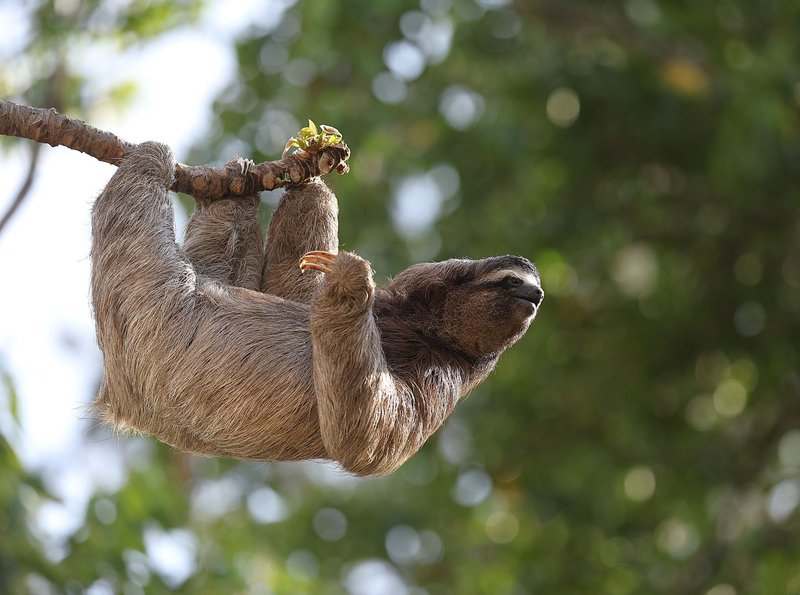
- Three-toed sloth (Amazon, Central America): leaves, mostly from Cecropia trees.
- Red howler monkey (Amazon): leaves and fruit.
- Green iguana (Central and South America): leaves, flowers and fruit.
- Lowland tapir (Amazon): leaves, twigs and fruit.
- Agouti (Amazon, Central America): seeds, nuts and fallen fruit.
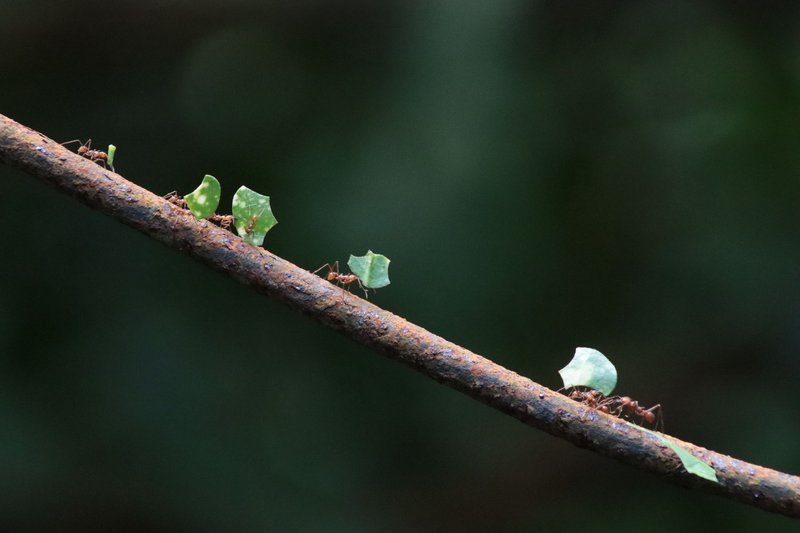
- Leafcutter ant (Neotropics): cuts leaves to grow the fungus it eats.
- Forest elephant (Congo Basin): fruit, leaves and bark.
- Okapi (Congo Basin): leaves and buds from understory plants.
- Orangutan (Borneo, Sumatra): mostly fruit, plus leaves and bark.
- Fruit bat (Africa, Southeast Asia): fruit and nectar.
Table of Contents
- What counts as a primary consumer
- Where primary consumers sit in the food chain
- Primary consumers by rainforest layer
- Primary consumers by food type
- Amazon vs Congo vs Southeast Asia
- Herbivore or omnivore? The messy middle
- Adaptations that make plant-eating work
- What happens when primary consumers disappear
What Counts as a Primary Consumer
A primary consumer gets its energy from producers, not from other animals. Herbivores are the obvious case. Frugivores (fruit eaters), granivores (seed eaters) and nectarivores (nectar feeders) count too, because fruit, seeds and nectar are all plant products.
The test is simple: what did the animal eat, and was it alive and green or a plant part? If yes, it’s a primary consumer. If it ate another animal, it’s not.
That rules out several animals that show up on weaker lists. Snakes are never primary consumers. Neither are horses, kangaroos or rabbits, which some pages list for the rainforest even though none of them live in one. And tapirs, which one popular page labels secondary consumers, are plant eaters through and through.
Where Primary Consumers Sit in the Food Chain
Rainforest trophic levels run in four or five steps:
- Producers: trees, palms, vines, epiphytes, ferns.
- Primary consumers: the plant eaters in this post.
- Secondary consumers: animals that eat primary consumers, such as tree frogs, ocelots and small snakes.
- Tertiary consumers: predators that eat secondary consumers, such as large snakes.
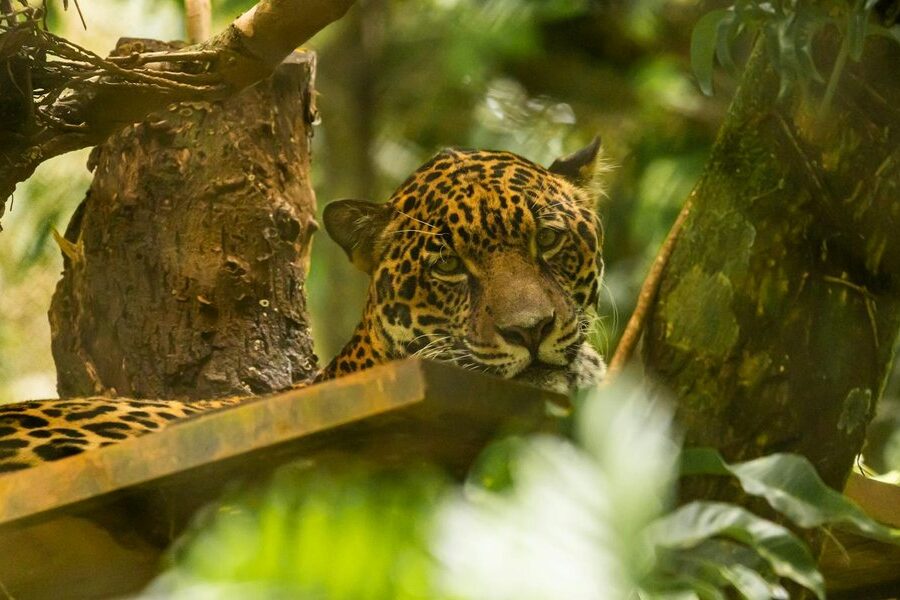
- Apex predators: jaguars, harpy eagles, leopards, tigers, crowned eagles.
Here are three real chains, one per region:
Amazon:          Cecropia leaf -> three-toed sloth -> harpy eagle
Congo Basin:     Fruit -> forest duiker -> leopard
Southeast Asia:  Leaf -> caterpillar -> tree frog -> snake -> crested serpent eagle
Energy shrinks at every arrow. The classic figure is the 10% rule, which comes from Raymond Lindeman’s 1942 study of trophic dynamics: roughly a tenth of the energy at one level ends up stored in the next. Real transfer rates swing between about 5% and 20%, but 10% is the number to use for homework.
Put numbers on it. If the plants in a patch of forest capture 10,000 units of energy, the primary consumers hold about 1,000, the secondary consumers about 100, and the top predators about 10. That’s why a hectare of rainforest holds thousands of caterpillars and only a handful of jaguars’ worth of territory.
Primary Consumers by Rainforest Layer
Rainforests are stacked into layers, and each one has a different menu. The National Geographic overview of rainforest structure covers the layers in more detail.
Emergent Layer
The tallest trees poke 60 meters or more above the canopy. Few animals live up there full time, because it’s hot, windy and dry. The primary consumers you’ll find are visitors: scarlet macaws feeding on seeds and fruit in the Amazon, hornbills in Africa and Asia, and fruit bats that commute from roosts to fruiting crowns at night.
Canopy
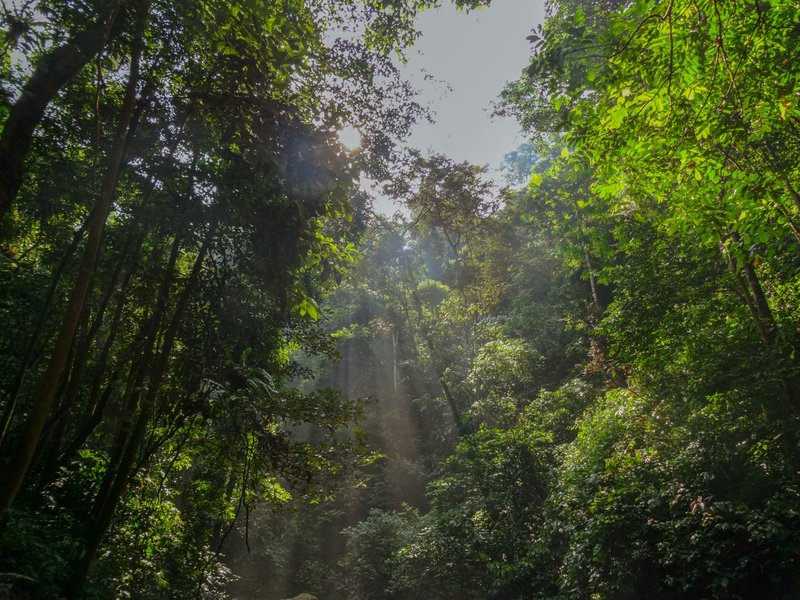
This is where most of the plant food is. Sunlight hits the leaves, so the canopy produces the bulk of the forest’s leaves, flowers and fruit, and most of its plant eaters live here.
- Sloths hang in the Amazonian canopy and eat leaves.
- Howler monkeys eat mostly leaves and switch to fruit when trees are fruiting.
- Spider monkeys and orangutans are fruit specialists.
- Green iguanas climb to the canopy and the emergent crowns for leaves and flowers.
- Toucans eat fruit, though they also take insects and eggs (more on that below).
Understory
Little light reaches the understory, so the plants here have big, thin leaves. The okapi, a giraffe relative found only in the Democratic Republic of the Congo, browses understory leaves and buds. Caterpillars and leaf-eating beetles do the same at smaller scale, and hummingbirds work the understory’s flowers in the Americas.
Forest Floor
Very little sunlight reaches the floor, so the food here is what falls: fruit, seeds, leaves, bark.
- Lowland tapirs in the Amazon and Malayan tapirs in Southeast Asia eat leaves, twigs and fruit.
- Agoutis crack open seeds and nuts, including Brazil nuts, that other animals can’t.
- Forest elephants and western lowland gorillas in the Congo Basin eat fruit, leaves and stems.
- Leafcutter ants run trails across the floor and up into the trees.
Primary Consumers by Food Type
Layer tells you where an animal lives. Food type tells you how it makes a living.
Leaf eaters (folivores). Sloths, howler monkeys, okapis, iguanas, caterpillars. Leaves are low in energy and often toxic, so these animals tend to be slow, sit still a lot, or have specialized guts.
Fruit eaters (frugivores). Toucans, spider monkeys, orangutans, fruit bats, hornbills, tapirs, forest elephants. Fruit is easy to digest and rich in sugar. These animals are the forest’s main seed movers.
Seed eaters (granivores). Agoutis, macaws, many rodents. Seeds are packed with fat and protein, and they’re protected by hard shells. Macaws crack them with their beaks, and agoutis do it with chisel-like teeth.
Nectar feeders (nectarivores). Hummingbirds in the Americas, sunbirds in Africa and Asia, nectar bats, and bees and butterflies everywhere. Nectar is sugar water. Most nectar feeders also eat small insects for protein.
Amazon vs Congo vs Southeast Asia
The three big rainforest regions have different animals filling the same jobs.
| Animal | Region | Main diet | Layer |
|---|---|---|---|
| Three-toed sloth | Amazon, Central America | Leaves | Canopy |
| Red howler monkey | Amazon | Leaves, fruit | Canopy |
| Green iguana | Central and South America | Leaves, flowers, fruit | Canopy |
| Scarlet macaw | Amazon, Central America | Seeds, fruit | Emergent and canopy |
| Hummingbirds | Amazon | Nectar (plus small insects) | Understory and canopy |
| Lowland tapir | Amazon | Leaves, twigs, fruit | Forest floor |
| Agouti | Amazon, Central America | Seeds, nuts, fallen fruit | Forest floor |
| Leafcutter ant | Amazon, Central America | Fungus grown on leaves | Floor and canopy |
| Forest elephant | Congo Basin | Fruit, leaves, bark | Forest floor |
| Okapi | Congo Basin | Leaves, buds | Understory |
| Western lowland gorilla | Congo Basin | Leaves, stems, fruit (plus ants and termites) | Forest floor |
| Orangutan | Borneo, Sumatra | Fruit, leaves, bark | Canopy |
| Malayan tapir | Southeast Asia | Leaves, twigs, fruit | Forest floor |
| Fruit bats (flying foxes) | Southeast Asia, Africa | Fruit, nectar | Canopy and emergent |
Amazon. The Amazon is the place for tree-dwelling folivores. Sloths and howler monkeys fill a niche that doesn’t exist in the same form in Africa or Asia. Leafcutter ants may be the biggest plant consumer by volume, since a mature colony can strip a tree overnight.
Congo Basin. Big-bodied floor browsers dominate: forest elephants, western lowland gorillas, and okapis. They’re heavy plant eaters, and they’re also the forest’s main movers of large seeds.
Southeast Asia. Fruit is the story. Borneo and Sumatra’s forests have mast fruiting, where dipterocarp trees fruit together every few years, and orangutans, hornbills and flying foxes build their lives around those events. The Malayan tapir plays the same floor-browser role that the lowland tapir does in the Amazon.
Herbivore or Omnivore? The Messy Middle
Nature doesn’t sort neatly. A lot of rainforest animals eat mostly plants but not only plants, and textbooks handle it by classifying an animal by its main food.
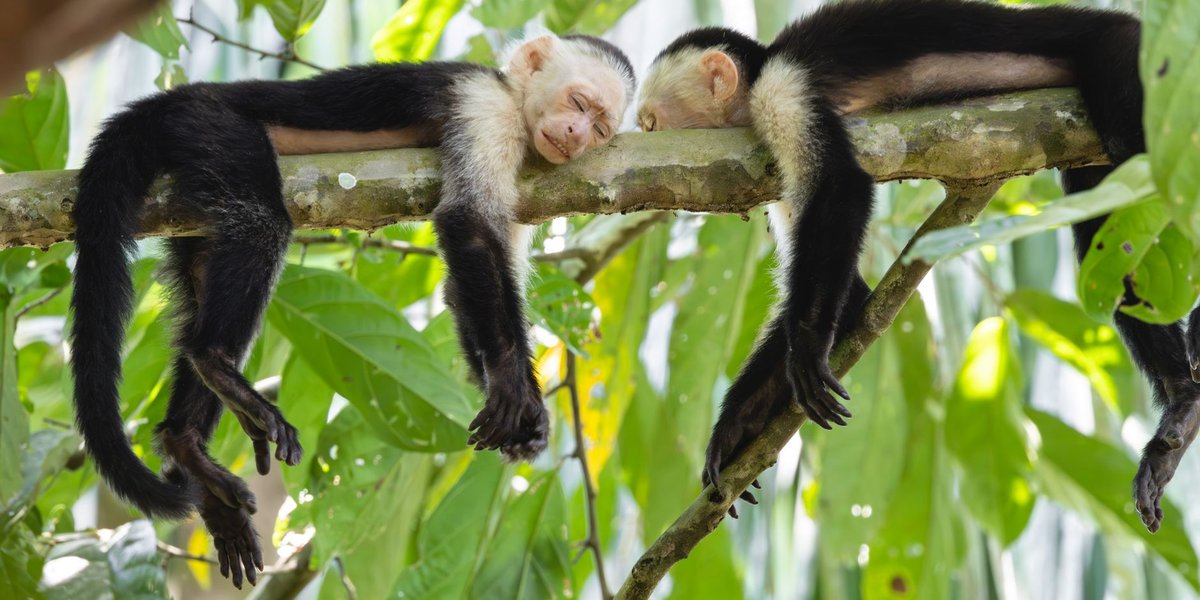
- Monkeys. Howlers are nearly all leaves and fruit, so they’re primary consumers. Capuchins eat fruit but spend a lot of time hunting insects and small vertebrates, so they sit between levels.
- Toucans. Fruit makes up most of the diet, but toucans also eat insects, eggs and nestlings. Count them as primary consumers who occasionally step up a level.
- Gorillas. Mostly leaves, stems and fruit. They also eat ants and termites, which are a small share of calories.
- Orangutans. Fruit-heavy, with some insects and the occasional bird egg.
- Tapirs. Plant eaters. If you’ve seen one called a secondary consumer, that’s an error: a tapir’s diet is leaves, twigs and fruit.
- Peccaries and coatis. True omnivores. They eat fruit and roots, but also invertebrates and small animals, so they’re primary and secondary consumers at once.
When a worksheet asks you to name a primary consumer, pick an animal from the plant-heavy end: sloth, tapir, agouti, howler monkey, caterpillar. You’ll be right every time.
Adaptations That Make Plant-Eating Work
Eating plants is harder than it looks. Leaves are tough to digest and often loaded with defensive chemicals, so primary consumers have developed some remarkable solutions.
Sloths run on a slow metabolism. Three-toed sloths have a metabolic rate that’s less than half of what you’d expect for a mammal of their size. A leaf meal can take up to a month to digest, and a sloth only leaves its tree about once a week, to defecate on the ground. Algae grows in their fur, which gives them a green tint that helps them blend in.
Leafcutter ants farm fungus. These ants don’t eat the leaves they carry. They chew them into a paste and use it to grow a fungus (Leucoagaricus gongylophorus) in underground gardens, then eat the fungus. The Smithsonian Tropical Research Institute has studied leafcutter colonies for decades. Strictly speaking, the fungus is the primary consumer of the leaves, and the ants are one step removed. They still count as plant-based feeders for any food-web diagram.
Tapirs are seed dispersers. A lowland tapir swallows whole seeds and drops them far from the parent tree, often in a pile of fertilizer. Studies have found seeds from dozens of plant species in tapir dung, which is why researchers call tapirs “gardeners of the forest.”
Agoutis plant trees by forgetting. Agoutis bury seeds to eat later and lose track of some of them. They’re one of the few animals strong enough to open Brazil nut pods, and the trees depend on them.
Hummingbirds and bats pollinate. Nectar feeders pick up pollen on their heads and carry it from flower to flower. They’re consumers and gardeners at once.
What Happens When Primary Consumers Disappear
Take out the plant eaters and the forest starts to unravel in two directions.
Upward, the predators starve. Jaguars depend on peccaries, tapirs, agoutis and deer. Leopards in the Congo depend on duikers. When hunting cuts the herbivore population, the big cats lose their prey, and they move toward livestock and villages.
Downward, the trees stop spreading. Large-seeded trees often rely on big fruit-eating animals to move their seeds. When elephants, tapirs, monkeys and hornbills vanish, the seeds drop under the parent tree, where they’re less likely to survive. Ecologists call the result an “empty forest”: the trees still stand, but the animals that spread them are gone. Research in Central Africa has linked the loss of forest elephants to lower carbon storage in the forest, because the trees they disperse are the dense, slow-growing ones.
This isn’t a hypothetical. The IUCN Red List classifies forest elephants and all three orangutan species as critically endangered, and tapirs are listed as endangered or vulnerable across their range.
Primary consumers are the link that moves energy from plants to predators and moves seeds from parent trees to new ground. A tropical rainforest food chain with that link removed doesn’t just lose animals. It loses its next generation of trees.