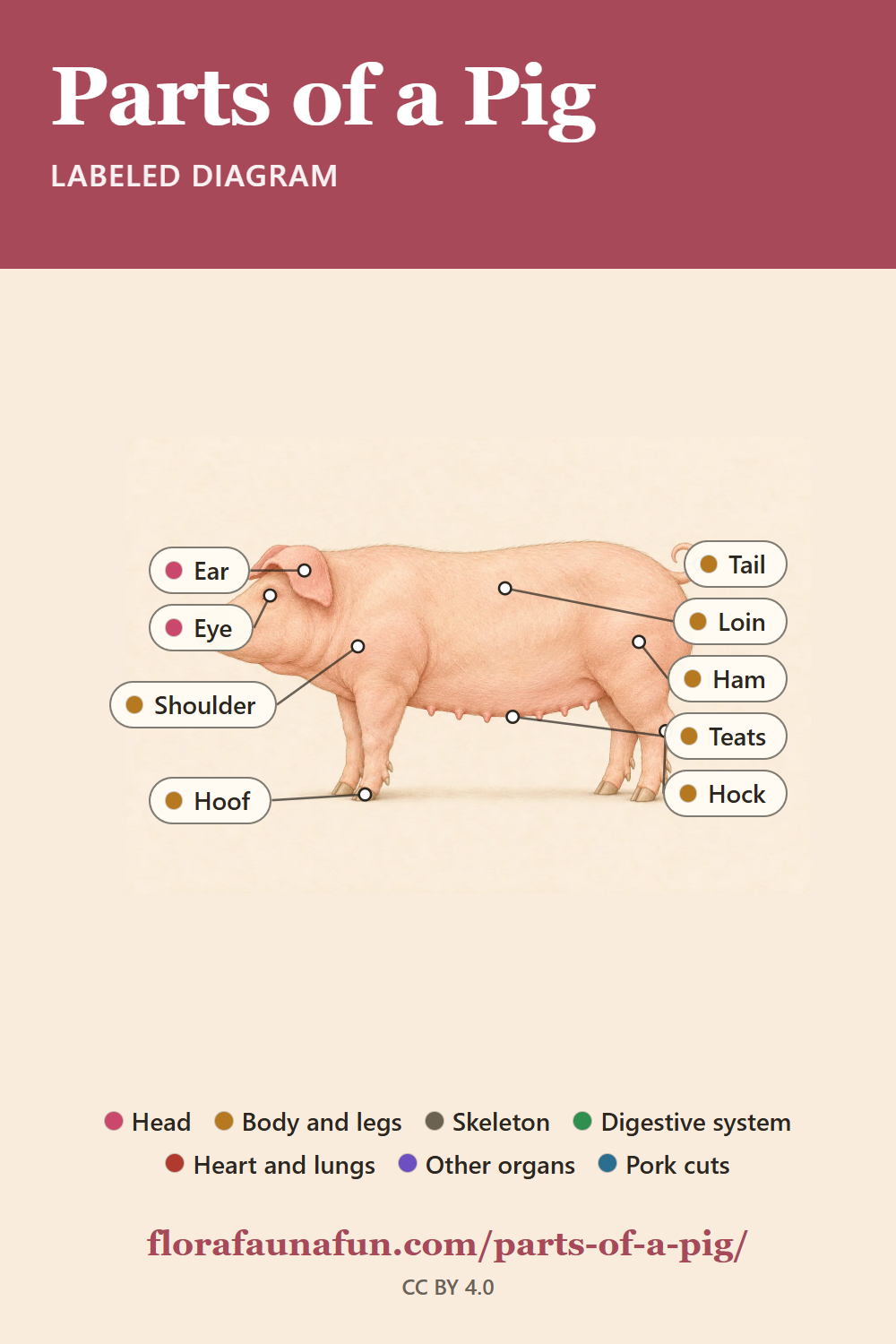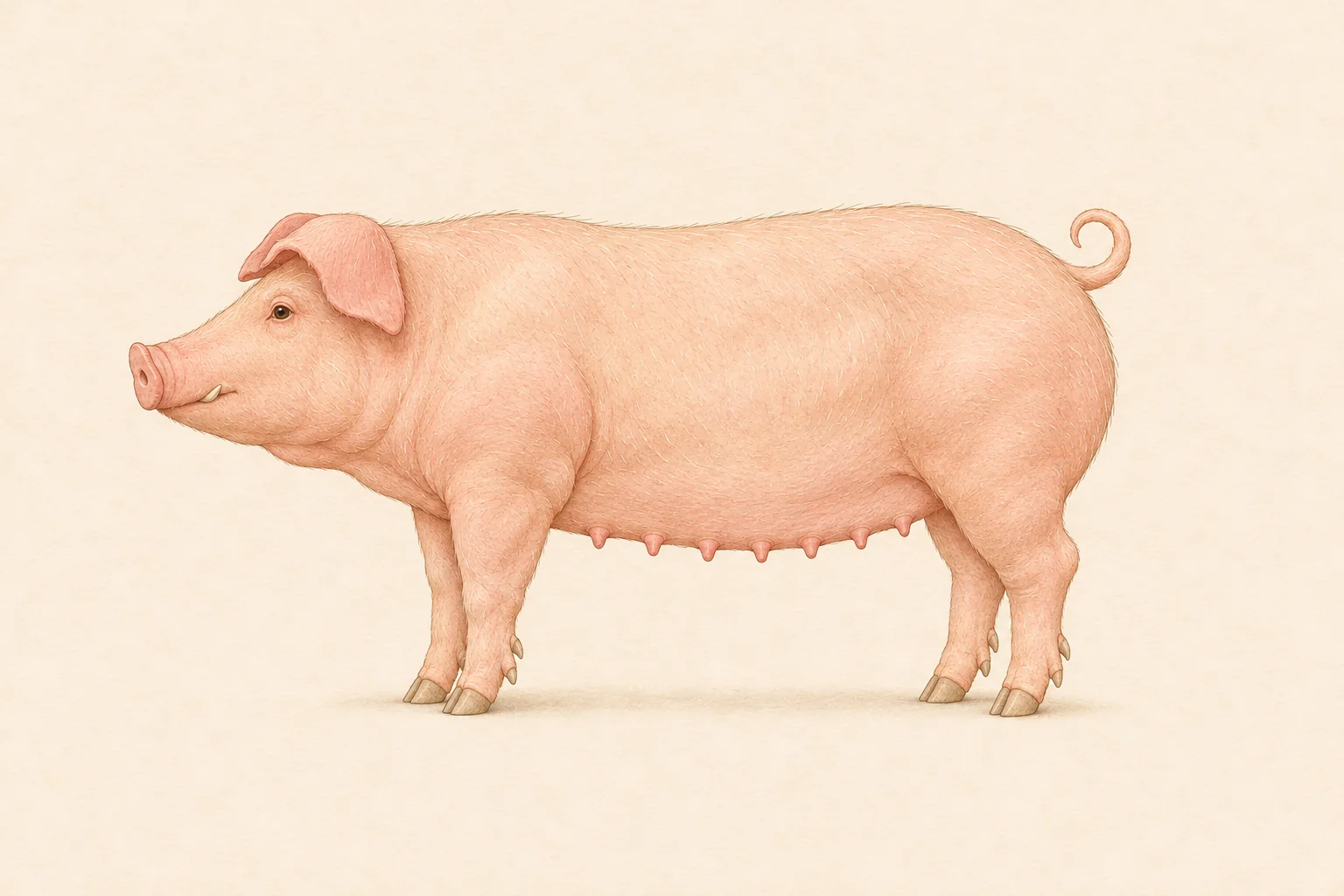
Short answer: In pig anatomy, the outside parts are a head with a snout, ears, eyes and tusks, a trunk with a shoulder, loin, belly and ham, four short legs with hooves and a curled tail. Inside are one stomach, a long intestine, a liver, a heart, two lungs and two kidneys.
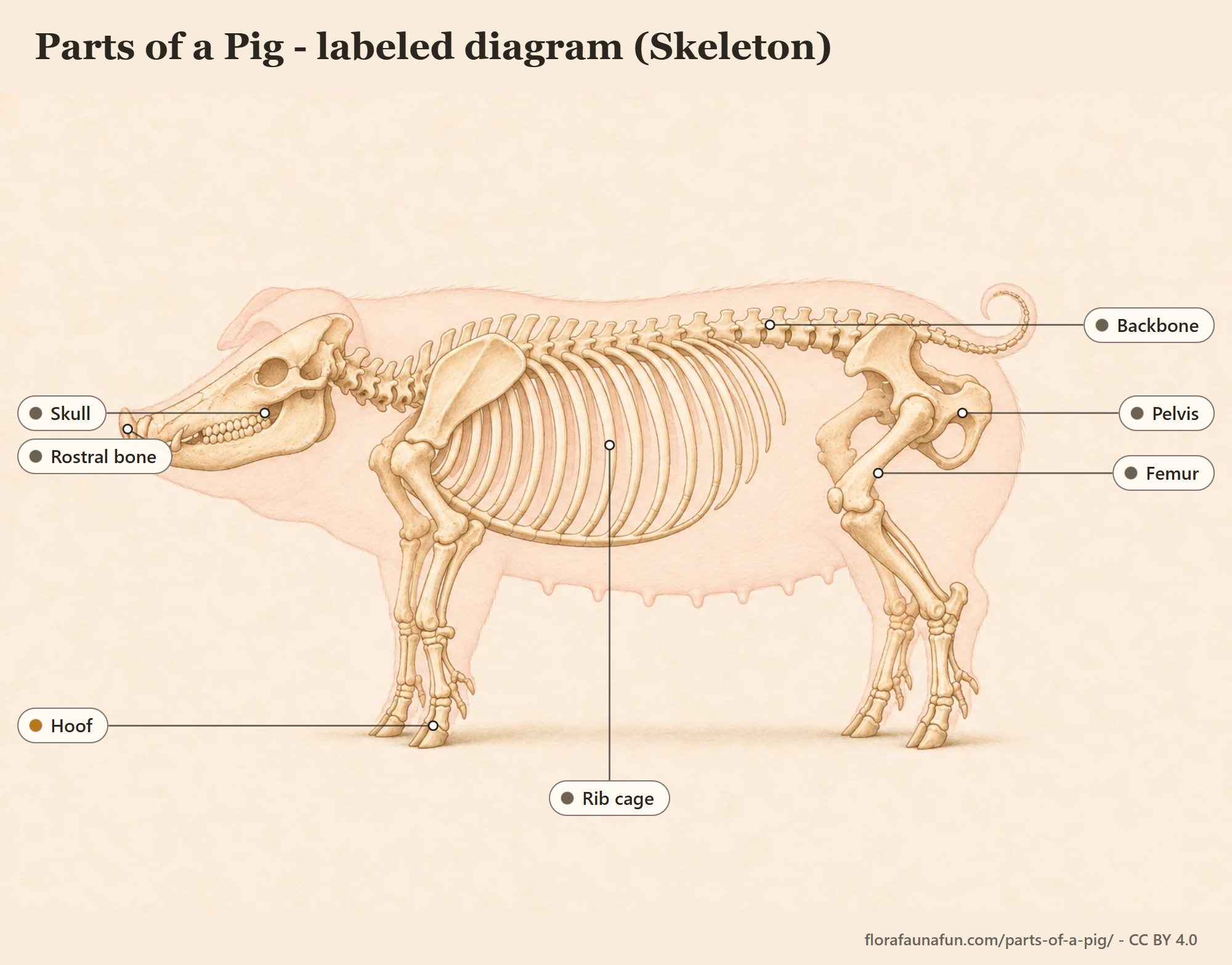
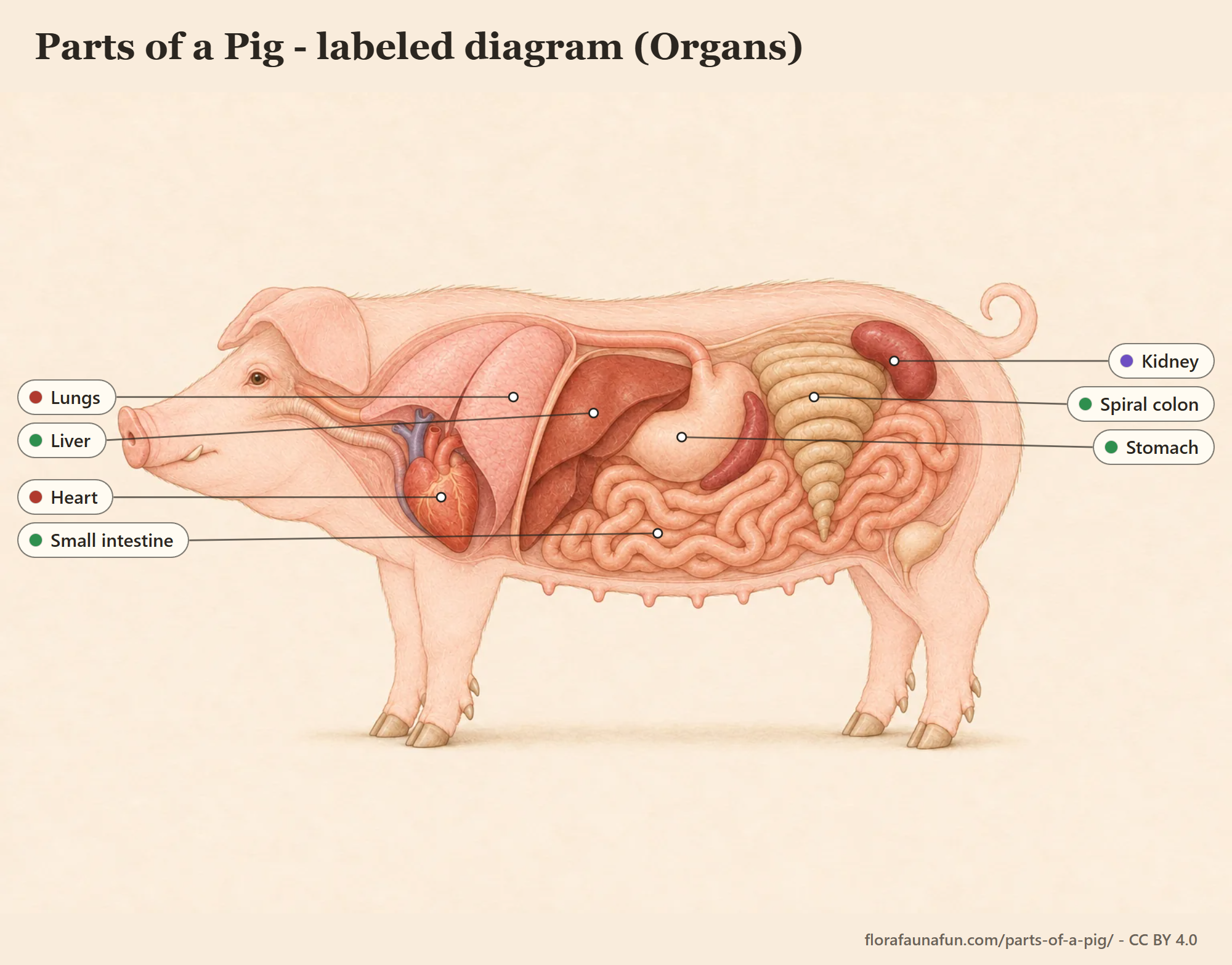
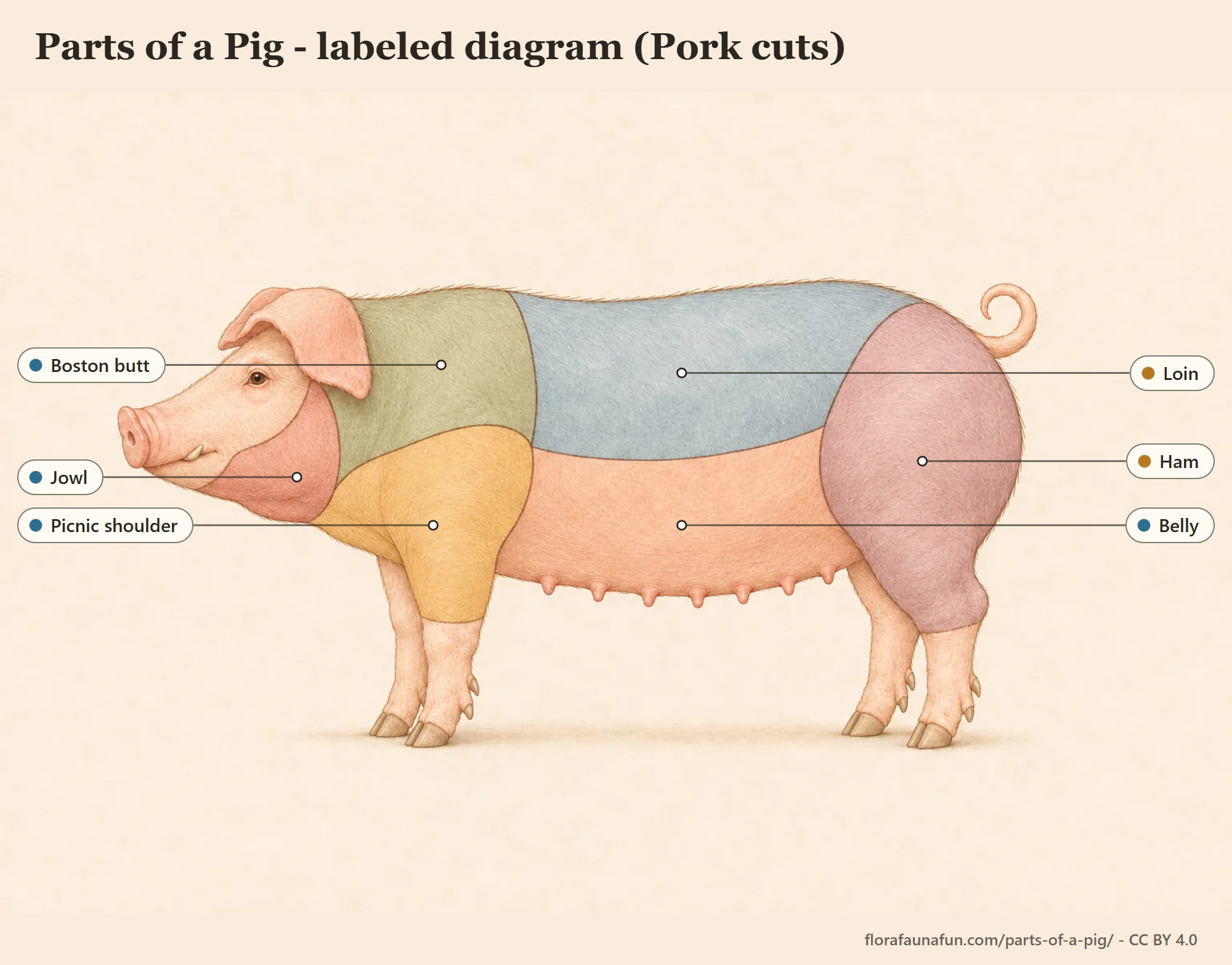
Tap any label in the pig anatomy diagram above to see what the part does. Four views show the whole pig (a sow), her skeleton, her organs and the pork cuts.
Head: snout, ears, eyes and tusks
Body and legs: shoulder, loin, ham and hooves
Skeleton: skull, backbone, ribs and pelvis
Internal pig anatomy: heart, lungs and kidneys
Pig digestive system: one stomach and a spiral colon
A pig has one stomach, not four. Food passes through three main organs.
The liver sits just behind the diaphragm. It makes bile, which the gallbladder stores for digesting fat, and it filters the blood.
Pork cuts: the parts of a pig for meat
The cuts view works as a pork cuts diagram. US retail cutting names six areas, four of them found only as cuts.
The other two areas are the loin and the ham.
Parts of a pig and their functions
| Part | Group | Function |
|---|---|---|
| Snout | Head | Digs; senses food |
| Ear | Head | Catches sound |
| Eye | Head | Wide field of view |
| Tusk | Head | Canine tooth |
| Shoulder | Body and legs | Front quarter |
| Loin | Body and legs | Back muscle; pork chops |
| Ham | Body and legs | Hind leg and rump |
| Teats | Body and legs | Feed piglets milk |
| Tail | Body and legs | Shows mood |
| Hoof | Body and legs | Four toes |
| Hock | Body and legs | Ankle of the hind leg |
| Skull | Skeleton | Protects the brain |
| Rostral bone | Skeleton | Supports the snout disc |
| Backbone | Skeleton | Vertebrae from skull to tail |
| Rib cage | Skeleton | Shields heart and lungs |
| Pelvis | Skeleton | Links legs to spine |
| Femur | Skeleton | Thigh bone |
| Heart | Heart and lungs | Pumps blood |
| Lungs | Heart and lungs | Swap gases |
| Stomach | Digestive system | Starts digestion |
| Small intestine | Digestive system | Digests; absorbs nutrients |
| Spiral colon | Digestive system | Ferments plant fiber |
| Liver | Digestive system | Makes bile; filters blood |
| Kidney | Other organs | Filters blood; makes urine |
| Jowl | Pork cuts | Cheek |
| Boston butt | Pork cuts | Upper shoulder |
| Picnic | Pork cuts | Lower shoulder |
| Belly | Pork cuts | Bacon and spareribs |
Male vs female pig anatomy
The diagram shows a sow, with teat rows and no boar features. A boar is an intact adult male. A sow is a female that has farrowed, a gilt is a young female that has not and a barrow is a castrated male.
Both sexes have canine teeth, so “only boars have tusks” is wrong.
Fetal pig dissection: where the organs are
Schools dissect fetal pigs because a pig is a mammal with organ systems close to a human’s. The organs are large, the soft tissue cuts easily and the specimen shows fetal circulation. Fetal pigs are by-products of the meat industry, taken from slaughtered pregnant sows, and are not bred for classrooms.
Students find the same organs the organs view labels: the heart, lungs, liver, stomach, small intestine, spiral colon and kidneys. A fetal pig differs from the adult: a proportionally larger head and liver, umbilical structures, teeth that have not erupted and two heart shunts that close soon after birth.
Studies have found that non-animal alternatives can teach as well as dissection.
Key facts about pigs
Free printable labeled pig anatomy diagram
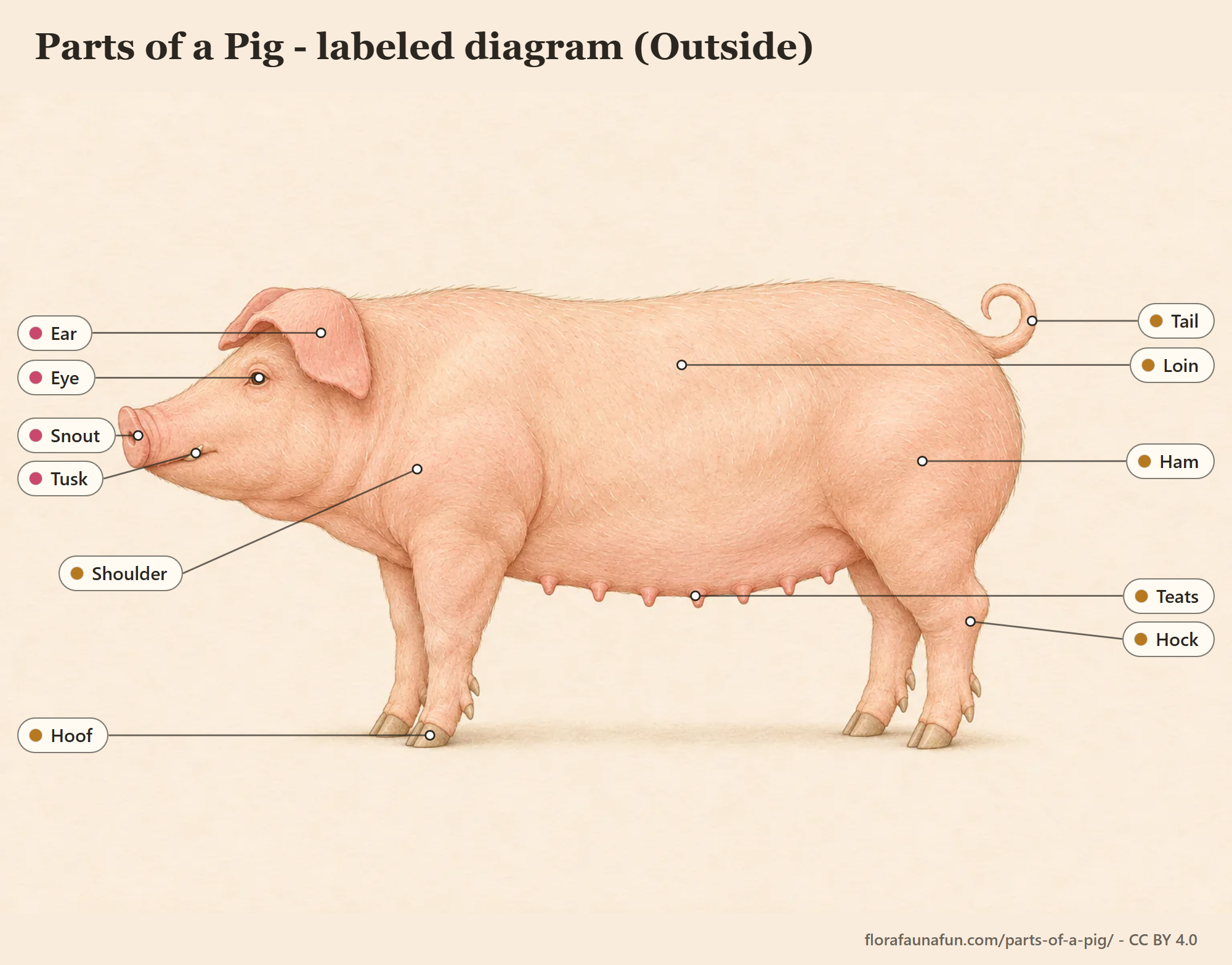
Free for classroom and home use under CC BY 4.0. Credit FloraFaunaFun.
How to use this diagram in class
- Label quiz. Turn the labels off and have students name each part, then tap to check.
- Print and cover. Cover the names on the PDF and have students rewrite them from memory.
- Match the layers. Switch views and ask which bones protect which organs.
- Cut to part. Show the pork cuts view and have students match each cut to a body part.
Frequently asked questions
The main parts are the head (snout, ears, eyes and tusks), the trunk (shoulder, loin, belly and ham), four legs ending in hooves and a curled tail. Inside are the skeleton and organs, including the heart, lungs, liver, stomach, intestines and kidneys.
A boar has larger tusks, a thick shield of tough skin over the shoulders and a scrotum with two testes between the hind legs. A sow has smaller tusks, two rows of teats along the belly, usually 12 to 14, and a vulva under the tail. Boars are larger on average.
No. A pig has one simple stomach, which makes it monogastric. The idea of several stomachs comes from cattle, which have four chambers. A pig’s large intestine includes a spiral colon where gut microbes ferment plant fiber.
It is similar enough for research and transplant studies, but not identical. A pig heart has four chambers like ours, yet its left atrium takes 5 to 7 pulmonary veins where a human’s takes 4. Pig lungs are not transplantable yet.
Four on each foot. Two large middle toes carry the weight and two smaller toes, the dewclaws, sit higher and behind them. The visible hoof is the pair of large toes, so pigs are cloven-hoofed.
The jowl is the cheek, the Boston butt is the upper shoulder and the picnic is the lower shoulder. The loin is the back, the belly is the underside that gives bacon and spareribs and the ham is the hind leg.
A pig is a mammal with organ systems close to a human’s. Fetal pig organs are large, the tissue cuts easily and the specimen shows fetal circulation. Fetal pigs are by-products of the meat industry, not bred for classrooms.
Sources
- Animal Diversity Web. Sus scrofa
- Missouri Department of Conservation. Feral hog
- Humane Society International. About Pigs
- University of Minnesota Veterinary Anatomy. Ungulate dissection Lab 4
- The Pig Site. Digestive system of the pig
- The Pig Site. Udder
- University of Kentucky Swine Discovery. Retail cuts
- Canadian Food Inspection Agency. Meat cuts manual: Pork
- Reichart et al. Pig heart xenotransplantation review, 2022
- Wikipedia. Fetal pig