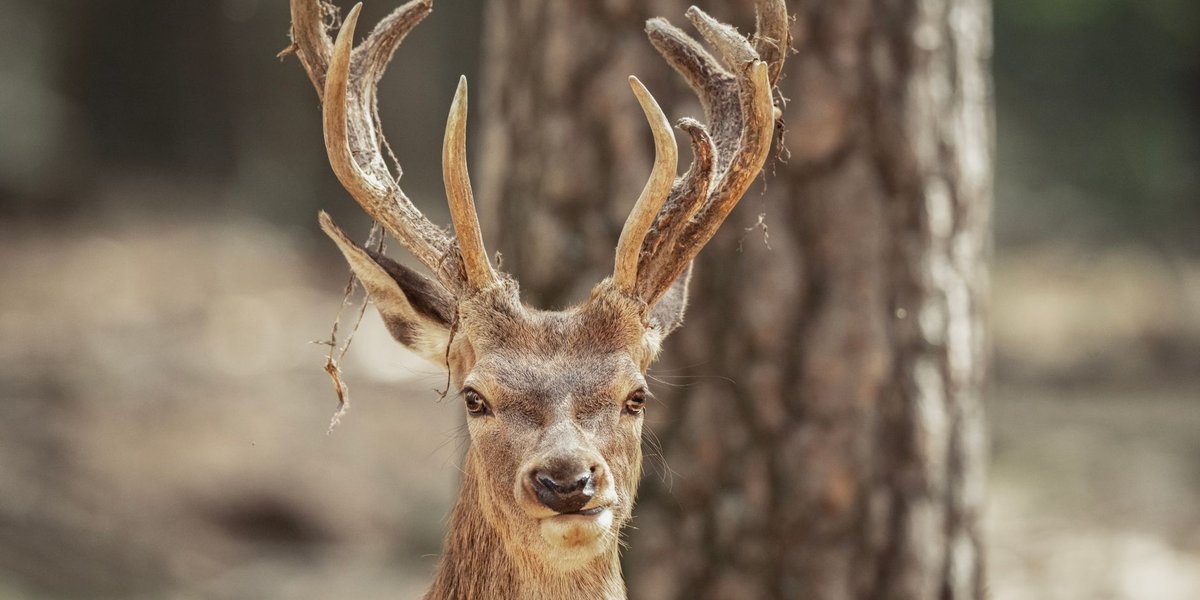
Just over half of Latvia is forest, and most of the rest is bog, meadow, river and Baltic coast. That mix explains why Latvia’s native animals read like a northern European greatest-hits list: elk, wolf, lynx, beaver, black stork, white-tailed eagle. It also explains why a country the size of West Virginia still has species that vanished from much of Western Europe.
This guide sorts the wildlife by habitat, says which animals are actually native and which are not, and points you to the parks where you have a real chance of seeing them.
TLDR
- National symbols: the white wagtail is the national bird and the two-spot ladybird is the national insect. Both are common and easy to spot.
- Headline mammals: elk (alnis), wolf (vilks), Eurasian lynx (lūsis) and Eurasian beaver (bebrs). Elk and beaver are the ones you can realistically find. Wolves and lynx mostly leave tracks.
- Headline birds: white-tailed eagle, black stork, common crane, corncrake.
- Endangered: European mink (Critically Endangered), pond bat and western barbastelle (both Near Threatened), European pond turtle.
- Best places: Gauja, Ķemeri, Slītere, Lake Engure and Lubāns.
- Not resident: brown bears show up occasionally from neighboring countries but don’t hold territories in Latvia.
Contents
- What “native” means here
- Forest mammals
- Birds of wetlands, coast and forest
- Reptiles and amphibians
- Endangered animals in Latvia
- Native Latvian farm breeds
- Quick-reference table
- Best parks for Latvian wildlife
What “native” means here
A native animal got to Latvia on its own after the last ice age. That sounds simple, but lists of wild animals in Latvia routinely blur three categories.
Native and continuous: elk, wolf, lynx, white-tailed eagle, black stork. They’ve been here the whole time, even when numbers dipped.
Native but reintroduced: the beaver. Hunting wiped it out across most of Latvia by the early 20th century, and animals were brought back in the 1920s from elsewhere in Europe. The species belongs here. The modern population has simply been rebuilt by people.
Introduced: the raccoon dog and the American mink, both escapees and releases from fur farming. Neither is native, and the American mink is a direct threat to a native species (more on that below).
Pages that call a fox, a seal or a brown bear a “Latvian animal” without context are skipping this step. Foxes and grey seals are native and present. Bears are visitors.
Forest mammals
Forest covers more than half the country, so this is where the big animals live. For a shorter tour of the standout species, the top eight wildlife of Latvia covers elk, wolves, eagles and beavers with key facts and viewing tips.
Elk
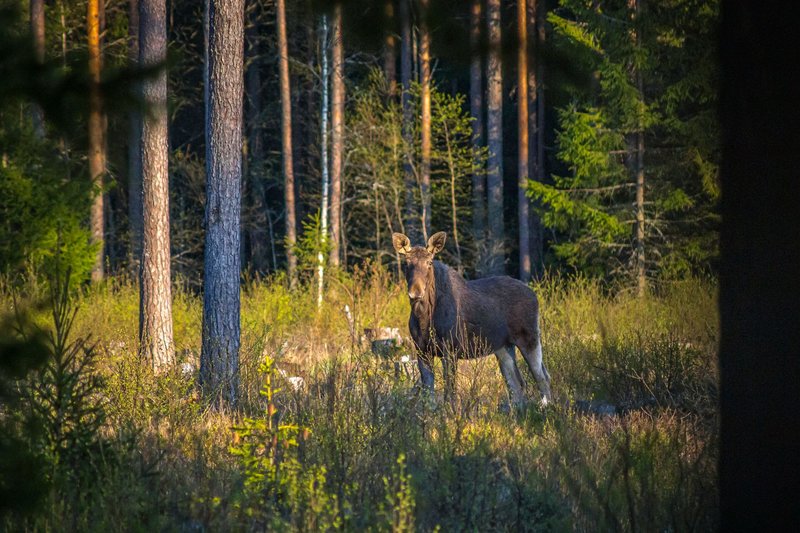
The elk is Latvia’s largest wild land animal. What Americans call a moose, Europeans call an elk, and the Latvian alnis is the same animal: long-legged, humpbacked at the shoulder, with a bulbous overhanging nose. Bulls carry flat, palmate antlers in autumn. You’ll find them at forest edges, in young stands after logging, and around wet ground. Dawn and dusk on quiet forest roads give you the best odds, and the animals are also a real hazard for drivers, so slow down.
Wolf
Wolves are native, present across the forested regions, and not as strictly protected as they are in much of Western Europe. Latvia manages them under the EU Habitats Directive’s more flexible provisions for the Baltic populations, which includes regulated hunting. Seeing one in the wild is rare. Winter tracks along forest tracks are the usual evidence.
Eurasian lynx
The lynx is the shy one. Lūsis hunts roe deer and hares, covers large territories, and is almost never seen by visitors. If you want a guaranteed look, the wildlife enclosures at Līgatne in Gauja National Park keep lynx, wolves, elk and other animals that were orphaned or injured, which makes them the practical place to see what you’d otherwise only read about.
Siberian flying squirrel
Few people expect this one. The Siberian flying squirrel lives in old mixed forests with aspen and spruce, glides between trees at night, and is protected under the EU Habitats Directive. It’s a Latvian forest indicator: if the species is present, the forest is old enough to have the hollow trees it needs. Seeing one takes a night walk and luck. Finding the cylindrical droppings at the foot of an aspen is the easier win.
Beaver
Eurasian beavers are everywhere now. Gnawed trunks, stick lodges and flooded forest edges are common along small rivers, and Gauja National Park is a reliable place to look for them. Beavers also get blamed for flooded fields and felled trees, so the species is both a conservation story and a local argument.
Others you’ll see
Roe deer, red deer, wild boar, red fox, pine marten and red squirrel are all native and widespread. They’re the animals you’re most likely to see, and the sort of species that fill out a list without telling you anything specific about Latvia.
Birds of wetlands, coast and forest
Latvia sits on a major migration route between Scandinavia and Africa, and the Baltic coast funnels birds in huge numbers in spring and autumn.
White wagtail, the national bird
The white wagtail (baltā cielava) became Latvia’s national bird in 1960, chosen by the Latvian Ornithological Society. It’s a small gray, black and white bird that bobs its tail constantly while walking, and it lives around farmyards, parking lots and riverbanks. It arrives in spring and tends to nest close to people. If you spend a day in Latvia between April and September you will see one.
White-tailed eagle
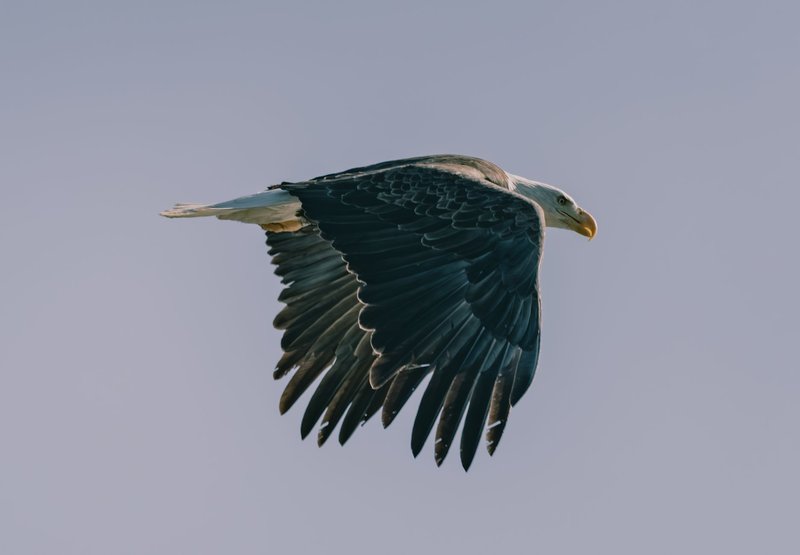
Europe’s largest eagle by wingspan, at roughly two meters or more, nests along coasts, large lakes and rivers. The Baltic Sea coast and the big wetland lakes are the best places to look. Adults have the pale head and wedge-shaped white tail that give the species its name, and the wide, flat “barn door” wings are unmistakable even at long range.
Black stork
The white stork gets the rooftop nests. The black stork, melnais stārķis, is the reverse: secretive, shy of people, and tied to old, undisturbed forest with streams. It’s far harder to find than its white cousin, and it’s one of the species that make Latvian forests significant for conservation across Europe. Look for it at forest streams and wet clearings, usually alone.
Common crane
Dzērve breeds in bogs and wet forest and gathers in groups in autumn. The rattling, trumpeting call carries a long way and is the sound of Latvian wetlands in spring.
Corncrake
The corncrake (grieze) is a bird you hear far more often than you see. Its rasping two-note call comes from tall damp meadows at night from May. Latvia is one of the strongholds for the species in Europe, because traditional hay meadows and river floodplains still exist at scale. Early mowing is the main threat.
Capercaillie and black grouse
Both are forest and bog grouse that perform spring displays, called leks, at dawn. Capercaillie need large tracts of old pine forest. Guided hides run in spring in several regions.
Reptiles and amphibians
Latvia is cool and damp, so reptiles are few and the amphibians do better. For the full set of Latvian animals, including reptiles and amphibians with their scientific names and status, see the complete list of animals of Latvia.
Adder (odze). The only venomous snake in Latvia. It’s shy, bites only when pressed, and is found on heaths, bog edges and forest clearings. A zigzag stripe down the back is the giveaway.
Grass snake, smooth snake, sand lizard, viviparous lizard and slow worm. All native, all harmless. The slow worm is a legless lizard, not a snake, which is one of the most commonly confused facts in European wildlife.
European pond turtle. Latvia is close to the northern limit of its range, so it’s a rare and vulnerable animal here, confined to a few warm, shallow wetlands. The IUCN lists the species as Near Threatened.
Frogs, toads and newts. The moor frog, common frog, common toad, smooth newt and great crested newt are widespread. Rarer finds include the natterjack toad, the fire-bellied toad and the European tree frog. Spring choruses near wet meadows and bog pools are loud.
Endangered animals in Latvia
Global IUCN categories don’t always match national lists, so treat these as the headline statuses. Latvia’s own protected species lists are managed by the country’s Nature Conservation Agency.
European mink (Mustela lutreola). One of Europe’s most threatened mammals and listed as Critically Endangered by the IUCN. Habitat loss and competition from the introduced American mink have driven its collapse across its range. Latvia is one of the countries where the story is told as a warning about fur-farm escapes.
Pond bat (Myotis dasycneme). Near Threatened. It forages over open water, which is why it’s tied to rivers and lakes, and it roosts in buildings and old trees.
Western barbastelle (Barbastella barbastellus). Near Threatened. A dark, flat-faced bat of old woodland that depends on loose bark and hollow trees. Latvia has more than a dozen bat species in total, and every one is protected.
European pond turtle. See above.
Good news exists too. White-tailed eagles and black storks have held on or recovered where old forest and quiet water remain. Protecting those habitats protects a lot of species at once.
Native Latvian farm breeds
Almost no competing page covers this, and it’s a good reminder that “native” applies to livestock too.
Latvian Blue cow (Latvijas zilā govs). A bluish-gray, hardy cattle breed that nearly disappeared and is now a small, conserved population. It’s kept as a heritage breed.
Latvian dark-headed sheep (Latvijas tumšgalves aita). A hardy sheep with a dark head and legs, raised for meat and wool in Latvia’s climate.
Latvian harness horse. A sturdy breed developed locally from regional stock for farm work and carriage use.
None of these are wild animals, but they’re part of the same story: a rural landscape that’s still managed in ways that keep wildlife around.
Quick-reference table
Statuses below are global IUCN categories: LC means Least Concern, NT Near Threatened and CR Critically Endangered.
| Species | Type | IUCN status | Where to look in Latvia |
|---|---|---|---|
| Elk | Mammal | LC | Forest edges, Gauja and Slītere |
| Wolf | Mammal | LC | Large forests (tracks); Līgatne enclosures |
| Eurasian lynx | Mammal | LC | Large forests (tracks); Līgatne enclosures |
| Eurasian beaver | Mammal | LC | Rivers and streams, Gauja |
| Siberian flying squirrel | Mammal | LC | Old mixed forest, night walks |
| Pond bat | Mammal | NT | Rivers and lakes at dusk |
| Western barbastelle | Mammal | NT | Old woodland |
| European mink | Mammal | CR | Extremely rare, not a visitor sighting |
| White wagtail | Bird | LC | Everywhere, April to September |
| White-tailed eagle | Bird | LC | Coast, Lake Engure, large lakes |
| Black stork | Bird | LC | Old forest streams |
| Common crane | Bird | LC | Bogs, Ķemeri, Lubāns |
| Corncrake | Bird | LC | Damp meadows, Lubāns |
| Adder | Reptile | LC | Heaths and bog edges |
| European pond turtle | Reptile | NT | Rare warm wetlands |
| Two-spot ladybird | Insect | Not assessed | Gardens, meadows, parks |
Best parks for Latvian wildlife
Gauja National Park. Latvia’s oldest and largest national park. Sandstone cliffs, river valleys and mixed forest make it the best all-round choice. Beavers, roe deer and many forest birds live here, and the Līgatne enclosures are the fallback for large mammals.
Ķemeri National Park. Raised bogs, boardwalk trails and wet forest close to the coast near Jūrmala. A good option for cranes, bog birds and amphibians.
Slītere National Park. The northwest tip of the country near Cape Kolka. Coastal forest, dunes and a migration funnel in spring and autumn. Bird counts at the cape can be enormous.
Lake Engure Nature Park. A shallow coastal lake and wetland recognized under the Ramsar Convention as a wetland of international importance. Waterbirds, reeds and white-tailed eagles are the draw.
Lubāns Wetland. The largest lake in Latvia sits in a vast floodplain wetland, also a Ramsar site. Expect cranes, corncrakes and beavers, plus spring and autumn bird migration.
Go in late spring for singing birds and amphibians, or in autumn for cranes, migrating waterfowl and rutting elk. Winter is the season for tracks in snow, which is the best way to confirm that wolves and lynx are around.