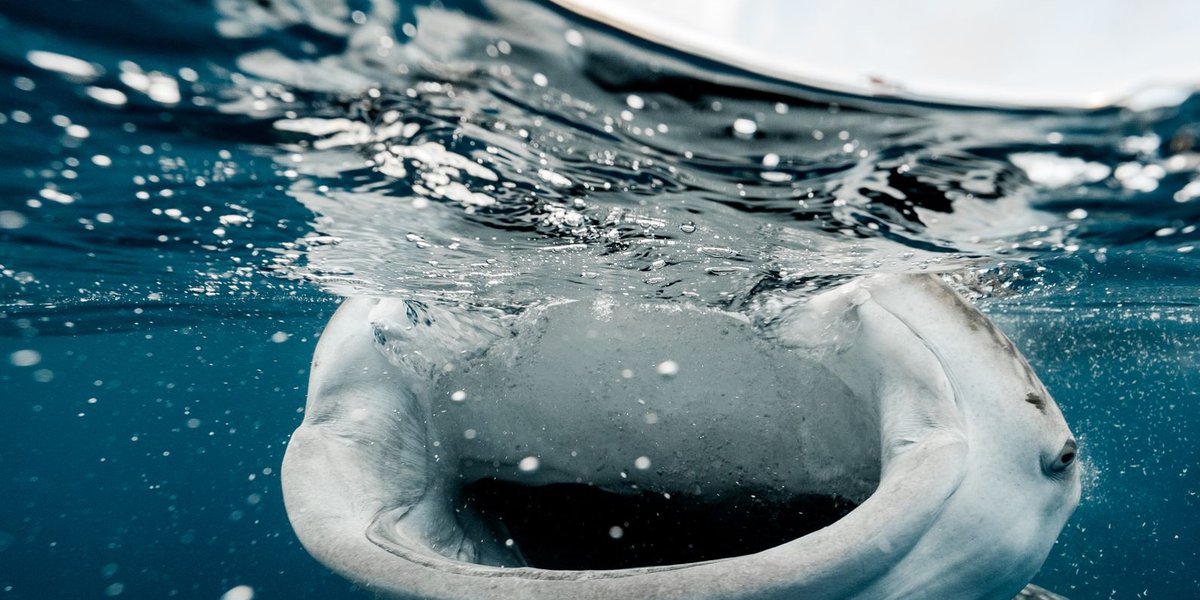
The biggest fish in the world is the whale shark, and it isn’t close. A fully grown whale shark can stretch past 40 feet and tip the scales at more than 20 tons — heavier than two loaded school buses — and it does all of that on a diet of plankton and small fish it filters through a mouth five feet wide. That’s the short answer. The longer, better answer involves a bony fish that looks like a ribbon dropped from the sky, a shark whose eyes are usually half-blind from parasites, and a stingray that can outweigh a grizzly bear.
Table of Contents
- TLDR
- What’s the Biggest Fish in the World?
- The Biggest Fish in the Ocean, Ranked
- Fish Size Comparison Table
- The Biggest Freshwater Fish
- The Biggest Fish Ever Caught (Record Catches)
- Why Some Fish Get So Big
TLDR
- Biggest fish overall: the whale shark, up to 41.5 feet and roughly 20+ tons.
- Biggest bony fish by weight: the ocean sunfish, up to 5,000 pounds.
- Longest bony fish: the giant oarfish, up to 36 feet, shaped like a length of chrome ribbon.
- Biggest freshwater fish: a toss-up between the beluga sturgeon and the giant freshwater stingray, both capable of topping 1,300 pounds.
- Biggest fish ever landed on rod and reel: a 2,664-pound great white shark, caught off South Australia in 1959 — a record IGFA has since stopped accepting for conservation reasons.
What’s the Biggest Fish in the World?
The whale shark (Rhincodon typus) holds the title outright. Confirmed specimens have measured over 41 feet, and one heavily documented individual weighed an estimated 21.5 tons. For comparison, that’s heavier than a fire truck.
Despite the size, it’s not a predator in any meaningful sense. A whale shark feeds by opening its enormous mouth and filtering plankton, fish eggs, and small schooling fish through rows of filter pads instead of teeth — it has thousands of vestigial teeth, but doesn’t use them to feed. It cruises warm tropical waters worldwide, often near the surface, which is why divers in places like the Philippines and the Maldives can swim alongside one without much risk. According to NOAA Fisheries, whale sharks can live 70 to 100 years, and females may not reach reproductive maturity until their 20s — one reason the species recovers slowly from fishing pressure. The IUCN currently lists the whale shark as Endangered, largely due to targeted fisheries in parts of Asia and accidental capture in nets meant for other species.
The Biggest Fish in the Ocean, Ranked
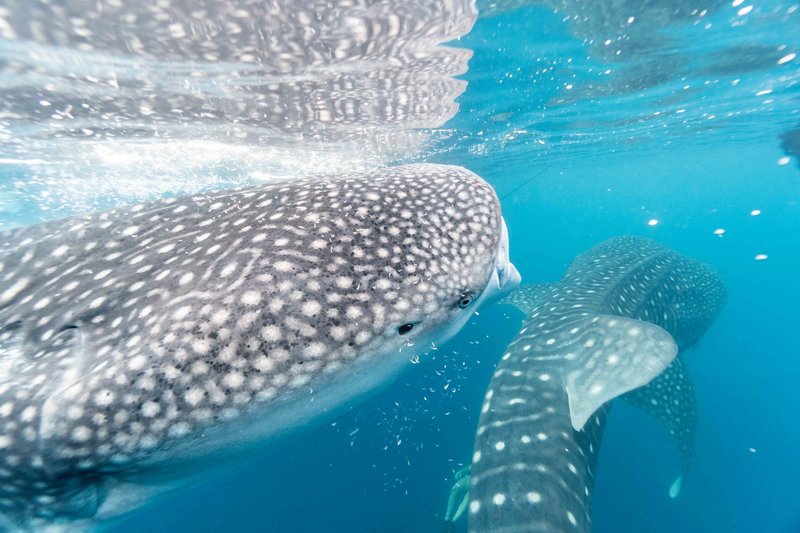
Whale sharks get the headline, but the rest of the ocean’s giants each hold a record of their own.
-
Whale shark — up to 41.5 ft / 20+ tons. The largest fish, full stop. Filter feeder, harmless to humans, found in warm coastal waters worldwide.
-
Basking shark — up to 40 ft historically, though most adults run 20–26 ft and around 5 tons. The second-largest fish and, like the whale shark, a filter feeder — it swims with its mouth gaping open, straining plankton, rather than actively hunting anything.
-
Giant oarfish — up to 36 ft, making it the longest bony fish on record. It’s a deep-sea species that’s almost never seen alive; most of what we know comes from specimens that wash ashore or get caught in nets. In Japanese folklore it’s called ryugu no tsukai, “messenger from the sea god’s palace,” and sightings are still sometimes linked to earthquake superstition, though there’s no scientific evidence connecting the two.
-
Ocean sunfish — up to 11 ft fin-to-fin and 5,000 lbs, making it the heaviest bony fish alive. It looks like a fish that stopped growing halfway through — flattened, finless-looking, mostly head and tail fin. It’s also absurdly fecund: a single female can release up to 300 million eggs, more than any other known vertebrate.
-
Great white shark — up to 20 ft and roughly 5,000 lbs, and the largest predatory fish in the ocean. Unlike the filter feeders on this list, it actively hunts seals, sea lions, and other fish, and can breach clear out of the water while doing it.
-
Greenland shark — up to 21 ft and among the longest-lived vertebrates on Earth, with a 2016 study estimating individual sharks can live 300 to 500 years. Most have corneas clouded by a parasitic copepod that lives on the eye, which is part of why the species is thought to hunt largely by smell in the near-freezing dark water it prefers. That longevity study, covered by National Geographic, used radiocarbon dating on the sharks’ eye tissue to arrive at the age estimate.
Fish Size Comparison Table
| Species | Max Length | Max Weight | Habitat |
|---|---|---|---|
| Whale shark | 41.5 ft (12.6 m) | ~20 tons | Warm oceans worldwide |
| Basking shark | 40 ft (12 m) | ~5 tons | Temperate oceans |
| Giant oarfish | 36 ft (11 m) | ~600 lb | Deep open ocean worldwide |
| Beluga sturgeon | 23 ft (7 m) | ~3,300 lb | Caspian and Black Sea basins |
| Greenland shark | 21 ft (6.4 m) | ~2,200 lb | Arctic and North Atlantic deep water |
| Great white shark | 20 ft (6 m) | ~5,000 lb | Coastal and offshore oceans |
| Giant freshwater stingray | 16 ft (5 m) incl. tail | ~1,300 lb | Mekong and Chao Phraya rivers |
| Ocean sunfish | 11 ft (3.3 m) | ~5,000 lb | Temperate and tropical oceans |
| Mekong giant catfish | 10 ft (3 m) | ~660 lb | Mekong River |
| Arapaima | 10 ft (3 m) | ~440 lb | Amazon basin |
The Biggest Freshwater Fish
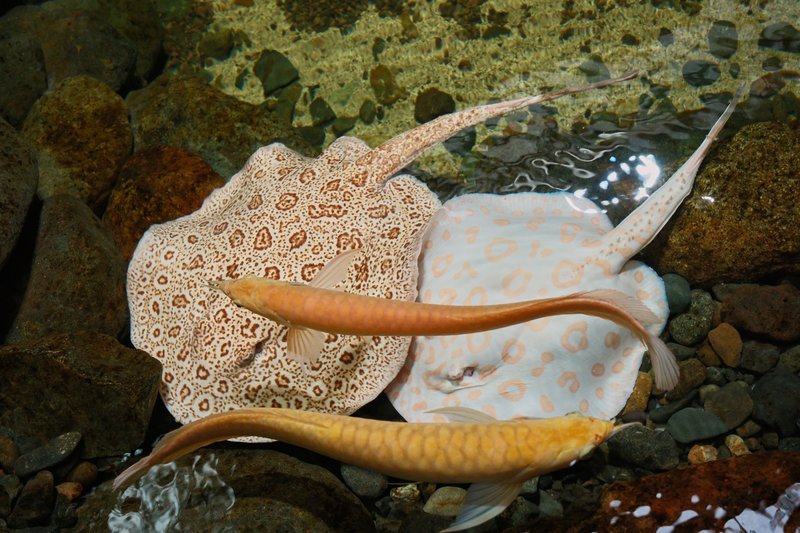
Ocean giants get most of the attention, but rivers hide some of the heaviest fish alive — and none of them need salt water to get there.
The beluga sturgeon is the traditional answer to “biggest freshwater fish.” Historic specimens from the Caspian and Black Sea basins reportedly reached 23 feet and over 3,000 pounds, though fish anywhere near that size are now essentially gone. The species built its reputation on beluga caviar, and that same reputation nearly wiped it out — decades of poaching for roe have left it critically endangered, and modern catches are a fraction of what 19th-century fishermen recorded.
The giant freshwater stingray, found in the Mekong and Chao Phraya river systems, gives the sturgeon real competition. It can stretch 16 feet including the tail and has been recorded at over 1,300 pounds, with a barb that can exceed a foot in length. It spends most of its life buried in river sand, which makes it one of the hardest large animals on Earth to survey — researchers still aren’t certain how big the species can actually get.
The Mekong giant catfish is smaller but no less striking: up to 10 feet and 660 pounds, entirely scaleless, and critically endangered thanks to dam construction and overfishing along the Mekong. The arapaima, native to the Amazon basin, rounds out the list at up to 10 feet and 440 pounds. It’s an obligate air-breather — it has to surface every 5 to 15 minutes to gulp air through a lung-like modified swim bladder, or it drowns. Its scales are also tough enough that piranhas reportedly can’t bite through an adult’s flank.
The Biggest Fish Ever Caught (Record Catches)
“Biggest fish in the world” and “biggest fish ever caught” aren’t the same question, and the record books for the second one belong to sport anglers, not marine biologists.
The largest fish ever landed on rod and reel, by IGFA all-tackle rules, was a 2,664-pound great white shark caught off Ceduna, South Australia, in 1959 by angler Alf Dean. It still stands as the heaviest fish ever officially recorded on sport tackle — but IGFA stopped accepting new great white shark entries in 1997 as part of a broader shift toward catch-and-release for vulnerable species, so the record is effectively frozen in place.
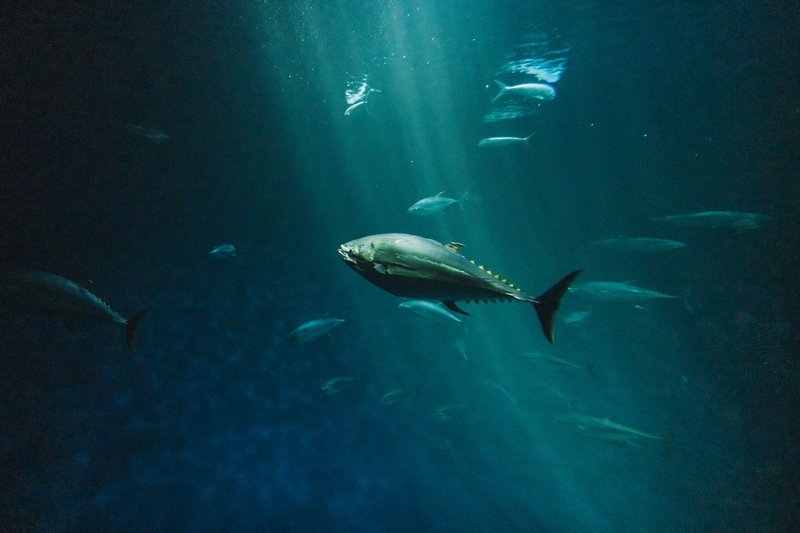
Among bony fish, the record belongs to a 1,496-pound Atlantic bluefin tuna, caught by Ken Fraser off Nova Scotia in 1979. Bluefin tuna are warm-blooded relative to most fish — a trait called regional endothermy — which lets them power through cold North Atlantic water fast enough to chase prey that most fish couldn’t catch. That same power and size made them one of the most valuable commercial catches on Earth; a single large bluefin has sold at Japanese auction for over $3 million.
Not every oversized freshwater fish makes it into a record book through sport fishing. A Mekong giant catfish weighing 646 pounds was pulled from a Thai fishing net in 2005 — a commercial catch, not a competition entry, but still one of the largest confirmed freshwater fish landed in modern times.
Why Some Fish Get So Big
A few patterns repeat across this list, and they’re not a coincidence.
Filter feeding removes the ceiling that limits most predators. Whale sharks and basking sharks don’t burn energy chasing prey — they swim slowly with their mouths open and let the ocean feed them, which means there’s no efficiency penalty for getting larger. Deep, cold water does something similar for the Greenland shark: a slower metabolism means slower growth, but also a longer life to keep growing in, which is how a shark ends up alive for half a millennium.
Fish also don’t stop growing the way mammals do. Sturgeon, catfish, and sharks show what’s called indeterminate growth — they keep adding size for as long as they live, so the biggest individual of a species is usually just the oldest one that survived long enough to get there. It’s part of why so many record-holders on this list, from beluga sturgeon to Greenland sharks, are also among the longest-lived vertebrates on the planet. Size, in the ocean, is often just another word for time.