Table of Contents
- TLDR
- Browsers first, grazers second
- How the diet changes with the seasons
- Why nyalas follow baboons and monkeys
- Males and females eat differently
- How much water do nyalas need?
- Wild diet vs. zoo diet
- Nyala vs. mountain nyala diet
- FAQ
TLDR
Nyalas are herbivores and mixed feeders: they browse and they graze. Most of what they eat is leaves, but the menu also includes fruits, seed pods, flowers, twigs, and grasses when fresh shoots are available.
Quick facts
- Scientific name: Tragelaphus angasii
- Diet type: Herbivore, mixed feeder (mostly browser)
- Main foods: Leaves, fruit, pods, flowers, twigs, fresh grass
- Feeding times: Early morning, late afternoon, and often into the night
- Digestion: Ruminant, four-chambered stomach
- Water: Drinks regularly, stays close to water in the dry season
- Range: Southern Africa, in dense thicket and riverine woodland
Browsers first, grazers second
A grazer eats grass. A browser eats leaves and other parts of woody plants. Nyalas do both, which is why “mixed feeder” is the label you’ll see in field guides.
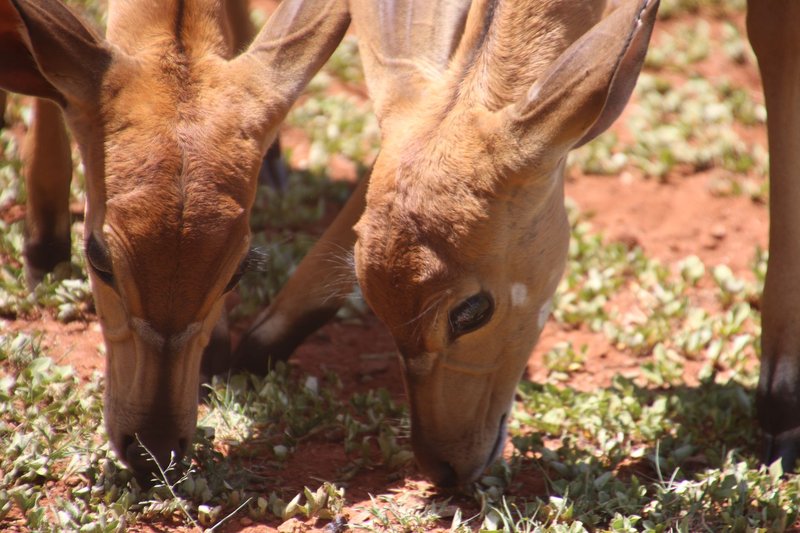
In practice, the balance leans toward browse. Nyalas live in dense bush, and dense bush is mostly shrubs, saplings, and vines. They nip young leaves, pull down low branches, and pick up fruits, flowers, and seed pods that have dropped to the ground. Grass fills in when it’s green and tender, and gets ignored when it dries out.
That flexibility is the point. An animal that can switch between leaves and grass doesn’t starve when one of them runs short, and it doesn’t need to migrate to find the other. Nyalas are homebodies with a home range of only a few square kilometers, so a flexible diet is the way they stay put.
Like other antelope, they’re ruminants. They swallow plant material quickly, retreat to cover, then bring it back up and chew it again. Leaves are easier to digest than tough grass, which is one reason nyalas manage on a diet that would leave a pure grazer short of protein.
How the diet changes with the seasons
The wet season and the dry season give nyalas two different menus.
Wet season. New leaves flush on every shrub, grass sprouts, and fruit is available. Nyalas eat more grass at this time because it’s soft and nutritious. Forage is everywhere, so they spread out and don’t have to travel far.
Dry season. Grass turns coarse and loses most of its protein. Nyalas shift heavily to browse: evergreen leaves, twigs, and whatever fruits and pods the bush drops. They also stay closer to rivers and thickets, where plants keep their leaves longer.
Feeding follows a pattern too. Nyalas are most active in the early morning and late afternoon, resting in shade through the midday heat. In places where they’re disturbed by people, they shift more of their feeding to the night.
Why nyalas follow baboons and monkeys
This is the most interesting part of the nyala diet. Nyalas often trail groups of baboons and vervet monkeys through the woodland.
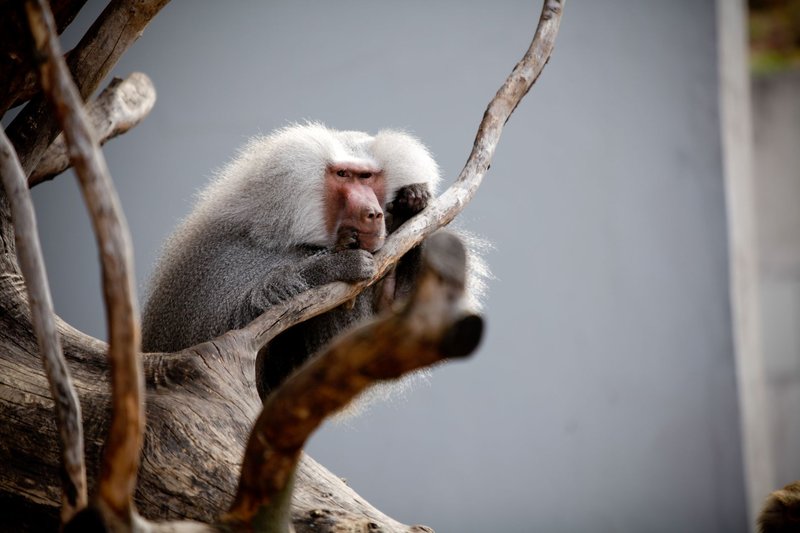
Monkeys feed in the canopy, and they’re messy. Fruit, leaves, and flowers drop to the ground as they eat. Nyalas wait underneath and collect what falls, gaining access to food that would otherwise be out of reach. The monkeys also act as lookouts: when a troop sounds an alarm at a leopard, the nyalas hear it too.
Nyalas aren’t the only ones. Bushbuck and other forest antelope use the same trick. But nyalas do it often enough that it’s one of the first behaviors mentioned in field descriptions of the species.
Males and females eat differently
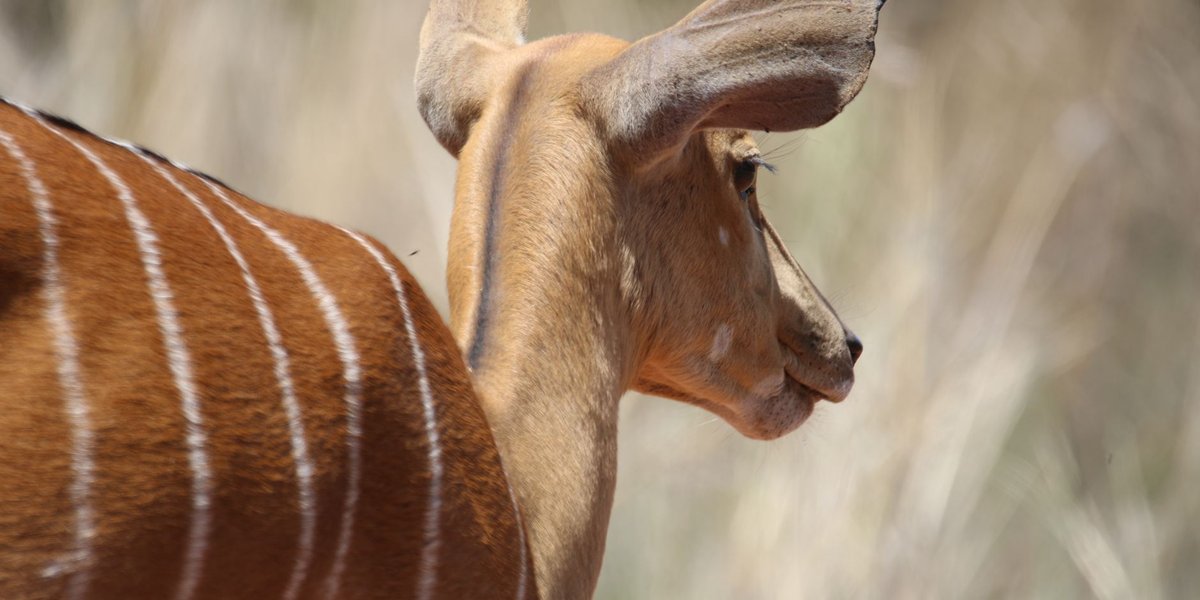
Nyalas are strongly sexually dimorphic. Adult males are dark, shaggy, and much larger, weighing roughly 100 to 125 kg. Females are chestnut-colored and weigh about 55 to 68 kg.
The size gap shows up at feeding time. Males are tall enough to reach higher branches, and they’ll rear up on their hind legs to pull down leaves that females can’t get to. Females and young stay lower and take a greater share of grass and low browse. The split reduces competition, so a group of mixed sexes can feed in the same patch without eating over each other.
Calves start out on milk and are typically weaned at around six months, after they’ve been nibbling solid food for weeks.
How much water do nyalas need?
Nyalas need drinking water and don’t wander far from it. They drink regularly, especially in the dry season, when leaves hold less moisture. Water sources such as rivers, streams, and waterholes anchor their home range.
That dependence is part of why nyalas are found where they are: dense woodland along rivers, lowland thicket, and bush with permanent water. Take away the water and the thicket, and the nyalas go too.
Wild diet vs. zoo diet
Zoos can’t replicate a thicket, so they build a diet that covers the same nutritional ground.
| Food category | In the wild | In a zoo |
|---|---|---|
| Leaves and twigs | Main food, year-round | Browse cuttings from safe trees |
| Fruit | Fallen fruit, often from monkey feeding | Apples and other fruit as treats |
| Grass | Fresh shoots in the wet season | Grass hay, fed daily |
| Vegetables | Not eaten | Carrots, sweet potatoes, leafy greens |
| Supplements | None | Pelleted feed for balanced minerals |
| Water | Rivers, streams, waterholes | Fresh water at all times |
Zoo staff feed hay and pellets for the bulk of nutrition and use produce as enrichment. The wild version is more varied, and far more seasonal.
Nyala vs. mountain nyala diet
Search results mix the two animals, so it’s worth separating them. The nyala in this post is the lowland (common) nyala, Tragelaphus angasii, from southern Africa. The mountain nyala, Tragelaphus buxtoni, is a different species that lives only in the highlands of Ethiopia.
Both are listed by the IUCN Red List, which tracks their conservation status separately.
The mountain nyala lives at high elevation, in heath, shrubland, and woodland on the Ethiopian plateau. Its diet follows the habitat: herbs, shrubs, and grasses of the highlands, with a larger share of grass than the lowland species and browse filling the gaps. Different animal, different plants, different diet.
| Lowland nyala | Mountain nyala | |
|---|---|---|
| Species | Tragelaphus angasii | Tragelaphus buxtoni |
| Region | Southern Africa | Ethiopian highlands |
| Habitat | Dense thicket, riverine woodland | High-altitude heath and woodland |
| Diet | Mostly browse, some grass | Herbs, shrubs, and grasses |
Nyalas are also often confused with kudu, a close relative in the same genus. Kudu are larger and live in drier, more open bush, and both species browse heavily.
FAQ
Are nyalas herbivores? Yes. Nyalas eat only plants: leaves, fruit, flowers, pods, twigs, and grass.
Do nyalas eat meat? No. They’re ruminants with a digestive system built for plant material.
What do baby nyalas eat? Calves nurse on their mother’s milk and begin nibbling leaves and grass within a few weeks. They’re usually fully weaned at around six months.
How much water do nyalas drink? They drink regularly and stay close to water, particularly in the dry season. Exact amounts vary with temperature and how moist their food is.
Are nyalas grazers or browsers? Both, with a lean toward browsing. They eat grass when it’s fresh and switch to leaves when it dries out.