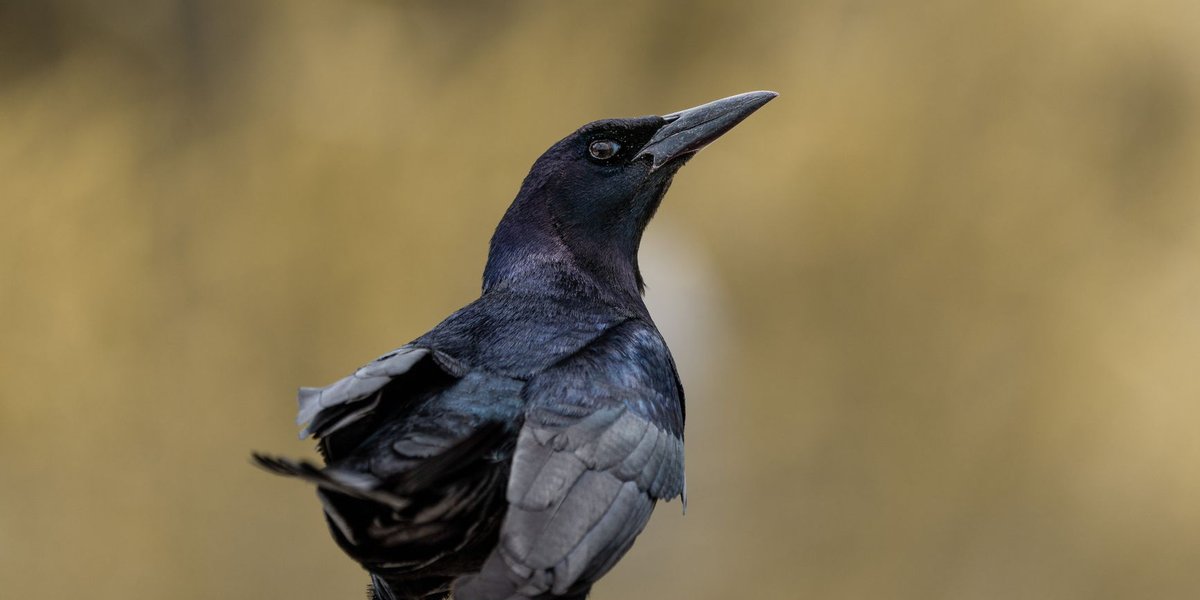
“Black bird” and “blackbird” are not the same search. One is a color description that fits half the birds in your yard. The other is a specific family — Icteridae in North America, Turdidae in Europe — that includes the red-winged blackbird, the common grackle’s cousins, and the true blackbird (Turdus merula) that turns up in British gardens and nursery rhymes. If you typed “black birds” because something dark and loud showed up at your feeder, you’re almost certainly dealing with a crow, a grackle, a starling, or an actual blackbird — and they’re easier to tell apart than field guides make it seem.
Quick answer: what am I looking at?
Four questions get you 90% of the way there:
- Is it huge, with a thick beak and a fan-shaped tail? Crow.
- Is it huge with a wedge-shaped tail and a shaggy throat? Raven.
- Is it medium-sized with a long, keel-shaped tail and a purple-green sheen? Common grackle.
- Is it stocky with a short tail, yellow beak, and speckles in winter? European starling.
If it’s smaller and glossy black with red-and-yellow shoulder patches, that’s a male red-winged blackbird. If it’s black with a distinctly brown head, you’ve found a brown-headed cowbird. Details on all six below, plus a side-by-side chart.
Table of Contents
- Crow
- Raven
- Common Grackle
- European Starling
- Red-Winged Blackbird
- Brown-Headed Cowbird
- Comparison Chart
- FAQ
Crow
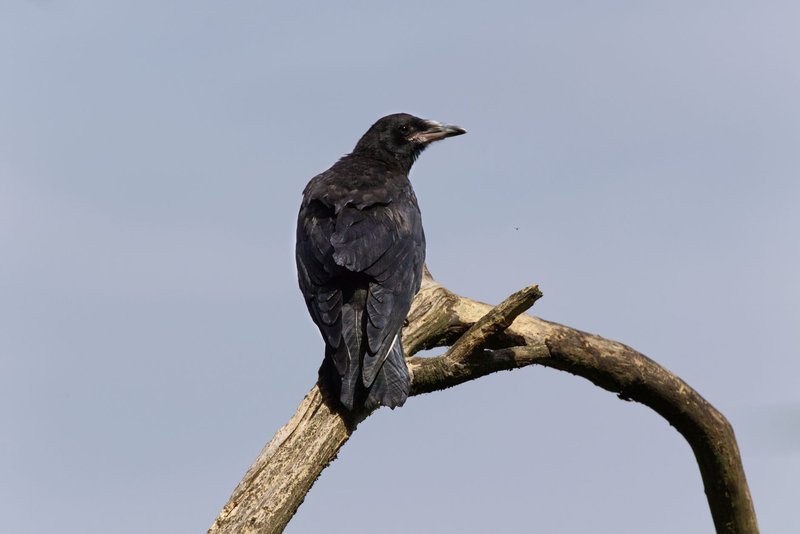
Crows are the baseline everyone measures other black birds against, and for good reason — they’re the ones showing up in parking lots, farm fields, and city parks in groups of a dozen or more. An American crow runs 16 to 20 inches long with a wingspan pushing 3 feet, matte black all over with barely a sheen, and a tail that fans out flat and square when it flies. The beak is straight, thinner than a raven’s, and built for an omnivore’s diet — crows eat everything from roadkill to unattended fries.
What actually separates crows from ravens in the field, more than size, is behavior. Crows are relentlessly social. They roost in the hundreds or thousands, mob hawks and owls in groups, and their flight is steady, direct wingbeats without much gliding. The call is the flat, nasal “caw” most people already associate with the word “crow.”
Raven
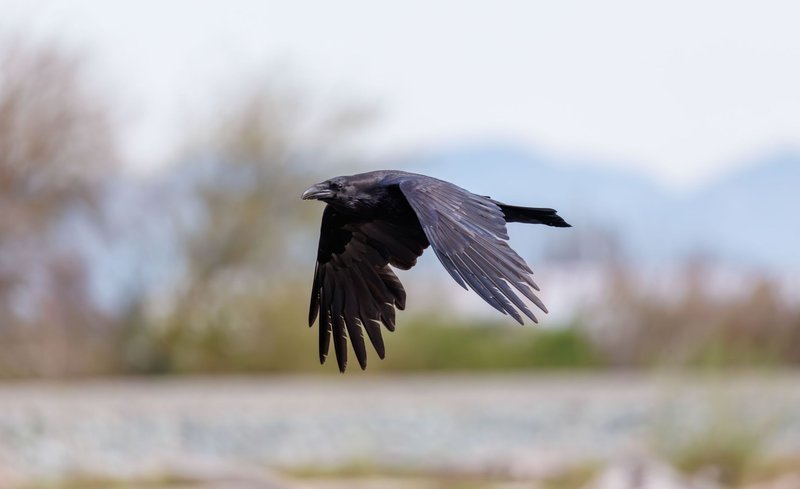
Common ravens are bigger than most people expect — around 24 to 27 inches, closer to a red-tailed hawk in wingspan than to a crow. The giveaway in flight is the tail: it comes to a distinct wedge or diamond point, versus the crow’s flat fan. Up close, ravens have a heavier, curved beak and shaggy feathers at the throat that crows lack entirely.
Ravens travel in pairs or small family groups rather than crowds, and they soar and tumble on thermals the way a crow rarely does — crows mostly flap. The voice is the other tell: a low, guttural croak instead of a caw, sometimes described as a knocking or clicking sound during courtship displays. Ravens also favor wilder terrain — cliffs, forests, open range — while crows lean into suburbs and farmland, though the two ranges overlap heavily across the western and northern U.S.
Common Grackle
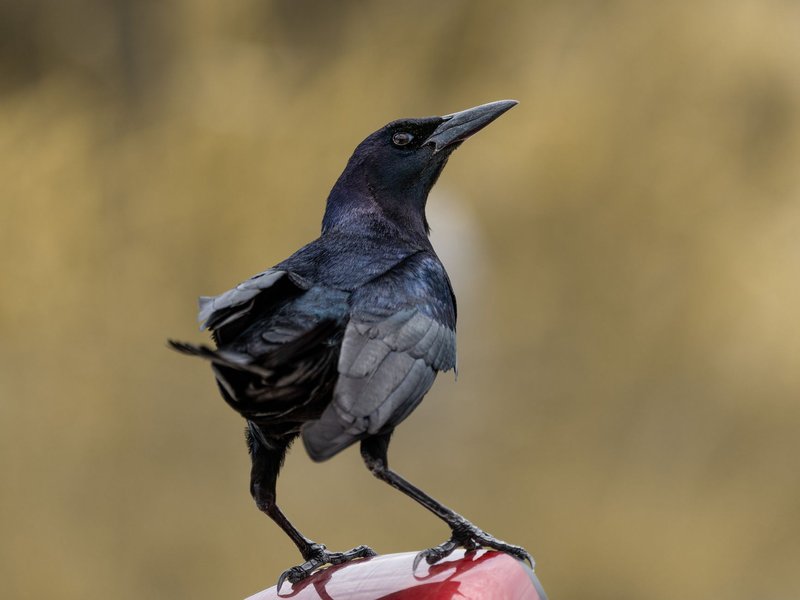
The common grackle is where a lot of “is that a crow?” questions actually resolve. Grackles are noticeably smaller — about 11 to 13 inches — and slimmer, with a long tail that folds into a distinct V or keel shape in flight, like the bird is being flown backward down a slot. In direct sun, the plumage isn’t flat black at all: it flashes iridescent purple, blue, and bronze across the head and body, a sheen crows simply don’t have.
The eye is the fastest field mark at a distance — grackles have a pale, almost white-yellow iris that stands out sharply against the dark head, while crows and ravens have dark brown eyes. Grackles gather in enormous mixed flocks with starlings and blackbirds each winter, sometimes numbering in the hundreds of thousands, and their call is a harsh, creaking note that birders often compare to a rusty gate hinge.
European Starling
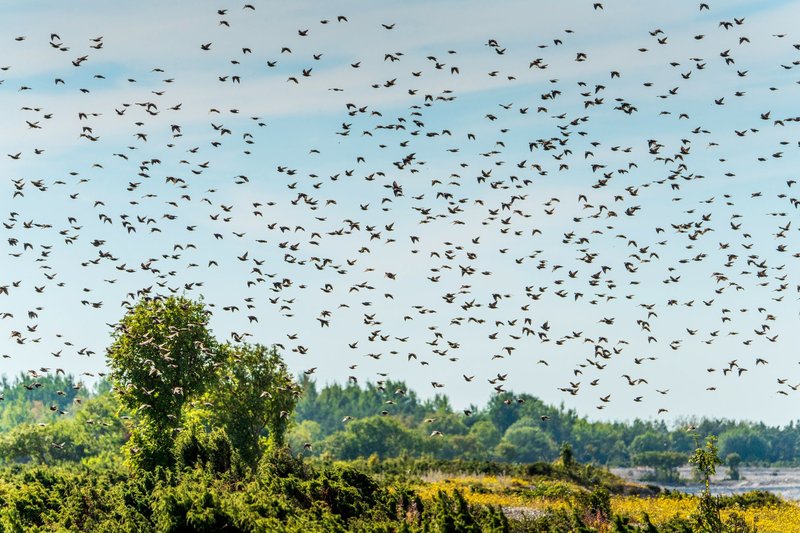
Starlings are an odd case: they’re not related to true blackbirds at all, but they’re black birds by every casual definition, and they’re one of the most abundant land birds in North America despite not being native here. Every starling on the continent descends from roughly 60 birds released in New York’s Central Park in 1890 by a group trying to introduce every bird mentioned in Shakespeare’s plays. The population is now estimated in the tens of millions.
Starlings are stocky and short-tailed with a long, pointed yellow beak in breeding season (it turns dark in winter). Summer plumage is glossy purple-green iridescent; by late fall they molt into a heavily speckled coat covered in white spots, which is where the old name “star-ling” comes from. In flight, look for short, triangular wings and a fast, direct wingbeat — starlings don’t glide the way blackbirds or grackles do, and they form the dense, swirling flocks called murmurations.
Red-Winged Blackbird
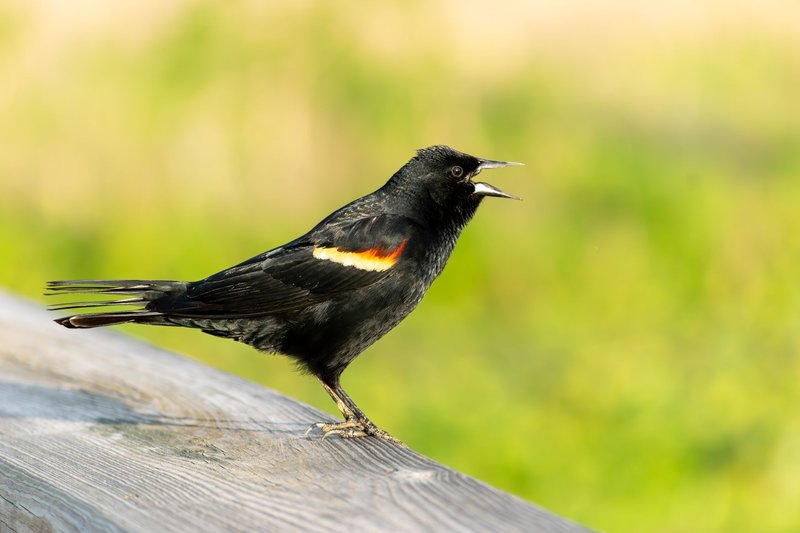
This is the bird “blackbird” technically refers to in North America, and the male is unmistakable once you’ve seen one: solid glossy black with a bright red-and-yellow patch, called an epaulet, on the shoulder. He’ll flare it deliberately while perched on a cattail or fence wire, calling a liquid, gurgling “conk-la-ree” to defend territory. Red-winged blackbirds are among the most numerous birds in North America, and males will dive-bomb anything — hawks, herons, people — that gets too close to a nest.
The confusion happens with females, who look nothing like the males: heavily streaked brown all over, closer in appearance to a large sparrow or a female cowbird than to their own mate. If you see a small flock of brown, streaky birds moving through a marsh alongside a few glossy black-and-red males, that’s a red-winged blackbird flock, not two different species.
Brown-Headed Cowbird
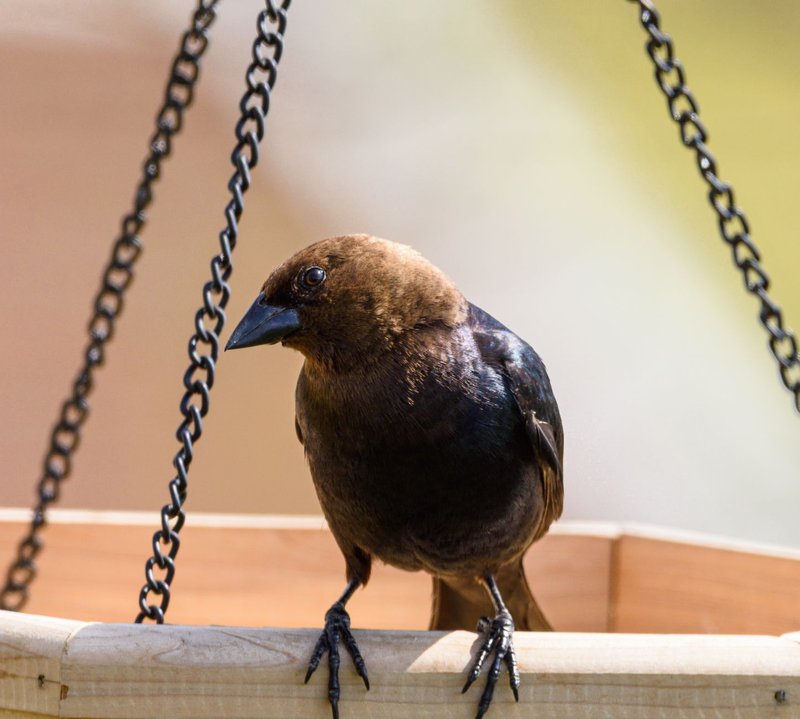
Male brown-headed cowbirds are glossy black with a chocolate-brown head and a notably short, thick, conical beak — seed-eater proportions rather than the all-purpose beak of a crow or grackle. Females are a plain, unstreaked gray-brown with no black at all, which makes them one of the harder blackbird-family birds to identify with confidence.
Cowbirds are brood parasites: females skip building nests entirely and instead lay their eggs in the nests of other species — over 220 documented host species — leaving the host bird to raise the cowbird chick, often at the expense of its own young. The behavior evolved when cowbirds followed migrating bison herds across the plains, feeding on insects stirred up by the animals, which meant staying put to raise a nest wasn’t an option. That evolutionary trade-off is the specific detail worth knowing if a warbler’s nest in your yard suddenly has one oversized, demanding chick in it.
Comparison Chart

| Species | Size | Beak | Tail | Eye Color | Call |
|---|---|---|---|---|---|
| Crow | 16–20 in | Straight, thin | Flat, fan-shaped | Dark brown | Flat “caw” |
| Raven | 24–27 in | Heavy, curved | Wedge/diamond-shaped | Dark brown | Low croak |
| Common Grackle | 11–13 in | Long, straight | Long, keel-shaped (V) | Pale yellow | Rusty-gate creak |
| European Starling | 8–9 in | Long, pointed (yellow in summer) | Short, squared | Dark brown | Chatters, mimics |
| Red-Winged Blackbird (male) | 7–9 in | Conical, sharp | Medium, rounded | Dark brown | Gurgling “conk-la-ree” |
| Brown-Headed Cowbird (male) | 6–8 in | Short, thick, conical | Medium, squared | Dark brown | High squeaky gurgle |
According to Cornell Lab of Ornithology’s All About Birds, tail shape and flight pattern together are more reliable field marks for separating these species than color alone, since lighting can make almost any of them look flat black at a distance.
FAQ
Is it “black bird” or “blackbird”? Both are correct, but they mean different things. “Black bird,” two words, is a description — any bird that’s black, including crows and starlings. “Blackbird,” one word, is a specific name: in North America it usually points to the Icteridae family (red-winged blackbirds, grackles, cowbirds); in the UK it’s Turdus merula, a thrush relative that has nothing to do with crows at all.
Are black birds a bad omen? Depends which culture you ask. Ravens and crows carry death or war associations in some European and Celtic folklore — the Norse god Odin kept two ravens, Huginn and Muninn, as messengers, while medieval superstition linked crows to witchcraft. Native American traditions more often cast the raven as a trickster or creator figure rather than a purely dark omen, and in plenty of contexts a black bird sighting is read as a sign of transformation or protection rather than doom.
Why are so many birds black in the first place? Melanin, the same pigment responsible for black in human hair and skin, is cheap for a bird to produce and structurally tough — feathers with more melanin resist wear better than lighter ones. It’s also why the “black” on a grackle or starling isn’t flat: melanin-rich feathers refract light into that oily, iridescent sheen you see on grackles, starlings, and crows in direct sun. Meanwhile, other bird species use different pigments to create their distinctive colors.
Do crows and ravens get along? Not particularly. Crows will mob a lone raven that gets too close to their nesting territory, ganging up in numbers to drive it off, and ravens have been documented preying on crow nests when they get the chance. Overlapping range doesn’t mean friendly neighbors.