The boreal forest flowers you’re most likely to meet are bunchberry, twinflower, starflower, pink lady’s slipper, purple pitcher plant, Labrador tea, fireweed and blue flag iris. Most bloom in a rush between late May and August, because the growing season in the taiga is only three to four months long. Miss a species in June and you may wait a year to see it again.
This guide sorts the flowers by where they grow, since habitat is the fastest way to narrow down an ID. Each profile gives the scientific name, color, bloom time, height, range and one trait that separates it from its lookalikes.
Contents
- Quick ID table
- Forest floor flowers
- Bog and wetland flowers
- Forest edge and burn flowers
- Riverbank flowers
- Bloom calendar: May to August
- How boreal forest flowers survive the cold, thin soil and low light
- Conservation: what to leave alone
- Final thoughts
Quick ID table
| Flower | Habitat | Color | Blooms | Look for |
|---|---|---|---|---|
| Bunchberry | Forest floor | White | June | Four white bracts around a green button |
| Twinflower | Forest floor | Pink | June-Aug | Two nodding bells on a forked stalk |
| Starflower | Forest floor | White | June | Seven petals above a whorl of leaves |
| Canada mayflower | Forest floor | White | June | Four tepals, heart-shaped leaves |
| Pink lady’s slipper | Forest floor | Pink | May-June | Pouch with a slit down the front |
| Calypso orchid | Mossy conifer woods | Magenta | May-June | One flower, one leaf |
| Purple pitcher plant | Bogs | Maroon | June | Nodding flower over vase-shaped leaves |
| Labrador tea | Bogs | White | June-July | Rusty fuzz under the leaves |
| Bog laurel | Bogs | Pink | May-July | Saucer flowers with ten tucked stamens |
| Cloudberry | Bogs | White | June | Single flower, crinkled leaves |
| Round-leaved sundew | Bogs | White | July-Aug | Sticky red leaf paddles |
| Showy lady’s slipper | Fens | White and pink | June-July | Tall stem, leafy to the top |
| Fireweed | Burns, edges | Magenta | July-Sept | Tall spike blooming bottom to top |
| Prickly rose | Edges | Pink | June-July | Five petals, bristly stems |
| Harebell | Rocky edges | Blue | June-Sept | Thin stem leaves, round basal leaves |
| Blue flag iris | Shorelines | Violet-blue | June-July | Sword leaves, veined petals |
| Marsh marigold | Streams | Yellow | May-June | Glossy kidney-shaped leaves |
| Tall bluebells | Riverbanks | Blue | June-July | Pink buds opening blue |
Forest floor flowers
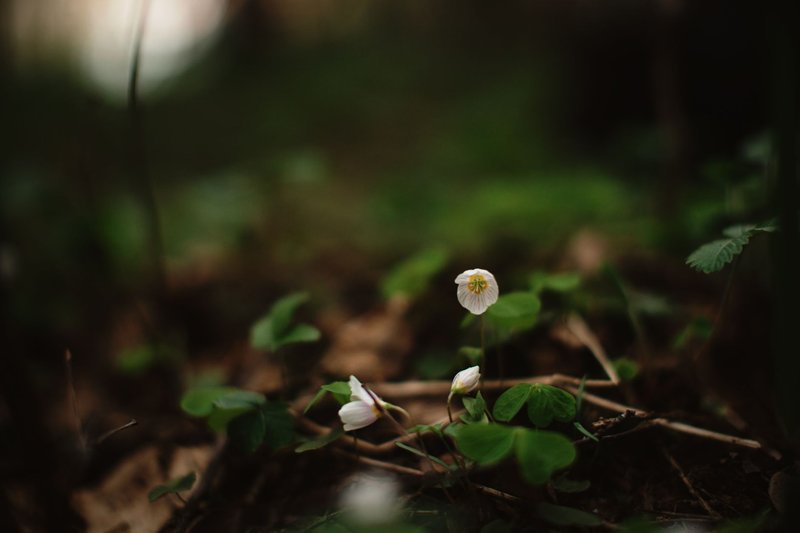
The understory of a spruce or pine forest, one layer of the taiga’s vegetation, is dim, acidic and carpeted in moss. The flowers here are small, low and mostly white or pink, and they tend to grow in patches because they spread by underground stems.
Bunchberry (Cornus canadensis)
Color: white | Blooms: late May to July | Height: 10-20 cm | Range: across Canada and the northern US, into Alaska and northeast Asia
Bunchberry is a dogwood that never became a tree. What looks like a four-petaled flower is really four white bracts surrounding a tight cluster of tiny greenish flowers. When a pollinator trips the trigger, the little petals snap open in well under a millisecond and fling pollen into the air. Researchers have timed it as one of the fastest plant movements ever recorded. Red berries follow in late summer. Several of the top-ranking guides call it a shrub, but it’s an herb that dies back to the ground each fall.
Twinflower (Linnaea borealis)
Color: pink | Blooms: June to August | Height: 5-10 cm | Range: circumpolar across the boreal zone
A trailing evergreen vine with pairs of nodding, bell-shaped pink flowers on a single forked stalk. They smell faintly of almond. It’s the plant that Carl Linnaeus, the father of modern taxonomy, liked best, which is why the species carries his name. Once you see the paired bells you won’t confuse it with anything else.
Starflower (Lysimachia borealis)
Color: white | Blooms: late May to July | Height: 10-20 cm | Range: Labrador to Manitoba and south into New England
One thin stem, a whorl of leaves at the top, and a few white flowers floating above it on hair-fine stalks. Count the petals. Most flowers have five or six, but starflower usually has seven, which is the quickest field mark. It was long filed under the genus Trientalis, so older field guides list it under that name.
Canada mayflower (Maianthemum canadense)
Color: white | Blooms: late May to July | Height: 8-20 cm | Range: Newfoundland to the Prairies
Often called wild lily-of-the-valley. It has two or three glossy, heart-shaped leaves and a short spike of tiny white flowers. The tell is the flower count: four tepals, where related lilies have six. By August it sets speckled berries that ripen red.
Pink lady’s slipper (Cypripedium acaule)
Color: pink | Blooms: May to June | Height: 15-40 cm | Range: Newfoundland west to Alberta and south into the Appalachians
The orchid people photograph first. Two big leaves lie flat at the base and a single pink pouch hangs from a leafless stalk. Unlike other lady’s slippers, whose pouch seam is closed, this one has a visible slit running down the front. It grows in acidic pine and spruce woods and depends on a specific soil fungus to germinate, so it’s very hard to transplant.
Calypso orchid (Calypso bulbosa)
Color: magenta-pink | Blooms: May to June | Height: 8-20 cm | Range: circumpolar, in cool mossy conifer woods
Also called the fairy slipper. One flower, one leaf, and nothing else. The single leaf appears in fall, lasts through the winter under snow, and withers by the time the flower opens. It’s small enough to walk past, so look for patches of magenta in the moss near rotting logs.
Bog and wetland flowers
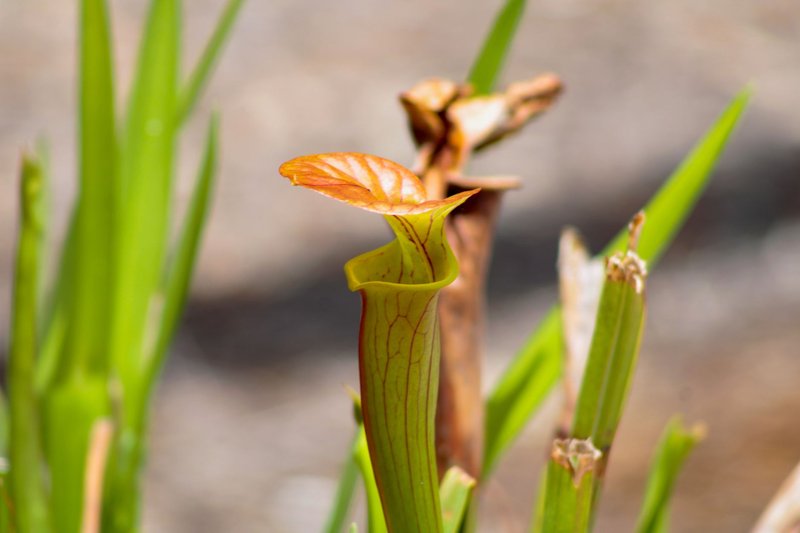
Bogs are wet, acidic and short on nutrients, which is why the strangest boreal forest plants live there. Wear waterproof boots, and stay on the edge or on boardwalks. A bog mat can be a thin skin over open water.
Purple pitcher plant (Sarracenia purpurea)
Color: maroon | Blooms: late May to July | Height: 30-60 cm | Range: Labrador to northeastern British Columbia, south to the Gulf Coast
A carnivorous plant with vase-shaped leaves that catch rainwater and drown insects. The flower is a single maroon bloom held on a leafless stalk well above the traps, which keeps pollinators away from the leaves. It’s the provincial flower of Newfoundland and Labrador.
Labrador tea (Rhododendron groenlandicum)
Color: white | Blooms: June to July | Height: 0.5-1 m | Range: Greenland to Alaska, across the boreal zone
A low evergreen shrub topped with flat white flower clusters. Turn a leaf over and you’ll see a rusty, felt-like underside with edges that curl under. That’s the ID. It’s a rhododendron, and the leaves have long been brewed into tea by Indigenous peoples across northern North America.
Bog laurel (Kalmia polifolia)
Color: pink | Blooms: May to July | Height: 10-50 cm | Range: Labrador to Alaska
Saucer-shaped pink flowers with ten stamens tucked into little pockets in the petals. When a bee lands, the stamens spring free and dust it with pollen. The leaves are opposite, narrow and white underneath, and the whole plant is toxic to grazing animals.
Cloudberry (Rubus chamaemorus)
Color: white | Blooms: June | Height: 5-25 cm | Range: circumpolar, in bogs and wet tundra
A raspberry relative with one white flower per stem and crinkled, maple-like leaves. Male and female flowers grow on separate plants, so a patch with plenty of blooms can still produce no fruit. The berries, when they come, ripen to amber and are a prized treat in Scandinavia and Newfoundland.
Round-leaved sundew (Drosera rotundifolia)
Color: white to pale pink | Blooms: July to August | Height: 10-20 cm (flower stalk) | Range: circumpolar
Another carnivore, this one tiny. The leaves form a flat rosette of red paddles covered in sticky droplets that trap gnats. The flower stalk rises above the rosette and the blooms open only in direct sun, often for just a few hours.
Showy lady’s slipper (Cypripedium reginae)
Color: white with magenta | Blooms: June to July | Height: 30-90 cm | Range: Newfoundland to Manitoba, south to the Great Lakes states
The tallest lady’s slipper and the most dramatic of the wild orchids of the boreal forest. A white pouch flushed with magenta sits on a hairy stem that is leafy all the way up, unlike the pink lady’s slipper. It grows in fens, which are wetlands fed by mineral-rich groundwater. It’s the state flower of Minnesota.
Forest edge and burn flowers
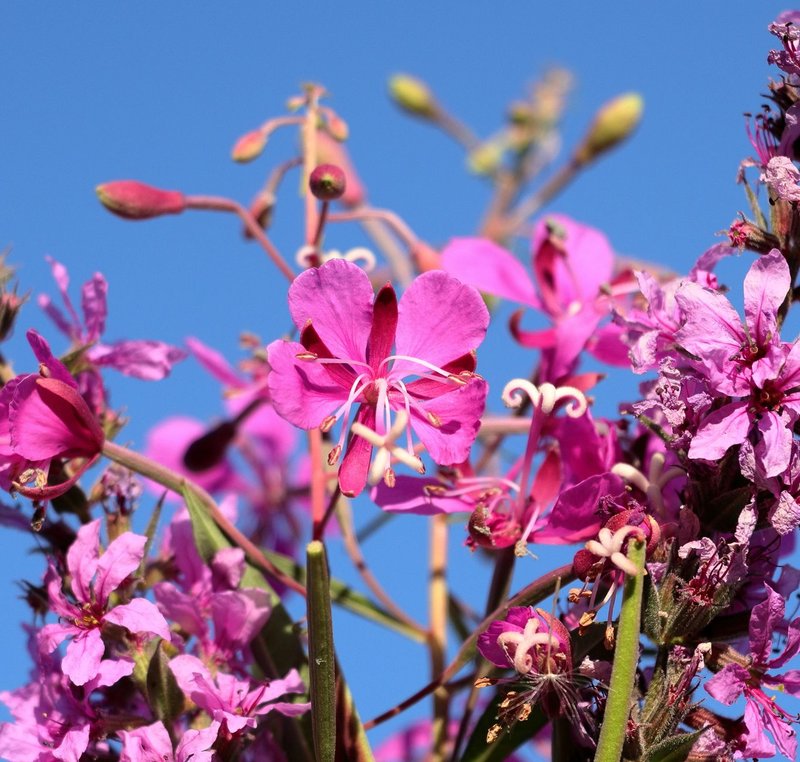
Fire is part of the boreal cycle. A burn opens the canopy, adds ash to the soil and sets off a bloom of sun-loving plants that fill the gap until the trees return. Roadsides, clearings and lakeshores give similar conditions.
Fireweed (Chamaenerion angustifolium)
Color: magenta | Blooms: July to September | Height: 1-2.5 m | Range: circumpolar
The classic burn colonizer. Tall spikes open from the bottom up, so a stem carries buds at the top and seed fluff at the bottom at the same time. Locals say that when the topmost flower opens, summer is over. Each plant releases tens of thousands of seeds on silky parachutes, which is how fireweed turns a blackened hillside pink within a season or two.
Prickly rose (Rosa acicularis)
Color: pink | Blooms: June to July | Height: 0.3-1.5 m | Range: across boreal Canada, Alaska and northern Eurasia
A five-petaled wild rose with a sweet scent and stems packed with fine bristles. The hips that follow are a food source for grouse and bears. It’s the provincial flower of Alberta.
Harebell (Campanula rotundifolia)
Color: blue-violet | Blooms: June to September | Height: 10-40 cm | Range: circumpolar, on rocky ground and open slopes
Nodding blue bells on wiry stems that shake in the lightest breeze. The name refers to the small, round basal leaves, but those usually wither before the plant flowers. What you actually see on a blooming stem are thin, grass-like leaves.
Riverbank flowers
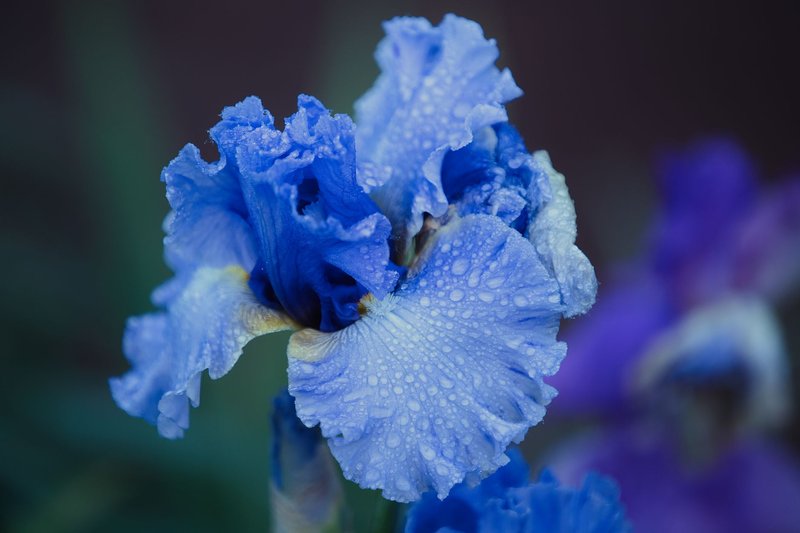
Moist soil and plenty of light mean larger flowers. These plants line streams, river margins and lakeshores.
Blue flag iris (Iris versicolor)
Color: violet-blue | Blooms: June to July | Height: 40-80 cm | Range: Newfoundland to Manitoba
Sword-shaped leaves and large flowers with purple veins and a yellow-and-white patch at the base of each falls. Don’t mix it up with the yellow flag iris, a European import that has taken over wetlands in parts of North America. If it’s blue and it’s native, it’s this one.
Marsh marigold (Caltha palustris)
Color: yellow | Blooms: May to June | Height: 15-60 cm | Range: circumpolar, in wet meadows and stream edges
One of the first boreal flowers up, sometimes within days of the ice going out. The glossy yellow “petals” are actually sepals, and the leaves are rounded and kidney-shaped. It looks like a giant buttercup, but the leaves give it away. All parts are toxic if eaten raw.
Tall bluebells (Mertensia paniculata)
Color: blue | Blooms: June to July | Height: 30-80 cm | Range: Alaska to Newfoundland
Drooping clusters of tubular flowers that open blue from pink buds, so the same plant can show both colors at once. The leaves are hairy and pointed, with obvious veins. It likes shaded streambanks and wet thickets.
Bloom calendar: May to August
The season runs fast, and each month has its own cast.
- May: marsh marigold, pink lady’s slipper, calypso orchid, bog laurel and the first pitcher plant flowers. Snow can still be on the ground in the north.
- June: the peak. Bunchberry, starflower, Canada mayflower, cloudberry, Labrador tea, blue flag iris, tall bluebells, prickly rose and showy lady’s slipper all open.
- July: twinflower is at its best, along with harebell, sundew and the first fireweed spikes. Most of the June flowers are setting fruit.
- August: fireweed climbs toward its tip, and harebell and the last twinflowers hang on. Bunchberry and Canada mayflower berries ripen.
Dates shift by about two to three weeks between southern Minnesota and northern Quebec or Alaska, so use this as a sequence rather than a schedule.
How boreal forest flowers survive the cold, thin soil and low light
Three problems define life here: short summers, poor soil and shade. The flowers have found different answers to each, and the wider taiga plant community faces the same limits.
Cold. Many species keep their leaves green under snow (twinflower, calypso orchid) so they can photosynthesize the moment it melts. Others, like bunchberry, spread by rhizomes and don’t rely on seed in a short season. Low, mat-forming growth keeps leaves near the warmer layer of air at ground level.
Poor soil. Spruce needles make acidic, nutrient-poor ground. Orchids work with mycorrhizal fungi that supply nutrients; pink lady’s slipper seeds can’t germinate without the right fungus, and plants can take more than a decade to flower. In bogs, where nitrogen is scarce, pitcher plants and sundews get nutrients from insects.
Low light. The spring flowers on the forest floor bloom early, before the canopy fully closes or the evergreen shade deepens. Some, like calypso, carry on with a single leaf and a small energy budget.
Pollinators. Bumblebee queens are among the few insects active in cold spring weather, and they do much of the work. Flies, small bees and moths cover the rest. A pink lady’s slipper traps a bee inside its pouch and forces it to climb out past the pollen, which is why so many flowers go unpollinated in a bad year for bees.
Conservation: what to leave alone
Orchids are the main concern. Pink and showy lady’s slippers grow slowly, depend on soil fungi, and rarely survive transplanting, so a plant dug from the woods usually dies within a couple of years. Many jurisdictions protect them, and picking one is often illegal. Take photographs instead.
Bogs and fens face their own pressures: peat harvesting, drainage and development. A drained bog loses its pitcher plants and sundews first. Stay on trails and boardwalks.
To check native ranges, the USDA PLANTS Database has county-level maps for North America, the National Park Service has species profiles from Voyageurs National Park in the boreal zone of Minnesota, and the Canadian Encyclopedia’s wildflower entry gives a good regional overview.
Final thoughts
Boreal forest flowers reward patience and low expectations about scale. The best ones are a handspan tall and open for a few weeks. Learn the forest floor group first (bunchberry, twinflower, starflower), then add the bog and burn specialists. By August you’ll recognize most of the flowers by habit alone.