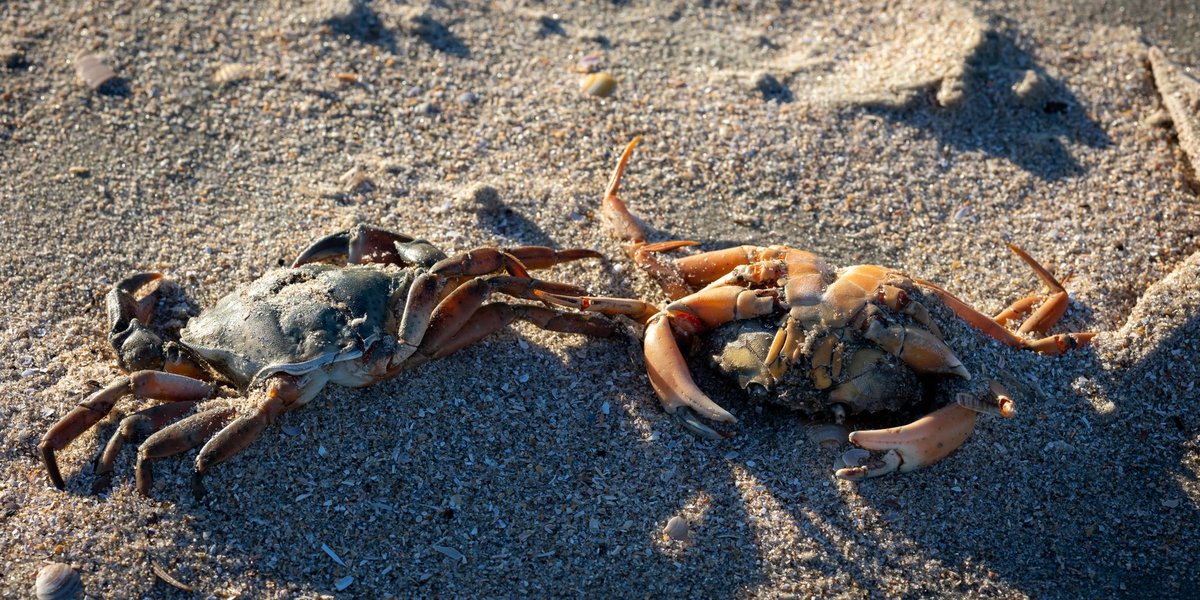
A crab is a ten-legged crustacean with a wide, flat shell, a tiny abdomen folded underneath it, and a body that moves sideways. That covers the basics. The rest of the characteristics of a crab are where it gets interesting, because almost every trait has a mechanical reason behind it, and a few animals called “crabs” don’t have those traits at all.
The Main Characteristics of a Crab at a Glance
- Hard exoskeleton. A shell made of chitin and hardened with calcium carbonate, shed periodically as the crab grows.
- Wide carapace. The shell over the head and chest is broad and flat, usually wider than it is long.
- Ten legs. Five pairs, with the front pair modified into claws (chelipeds).
- Sideways walk. Leg joints bend outward, so most crabs move fastest side to side.
- Stalked compound eyes. Eyes sit on movable stalks and fold into sockets for protection.
- Gill breathing. Gills sit in chambers under the carapace, even in crabs that live on land.
- Molting. Growth happens in bursts, each one after the crab backs out of its old shell.
- Tucked abdomen. The “tail” is short and folded under the body, and its shape tells you the crab’s sex.
Scientists call true crabs Brachyura, Greek for “short tail.” There are roughly 7,000 species, from freshwater crabs in tropical streams to deep-sea crabs that never see sunlight.
Table of Contents
- Exoskeleton and carapace
- Five pairs of legs and what the claws do
- Why crabs walk sideways
- Eyes and antennae
- Gills, and how land crabs breathe
- The crab molting process
- The abdomen: male vs female
- Crab anatomy summary table
- True crabs vs look-alikes
- Habitat and diet
- Size extremes and example species
- FAQ
Exoskeleton and carapace
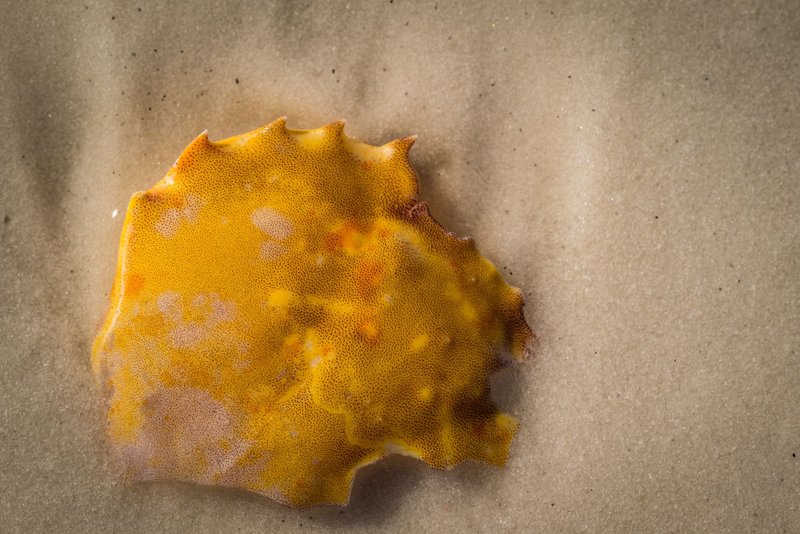
A crab wears its skeleton on the outside. The exoskeleton is built from chitin, the same tough polymer found in insect shells, and stiffened with calcium carbonate, the mineral in seashells and chalk. That is why a crab shell cracks instead of bending.
The top section is the carapace. It covers the head and thorax together, and in most species it is wider than it is long. Some crabs are almost perfectly round, others are triangular, and spider crabs have a narrow, pointed shell with spines. The carapace also roofs the gill chambers on each side, which matters later.
The underside is flatter and thinner. This is where the legs, mouthparts, and folded abdomen attach.
Five pairs of legs and what the claws do
How many legs does a crab have? Ten. Crabs are decapods, which literally means “ten-footed,” and the count includes the claws.
The front pair are the chelipeds, the pincers. The other four pairs are walking legs. Two details are worth knowing:
- Claws are not matched. Many crabs have a heavy “crusher” claw for cracking shells and a slimmer “cutter” claw for tearing and holding. Fiddler crab males take this to an extreme: one claw is enormous, used for waving at females and sparring with rivals, while the other stays small and does the actual feeding.
- Claws do more than fight. Crabs use them to pick food apart, pass it to the mouthparts, dig burrows, and signal. Behind the claws, a set of small appendages called maxillipeds handle chewing and tasting.
Some crabs also have paddle-shaped back legs. Swimming crabs, including the blue crab, use them like oars, which is why they can cross open water instead of just crawling along the bottom.
Why crabs walk sideways
Crab legs attach at the sides of a wide body, and the joints bend mainly outward, like a hinge that only swings one way. Try stepping forward with your knees bent sideways and you get the idea.
Moving sideways solves a practical problem. A crab with five pairs of legs and a broad shell would trip over itself walking forward. Sideways, the legs on the leading side reach and pull while the trailing legs push, and nothing tangles. It also lets a crab keep its claws facing a threat while it retreats toward a burrow.
It isn’t universal. Some crabs walk forward or diagonally, and soldier crabs, which march across tidal flats in huge groups, move straight ahead. But for the typical beach crab, sideways is the fast gear, and ghost crabs use it to outrun a person on sand.
Eyes and antennae
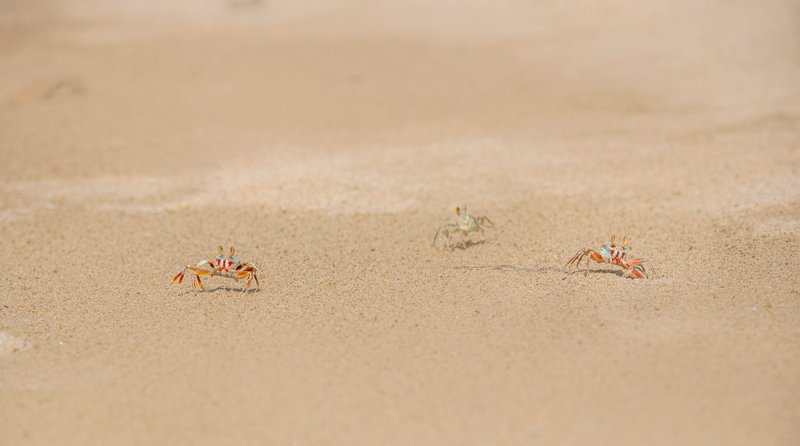
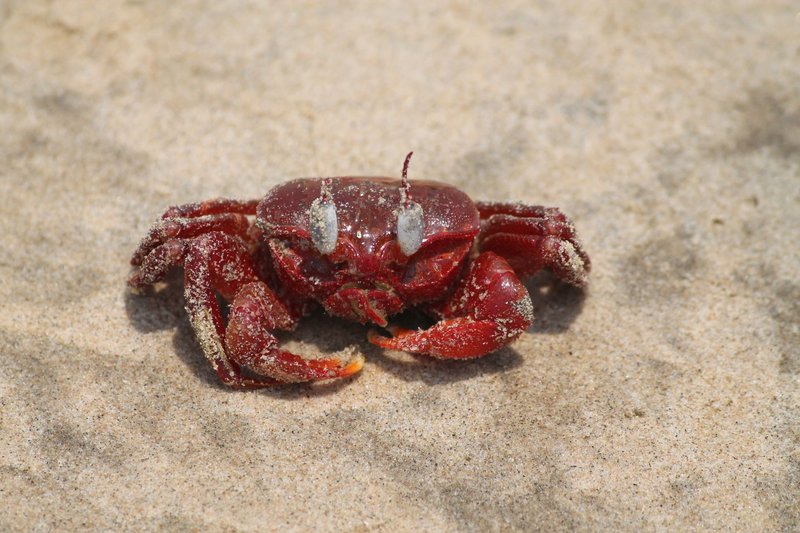
Crab eyes are compound, built from many tiny lenses like an insect’s, and they sit on movable stalks. The stalks lift the eyes above the shell for a near-360-degree view and fold down into sockets when a predator or wave threatens.
Some crabs lean on the stalks in a more dramatic way. Ghost crabs and fiddler crabs have long, upright eyestalks suited to open flats where the main danger comes from above and the horizon is wide.
Crabs also carry two pairs of antennae, but they are small and easy to miss. The shorter pair, the antennules, pick up chemical signals in the water, which is how crabs find food they can’t see. The longer pair handles touch and taste.
Gills, and how land crabs breathe
Crabs breathe with gills housed in chambers under the sides of the carapace. Water flows in near the base of the legs, passes over the gills, and exits near the mouth. A small paddle-like mouthpart beats to keep the flow moving.
Gills only work while wet, so how do land crabs manage? Species such as the Christmas Island red crab keep the gill chambers moist and use the chamber lining to absorb oxygen from air. They still depend on the sea. Every year, red crabs on Christmas Island migrate from forest burrows to the coast so females can release their eggs into the water.
The crab molting process
A rigid shell can’t stretch, so a crab has to leave it to grow. The molting process runs in stages:
- Preparation. The crab builds a new, soft shell under the old one and absorbs some minerals from the old shell. It often hides in a burrow or crevice.
- Splitting. The old shell cracks along the rear edge of the carapace.
- Backing out. The crab pulls itself free, legs and claws included, and can regrow a lost limb during molts.
- Expanding. The soft crab pumps up with water, stretching its new shell to a larger size.
- Hardening. Over days or weeks, the shell stiffens. Until then, the crab is vulnerable and stays hidden.
Young crabs molt often. A blue crab goes through more than 20 molts before reaching adult size, and adults slow down dramatically, with some species molting only once a year or even less.
The abdomen: male vs female
Flip a crab over and you’ll see the abdomen, a small plate folded tight against the underside. This is the “short tail” that gave true crabs their name.
Its shape tells you the sex:
- Males have a narrow abdomen, often triangular or T-shaped.
- Females have a broad, rounded one, because they carry fertilized eggs beneath it. The orange or dark egg mass is called a sponge.
Blue crab fishers use the shapes as nicknames: a mature male is a “jimmy,” and a mature female is a “sook.” The wide female apron has to hold thousands of eggs, sometimes millions in the largest species, until the larvae hatch.
Crab anatomy summary table
| Trait | What it does | Example species |
|---|---|---|
| Carapace | Protects the head, thorax, and gills | Dungeness crab |
| Chelipeds (claws) | Crush, cut, dig, and signal | Fiddler crab |
| Four walking pairs | Sideways movement, climbing, burrowing | Ghost crab |
| Paddle back legs | Swimming | Blue crab |
| Stalked eyes | Wide-angle vision, retractable | Ghost crab |
| Antennules | Detect chemicals in water | Most marine crabs |
| Gills in chambers | Breathe underwater or in damp air | Christmas Island red crab |
| Folded abdomen | Protects eggs (female), identifies sex | Blue crab |
| Molting | Allows growth and limb regeneration | Nearly all crabs |
True crabs vs look-alikes
Many animals called crabs aren’t true crabs. The easiest check is to count the legs and look at the tail.
Hermit crabs belong to a different group (Anomura). They have a long, soft, spiral abdomen that they hide in a borrowed shell, and the last two pairs of legs are small and used for gripping the shell. True crabs make their own armor and keep a short, tucked tail.
King crabs are also Anomura. They look like true crabs, but their fifth pair of legs is small and hidden under the carapace, so you see only eight legs, including claws, instead of ten. Their ancestors were hermit crab-like animals that evolved a crab shape. Biologists call that crab-like convergence “carcinization.”
Porcelain crabs share the same trick. They look like tiny flattened crabs but belong with the Anomura, and they hold their abdomens folded under them.
Horseshoe crabs aren’t crustaceans at all. They’re more closely related to spiders and scorpions, and their lineage goes back more than 400 million years. Their copper-based blue blood clots around bacteria, which is why it is used to test injectable medicines for contamination.
Habitat and diet
Most crabs live in the sea, from tidal pools and mangroves to the deep ocean floor. Freshwater crabs live in streams and lakes across the tropics and parts of southern Europe. Land crabs live in forests and coastal burrows, though most return to water to breed.
Crabs are mostly omnivores and scavengers. Depending on the species, the menu includes algae, mollusks, worms, fish, carrion, and detritus. That flexibility is part of why crabs have spread into so many habitats.
Size extremes and example species
Crab sizes cover an enormous range:
- Pea crabs are among the smallest, often under a centimeter across, and many live inside the shells of mussels and oysters.
- The Japanese spider crab has the longest leg span of any arthropod, reaching close to 3.7 meters (12 feet) from claw tip to claw tip, though its body is only about the size of a basketball.
- Dungeness crabs and blue crabs are mid-sized commercial species across North American coasts.
- Fiddler crabs are small, with a carapace usually under 4 centimeters wide, and are easy to spot on mudflats because of their lopsided claws.
FAQ
How many legs does a crab have? Ten: four pairs of walking legs and one pair of claws.
Why do crabs walk sideways? Their leg joints bend outward, and a sideways stride keeps ten legs from tangling under a wide body.
What is the difference between true crabs and hermit crabs? True crabs have a hard shell and a short abdomen tucked underneath. Hermit crabs have a soft, curled abdomen and live in borrowed shells.
Do crabs have bones? No. They have an external skeleton, the exoskeleton, and no internal bones.
Can crabs regrow claws? Yes. A lost claw or leg regrows over successive molts, usually smaller at first.
Are horseshoe crabs real crabs? No. They’re related to spiders and scorpions and aren’t crustaceans.