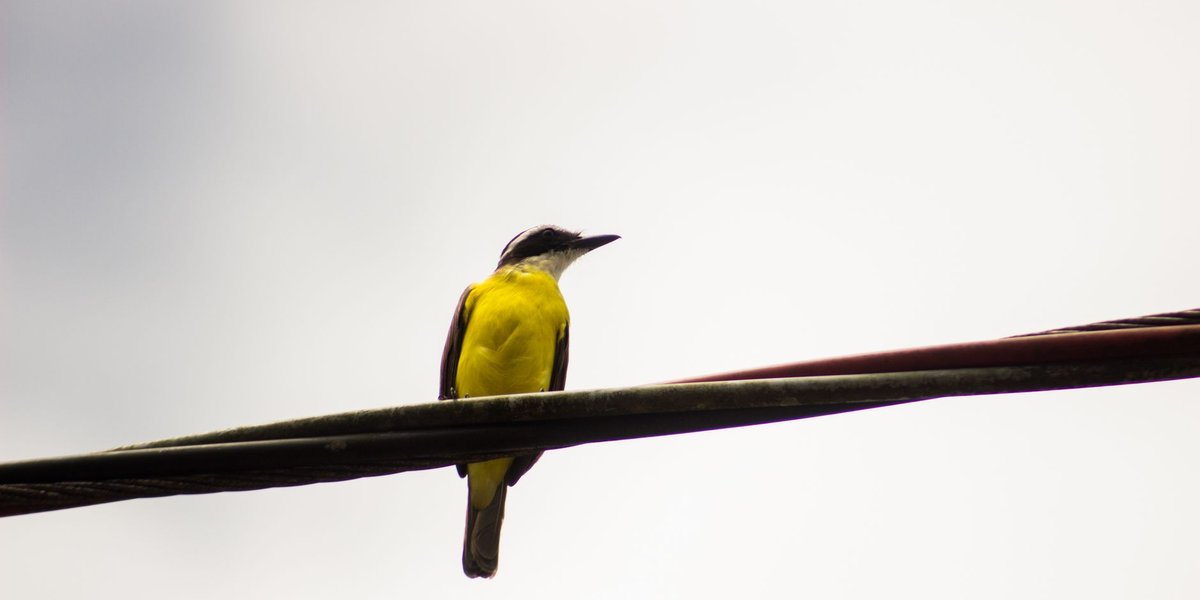
Yellow is one of the loudest colors in nature, and it usually means one of three things: “don’t eat me,” “I’m invisible on this flower,” or “pick me as a mate.” This list of yellow animals covers 24 species across birds, mammals, reptiles and amphibians, insects, and ocean life, each with its scientific name, range, size, diet, and one detail you won’t get from a photo caption.
Some entries are fully yellow. Others are yellow at one life stage or in one color morph. We’ve flagged those so you know what you’re looking at.
Contents
- Why animals are yellow
- Yellow birds
- Yellow mammals
- Yellow reptiles and amphibians
- Yellow insects and spiders
- Yellow fish and ocean animals
- Quick-reference table
- Wild yellow, morphs, and albinos
Why animals are yellow
Three jobs, mostly.
Warning. Yellow against a green or dark background is easy to spot, which is the point. Wasps, poison frogs, and boxfish advertise that they’re toxic or painful, and predators that learn the lesson once tend to remember it. This is called aposematism.
Camouflage. On a goldenrod flower or in dry grass, yellow is the best hiding color there is. Ambush hunters like crab spiders and some vipers rely on it.
Signaling. Bright yellow plumage tells a female bird the male is well fed and healthy. That’s the logic behind most yellow birds.
The pigments behind those jobs differ by group:
- Carotenoids give birds and many fish their yellows and oranges. Animals can’t make carotenoids, so they have to eat them, from seeds, insects, algae, or plants. A goldfinch that eats poorly molts into a duller yellow.
- Pteridines (pterins) are yellow pigments the body builds itself. They show up in frogs and in the wings of butterflies such as the brimstone.
- Pheomelanin is why yellow mammals tend to look golden or tan rather than lemon. Mammals mostly can’t deposit carotenoids in their fur, so a “yellow” mammal is almost always a pale or reddish-gold one.
Yellow birds
1. American goldfinch
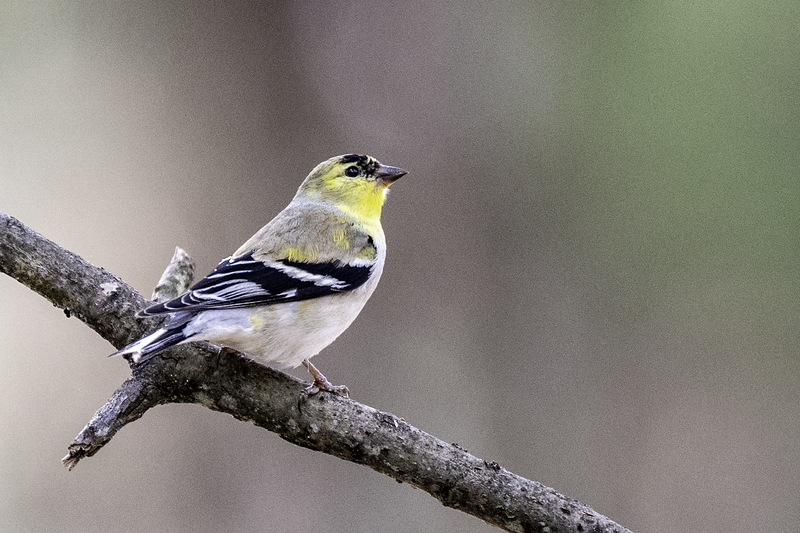
- Scientific name: Spinus tristis
- Habitat: Weedy fields, roadsides, and gardens across North America
- Size: About 11 to 13 cm long
- Diet: Seeds, especially thistle and sunflower
Males turn lemon yellow with a black cap each spring and molt to olive-brown for winter, so a “yellow bird” at your feeder in January is probably a goldfinch in disguise. They nest late, in July and August, when thistle seed is ripe, and they feed nestlings seeds rather than the insects most songbirds use. Cornell’s All About Birds has range maps and calls.
2. Eurasian golden oriole
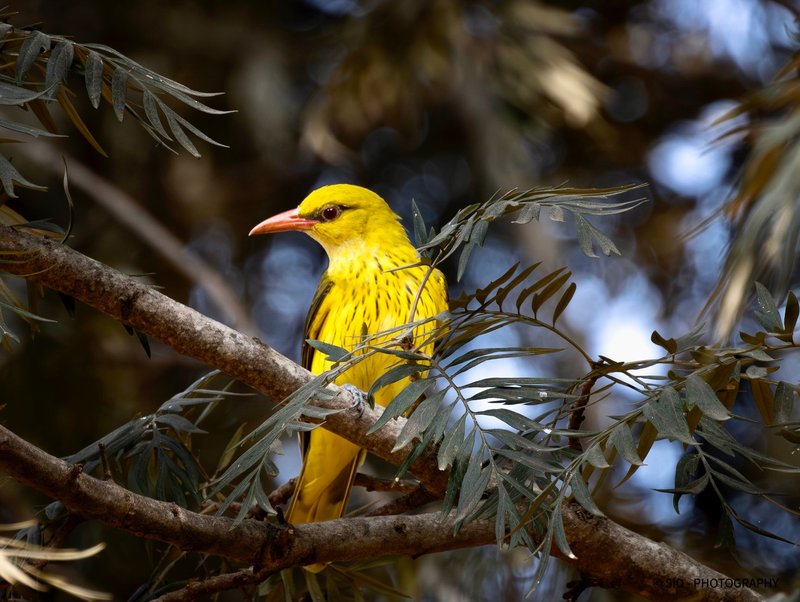
- Scientific name: Oriolus oriolus
- Habitat: Open broadleaf woodland and poplar plantations in Europe and Asia; winters in sub-Saharan Africa
- Size: About 24 cm long
- Diet: Insects, hairy caterpillars, and fruit such as figs and cherries
The male is intense yellow with black wings, and you’d expect to see one easily. You usually don’t. Orioles stay high in the leaf canopy, where yellow and green light blend together, and most people find one by its flute-like call first.
3. Yellow warbler
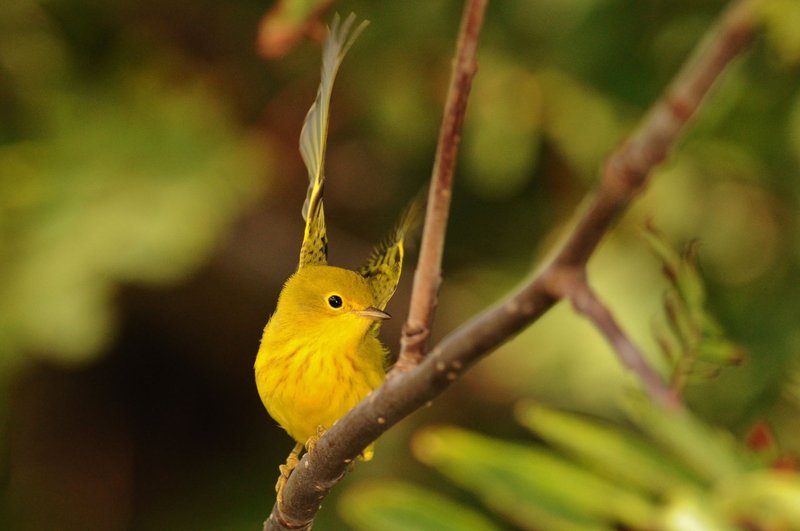
- Scientific name: Setophaga petechia
- Habitat: Willow thickets and streamside shrubs across North America; winters in Central and South America
- Size: About 12 cm long
- Diet: Insects, mostly caterpillars
Males are yellow all over with fine red streaks on the chest. The yellow warbler is also a notable defender against nest parasites. When a brown-headed cowbird lays an egg in its nest, the warbler builds a new floor over the top and starts again, as All About Birds describes. Some nests end up with several layers stacked on buried eggs.
4. Atlantic canary
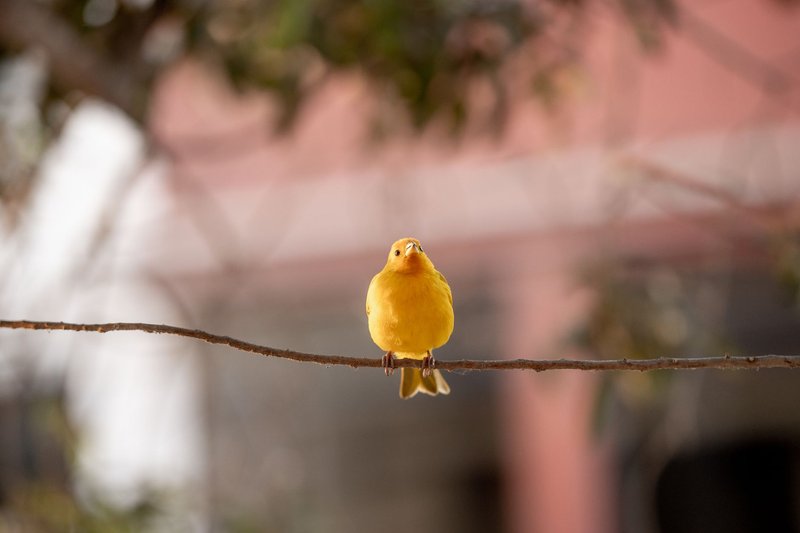
- Scientific name: Serinus canaria
- Habitat: Scrub and woodland edges in the Canary Islands, Madeira, and the Azores
- Size: About 12 cm long
- Diet: Seeds, buds, and small fruits
Here’s a correction for the color-coded list: the wild canary is a streaky yellow-green finch. The solid yellow bird in a cage is the product of centuries of selective breeding, which began in Spain in the 1500s. Canaries also had a working life. British coal mines used them as gas detectors until 1986.
5. Golden pheasant
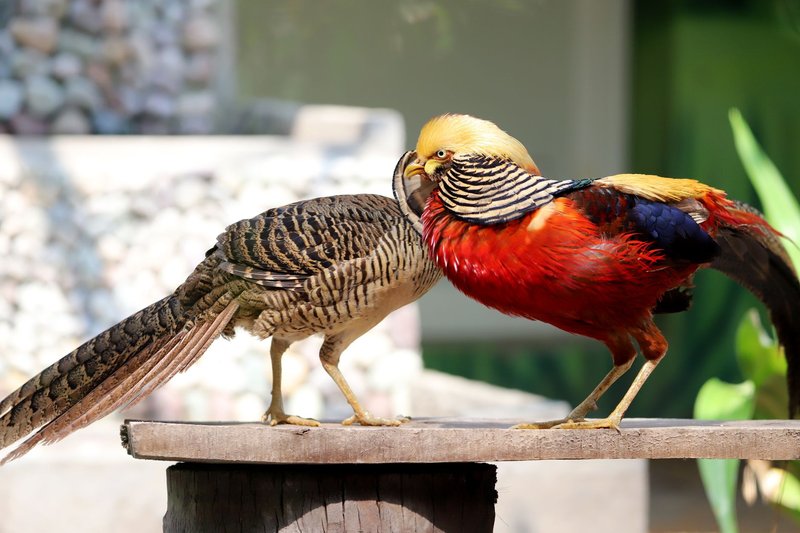
- Scientific name: Chrysolophus pictus
- Habitat: Dense mountain forest in central and western China; feral in parts of the UK
- Size: Males reach about 90 to 105 cm including the tail; females are smaller and brown
- Diet: Grain, seeds, leaves, and invertebrates
The male has a gold crest that falls over his neck, a red body, and a tail that makes up about two-thirds of his length. His wild relatives are secretive and stay low in thick cover, which is why so many people only know the bird from parks and wildfowl collections.
Yellow mammals
Most top-ranking lists skip mammals entirely. The reason is the pigment problem above: few mammals are truly yellow. These five are the closest.
6. Golden lion tamarin
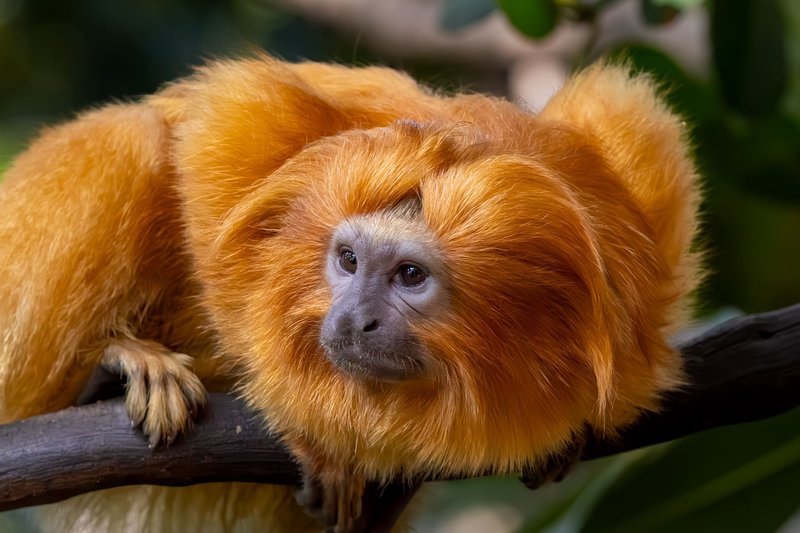
- Scientific name: Leontopithecus rosalia
- Habitat: Coastal Atlantic Forest in Rio de Janeiro state, Brazil
- Size: About 600 g
- Diet: Fruit, insects, and small lizards
The fur is more orange-gold than yellow, but it’s the classic golden primate. Habitat loss left only a few hundred in the wild in the 1970s. Zoo-bred animals were released into protected forest, and the wild population has since grown to several thousand, a rare success story that the Smithsonian’s National Zoo helped fund and run.
7. Yellow mongoose
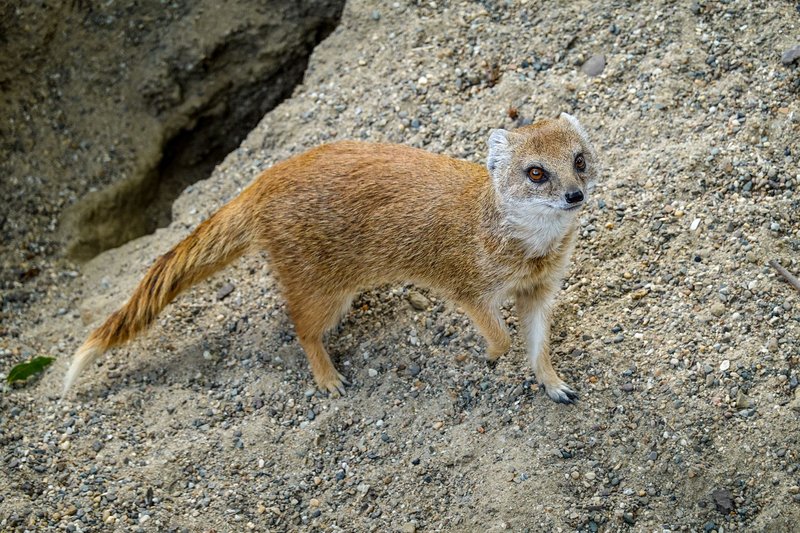
- Scientific name: Cynictis penicillata
- Habitat: Grassland, scrub, and semi-desert in southern Africa
- Size: Roughly 0.5 to 1 kg
- Diet: Insects, small rodents, reptiles, and eggs
It’s tan to rusty yellow with a white-tipped tail. Yellow mongooses dig warrens, and they often share them with Cape ground squirrels and meerkats. Watch a colony in the morning and you’ll see the whole group standing upright on their haunches in the sun.
8. Golden jackal
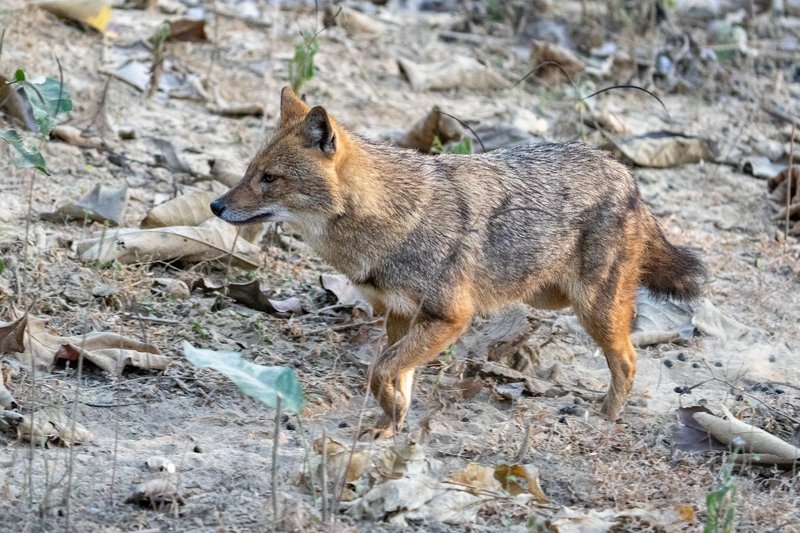
- Scientific name: Canis aureus
- Habitat: Open country from southeastern Europe through the Middle East to South Asia
- Size: Typically 8 to 10 kg
- Diet: Rodents, birds, fruit, and carrion
A golden jackal’s coat shifts from sandy yellow in summer to a darker, grayer coat in winter. The African animals once lumped in with it turned out to be a different species. A 2015 genetic study in Current Biology showed they’re a separate lineage now called the African golden wolf. Meanwhile, true golden jackals have been spreading north through central Europe.
9. Golden retriever
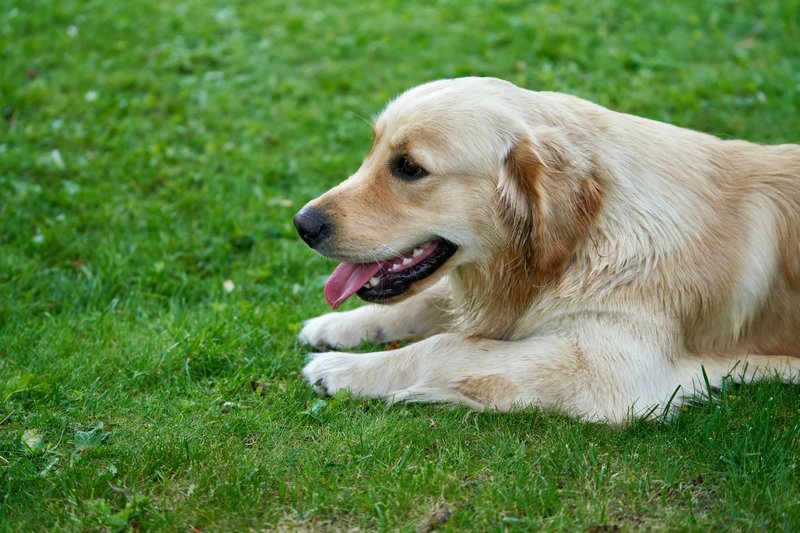
- Scientific name: Canis lupus familiaris (domestic dog)
- Habitat: Homes, mostly, and the hunting fields it was bred for
- Size: About 25 to 34 kg
- Diet: Commercial dog food and whatever falls off the counter
This one is a pet, not a wild animal, but it’s what many searchers want to see. The breed was developed in the Scottish Highlands in the 1800s to retrieve waterfowl. A yellow dog coat comes from a recessive variant of the MC1R gene that blocks black pigment, so the shade runs from pale cream to deep gold depending on how much pheomelanin gets made.
10. Golden snub-nosed monkey
- Scientific name: Rhinopithecus roxellana
- Habitat: Cold mountain forests in central China, at roughly 1,500 to 3,400 m
- Size: Males up to about 16 kg; females smaller
- Diet: Leaves, buds, bark, seeds, and lichen in winter
Gold-orange shoulders and back frame a pale blue face. This is one of the few primates that live where snow lies on the ground for months, and lichen is a major winter food. The IUCN Red List classifies it as Endangered.
Yellow reptiles and amphibians
11. Golden poison frog
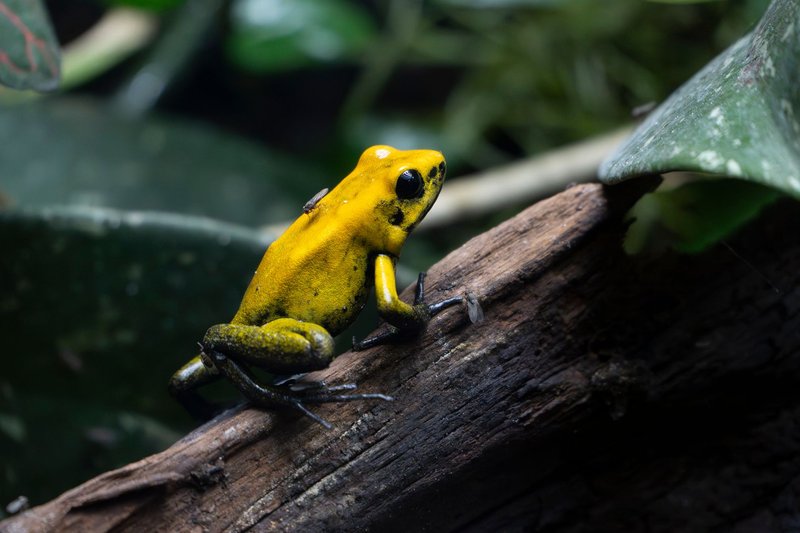
- Scientific name: Phyllobates terribilis
- Habitat: Rainforest on the Pacific coast of Colombia, in a very small range
- Size: About 5 cm
- Diet: Ants, mites, and small beetles
The most toxic of the poison frogs. Popular articles disagree on exactly how many people one frog could kill, and the numbers you’ll see (10, 20, “a dozen”) are rough estimates, not measurements. What’s solid is that the toxin, batrachotoxin, comes from the frog’s diet. Captive-raised frogs fed on fruit flies are not poisonous. Wild frogs come in yellow, orange, and pale mint-green forms.
12. Eyelash viper (yellow morph)
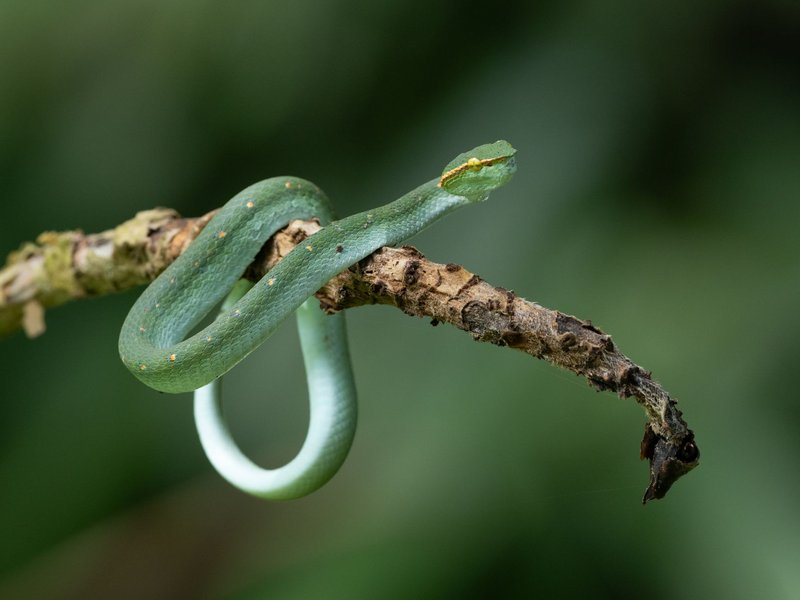
- Scientific name: Bothriechis schlegelii
- Habitat: Humid lowland forest from southern Mexico to Ecuador
- Size: Usually about 50 to 80 cm
- Diet: Frogs, lizards, small mammals, and birds, including hummingbirds
Yellow is one of many morphs for this snake, along with green, pink, and brick-red. The yellow ones are called “oropel,” Spanish for gold leaf. The pointed scales over each eye give it the name. It’s a venomous ambusher: it hangs from a branch by its prehensile tail and waits at flowers for hummingbirds to arrive.
13. Green tree python (juvenile)
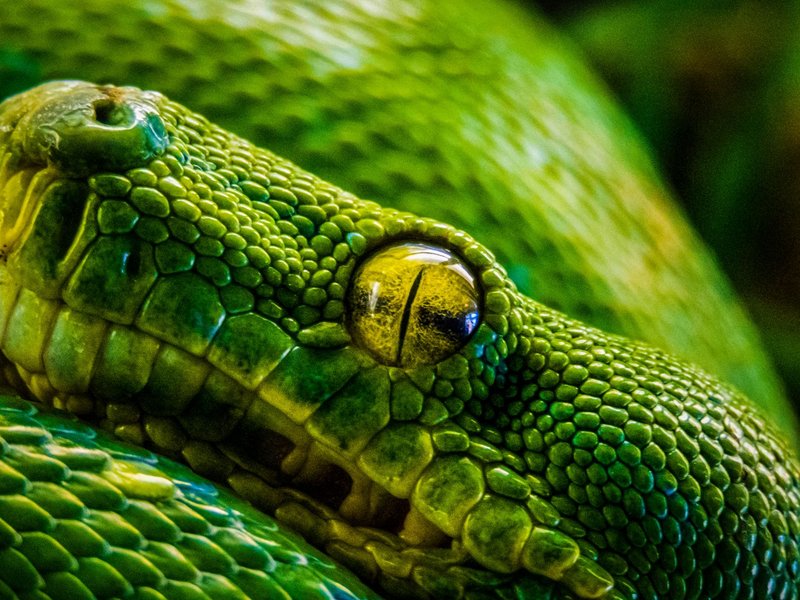
- Scientific name: Morelia viridis
- Habitat: Rainforest in New Guinea, nearby Indonesian islands, and Cape York, Australia
- Size: Adults about 1.5 m
- Diet: Rodents, small mammals, and lizards
Despite the name, hatchlings are bright yellow or brick-red and turn green over their first year or two. That’s a fact missing from most lists, which show the adult and call it yellow. It rests coiled over a branch with its head tucked in the middle.
14. Yellow anaconda
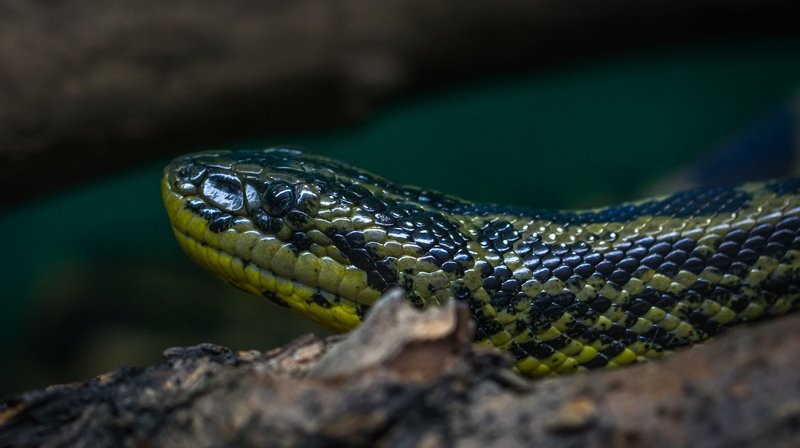
- Scientific name: Eunectes notaeus
- Habitat: Wetlands and slow rivers in Paraguay, Brazil, Bolivia, and Argentina
- Size: Around 3 m
- Diet: Fish, birds, rodents, and small caiman
Pale yellow-brown with black blotches. It’s smaller than the green anaconda and hard to see in marsh grass. The yellow is camouflage here, not a warning.
Yellow insects and spiders
15. Goldenrod crab spider
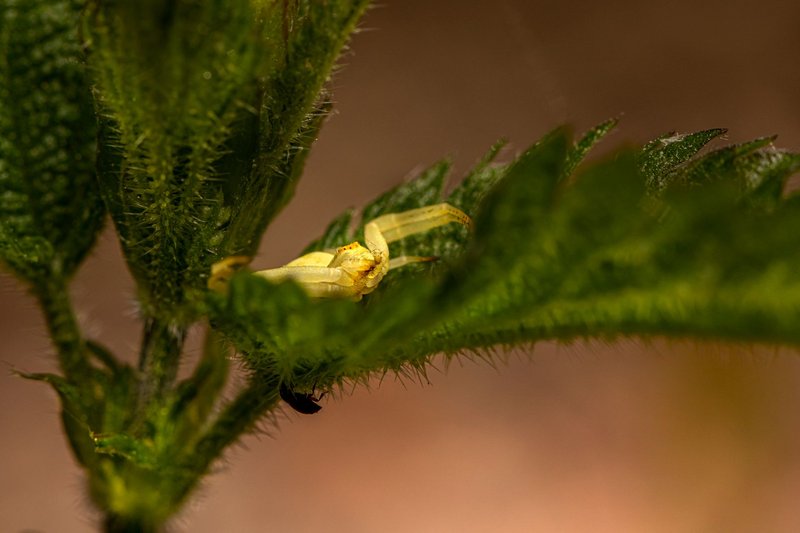
- Scientific name: Misumena vatia
- Habitat: Meadows and flower beds across North America and Europe
- Size: Females about 10 mm; males about 4 mm
- Diet: Bees, flies, and butterflies
A female sits on a flower and changes color to match it. In lab studies, white-to-yellow takes roughly 10 to 20 days, and yellow-to-white takes about 6. She takes prey larger than herself, including bees, by grabbing them as they land.
16. 22-spot ladybird
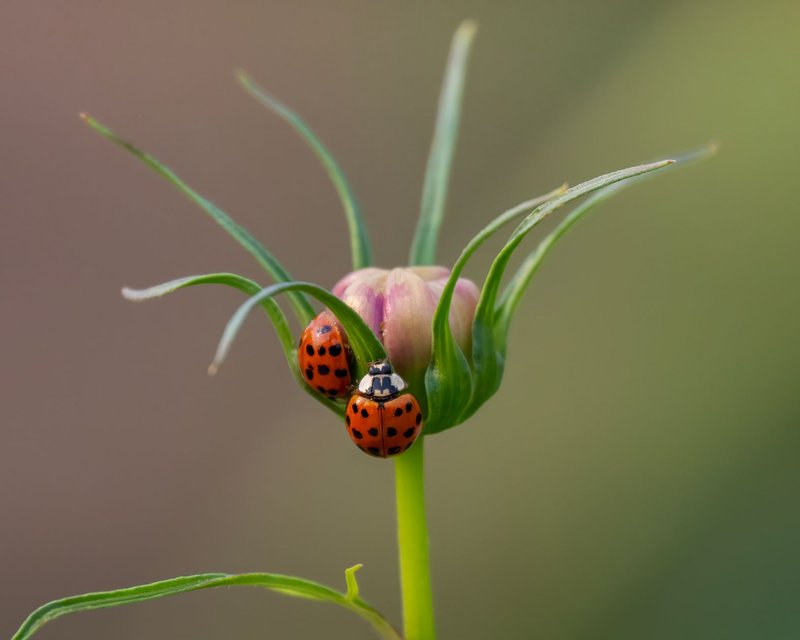
- Scientific name: Psyllobora vigintiduopunctata
- Habitat: Hedgerows, gardens, and woodland across Europe
- Size: 3 to 4 mm
- Diet: Powdery mildew fungus
Lemon yellow with 22 black spots, and unlike most ladybirds it doesn’t eat aphids. It grazes the white mildew on leaves, so a plant covered in mildew can attract one.
17. Brimstone butterfly
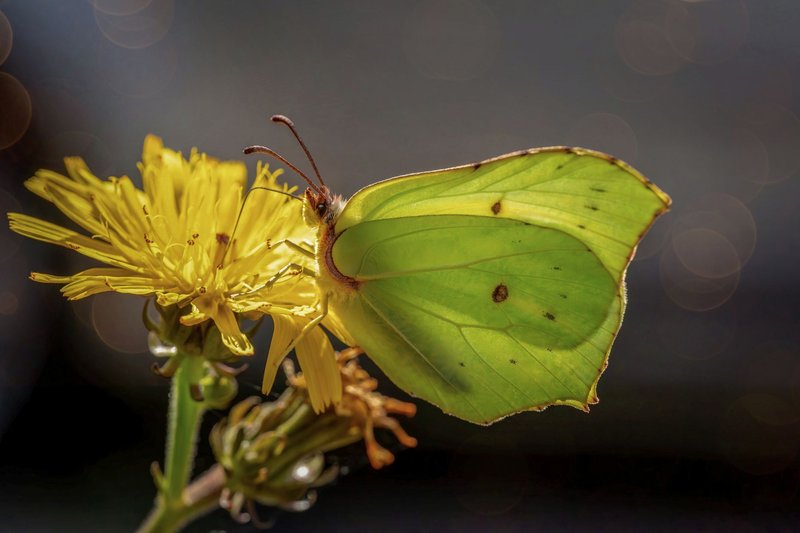
- Scientific name: Gonepteryx rhamni
- Habitat: Woodland edges, hedgerows, and gardens across Europe, North Africa, and Asia
- Size: Wingspan about 6 to 7 cm
- Diet: Nectar; caterpillars eat buckthorn leaves
Only the male is butter yellow. The female is pale greenish-white. Adults overwinter and can live nearly a year, among the longest-lived butterflies in Europe. One popular theory says the word “butterfly” came from this butter-colored species.
18. Eastern tiger swallowtail
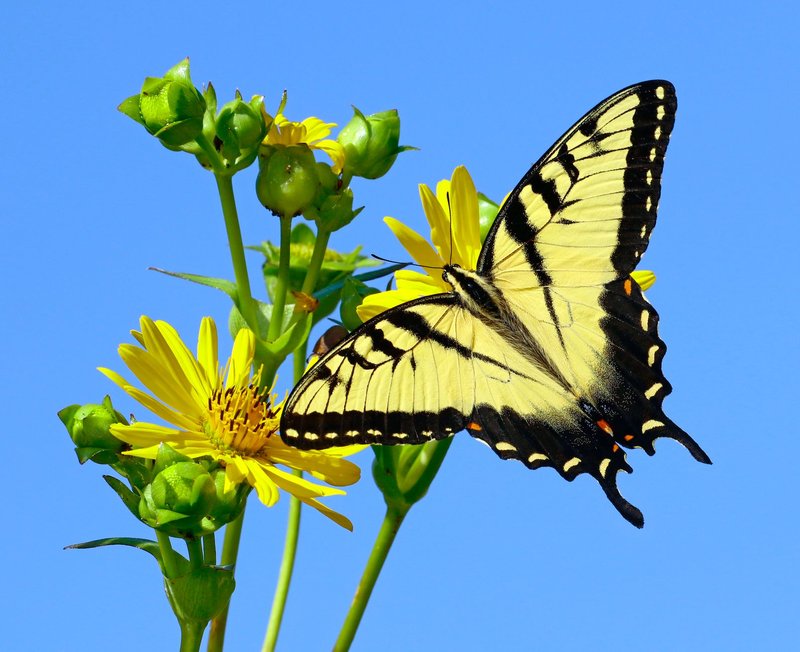
- Scientific name: Papilio glaucus
- Habitat: Woodland, gardens, and river corridors in eastern North America
- Size: Wingspan about 8 to 10 cm
- Diet: Nectar; caterpillars eat tulip tree, wild cherry, and ash leaves
Yellow with black tiger stripes, but the females come in two forms. One is yellow. The other is almost entirely dark and mimics the toxic pipevine swallowtail, which predators avoid.
Yellow fish and ocean animals
19. Yellow tang
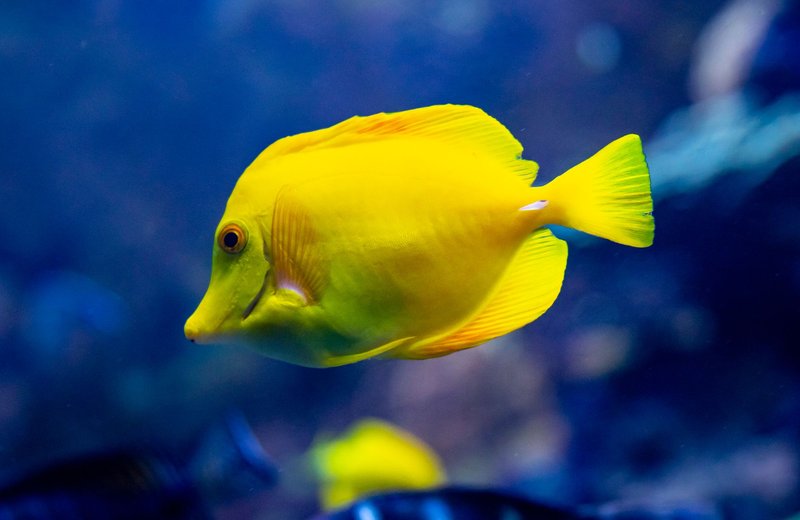
- Scientific name: Zebrasoma flavescens
- Habitat: Coral reefs, mostly around Hawaii
- Size: About 20 cm
- Diet: Algae
Bright yellow by day. At night it fades pale and shows a white stripe along its side. It’s a common aquarium fish, and nearly all of them are wild-caught: the first captive breeding came only in 2015, in Hawaii.
20. Yellow boxfish
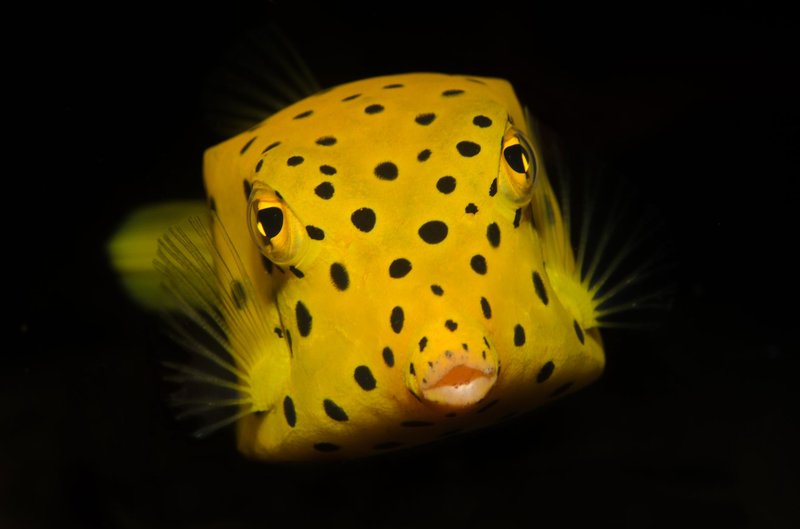
- Scientific name: Ostracion cubicus
- Habitat: Indo-Pacific reefs and lagoons
- Size: Up to about 45 cm as an adult
- Diet: Algae, sponges, worms, and small invertebrates
The juvenile is the famous one, a yellow cube covered in black dots. Adults are larger and duller, a brownish blue with pale spots. The boxy shell is bony plates, and a stressed fish releases a toxin into the water.
21. Longnose butterflyfish
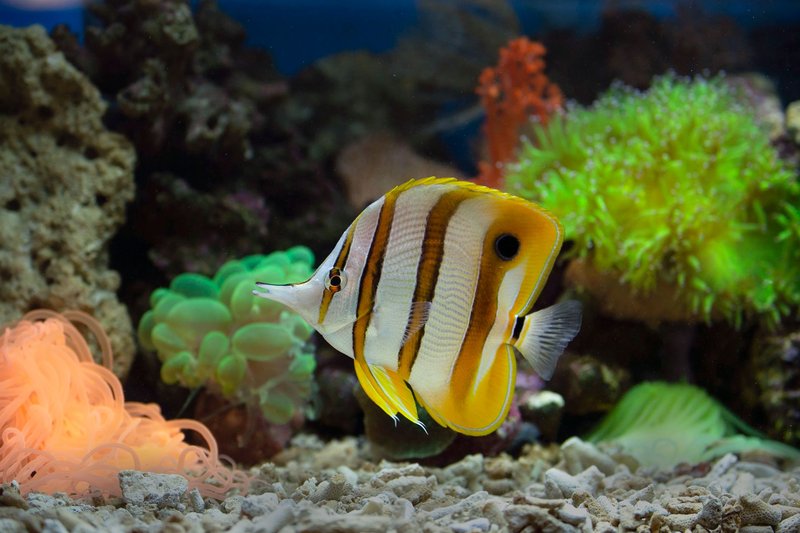
- Scientific name: Forcipiger flavissimus
- Habitat: Reef slopes across the Indo-Pacific
- Size: About 22 cm
- Diet: Small invertebrates, such as shrimp and the tube feet of urchins
Yellow body, black upper face, and a snout like a pair of tweezers. It uses that snout to pick food out of coral crevices that other fish can’t reach.
22. Yellow seahorse
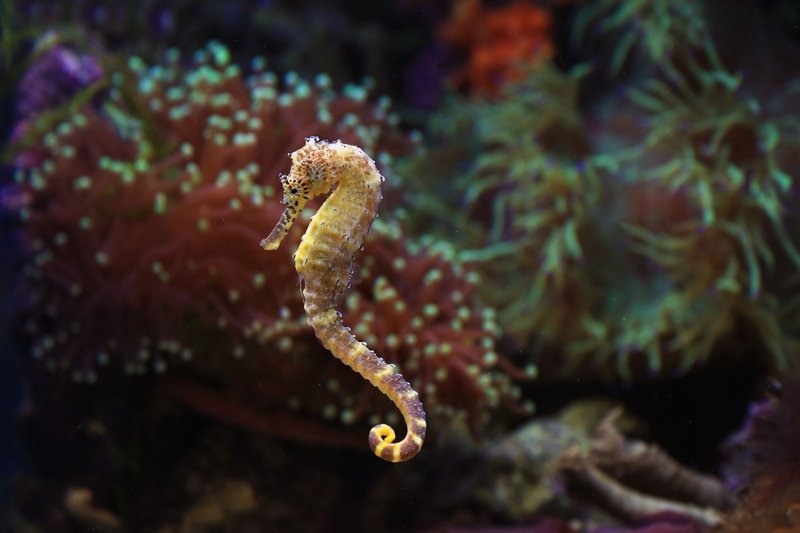
- Scientific name: Hippocampus kuda (common or spotted seahorse)
- Habitat: Seagrass beds, mangroves, and estuaries in the Indo-West Pacific
- Size: Up to about 17 cm
- Diet: Small crustaceans such as copepods and shrimp
“Yellow seahorse” isn’t a separate species. Several seahorses have yellow forms, and H. kuda is the one most often pictured. It can also be black or brown. Males carry the young in a brood pouch. The IUCN lists the species as Vulnerable, largely because of fishing for traditional medicine and the aquarium trade.
23. Yellow-bellied sea snake
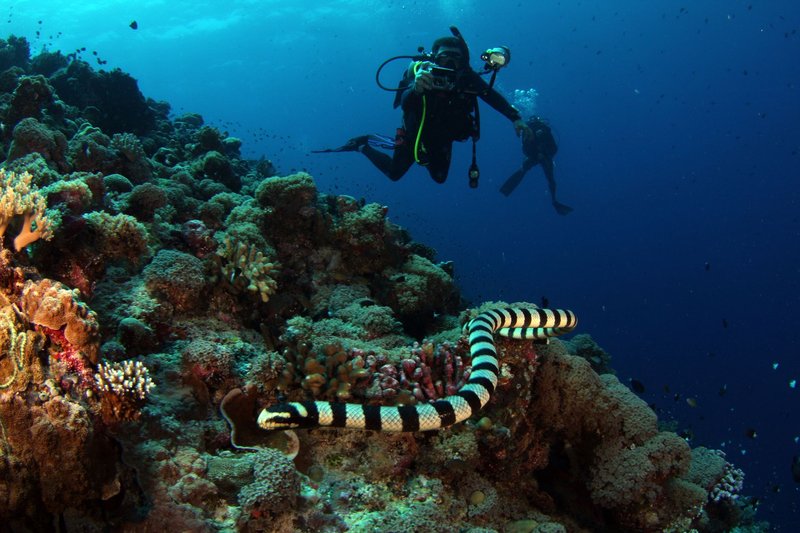
- Scientific name: Hydrophis platurus
- Habitat: Open surface waters of the Indian and Pacific Oceans, including the Pacific coast of the Americas
- Size: About 1 m
- Diet: Small fish
Black back, yellow belly, and a spotted yellow tail. It has the widest range of any snake and spends its life drifting on the ocean surface, often along slicks where currents gather prey. The venom is strong, but bites on humans are rare.
24. Yellow tube sponge
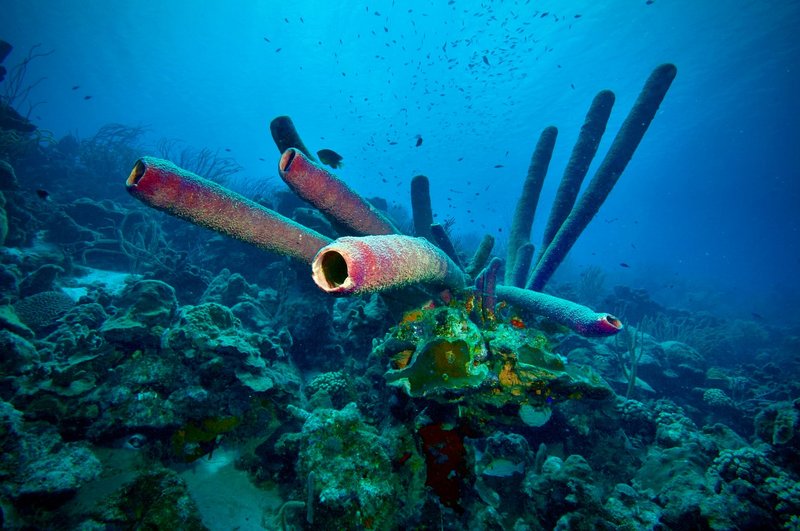
- Scientific name: Aplysina fistularis
- Habitat: Caribbean and Gulf of Mexico reefs
- Size: Tubes up to about a meter long
- Diet: Plankton and bacteria filtered from seawater
Plants don’t make the list, but sponges do, because they’re animals, with no brain, muscles, or stomach. The yellow tubes turn dark when a sponge is pulled out of the water and exposed to air.
Quick-reference table
| # | Animal | Group | Region | Size |
|---|---|---|---|---|
| 1 | American goldfinch | Bird | North America | 11–13 cm |
| 2 | Eurasian golden oriole | Bird | Europe, Asia, Africa | 24 cm |
| 3 | Yellow warbler | Bird | The Americas | 12 cm |
| 4 | Atlantic canary | Bird | Atlantic islands | 12 cm |
| 5 | Golden pheasant | Bird | China | 90–105 cm (male) |
| 6 | Golden lion tamarin | Mammal | Brazil | 600 g |
| 7 | Yellow mongoose | Mammal | Southern Africa | 0.5–1 kg |
| 8 | Golden jackal | Mammal | Europe, Asia | 8–10 kg |
| 9 | Golden retriever | Mammal (dog) | Worldwide | 25–34 kg |
| 10 | Golden snub-nosed monkey | Mammal | China | Up to 16 kg |
| 11 | Golden poison frog | Amphibian | Colombia | 5 cm |
| 12 | Eyelash viper | Reptile | Central America | 50–80 cm |
| 13 | Green tree python | Reptile | New Guinea, Australia | 1.5 m |
| 14 | Yellow anaconda | Reptile | South America | 3 m |
| 15 | Goldenrod crab spider | Arachnid | North America, Europe | 10 mm |
| 16 | 22-spot ladybird | Insect | Europe | 3–4 mm |
| 17 | Brimstone butterfly | Insect | Europe, Asia | 6–7 cm wingspan |
| 18 | Eastern tiger swallowtail | Insect | Eastern North America | 8–10 cm wingspan |
| 19 | Yellow tang | Fish | Hawaii | 20 cm |
| 20 | Yellow boxfish | Fish | Indo-Pacific | Up to 45 cm |
| 21 | Longnose butterflyfish | Fish | Indo-Pacific | 22 cm |
| 22 | Yellow seahorse | Fish | Indo-West Pacific | 17 cm |
| 23 | Yellow-bellied sea snake | Reptile | Indian and Pacific Oceans | 1 m |
| 24 | Yellow tube sponge | Sponge | Caribbean | Up to 1 m |
Wild yellow, morphs, and albinos
A few distinctions help when you’re searching for yellow animals in the wild or deciding what counts.
Wild species vs. morphs. The eyelash viper and green tree python are naturally yellow in some individuals or at some ages. Many pet reptiles, such as “golden” ball pythons, are captive-bred color morphs that don’t exist in the wild.
Albino vs. yellow. Albino animals lack pigment entirely and look white or pale yellow with pink eyes. A truly yellow animal has yellow pigment and normal dark eyes. Animals with an excess of yellow pigment, called xanthochromism, are a third case: a normally red cardinal that shows up in a yellow form is one example.
Not quite yellow. Banana slugs vary from yellow to green to brown, and the Burmese python is tan with brown blotches. Both show up on other yellow animals lists, but neither is reliably yellow.
Yellow animals are rarer in some groups than others. Birds, fish, and insects have plenty, mammals have only a handful, and the next one you see will likely be on a flower, a branch, or a reef.