Cyprus has roughly 1,650 native plant species and subspecies, and about 142 of them grow nowhere else on Earth. That’s a lot of endemism for an island of 9,251 square kilometers. The national tree is the golden oak (Quercus alnifolia). The national flower is the Cyprus cyclamen (Cyclamen cyprium). Both are found only here.
This guide sorts Cyprus’ native plants by habitat, so you can match what you’re looking at to where you’re standing. For each plant: common name, Latin name, what sets it apart, and when to look.
Table of Contents
- TLDR: the plants worth knowing first
- Troodos forests
- Maquis and garrigue
- Akamas and the coast
- Native or introduced? The usual mix-ups
- Seasonal bloom calendar
- Seeing them responsibly
TLDR: the plants worth knowing first {#tldr}
- Golden oak (Quercus alnifolia): national tree, Troodos only, leaves gold-felted underneath.
- Cyprus cyclamen (Cyclamen cyprium): national flower, blooms in autumn and winter.
- Cyprus cedar (Cedrus brevifolia): a short-needled cedar confined to the Paphos Forest.
- Cyprus crocus (Crocus cyprius): appears at the edge of melting snow in the Troodos.
- Akamas centaury (Centaurea akamantis): an endemic restricted to the Akamas peninsula.
Troodos forests {#troodos}
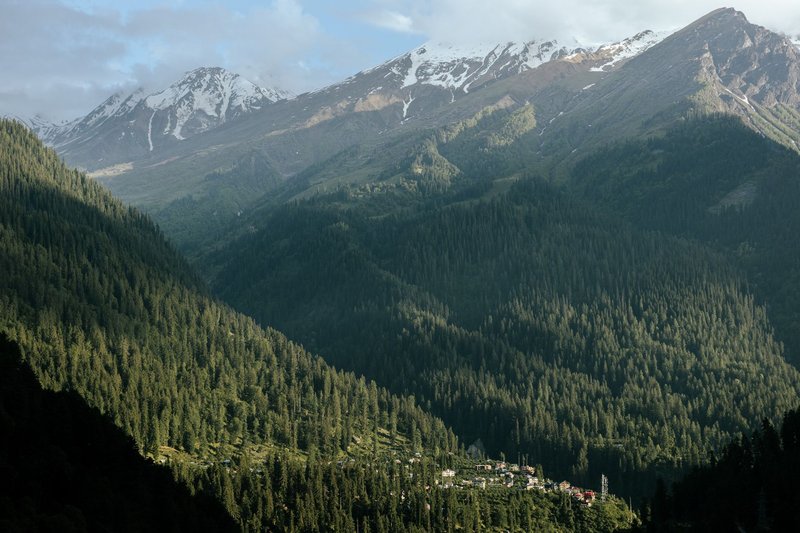
The Troodos massif is the island’s botanical engine room. Altitude, serpentine and igneous soils, and winter snow create conditions that coastal Cyprus lacks, and many endemics are tucked into this one mountain range.
Golden oak (Quercus alnifolia). A low, spreading, evergreen oak with rounded leaves that are dark and glossy on top and covered in golden-brown felt beneath. Flip a leaf and you’ll know it. It grows on the Troodos igneous rocks, often above 1,000 meters, and you’ll meet it along many trails around Platres and Mount Olympus. Look for it year-round.
Cyprus cedar (Cedrus brevifolia). Regarded by some botanists as a subspecies of the Lebanon cedar, it has shorter needles and a more compact crown. Its stronghold is the Paphos Forest, especially Cedar Valley, where the oldest trees stand in the shade of the Tripylos peak. It is evergreen, so any season works, and the valley is far quieter than the summer hiking trails near Platres.
Black pine (Pinus nigra subsp. pallasiana). Not endemic as a species, but it dominates the high Troodos and gives the mountain its dark, resinous smell. Its flaking, silvery bark separates it from the Calabrian pine lower down.
Cyprus crocus (Crocus cyprius). A small endemic crocus with lilac petals, found on the Troodos above roughly 1,000 meters. It flowers in late winter and early spring, often on ground that was under snow only days before.
Cyprus rose (Rosa chionistrae). An endemic wild rose of the Troodos, it forms thorny shrubs along streams and rocky slopes. It flowers in late spring.
Cyprus alder and plane trees. Along Troodos streams, you’ll find the native oriental plane (Platanus orientalis) and alder (Alnus orientalis). They mark water in a landscape that’s otherwise dry for half the year.
Maquis and garrigue {#maquis}
Below the pines, the island turns to maquis (dense evergreen shrubland) and garrigue (lower, scrubbier, more open ground). This is where most visitors walk without realizing they’re surrounded by natives.
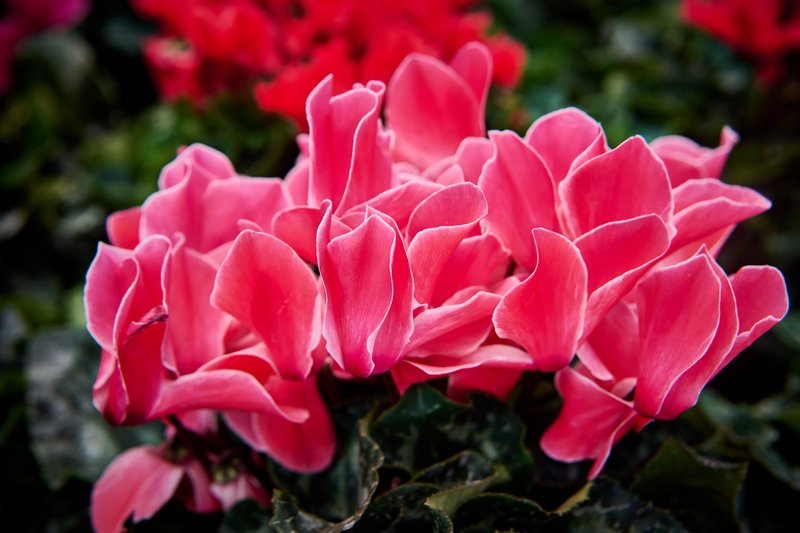
Cyprus cyclamen (Cyclamen cyprium). Small pink-to-white flowers with a purple blotch at the base and swept-back petals, and silvery-marbled heart-shaped leaves. It grows in the shade of rocks and pines, mostly from the western and central hills up into the Troodos. It’s one of the few things in bloom in the Cyprus autumn, from about September to January, which makes it a reward for off-season visitors.
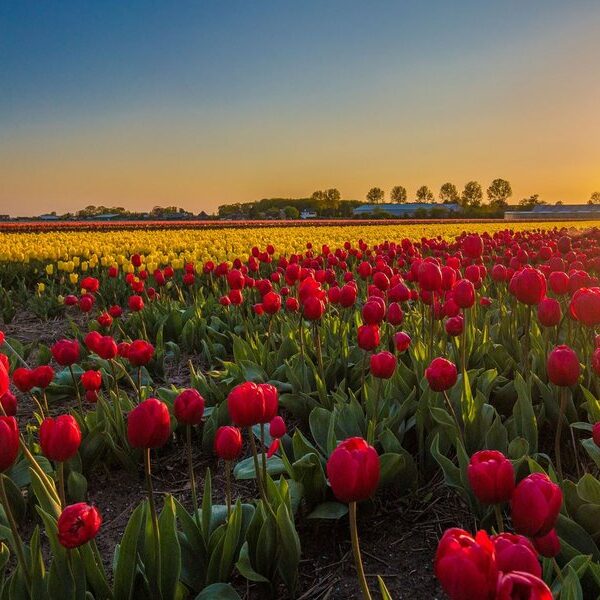
Cyprus tulip (Tulipa cypria). An endemic tulip with a narrow, pointed, deep red flower, found in rocky and fallow ground in the lower hills. It blooms in March and April, and it’s a good reason to visit Cyprus in spring.
Cyprus Jerusalem sage (Phlomis cypria). An endemic shrub with yellow whorled flowers and felty gray-green leaves. It flowers from spring into early summer and is one of the island’s most photogenic hillside plants.
Eastern strawberry tree (Arbutus andrachne). Smooth, peeling, cinnamon-colored bark and clusters of orange-red fruit. It’s native to the eastern Mediterranean and it’s easy to identify, because few trees here look so naked and polished.
Kermes oak (Quercus coccifera subsp. calliprinos). The spiny, holly-like oak that forms much of the maquis. If an oak looks more like a bush with prickles, this is the one.
Mastic and terebinth (Pistacia lentiscus, Pistacia terebinthus). Two native pistachio relatives. Mastic is the evergreen one with paired leaflets and a resin scent; terebinth is deciduous, with red autumn color.
Rock-roses (Cistus creticus, Cistus salviifolius). Pink and white papery flowers that open in the morning and drop by afternoon. Peak bloom is April and May.
Akamas and the coast {#akamas}
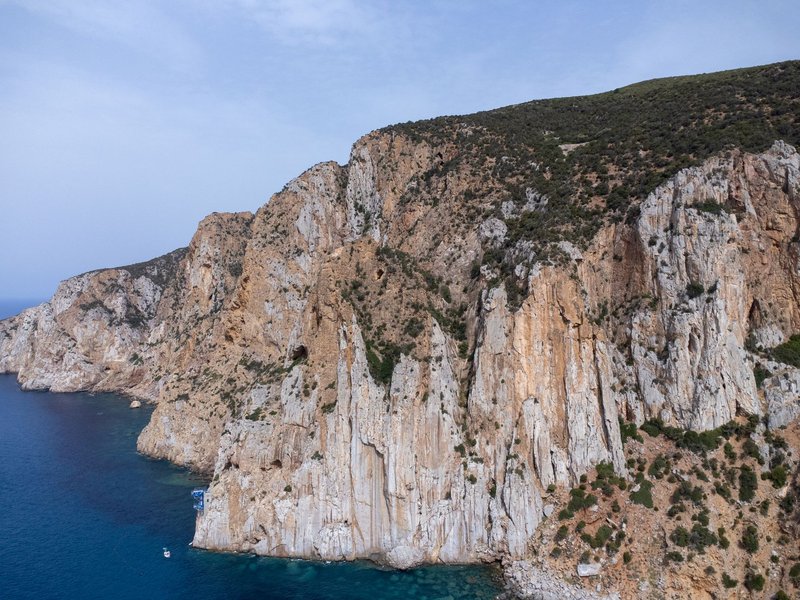
The Akamas peninsula in the northwest is the island’s wildest corner, and botanists treat it as a hotspot in its own right. Cliffs, gorges such as Avakas, and limestone ground hold several narrow endemics.
Akamas centaury (Centaurea akamantis). A rare endemic with yellow flowers, confined to the Akamas area. It grows on cliffs and rock faces, so you’ll mostly spot it from trails rather than up close. It’s listed as threatened in the IUCN Red List system, so photograph it and leave it.
Calabrian pine (Pinus brutia). The main pine of low and middle elevations, and the one you see behind most Cyprus beaches. It’s the dominant tree of the Paphos Forest too. Where black pine takes over at altitude, the Calabrian pine owns everything below.
Juniper (Juniperus phoenicea). A scale-leaved native juniper that survives in coastal sand and rocky headlands. It’s slow, twisted, and often hundreds of years old.
Spring orchids. Cyprus has a rich orchid flora, including several bee orchids (Ophrys species) that mimic insects to be pollinated. They peak from February to April on grassy slopes and olive-grove edges.
Native or introduced? The usual mix-ups {#native-vs-introduced}
Cyprus is drenched in plants that look like they’ve always been here. Many haven’t.
| Plant | Status | Quick note |
|---|---|---|
| Eucalyptus | Introduced (Australia) | Planted widely for shade and windbreaks |
| Acacia (Acacia saligna) | Introduced (Australia) | Spreads aggressively along roadsides |
| Prickly pear (Opuntia) | Introduced (Americas) | Now a fixture of village edges |
| Agave | Introduced (Americas) | Common on dry slopes and walls |
| Olive (Olea europaea) | Wild form native; orchards cultivated | The groves you see are planted crops |
| Carob (Ceratonia siliqua) | Mediterranean native, widely cultivated | Many trees are in managed orchards |
| Calabrian pine | Native | Often replanted, but a genuine native |
The rule of thumb: a tree in neat rows is a crop. A plant that fills every roadside ditch and fence is probably an introduced one—many are profiled in this comprehensive list of invasive species in Cyprus. A plant with a tiny range on one mountain is almost certainly the real thing.
Seasonal bloom calendar {#calendar}
| Season | What to look for | Where |
|---|---|---|
| Autumn (Sep-Nov) | Cyprus cyclamen begins | Shaded hills and pine forest |
| Winter (Dec-Feb) | Cyclamen peak, Cyprus crocus starts at the snow line | Low hills, upper Troodos |
| Early spring (Feb-Mar) | Orchids, anemones, crocus | Grassy slopes, Troodos |
| Spring (Mar-May) | Cyprus tulip, rock-roses, Phlomis | Lower hills, garrigue |
| Late spring (May-Jun) | Cyprus rose, mountain shrubs | Troodos streams and slopes |
| Summer (Jul-Aug) | Evergreen trees: golden oak, cedar, pines | Troodos and Paphos Forest |
Spring is the headline season. By July the lowlands are brown, and the Troodos is where the green survives.
Seeing them responsibly {#responsibly}
Many Cyprus endemics have tiny ranges, and wild-flower picking and bulb digging are the sort of thing that erases a population. Stay on trails, don’t pick or dig, and leave seeds where you find them. The Royal Botanic Gardens, Kew and the IUCN both document how narrow-range island plants are the most vulnerable to collection and habitat loss.
If you want natives in a garden, buy from nurseries that propagate them, rather than collecting. The golden oak, cyclamen, and rock-roses all do well in Mediterranean-style planting without needing extra water once established.
Cyprus’ native plants are best met in person, one habitat at a time: a cedar at Tripylos, a cyclamen under a pine in November, a tulip in a spring field. The island rewards the walker who looks down.