Table of contents
- Quick facts and seasonal calendar
- Coastal dunes
- Polders and reclaimed land
- Heathland
- Wetlands and peat
- Forests
- Bulb fields and gardens
- Invasive plants to recognize
- Where to see Dutch plants
- Summary
The plants of the Netherlands are shaped by one fact: almost nothing here is far from water, and a large part of the country was water not long ago. Dunes, drained lakebeds, sandy heath, peat bogs and river forests each grow their own plant communities, sometimes within an hour’s cycle of each other. Learn the habitats and the plants sort themselves out.
This guide walks through six habitats, profiles the species you’ll actually meet in each, and ends with where and when to go looking.
Quick facts and seasonal calendar
The Netherlands has a temperate maritime climate. Summers are mild, winters rarely stay below freezing for long, and rain falls through the year rather than in a single season. Gardeners would call most of the country USDA zone 8, with colder pockets inland. The sea moderates temperatures, which is why bulbs, heathers and many grasses do so well.
Plant life here is almost entirely lowland. The country’s wild flora runs to roughly 1,400 native vascular plant species, a modest list compared with southern Europe, but a dense one packed into small, well-protected reserves. For background on national biodiversity, the Convention on Biological Diversity’s Dutch country profile and the research of Naturalis Biodiversity Center are good starting points.
| Season | What’s in bloom |
|---|---|
| Late winter (Feb-Mar) | Snowdrops, winter aconite, early crocuses |
| Spring (Mar-May) | Daffodils, hyacinths, tulips, wood anemone, ramsons, cuckooflower |
| Early summer (Jun-Jul) | Dune roses, yellow flag iris, polder meadow flowers, sea holly begins |
| Late summer (Aug-Sep) | Heather on the Veluwe, sea lavender on salt marshes, sea buckthorn berries |
| Autumn (Oct-Nov) | Fungi, beech and oak color, bog cranberry fruit |
Coastal dunes
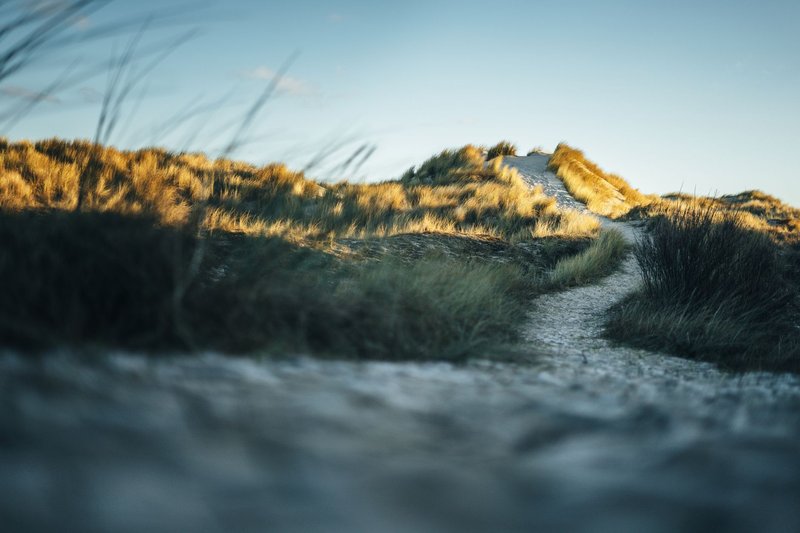
The Dutch coast is a long ribbon of dunes, and the plants that live on it handle salt spray, wind, drifting sand and almost no soil. Dunes are the Dutch habitat with the most obvious zonation: pioneers on the beach side, then grasses, then scrub, then wet hollows behind.
Marram grass (Ammophila arenaria). The foundation of the whole system. Its roots and rhizomes bind loose sand, and it grows taller when buried, which is how foredunes build themselves. No marram, no dunes, and no dunes means a flooded country.
Sea holly (Eryngium maritimum). Spiny, blue-gray and frankly strange, with steel-blue flower heads from July. It grows on the seaward dune slope and is protected. Don’t pick it.
Sea buckthorn (Hippophae rhamnoides). A thorny shrub with bright orange berries from late summer. It fixes nitrogen in poor sand, which helps it spread aggressively in some dune reserves where managers now cut it back to keep open habitat.
Burnet rose (Rosa spinosissima). Low, thorny, with cream flowers in May and June and almost black hips. Look for it in the older, more stable dunes.
Grass-of-Parnassus (Parnassia palustris). Not a grass. A white-flowered plant of damp dune slacks, with green veins that look hand-drawn, blooming from July to September. Slacks are the wet hollows between dune ridges, and they hold the rarest plants on the coast.
Best places: Zuid-Kennemerland near Haarlem, Meijendel near The Hague, and the Wadden Islands.
Polders and reclaimed land
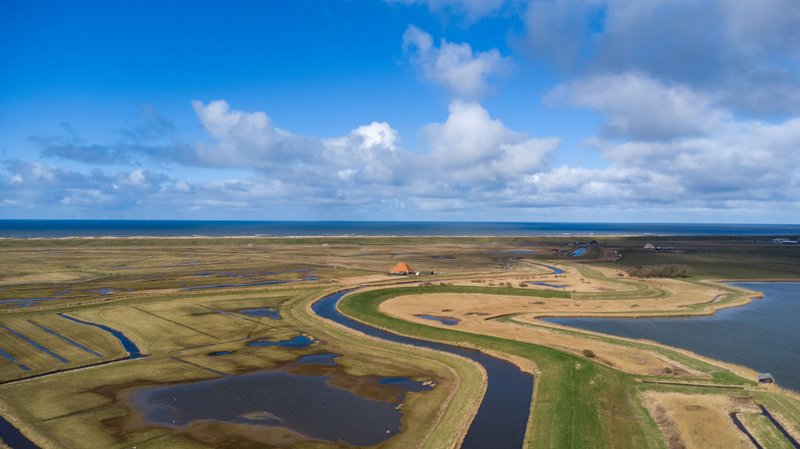
Polders are land won from water by diking and pumping. Flevoland, the youngest province, only emerged from the former Zuiderzee in the 1950s and 1960s, so its flora started from zero and was colonized in a few decades. Older polders are mostly grassland, ditches and field margins.
Cuckooflower (Cardamine pratensis). Pale lilac flowers over wet meadows in April and May. It’s the plant that turns a polder pink-white in spring and the food plant for orange-tip butterflies.
Meadow buttercup (Ranunculus acris). Everywhere in damp grassland, flowering from May through the summer. Cattle avoid it, which is why you’ll often see yellow patches in grazed fields.
Ragged robin (Silene flos-cuculi). Shredded pink petals that look like a flower someone attacked with scissors. A good indicator of unfertilized, species-rich meadow, now a rarer sight than it used to be.
Snake’s head fritillary (Fritillaria meleagris). Checkered purple and white bells in April, found in a few river meadows and nature reserves. Dutch populations are small and protected, and a lot of what looks wild is naturalized garden stock, so treat any field of them with respect.
Common reed (Phragmites australis). The tall grass that lines ditches and fills the marshes of Oostvaardersplassen in Flevoland. Beds of reed give cover to bitterns and marsh harriers.
Heathland
Heath is a human-made habitat, created over centuries by grazing and cutting on poor sandy soils, and it survives only because someone keeps it open. The big areas are on the Veluwe and in Drenthe.
Heather (Calluna vulgaris). The defining plant. Blooms August to September, when the Veluwe turns purple. Reserve managers use sheep and occasional turf-cutting to stop birch and pine from taking over.
Cross-leaved heath (Erica tetralix). Pale pink bells, earlier than heather, on the wetter parts of the heath. Leaves grow in whorls of four, which gives it its name.
Juniper (Juniperus communis). A native conifer that was once widespread and is now declining. Tall columns of dark green, grazed by sheep when young.
Gorse and broom. Yellow in May. Gorse (Ulex europaeus) has spines; broom (Cytisus scoparius) doesn’t. That’s the fastest identification trick.
Wetlands and peat
The west and north of the country sit on peat, and the ditches that drain it are plant habitats of their own.
Water soldier (Stratiotes aloides). Spiky rosettes that float in clear peat ditches and sink after flowering. Locals know it as krabbenscheer, “crab’s claw.”
Yellow flag iris (Iris pseudacorus). Large yellow flowers from May to June along canal edges. Its roots tolerate standing water.
Marsh marigold (Caltha palustris). Glossy yellow, one of the first wetland flowers in March and April.
Round-leaved sundew (Drosera rotundifolia). A carnivorous plant, living in acid bogs and wet heath. Tiny, sticky-leaved and easy to miss. Dutch raised bogs have lost most of their area to peat cutting, so remaining sites like the Groote Peel are valuable.
Bog asphodel (Narthecium ossifragum). Yellow-orange spikes in July on wet heath and bog margins.
Forests
Only a small share of the country is forest, and most of it is planted. Even so, older woods hold a distinctive plant layer.
Pedunculate oak (Quercus robur) and beech (Fagus sylvatica). The two dominant broadleaf trees. Beech is shade-heavy, so little grows beneath it once the canopy closes, which is why spring flowers hurry to bloom before the leaves open.
Wood anemone (Anemone nemorosa). White carpets in March and April. Slow to colonize, so a large patch indicates an old woodland.
Ramsons (Allium ursinum). Wild garlic. You smell it before you see it, in damp deciduous woods in April and May.
Common bluebell relatives and lily-of-the-valley. Lily-of-the-valley (Convallaria majalis) grows in some dune and woodland sites, with fragrant white bells in May. All parts are poisonous.
Bulb fields and gardens
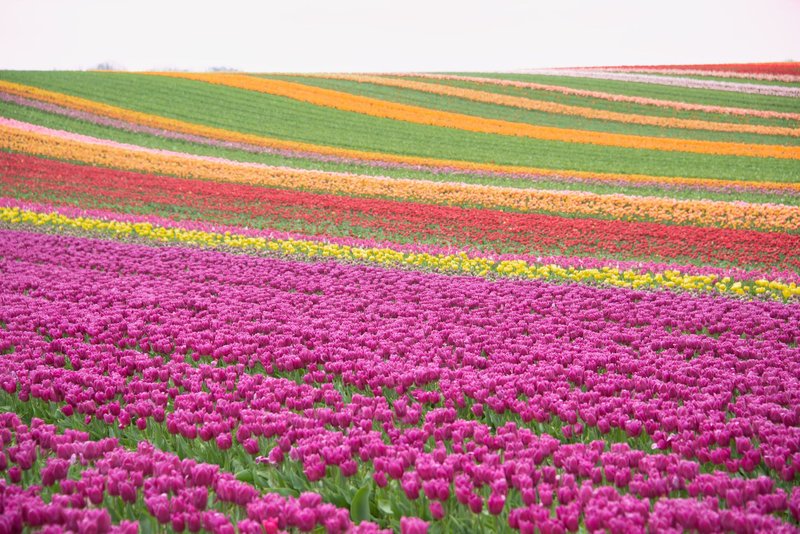
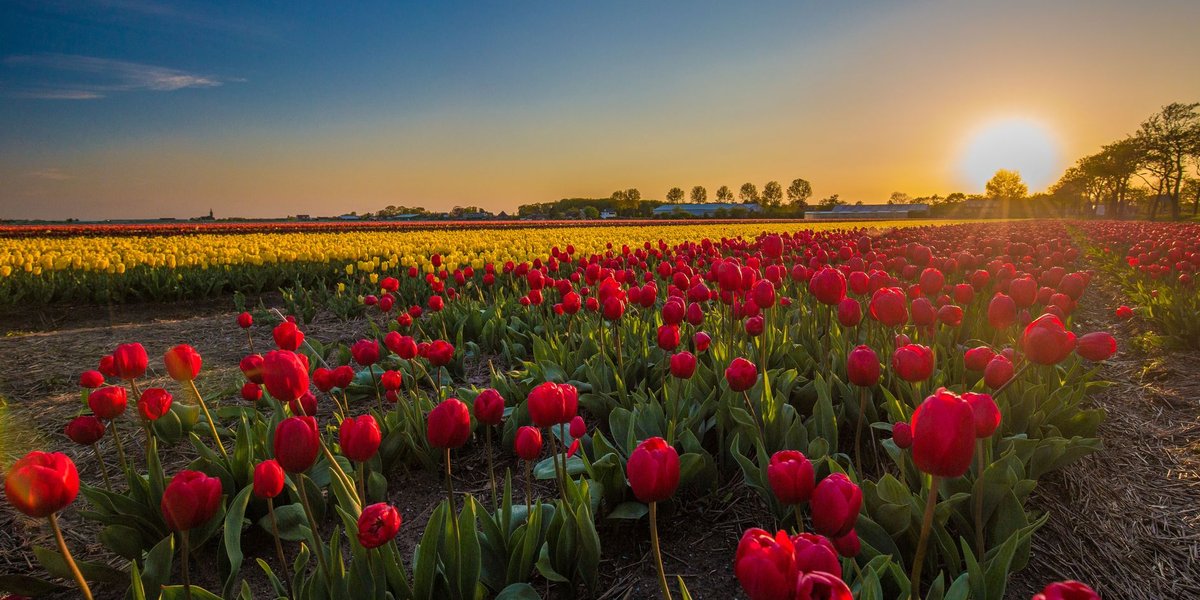
Here’s the answer to “when do tulips bloom in the Netherlands.” Hyacinths and daffodils come first, from late March into April. Tulips follow, peaking from mid-April to early May. The exact dates move by a week or two depending on how cold the winter was.
Tulip (Tulipa). Not native. Wild tulips come from Central Asia, and bulbs reached Dutch growers in the late 1500s via the Ottoman world. The speculative boom in bulb prices peaked in 1637. Today the main growing region is the Bollenstreek between Haarlem and Leiden, plus fields in Noordoostpolder and North Holland.
Hyacinth (Hyacinthus orientalis). Native to the eastern Mediterranean and southwest Asia, grown commercially around Lisse and Hillegom. The scent carries across the fields on warm days.
Daffodil (Narcissus). Earliest of the three, with fields yellow by late March.
One practical rule: bulb fields are working farms. Photograph from the road. Walking in the rows damages crops and breaks the rules the growers rely on.
Invasive plants to recognize
A good plant guide includes the ones you shouldn’t encourage. Four species cause most of the trouble:
- Giant hogweed (Heracleum mantegazzianum). Up to 3 meters tall. The sap causes severe skin burns in sunlight. Don’t touch it.
- Japanese knotweed (Reynoutria japonica). Bamboo-like stems, breaks through paving, and spreads from root fragments.
- Himalayan balsam (Impatiens glandulifera). Pink flowers, exploding seed pods, crowding out riverbank natives.
- Floating pennywort (Hydrocotyle ranunculoides). Covers ditches in dense green mats, starving the water of oxygen.
The IUCN lists invasive alien species among the leading causes of biodiversity loss worldwide, and Dutch water boards spend serious money clearing ditches of the last one on this list.
Where to see Dutch plants
| Place | Best for | Best time |
|---|---|---|
| Keukenhof, Lisse | Cultivated tulips, hyacinths, daffodils | Late March to mid-May |
| Bollenstreek fields | Bulb fields from the road | Mid-April to early May |
| Zuid-Kennemerland National Park | Dune plants, slacks | June to August |
| Hoge Veluwe National Park | Heathland | Late August to September |
| Oostvaardersplassen, Flevoland | Reed, wetland vegetation | May to July |
| Hortus Botanicus, Leiden | Historic collection, early tulips | Spring to autumn |
Keukenhof opens for about eight weeks each spring. Book ahead for peak weeks.
Summary
The plants of the Netherlands split cleanly by habitat. Dunes belong to marram, sea holly and sea buckthorn. Polders and ditches hold cuckooflower, reed and water soldier. Heath is heather country in late summer, forests flower early before the canopy closes, and bulbs come from elsewhere but made the country famous. Pick a habitat, pick a month from the calendar, and go. Dutch flora rewards the visit with specifics: a plant that grows here and nowhere else nearby, in the right week.