Switzerland’s native plants sort themselves by altitude better than almost any flora in Europe. Walk up from a valley hay meadow to a scree slope at 2,800 meters and you pass through four or five distinct plant communities, each with its own stars. Know the zone and the month, and you can name most of what you see before you reach for an app.
This guide is organized the way a hiker experiences the country: bottom to top. Each plant gets its Latin name, bloom window, habitat, and one trait that separates it from its lookalikes.
Table of Contents
- How altitude shapes Swiss plant life
- Valley meadows (below 1,000 m)
- Subalpine pastures and forest edges (1,000 to 2,000 m)
- Alpine rock and scree (above 2,000 m)
- Wetlands and bogs
- Bloom calendar: what flowers when
- Where to see Switzerland’s native plants
- Protected species and the rules for picking
- Invasive neophytes: the plants that don’t belong
- Climate pressure on alpine flora
- Summary
How altitude shapes Swiss plant life
Every 100 meters you climb, the growing season shrinks by roughly a week or so. At the valley floor, plants have seven months. Near 2,500 meters, they have eight to ten weeks between snowmelt and the next frost, and they have to flower, set seed, and store energy inside that gap.
That is why alpine plants look the way they do: low cushions, hairy leaves, deep taproots, and flowers that are oversized for the plant carrying them. Geology matters too. Limestone and granite give different plant communities at the same height, which is why two similar-looking slopes can hold different species. Keep that in mind when we get to the alpenroses.
Valley meadows (below 1,000 m)
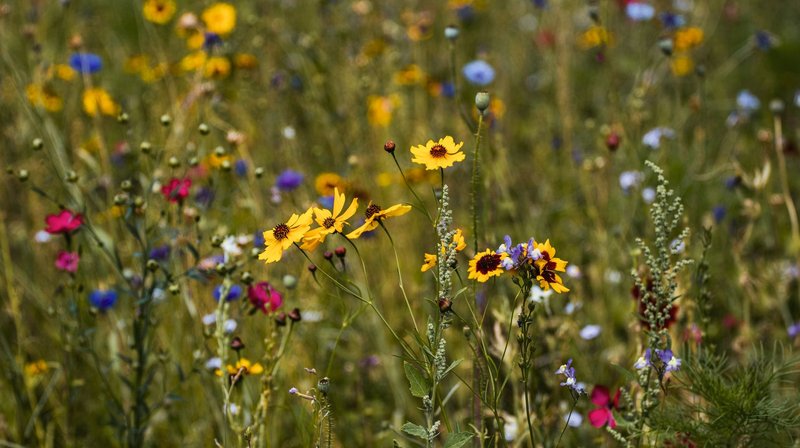
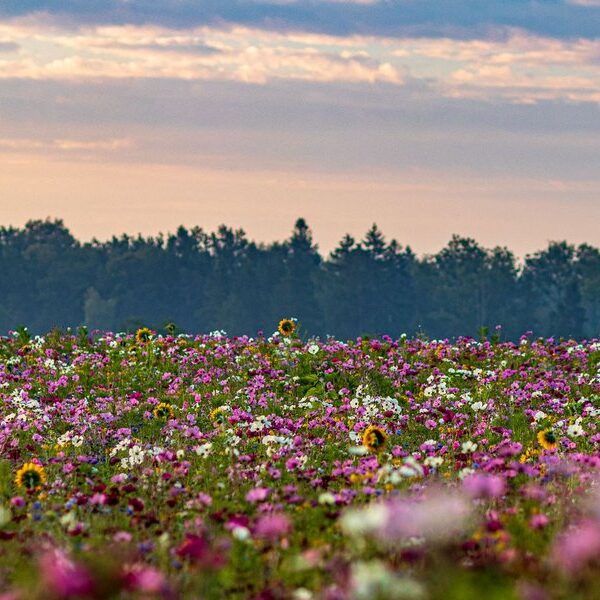
Traditionally mown hay meadows are the lowland jewels, and they depend on farming. Mow once or twice a year, skip the fertilizer, and you get a meadow with 40 or more species in a single square of turf.
Meadow sage (Salvia pratensis), May to July. Violet-blue flowers in whorls up the stem. Crush a leaf and it smells like the garden herb. Common on dry, sunny meadows.
Field scabious (Knautia arvensis), June to September. Pincushion-shaped heads in lilac-pink, on tall, thin stems. Look for bumblebees clinging to it.
Oxeye daisy (Leucanthemum vulgare), May to August. The classic white-and-yellow daisy, but bigger than the garden version, and it carpets lower meadows in early summer.
Poet’s narcissus (Narcissus poeticus), May. White petals with a small red-rimmed yellow cup. The famous narcissus meadows above Lake Geneva, around Montreux, turn whole slopes white in late spring. Locals call it “snow in May.”
Autumn crocus (Colchicum autumnale), September to October. It flowers in autumn, leaves long gone, and its pale lilac blooms rise straight from bare ground. It’s toxic to livestock, which is why farmers hate finding it in hay.
Subalpine pastures and forest edges (1,000 to 2,000 m)
This is the zone most visitors mean when they say “Swiss wildflowers.” Cattle graze it, larch and spruce thin out above it, and the flowers arrive in waves from late May into August.
Great yellow gentian (Gentiana lutea), June to August. The giant of the family: stems up to 1.5 meters, broad pleated leaves, whorls of yellow flowers. Its roots are the base of traditional gentian spirits, which is part of why it is protected. Don’t confuse it with white false hellebore, whose leaves look similar before flowering and are poisonous. Gentian leaves grow in opposite pairs; hellebore leaves alternate.
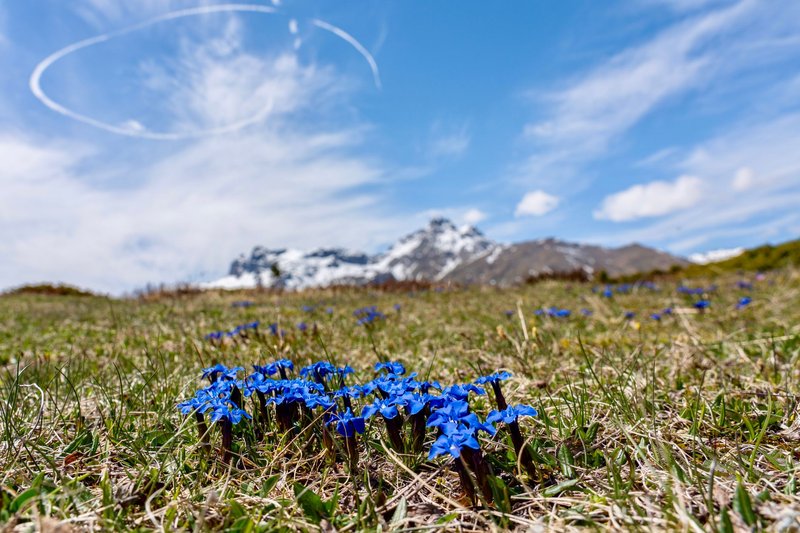
Spring gentian (Gentiana verna), April to July. A small plant with a vivid blue flower, five petals, a tight white-green tube. It grows low in short turf, often in groups. The color is hard to describe if you haven’t seen it: a blue that makes everything around it look gray.
Stemless gentian (Gentiana acaulis), May to August. Deep blue trumpets, up to 5 cm long, sitting on a rosette without a visible stem. Greenish spots inside the throat help separate it from the spring gentian.
Alpenrose (Rhododendron ferrugineum), June to July. The shrub that turns whole slopes pink-red. It grows on acidic, siliceous soils such as granite and gneiss, and the undersides of the leaves are rust-colored, which gives it the Latin name. On limestone, you’ll see its cousin, the hairy alpenrose (Rhododendron hirsutum), which has fringed leaf edges and paler flowers. The soil under your boots tells you which one you’re looking at.
Pasque flowers (Pulsatilla alpina and Pulsatilla vernalis), May to July. The white alpine pasque flower (P. alpina) has a yellow center and tousled, feathery seed heads after flowering, which look like a bad haircut. The spring pasque flower (P. vernalis) is white inside and tinged violet outside, with a covering of silky hairs. Both tend to appear right after the snow retreats.
Martagon lily (Lilium martagon), June to August. Also called Turk’s cap lily. Up to 20 nodding pink-purple flowers with recurved petals, spotted dark. It grows in light woods and meadow edges, and it’s one of the few big lilies you’ll find wild in the Alps.
Globeflower (Trollius europaeus), May to August. Round, pale-yellow, ball-like blooms that never fully open. Common on damp mountain pastures.
Arnica (Arnica montana), June to August. Bright yellow, daisy-like, with opposite leaves. Its leaves are in a basal rosette on nutrient-poor meadows, and it’s a known medicinal plant that is protected in several places.
Alpine rock and scree (above 2,000 m)
Above the tree line, plants stop competing with each other and start competing with the weather. Most are perennials that grow slowly for years before they flower at all.
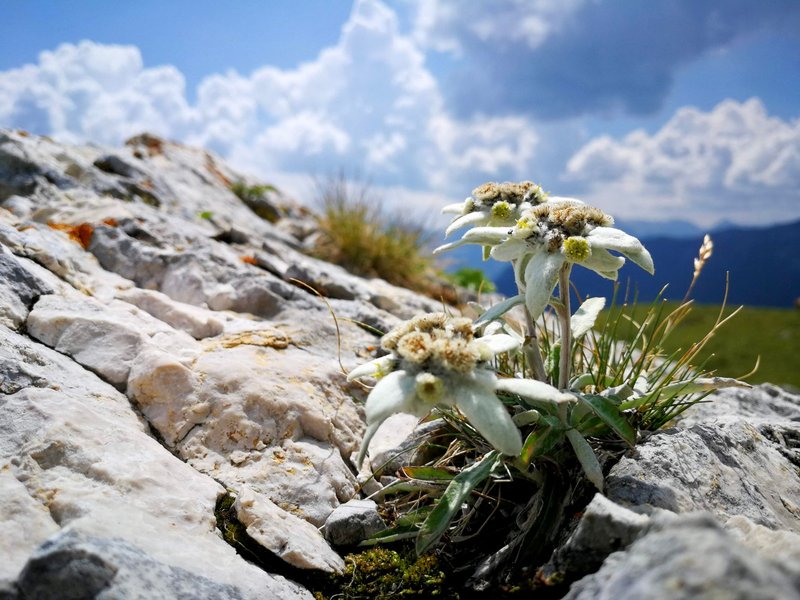
Edelweiss (Leontopodium nivale subsp. alpinum), July to September. Not what the postcards suggest. The “flower” is a cluster of small yellow florets surrounded by woolly white bracts, shaped like a star. The felt covering is an adaptation against UV and drying wind. It likes sunny, dry, rocky ledges on limestone between roughly 1,800 and 3,000 meters. It’s the national emblem, and it’s protected, so look, photograph, and leave it.
Moss campion (Silene acaulis), June to August. A dense, bright-green cushion covered in pink flowers. The cushion can be decades old; some are thought to exceed a century. Inside it, temperatures run several degrees warmer than the air outside. It grows on rock ledges and ridge tops up to 3,000 meters and beyond.
Alpine snowbell (Soldanella alpina), April to July. It flowers right at the snow edge, sometimes pushing through a thin layer of melting snow. Violet bells with fringed lips, nodding on short stems. Early-season hikers see it first; the meltwater line is where to look.
Glacier buttercup (Ranunculus glacialis), July to August. White flowers that turn pink with age, on dark scree and moraine near the permanent snow line. It holds the Alpine altitude record for flowering plants: it has been recorded at more than 4,200 meters on the Finsteraarhorn.
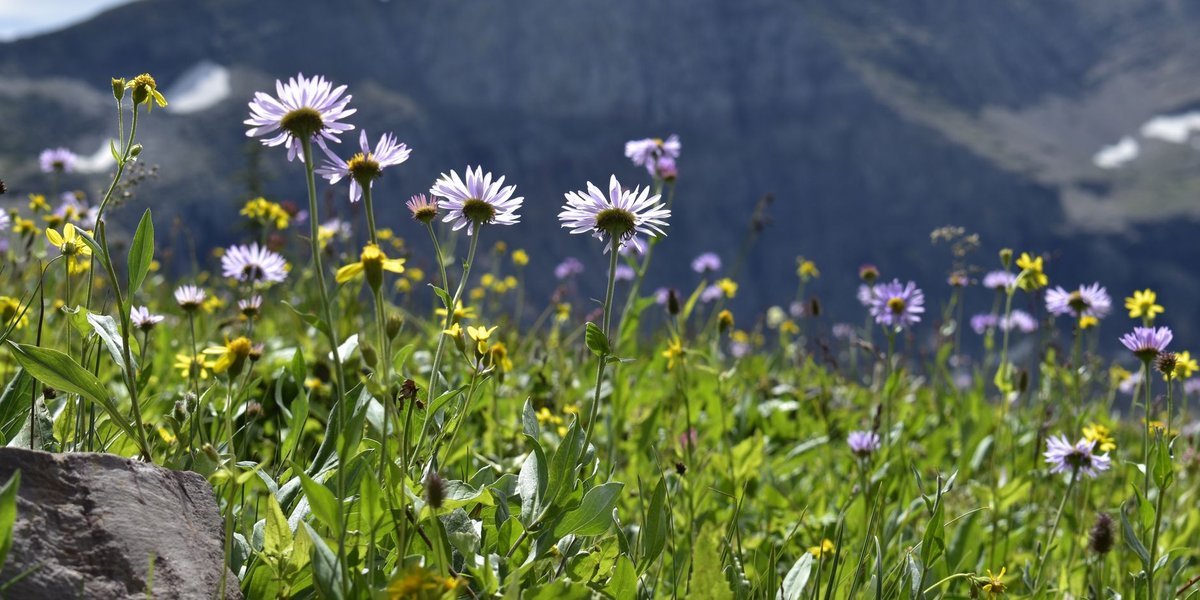
Alpine aster (Aster alpinus), July to August. Purple petals around a yellow disk, on dry, sunny rocky slopes. Single flower per stem, which separates it from garden asters.
Wetlands and bogs
Switzerland has lost most of its wetlands over the last two centuries to drainage and farming. What remains is a protected habitat, and a few of the best plants live in it.
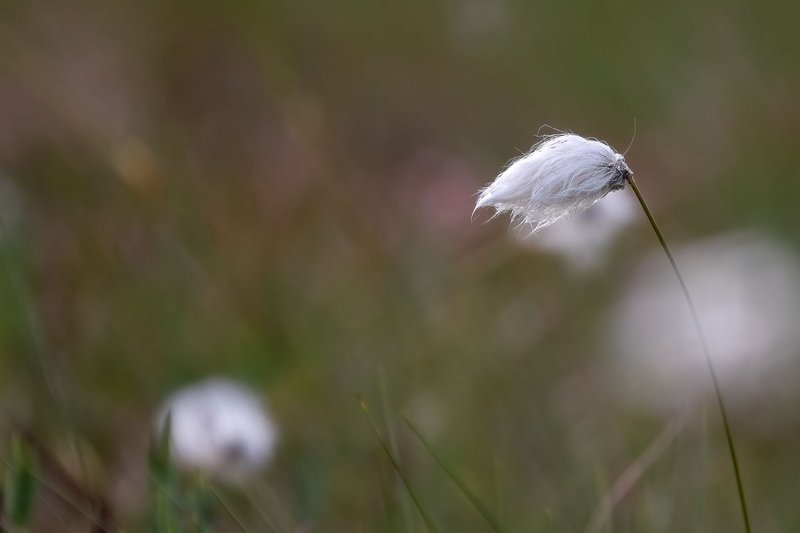
Common cottongrass (Eriophorum angustifolium), May to July. White tufts like cotton balls on slender stalks, growing in dense stands over wet peat. Easy to spot from a distance.
Round-leaved sundew (Drosera rotundifolia), June to August. A carnivorous plant with sticky red-haired leaves that trap small insects. It’s tiny, so look down at sphagnum moss, not out at the horizon.
Bogbean (Menyanthes trifoliata), May to June. Fringed white-pink flowers on stalks in shallow water, with three-part leaves. Grows in bog pools and fen margins.
Bloom calendar: what flowers when
Use this table to match your trip dates to what’s open. Elevations are approximate, and a late snowmelt shifts everything by two to three weeks.
| Month | What’s in bloom | Where to look |
|---|---|---|
| April | Spring gentian, alpine snowbell | Lower slopes, snowmelt edges |
| May | Narcissus, meadow sage, globeflower, pasque flowers | Valley meadows, low pastures |
| June | Alpenrose, stemless gentian, oxeye daisy, great yellow gentian | Subalpine pastures, forest edges |
| July | Martagon lily, edelweiss, moss campion, alpine aster | 1,800 to 2,800 m |
| August | Glacier buttercup, arnica, great yellow gentian | Highest ridges and scree |
| September to October | Autumn crocus | Valley meadows |
Peak weeks for the mid-elevations are late June to late July. If you can only pick one window, pick that one.
Where to see Switzerland’s native plants
You don’t need to hike for hours to see these plants. Alpine gardens collect hundreds of species in one place and label them.
Schynige Platte Alpine Garden, above Interlaken in the Bernese Oberland, is the best known. It has been open since 1929 and holds more than 600 native species, arranged by habitat type. It runs from late May to late October. A cogwheel railway takes you to the site, and the garden sits at about 1,900 meters.
Other options include:
- Schatzalp Alpine Garden, above Davos in Graubünden.
- Flore-Alpe, a botanical garden at Champex-Lac in Valais.
- La Thomasia, in Bex, Vaud, at the foot of the Alps.
- Rochers-de-Naye alpine garden, above Montreux, which pairs well with the narcissus meadows in May.
In the wild, the most reliable spots are well-grazed subalpine slopes in the Bernese Oberland, Valais, and Graubünden. Start early in the day, since many gentians and pasque flowers close in cloud or shade.
Protected species and the rules for picking
Protected plants in Switzerland fall under federal rules and cantonal laws. The federal Nature and Heritage Protection Act lets the government protect specific species, and the cantons add their own lists and restrictions. Some are fully protected. Others, like arnica, can be picked in small quantities for personal use in some cantons but not in others.
The short version: don’t pick anything you can’t identify, and don’t pick edelweiss, orchids, or gentians anywhere. Photograph instead. The rule for cushion plants is simple: don’t sit on them. Moss campion takes decades to build.
Info Flora, the national data and information center for Swiss plants, publishes the Red List of threatened species and the legal status of each plant. Check it, or the cantonal nature office website, before harvesting anything.
Wetland plants are the most threatened group. Swiss bogs and fens are strictly protected habitats. Staying on boardwalks and marked paths is not a suggestion in them. A single boot on a peat bog leaves a depression that takes years to recover.
Invasive neophytes: the plants that don’t belong
A neophyte is a plant introduced after 1492 that has spread in the wild. Most are harmless. Some are not, and the Swiss government treats them as an ecological and economic problem. The Federal Office for the Environment tracks and regulates invasive alien species.
Two garden favorites made the headlines:
- Summer lilac (Buddleja davidii) lines railways, gravel banks, and river edges. It looks lovely and feeds butterflies as adults, but it doesn’t feed their caterpillars, and it crowds out native shrubs.
- Cherry laurel (Prunus laurocerasus) is the glossy evergreen hedge that spreads into forests, where it shades out native seedlings. Both are now banned from sale in Switzerland.
Others to know: Japanese knotweed, which breaks through asphalt; giant hogweed, whose sap causes severe skin burns in sunlight; and common ragweed, a major allergen. If you find them, don’t compost them. Report them to your municipality.
Replacing a cherry laurel hedge with native shrubs such as hawthorn, hazel, or dogwood gives you the same privacy and supports far more insects.
Climate pressure on alpine flora
Alpine plants can’t move sideways, only up. Long-term monitoring on Alpine summits, such as the GLORIA network, shows species creeping to higher elevations decade after decade. The lowland species arrive first. The cold specialists at the top run out of mountain.
The plants most at risk are those with narrow niches: snowbed specialists and the cushion plants on the highest summits. For the rest, change comes more slowly, as the meadows shift in composition and the bloom calendar slides earlier in the year.
Summary
Switzerland’s native plants read like a vertical map. Valley meadows have sage, scabious, and narcissus. Subalpine pastures bring the gentians, alpenroses, pasque flowers, and martagon lilies. Above the tree line, edelweiss, moss campion, and snowbells hang on rock and scree. Wetlands hold cottongrass and sundews.
Plan around the bloom calendar, visit an alpine garden if you want a head start on identification, and leave the protected species where they are. The best photographs of these plants are the ones where the plant is still in the ground afterward.