A tree’s age is written into its trunk. Measure the trunk at chest height, tell the calculator the species and where the tree grows, and it gives you an age range and the year your tree most likely sprouted. If you have a stump, a core sample or a planting record, use the other two tabs instead.
- Typical tree
- Middle 80% of trees
- Your tree
- 1979Jimmy Carter was president of the United States.
- 1979The Sony Walkman goes on sale
- 1990The Hubble Space Telescope is launched
- 2002Euro coins and bills begin to be used in Europe
- 2014The Philae lander touches down on a comet
The calculator uses growth curves from the USDA Forest Service Urban Tree Database. Those curves come from about 14,500 street and park trees measured across 16 US climate regions. For woodland trees and for trees outside the US it uses the growth factor method that arborists have relied on for decades. Both methods, their limits and how accurate they are, are explained below.
How to measure a tree for its age
Every method on this page starts with the same measurement: the trunk at 4.5 feet (1.37 m) above the ground. Foresters call this diameter at breast height, or DBH. The height is fixed so that the flare of the roots at the base does not inflate the number.
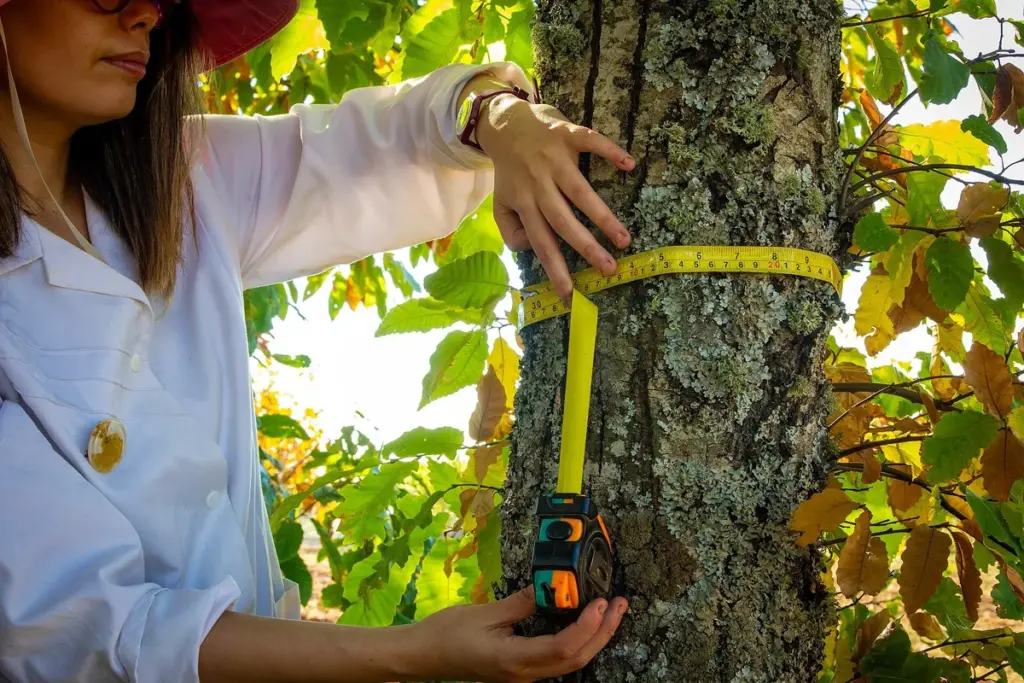
- Find a point on the trunk 4.5 ft (1.37 m) up from the ground. On a slope, measure from the uphill side.
- Wrap a flexible tape measure (a sewing tape works) around the trunk at that height. Keep it level and snug, not twisted.
- Read the circumference. You can enter it directly: the calculator divides by π (3.14) to get the diameter.
- If the trunk splits below 4.5 ft, measure each stem separately and add them with the “add another trunk” button. The calculator combines them into one equivalent diameter, the same way arborists do.
- If a burl, branch stub or bulge sits right at 4.5 ft, measure just above or below it, where the trunk is regular.
No tape? A piece of string wrapped around the trunk and then laid along a ruler gives the same answer.
Three ways to tell the age of a tree
There are three reliable ways to find out how old a tree is. Only one of them requires a cut tree.
1. Measure the trunk (no cutting)
Trees add a layer of wood every year, so a wider trunk means an older tree. The relationship depends heavily on species: a cottonwood can put on half an inch of diameter in a year, while an ironwood may take five years to do the same. That is why the calculator asks for the species. It also depends on where the tree grows, which is why it asks for your state. This is the method to use for a living tree in your yard, and it is what the first tab does.
2. Count the rings (stump or core sample)
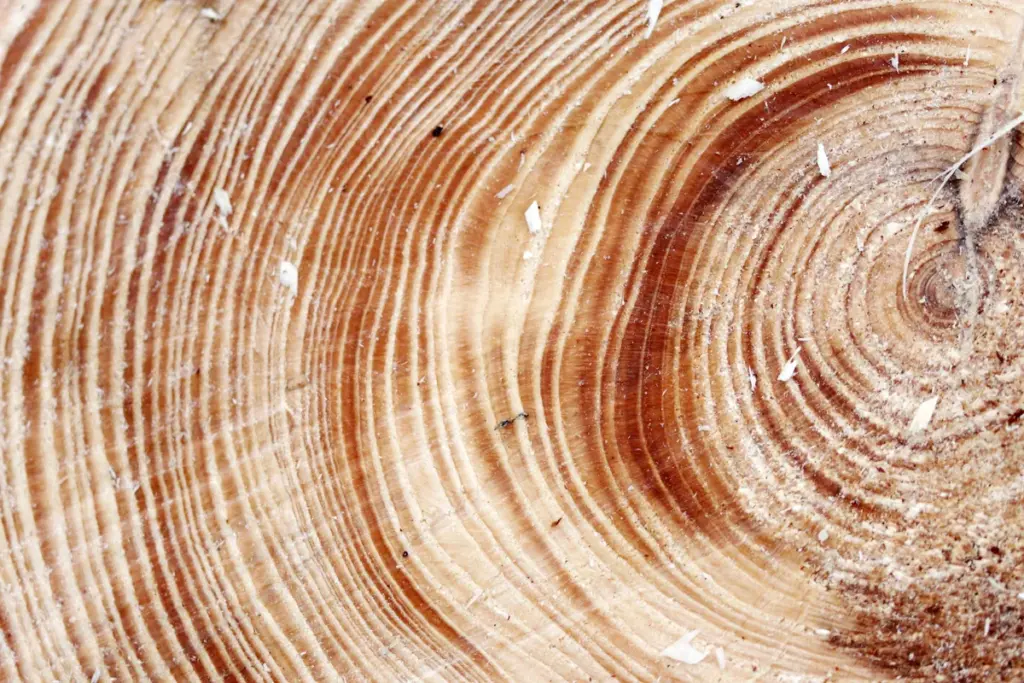
In climates with a cold winter or a dry season, a tree grows one ring per year: pale, wide wood in spring and a dark, narrow band in late summer. Count the dark bands from the center to the bark and you have the number of years the tree grew at that height.
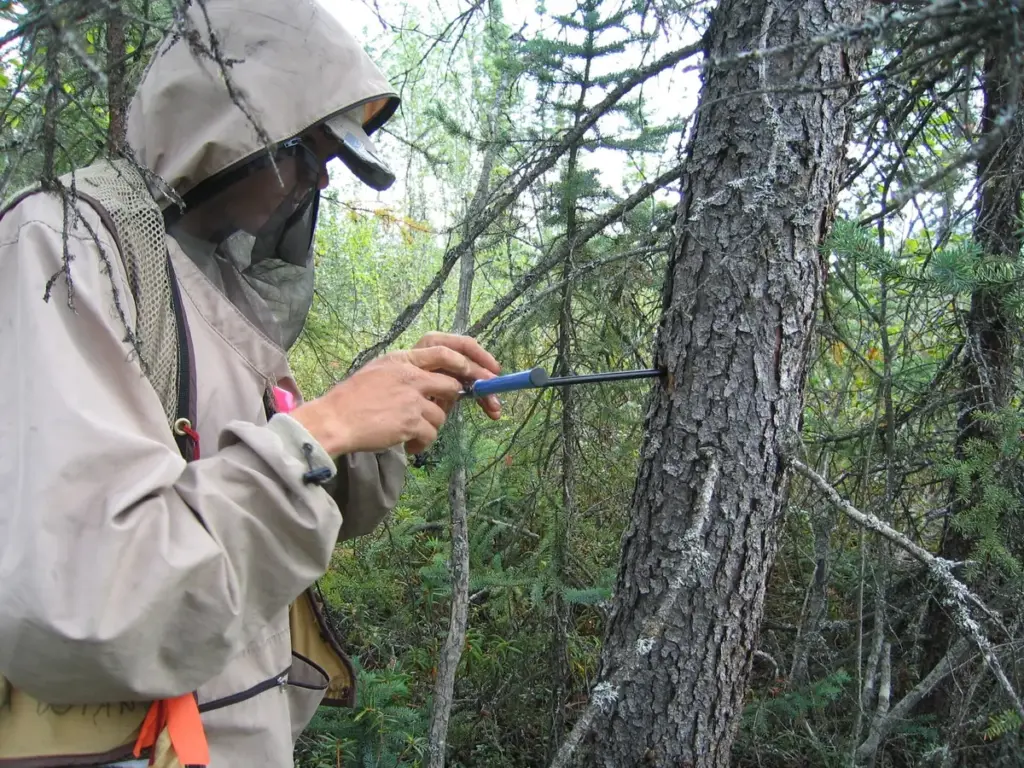
Foresters count rings on living trees without cutting them, using an increment borer. It is a hollow drill that pulls out a core about the width of a pencil. The small hole does not harm a healthy tree. The second tab handles both stumps and cores, and it adds the years the tree needed to grow up to the height where the rings were counted.
3. Check the planting records
For trees planted in the last century, records often beat any estimate. Property deeds, old photos, city tree inventories and nursery receipts can all date a tree. Remember that nursery trees are already 2 to 5 years old when planted, so add that to the years since planting. The third tab does this for you.
Tree growth factor chart
The growth factor method is the classic way to estimate tree age: multiply the trunk diameter in inches by a growth factor for the species. A sugar maple has a growth factor of 5.0, so a sugar maple 20 inches across is about 20 × 5.0 = 100 years old. Fast growers have low factors and slow growers have high ones.
| Tree | Latin name | Growth factor | Typical lifespan |
|---|---|---|---|
| Afghan pinePinus eldarica | Pinus eldarica | 4.5 (genus average) | not published |
| African sumacRhus lancea | Rhus lancea | 4 | not published |
| Aleppo pinePinus halepensis | Pinus halepensis | 4.5 (genus average) | 100 years |
| American basswoodTilia americana | Tilia americana | 3 | 200 years |
| American beechFagus grandifolia | Fagus grandifolia | 6 | 300 to 400 years |
| American elmUlmus americana | Ulmus americana | 4 | 175 to 300 years |
| American hollyIlex opaca | Ilex opaca | 4 | 100 to 150 years |
| American hornbeamCarpinus caroliniana | Carpinus caroliniana | 7 | 100 to 150 years |
| American sycamorePlatanus occidentalis | Platanus occidentalis | 4 | 50 to 200 years |
| American yellowwoodCladrastis kentukea | Cladrastis kentukea | 4 | not published |
| AppleMalus spp. | Malus spp. | 4 (all-species average) | not published |
| Australian pineCasuarina equisetifolia | Casuarina equisetifolia | 4 | 40 to 50 years |
| Austrian pinePinus nigra | Pinus nigra | 4.5 | 400 years |
| BaldcypressTaxodium distichum | Taxodium distichum | 1.5 | not published |
| Balsam firAbies balsamea | Abies balsamea | 7.5 (genus average) | 200 years |
| Bigleaf mapleAcer macrophyllum | Acer macrophyllum | 4.7 | 200 years |
| Bigtooth aspenPopulus grandidentata | Populus grandidentata | 2 | 50 to 100 years |
| Bitternut hickoryCarya cordiformis | Carya cordiformis | 6 (genus average) | 200 years |
| Black walnutJuglans nigra | Juglans nigra | 4.5 | 150 to 250 years |
| Blue sprucePicea pungens | Picea pungens | 4.5 | 150 to 350 years |
| Callery pearPyrus calleryana | Pyrus calleryana | 3 | 20 years |
| Eastern cottonwoodPopulus deltoides | Populus deltoides | 2 | 100 to 200 years |
| Eastern redbudCercis canadensis | Cercis canadensis | 7 | 30 years |
| Eastern white pinePinus strobus | Pinus strobus | 5 | 200 to 450 years |
| Flowering dogwoodCornus florida | Cornus florida | 7 | 125 years |
| Green ashFraxinus pennsylvanica | Fraxinus pennsylvanica | 4 | 120 to 175 years |
| Live oakQuercus virginiana | Quercus virginiana | 4.5 (genus average) | 200 to 300 years |
| Northern red oakQuercus rubra | Quercus rubra | 4 | 200 to 400 years |
| Norway mapleAcer platanoides | Acer platanoides | 4.5 | 150 years |
| Pin oakQuercus palustris | Quercus palustris | 3 | 100 to 150 years |
| Red mapleAcer rubrum | Acer rubrum | 4.5 | 150 years |
| River birchBetula nigra | Betula nigra | 3.5 | 30 to 50 years |
| Silver mapleAcer saccharinum | Acer saccharinum | 3 | 130 years |
| Southern magnoliaMagnolia grandiflora | Magnolia grandiflora | 3 | 80 to 120 years |
| Sugar mapleAcer saccharum | Acer saccharum | 5 | 300 to 400 years |
| SweetgumLiquidambar styraciflua | Liquidambar styraciflua | 4 | 200 to 300 years |
| Tulip treeLiriodendron tulipifera | Liriodendron tulipifera | 3 | 200 to 250 years |
| Weeping willowSalix babylonica | Salix babylonica | 2 (genus average) | 30 years |
| White ashFraxinus americana | Fraxinus americana | 5 | 80 to 150 years |
| White oakQuercus alba | Quercus alba | 5 | 300 to 600 years |
Growth factors were measured on trees growing in forests in the Midwest, where trees compete for light. A tree standing alone in a yard gets full sun and usually grows faster, so the growth factor method overestimates its age. On 2,371 US street trees of known age, growth factors put the typical tree at almost twice its real age. That is the main reason the calculator prefers the Forest Service curves for yard and street trees.
Why location and setting change the answer
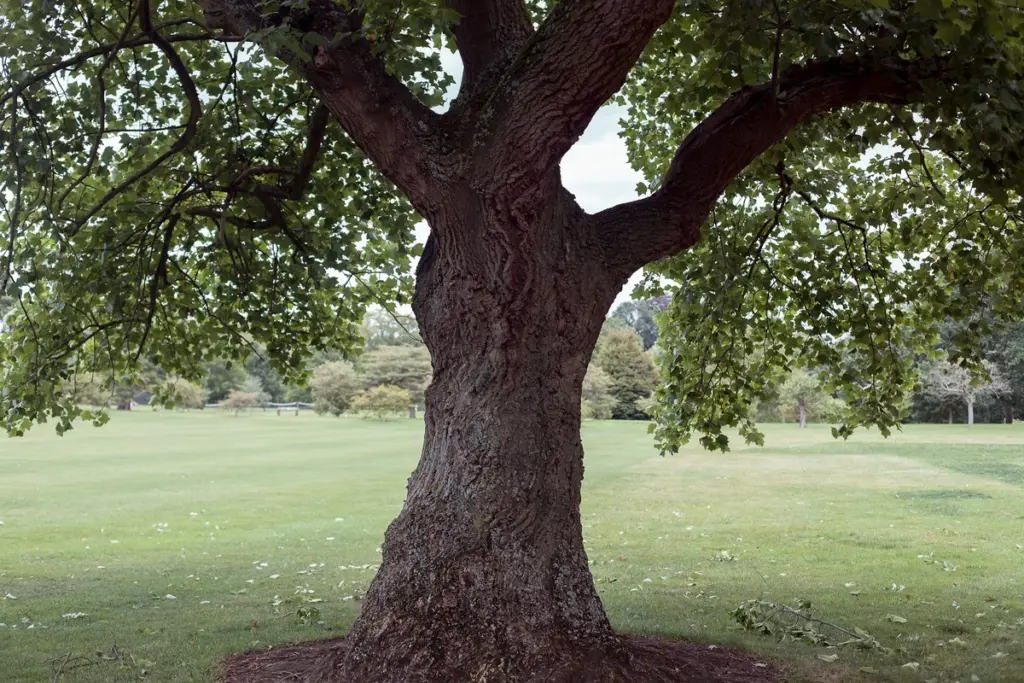
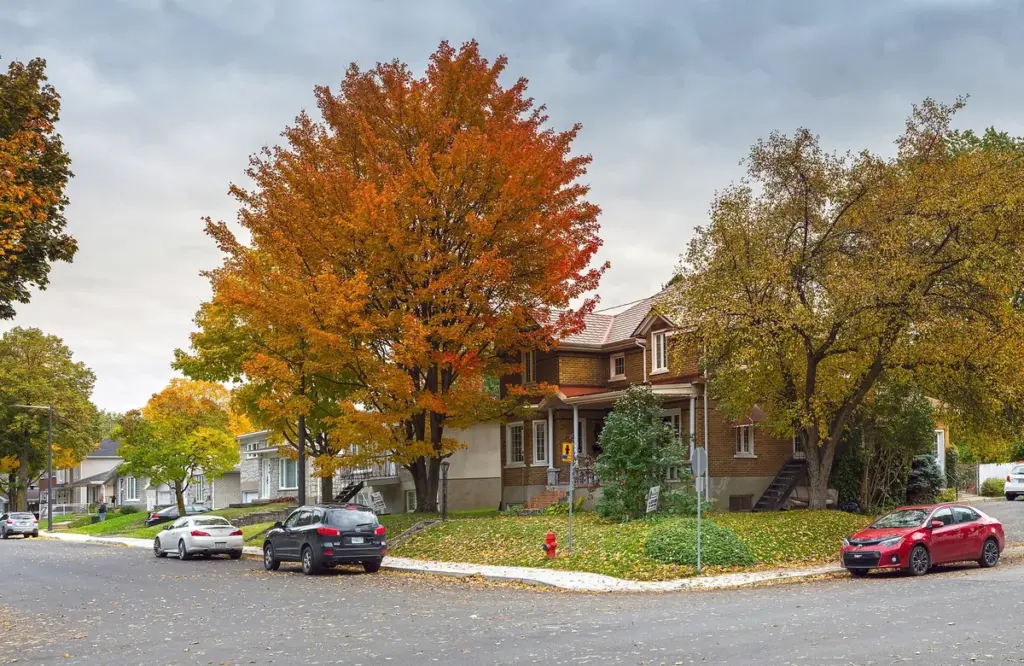
The same species grows at different speeds in different places. A red maple in Charlotte, North Carolina has a longer growing season than one in Minneapolis, and a London planetree on a watered Los Angeles boulevard grows differently from one in Boise. The Forest Service measured trees in 16 US climate regions for this reason, and the calculator matches your state to its region.
Setting matters as much as climate:
- Yard, park or street tree (open-grown): full sun, little competition, often watered. Grows fastest. The calculator uses the regional curve.
- Woodland or forest tree: shaded by neighbors, competing for water and light. Grows slower. The calculator uses the growth factor method, which was built from forest trees.
When an age estimate breaks down
Any estimate from trunk size is a range, not a birth certificate. It is least reliable in these cases:
- Very large, very old trees. Old trees slow down. Past a certain size each extra inch of trunk represents many more years, and very few old trees with known ages exist to calibrate against. The calculator marks these results as extrapolated.
- Palms. Palms are not true trees in the botanical sense. They have no growth rings and their trunks stop widening early, so trunk size says almost nothing about their age. Use the planting tab for palms.
- Trees that were stressed or damaged. Drought, poor soil, construction near the roots and heavy pruning all slow growth, which makes a tree older than its trunk suggests.
- Hollow trees and multi-trunk trees. A hollow trunk still measures the same on the outside but cannot be cored. Trees that resprouted from a stump can be much older at the root than any of their stems.
- Tropical trees. Without a cold or dry season, many tropical species do not form clear annual rings, and growth rates vary widely.
How to count tree rings
- Sand or cut the stump surface smooth. A clean cut with a sharp saw, or a few passes with sandpaper, makes the rings far easier to read. Wetting the wood makes the dark bands stand out.
- Find the pith, the small dark spot near the center. It is often off-center, because trees grow faster on their sunnier side.
- Count the dark latewood bands outward along one straight line from the pith to the bark. Mark every 10th ring with a pencil so you do not lose your place.
- Count along a second line to check. The two counts should match within a ring or two.
- Add the years the tree took to reach the height of the cut. A stump cut at ground level needs little correction. A cut at chest height needs about 5 to 10 years added, which the ring tab does automatically.
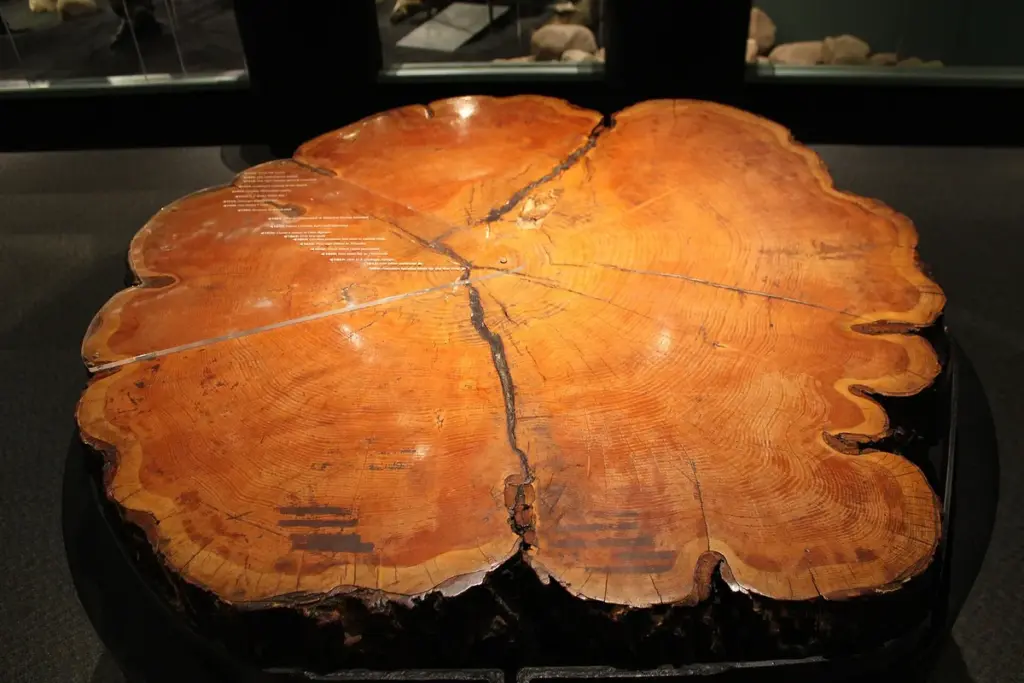
Watch for false rings, where a drought in midsummer creates an extra dark band, and missing rings, where a bad year produced almost no wood. Scientists who date wood (dendrochronologists) cross-check ring patterns between many trees to catch these errors.
How old can trees get?
Most yard trees live between 60 and 300 years. A silver maple or a cottonwood rarely passes 100. A white oak can live 300 to 600 years. A few species live far longer:
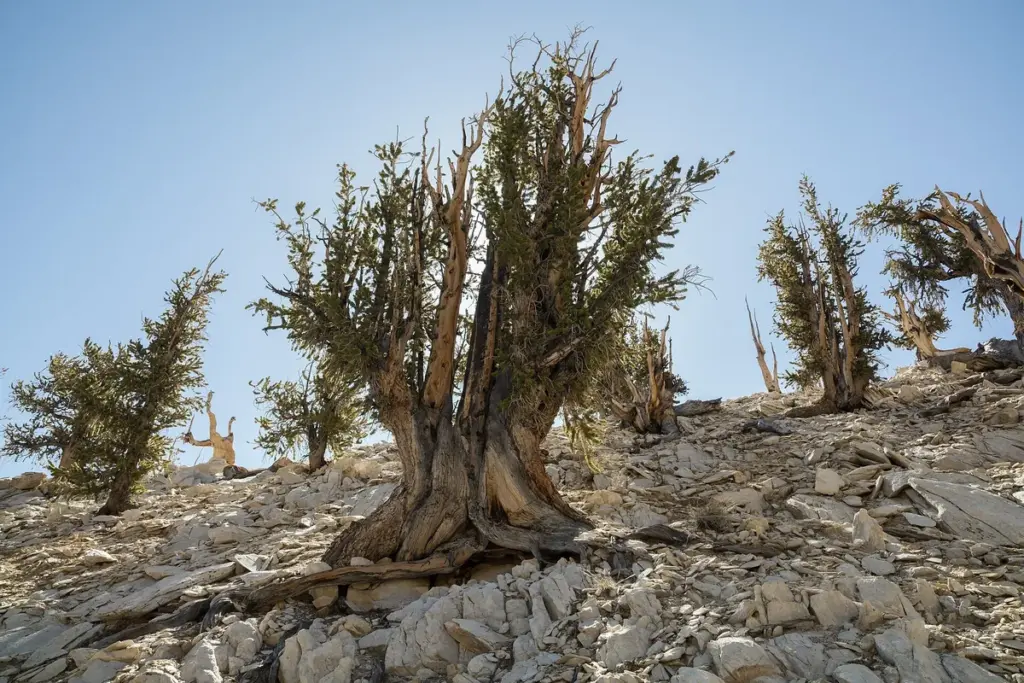
- Great Basin bristlecone pines in California’s White Mountains include individuals more than 4,800 years old, with ages dated from ring counts on core samples.
- Giant sequoias in the Sierra Nevada can live more than 3,000 years.
- Some clonal trees, such as the Pando aspen colony in Utah, are many thousands of years old as a root system even though each stem lives only about 100 to 150 years.
For the biggest, tallest and widest examples, see our guide to huge trees.
Method and sources
Yard and street trees in the US. The USDA Forest Service Urban Tree Database (McPherson, van Doorn and Peper, 2016) measured 14,487 street and park trees in 16 US climate regions, most of them with recorded planting dates, and published equations that predict trunk diameter from age for each species in each region. We inverted those equations to predict age from diameter. The range shown is the spread of the measured trees around that curve: about 8 in 10 trees of that species and size in that region fall inside it. When your species was not measured in your region, the calculator uses the nearest region where it was and says so.
Woodland trees, trees outside the US and species without a curve. The calculator multiplies diameter in inches by the species’ published growth factor (International Society of Arboriculture and university extension tables) and shows a range of 75% to 130% around that figure.
Accuracy. We tested both methods on 2,371 measured trees that were held out of the curve fitting. The regional curves had a median error of 12.5% of the true age, and 82.5% of the true ages fell inside the range shown. The growth factor method had a median error close to 90% on the same trees, almost always in the same direction: it nearly doubled the age of the typical yard tree.
Ring and planting tabs. Ring counts get a correction for the years the tree spent growing up to the height of the count. Planting dates get the age of the tree at planting, which is 3 years unless you enter another number.
Sources:
- McPherson, E.G., van Doorn, N.S. and Peper, P.J. (2016). Urban Tree Database. Fort Collins, CO: Forest Service Research Data Archive. doi:10.2737/RDS-2016-0005
- McPherson, E.G., van Doorn, N.S. and Peper, P.J. (2016). Urban tree database and allometric equations. Gen. Tech. Rep. PSW-GTR-253. USDA Forest Service.
- Purdue Extension, Purdue Landscape Report: How Old Is My Tree? (Issue 18-04).
- Morton Arboretum growth factor table, as summarized by Friends of the Wildflower Garden (Tree Age Calculator Table #2).
- Allegheny County Parks, Latodami Nature Center: How to Age a Living Tree.
- Grosse Ile Nature and Land Conservancy: Estimating the Age of a Tree.
Looking for something to identify next? Browse our guide to common tree species, learn the characteristics of coniferous trees and evergreen trees, or read why planting a tree pays off and how to prune one properly.