TLDR
Nilgiri langurs are leaf-eating specialists. Young leaves make up almost half their diet (around 44%), with the rest split between seeds, fruit, flowers, bark, and — oddly — soil. They favor teak leaves above nearly everything else, work through more than 100 plant species across the Western Ghats, and eat dirt on purpose to counteract the toxins in all that foliage.
Table of Contents
- What Nilgiri Langurs Actually Eat
- How a Langur Eats a Leaf
- The Teak Leaf Obsession
- Why They Eat Soil
- Fruit, Flowers, and Seasonal Swings
- A Typical Feeding Day
- Diet, Habitat, and Why This Species Is in Trouble
- Nilgiri Langur Diet at a Glance
- FAQ
What Nilgiri Langurs Actually Eat

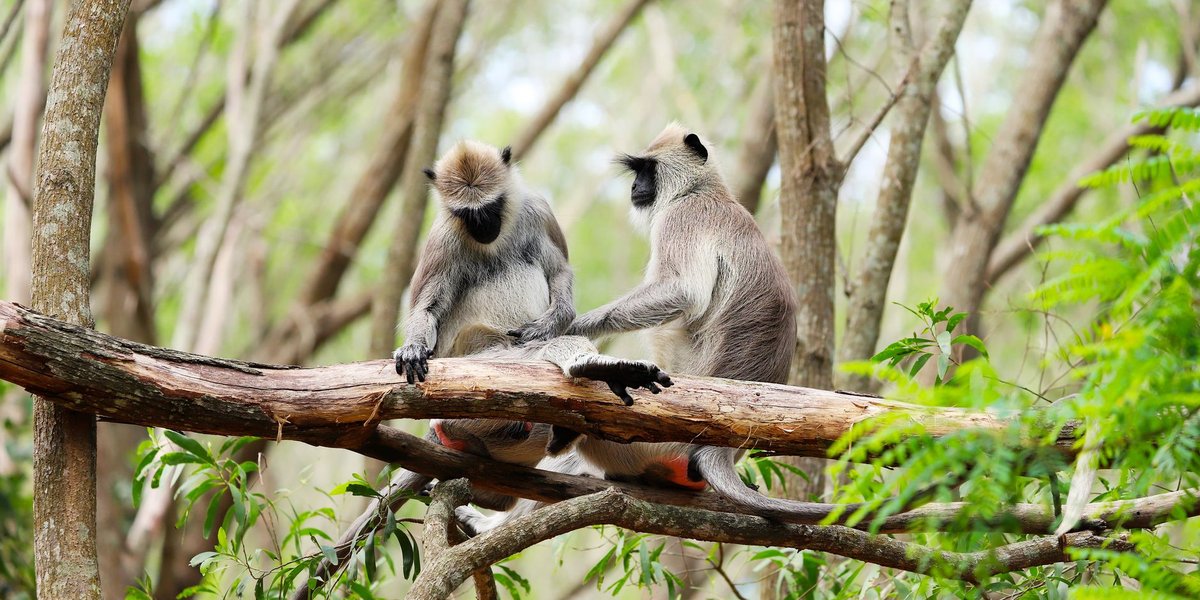
Nilgiri langurs (Trachypithecus johnii, sometimes listed as Semnopithecus johnii) are colobine monkeys, which means their whole biology is built around eating leaves other primates can’t handle. Young leaves account for roughly 44% of what they eat in a given day — by far the single largest category. Seeds come in second at around 19%, followed by young fruit near 10%, flowers around 8%, ripe fruit about 5%, and mature leaves a bit over 4%. The remainder — roughly 9-10% — is a grab bag of petioles, bark, pith, soil, gum, dead wood, and the occasional insect.
That’s not a random sampling of whatever’s nearby. Troops range across more than 100 plant species in a single home range, and trees supply the overwhelming majority of it — around 84% of the plant matter they eat comes from trees, with climbing vines, shrubs, herbs, and grasses filling in the gaps. A langur troop moving through a shola forest in the Nilgiris isn’t foraging so much as running a route, hitting the same productive trees on a rotation.
How a Langur Eats a Leaf
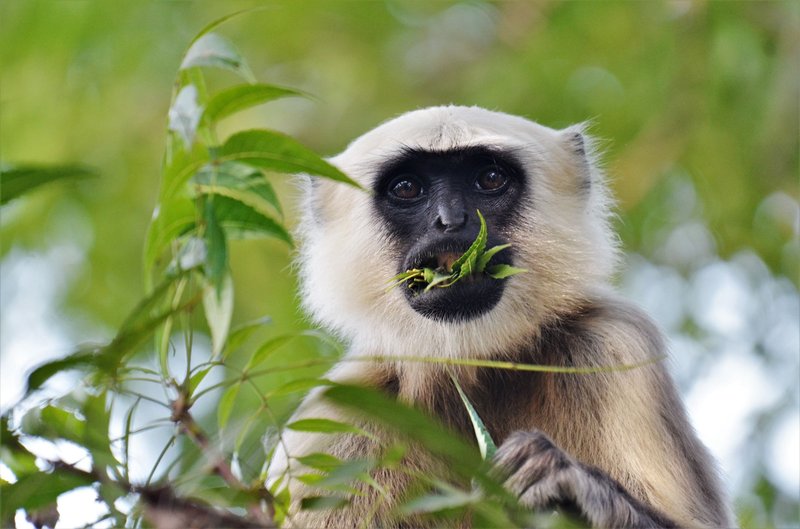
Watch a Nilgiri langur work through a single leaf and you’ll notice it’s not a quick bite-and-swallow. They tend to start at the tip, working their way down toward the midrib and base, discarding the tougher fibrous parts as they go. It’s a deliberate, almost fussy process — and it needs to be, because leaves are mostly indigestible cellulose wrapped around a small amount of usable protein and sugar.
That’s where the langur’s stomach earns its keep. Like other colobine monkeys, Nilgiri langurs have a multi-chambered, foregut-fermenting stomach — a setup closer to a cow’s than to a human’s. Bacteria in the forestomach break down cellulose and detoxify some of the plant compounds before the food ever reaches the acidic part of the gut. Without that adaptation, a diet built around young leaves simply wouldn’t provide enough energy to survive on.
The Teak Leaf Obsession
If you had to name one plant that defines the Nilgiri langur’s diet, it would be teak. Troops show a marked preference for teak leaves over nearly everything else on offer, targeting the larger, tender leaves when they’re available and returning to teak stands more often than the sheer abundance of the tree would predict. It’s likely a combination of leaf size (more food per bite, less energy spent foraging) and a favorable nutrient-to-toxin ratio compared to other species in the canopy.
This preference has a practical downside for conservation. Where native forest has been replaced with monoculture teak or timber plantations, langurs will use them — but a plantation isn’t a substitute for the 100-plus species of trees, vines, and shrubs a healthy shola forest provides across the year.
Why They Eat Soil
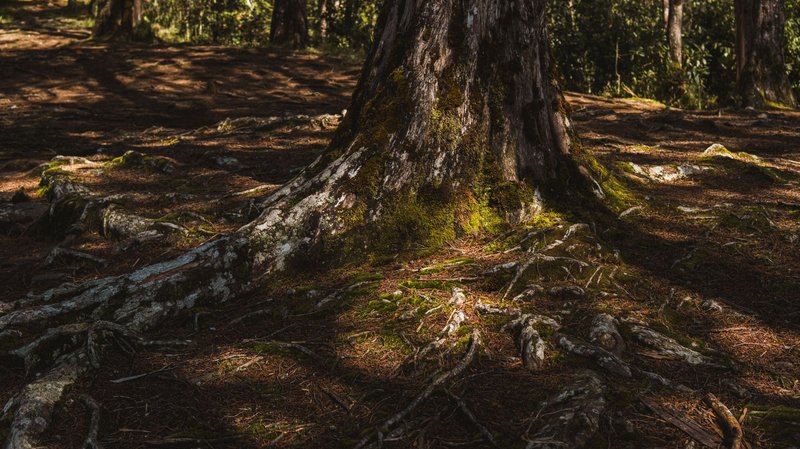
This is the detail that surprises most people: Nilgiri langurs eat dirt, and it’s not accidental. The behavior is called geophagy, and it shows up regularly enough in this species that researchers treat it as a normal part of the feeding routine, often sourced from termite mounds or exposed earth banks.
The leading explanation is straightforward chemistry. A diet this heavy in young leaves comes loaded with plant secondary compounds — tannins and other toxins the plant produces specifically to discourage being eaten — plus a fair amount of acid-forming material. Soil, particularly clay-rich soil, can bind to some of these toxins in the gut and buffer stomach acidity, functioning something like a natural antacid. Eat enough leaves and you need something to neutralize what’s in them; dirt does the job.
Fruit, Flowers, and Seasonal Swings
Leaves are the baseline, but Nilgiri langurs aren’t strict folivores year-round. When fruit and flowers come into season, troops shift noticeably toward them — fruit and flowers together can make up close to a quarter of intake during peak availability, versus a much smaller share the rest of the year. This isn’t unusual for leaf-eating primates: fruit and flowers deliver sugar and nutrients far more efficiently than leaves do, so animals capitalize on them whenever the forest offers them up, then fall back on leaves as the reliable, always-available default.
Seasonal fruiting patterns in the Western Ghats also shape where troops travel. A patch of fruiting trees can pull a group off its usual route for days, which is part of why Nilgiri langur diet studies show real variation between wet and dry season observations.
A Typical Feeding Day
Nilgiri langurs aren’t grazing constantly — they feed in distinct bouts, typically a couple of concentrated sessions rather than one long stretch, interspersed with resting, grooming, and moving between feeding trees. Feeding and feeding-related activity fills a large share of their waking hours, which tracks with how much low-calorie leaf material they need to process to meet their energy needs. It’s a pattern common to leaf-eating primates generally: when your food is abundant but nutritionally thin, you compensate with time, not intensity.
Diet, Habitat, and Why This Species Is in Trouble
Diet and conservation status are more connected here than they might seem. The Nilgiri langur is classified as Vulnerable on the IUCN Red List, with the total population estimated at under 20,000 individuals — and less than half of those are mature adults. It’s also listed under CITES Appendix II, which restricts international trade in the species.
The core threat is habitat loss. Native shola forest and the grassland-forest mosaic surrounding it have been steadily converted into tea, coffee, and eucalyptus plantations across the Nilgiris and the wider Western Ghats. Since these langurs depend on access to a wide range of tree species to meet their nutritional needs — not just calories, but the right mix of leaves, fruit, and flowers across the seasons — fragmented habitat doesn’t just shrink their territory, it narrows their menu. A troop confined to a small forest patch or plantation edge has fewer food sources to rotate through and less buffer during lean months.
That food pressure is also behind the crop-raiding incidents reported near farms and estate borders in the region. When natural food sources thin out or troops get boxed into small forest fragments next to agricultural land, langurs will take advantage of cultivated crops nearby. It’s less a behavioral quirk than a predictable outcome of habitat squeeze — a well-fed troop with an intact forest range has little reason to cross into a farmer’s plot. Conservation groups working in the Nilgiris consider the two problems, habitat loss and crop conflict, as directly linked rather than separate issues.
Nilgiri Langur Diet at a Glance
| Food Type | Share of Diet | Why It Matters |
|---|---|---|
| Young leaves | ~44% | Primary energy source; digested via foregut fermentation |
| Seeds | ~19% | Concentrated nutrition, available across seasons |
| Young fruit | ~10% | Sugar-rich; targeted when in season |
| Flowers | ~8% | Seasonal supplement, nutrient-dense |
| Ripe fruit | ~5% | Highest sugar content; opportunistic feeding |
| Mature leaves | ~4% | Lower preference than young leaves; tougher fiber |
| Bark, pith, soil, insects, gum | ~9-10% | Soil aids digestion (geophagy); rest fills nutritional gaps |
FAQ
Do Nilgiri langurs eat meat? Essentially no. Their diet is almost entirely plant-based; any insect matter they consume is incidental, not a targeted food source.
Why do Nilgiri langurs eat soil? To neutralize toxins and acidity from their leaf-heavy diet. Soil, especially from termite mounds, can bind plant toxins and buffer stomach acid — a natural counterbalance to eating so many young leaves.
What’s their favorite food? Young leaves overall, with a clear preference for teak leaves specifically when they’re available.
Do Nilgiri langurs raid crops? Yes, particularly in areas where habitat fragmentation has pushed troops close to farmland. It tends to correlate with reduced access to natural food sources rather than being routine behavior.
How does their stomach handle so many leaves? Through a multi-chambered, foregut-fermenting stomach similar in function to a cow’s, which lets gut bacteria break down cellulose before digestion.