Short answer: a baby crow needs a high-protein, calcium-rich mash, not worms, bread or milk. As a stopgap until a rehabber takes over, soak dry kitten kibble until soft, mash in chopped hard-boiled egg with its shell, and offer pea-sized bites with blunt tweezers until the bird stops gaping. Never drip water or milk into its beak. Warm a cold baby before you feed anything. From about 8 weeks, a young crow starts picking up chopped unsalted peanuts, corn and fruit on its own.
Most baby crows people find don’t need feeding at all. A feathered crow hopping on the ground is a fledgling, and its parents are still feeding it. The chart below sorts common foods into safe staples, small amounts only and never feed, and the box above it covers what to do first. Under the chart are the feeding method, a schedule by age and a printable cheat sheet.
Before you feed anything
Can a baby crow eat it?
Safe staples (5)
- Safe to feed. Merck's stopgap for orphaned songbirds: dry kitten kibble soaked soft and blended, plus calcium. Kitten chow is about 34% protein.Ages 0–12 weeks#
- Safe to feed. Chopped hard-boiled egg, yolk included, with the shell mashed in for calcium. McGowan adds it to every crow mash.All ages#
- Safe to feed. McGowan calls turkey starter a good base for a young crow's diet, soaked soft. It still needs egg and calcium added.Ages 0–12 weeks#
- Safe to feed. Growing crows need a lot of calcium. Rehab diets add calcium and avian vitamins; poor diets cause metabolic bone disease.All ages#
- Safe to feed. Only once it perches and feeds itself. Never drip water into the beak: it can go into the lungs. Nestlings get water from food.From fledging#
Small amounts only (9)
- Small amounts only. Rehabbers use feeder insects dusted with vitamins and calcium alongside the mash. Insects alone are low in calcium.From about 1 week#
- Small amounts only. A supplement, not a diet. High in chitin and low in calcium; McGowan warns too many cause blockages. Cut up for small chicks.From about 1 week#
- Small amounts only. Only cooked and mixed into a kibble mash: McGowan's rehab recipe is 2 parts kibble, 1 part cereal, 1 egg per 2 cups.Ages 0–8 weeks#
- Small amounts only. Unsalted and chopped, once it feeds itself (McGowan). Whole peanuts can choke young birds; salted ones dehydrate them.From 8 weeks#
- Small amounts only. One of the foods McGowan offers once young crows can feed themselves. Not a nestling food.From 8 weeks#
- Small amounts only. Offered once young crows feed themselves (McGowan). Unsalted only. Seeds don't replace the protein mash.From 8 weeks#
- Small amounts only. Fresh fruit is on McGowan's list for crows that feed themselves. Remove seeds and pits, which shouldn't be fed to birds.From 8 weeks#
- Small amounts only. Halved and seedless, as part of the fresh fruit McGowan offers self-feeding crows. Not for nestlings.From 8 weeks#
- Small amounts only. McGowan says these are favorites once young crows can work food on their own, usually late summer. Not for nestlings.From 12 weeks#
Never feed (12)
- Never feed. Merck lists soaked dog food among foods not to feed orphaned birds. Soaked kitten kibble is the stopgap and runs higher in protein.
- Never feed. McGowan says canned cat and dog food are too low in protein for a growing crow. Use dry kitten kibble, soaked.
- Never feed. Birds are lactose intolerant and get diarrhea from milk. No bird can live on bread and milk (McGowan).
- Never feed. McGowan: never feed dairy products to birds. They can't digest milk sugar and get diarrhea.
- Never feed. Merck lists bread and milk among foods not to feed orphaned birds. It's empty calories, and dry bread can choke young birds.
- Never feed. Rehabbers advise against soil worms: they can carry gapeworm (Syngamus trachea) picked up from infected bird droppings.
- Never feed. Merck lists hamburger among foods not to feed orphaned birds. McGowan: young crows can't live on hamburger alone.
- Never feed. Merck lists uncooked rice among foods not to feed orphaned birds. Starches are empty calories for a bird that needs protein.
- Never feed. Contains persin, which damages the heart muscle in birds.
- Never feed. Theobromine and caffeine cause heart rhythm changes, seizures and death in birds.
- Never feed. Salted foods dehydrate birds. Chips, pretzels and salty popcorn are on vets' lists of foods to avoid.
- Never feed. Can damage a bird's red blood cells.
Sources
- Baby crows (Kevin J. McGowan) — Cornell Lab of Ornithology
- Frequently Asked Questions About Crows (Kevin J. McGowan) — Cornell Lab of Ornithology
- Care of Orphaned Native Birds and Mammals (Gage and Duerr) — Merck Veterinary Manual
- Raising Orphaned Wild Baby Birds (Ron Hines DVM PhD) — 2nd Chance (vetspace.2ndchance.info)
- Crows and Ravens: Renesting and Reuniting — San Diego Humane Society
- Crows and Ravens: Coexisting with Wildlife — San Diego Humane Society
- I found a nestling songbird — Toronto Wildlife Centre
- I found a fledgling songbird — Toronto Wildlife Centre
- Found a baby corvid — RSPCA
- American Crow Life History — Cornell Lab of Ornithology, All About Birds
- Crows (species profile) — Pennsylvania Game Commission
- Crows — Birds Connect Seattle
- 50 CFR 10.13 List of Birds Protected by the Migratory Bird Treaty Act — eCFR, US Government
- 50 CFR 21.76 Rehabilitation permits — eCFR, US Government
- 16 US Code 703 Taking, killing, or possessing migratory birds unlawful — Cornell Legal Information Institute
- Frequently Asked Questions for Migratory Bird Rehabilitation Permit — US Fish and Wildlife Service
- Patient of the Week: For the Love of Crows (June 12, 2026) — California Wildlife Center
- Caws for Care: Raising Crows in Crowtopia (June 6, 2025) — California Wildlife Center
- Help! I've found a baby crow (Kaeli Swift) — Corvid Research
- Foods That Are Toxic to Birds (Lauren Jones VMD) — PetMD
- Avocado (Persea spp) Toxicosis in Animals — Merck Veterinary Manual
- Chocolate Toxicosis in Animals — Merck Veterinary Manual
- How and what to feed your garden birds — RSPB
The first hours: nestling or fledgling?
Kevin McGowan, a crow researcher at the Cornell Lab of Ornithology, found that young crows depend on their parents for about 2.5 months. A found baby is usually in the middle of that stretch, with parents nearby.
1. Decide whether it needs you
McGowan’s test: if the bird can sit on your finger and grip it, it’s a fledgling, and it should be left where it is. Fledglings are fully feathered, with bright blue eyes, a short tail and pink fleshy corners to the mouth. They stand, walk and perch but can’t fly well yet.
That stage confuses people because a fledgling crow is big. It weighs 80 to 100% of an adult, about 300 to 450 grams, and its legs are full size. Crows leave the nest 7 to 10 days before they can fly, so a flightless young crow on a lawn from late May to July is normal. Kaeli Swift, a crow researcher in Seattle, points out that it has not fallen out and has not been abandoned.
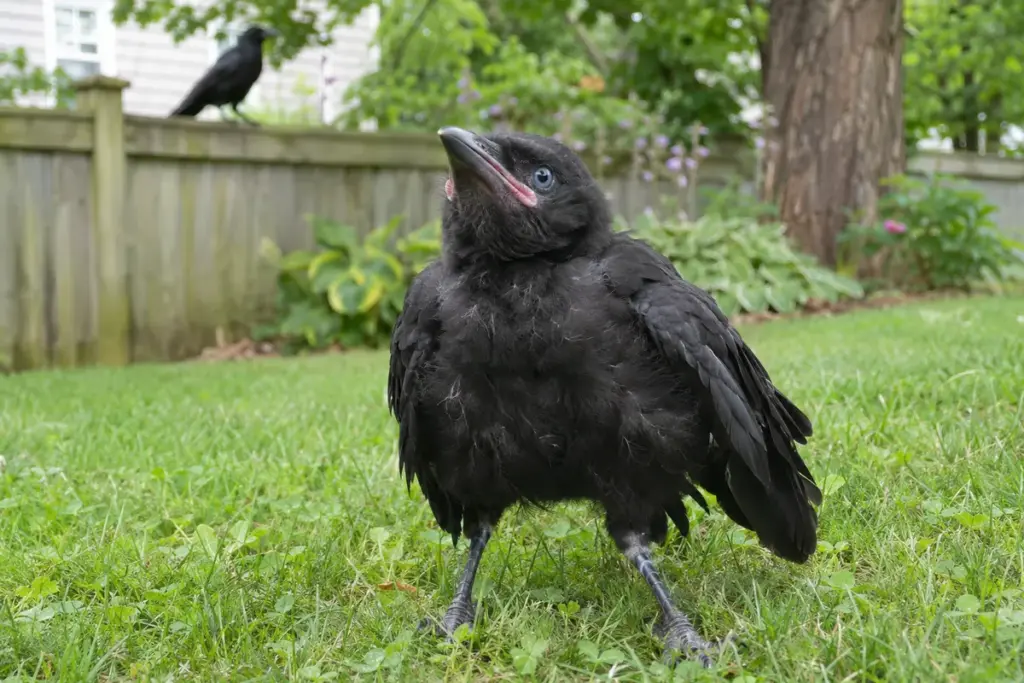
A nestling has bare skin on parts of its body, pin feathers or gray down and can’t stand properly. It belongs in the nest.
2. Put it back, then watch
Touching a baby bird does not make its parents abandon it. San Diego Humane Society’s protocol for crows and ravens:
- Fledgling: leave it where you found it, or set it on a nearby branch if it sits still. Watch from a distance for 2 hours, then another 2 if it looks fine. Parents leave young alone for up to 2 hours while they forage. Keep pets indoors.
- Nestling: return it to the nest if you can reach it. If not, make a new one from a shallow plastic container or basket with drainage holes, lined with grass or sticks, and fix it in the same tree with zip ties. Watch for an hour, then give the parents another hour.
- Warm a cold baby before you put it back.
- Wear a hat or carry an umbrella. Crow parents dive at people near their young.
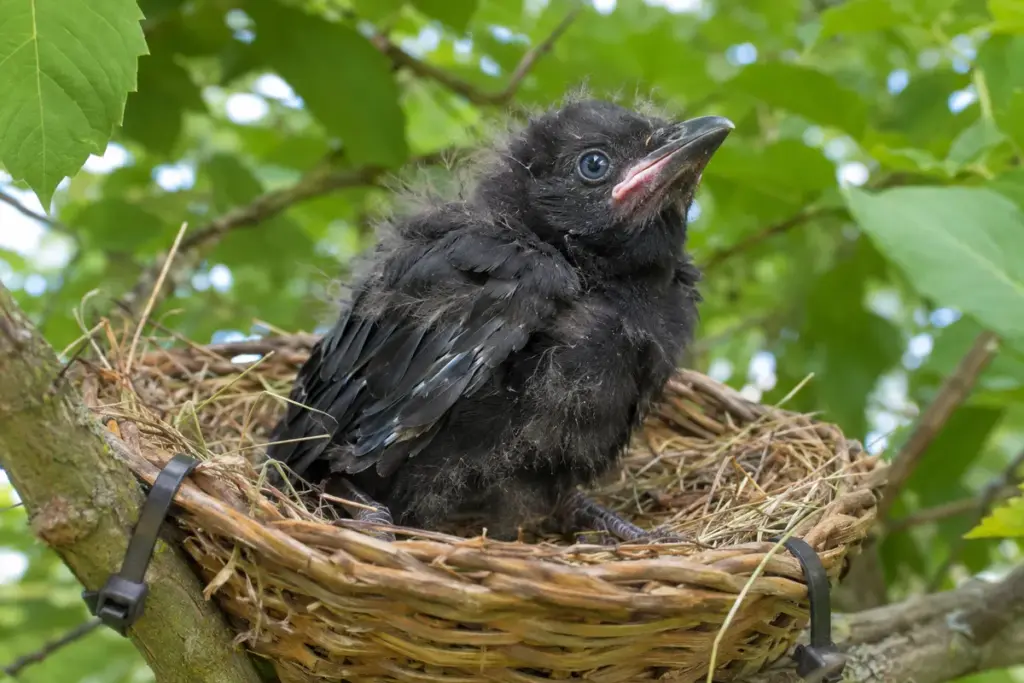
Take the bird in only if the parents don’t come back within those times, or right away if it is injured, bleeding, has a drooping wing, can’t grip with one foot or was caught by a cat. Toronto Wildlife Centre treats any cat contact as an emergency, even with no visible wound. McGowan adds that crows sometimes push a nestling out on purpose, and a renested baby can end up on the ground again. If that happens, call a rehabber.
3. Warm it before anything else
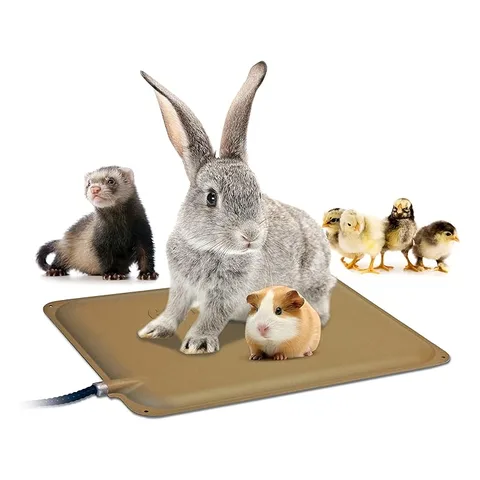
Put the baby in a small cardboard box with a soft cloth, not a cage. Toronto Wildlife Centre lists four heat sources: a heating pad on low under half the box, a hot water bottle wrapped in a towel, a sock of dry rice heated for a minute in the microwave, or chemical hand warmers. The bird must be able to move off the heat. Keep the box in a dark, quiet room away from pets and children.
4. No food or water yet
Toronto Wildlife Centre says not to give a found baby bird food or water. Baby birds get their water from food, and water from a dropper or syringe can run into the airway. Merck Veterinary Manual sets the order of care as warm first, then hydrate, then feed. Hydrating a weak bird is a rehabber’s job, often with injected fluids.
5. Call a licensed rehabber
Find one through Animal Help Now. Ask whether they take crows before you drive over.
The American crow, fish crow and common raven are protected under the federal Migratory Bird Treaty Act. Federal rules let anyone who finds an orphaned or injured migratory bird pick it up without a permit to take it straight to a licensed rehabber or vet. Keeping it at home, even until it can fly, is possession without a permit. Hawaii protects all crows because of the endangered Hawaiian crow. Feral pigeons are a different case: they are non-native, so the act does not cover them.
The law also protects the bird. Of six hand-raised crows McGowan marked and released, all died or disappeared in their first fall or winter. Rehab centers such as the California Wildlife Center raise crows together with other corvids and release them as a flock, because a crow raised alone imprints on people and never learns to live with other crows.
The rest of this guide covers the hours before you reach help, and care a rehabber may ask you to give.
What to feed a baby crow
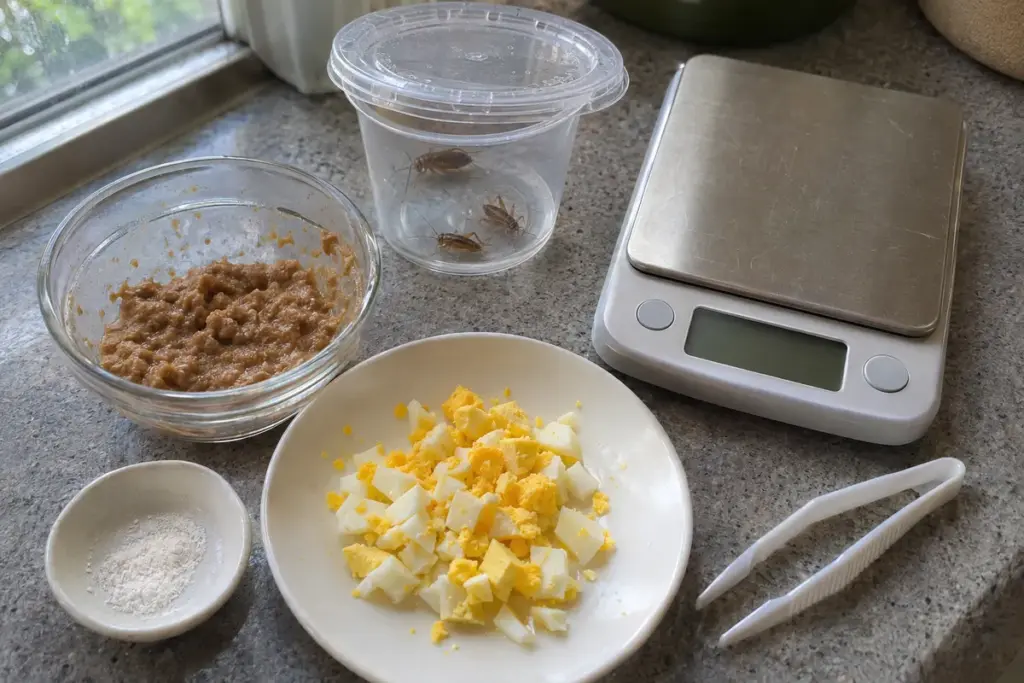
Growing crows need far more protein than most bird foods give them. McGowan puts it at 25 to 50% of the diet, plus a lot of calcium. Rehabbers build a mash from three parts:
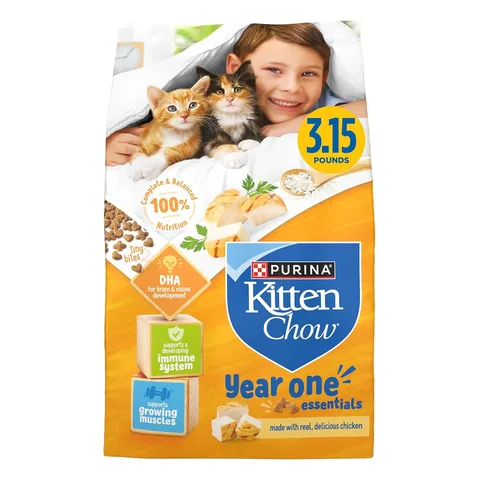
- Soaked dry kitten kibble. Merck’s temporary diet for orphaned songbirds is puréed high-quality kitten kibble with added calcium. Dr. Ron Hines raises perching birds on about 60% soaked kitten chow, which is about 34% protein dry.
- Hard-boiled egg. Hines makes it about 20% of the mix. McGowan uses the yolk and mashes the shell in for calcium.
- Insects. Hines adds about 20% mealworms. Merck uses crickets and waxworms dusted with a vitamin and mineral supplement, because insects alone are low in calcium.
Turkey or game bird starter, soaked soft, is McGowan’s other base. It still needs egg and calcium added. Some rehab centers use high-quality puppy food in a balanced mash, but Merck lists soaked dog food among foods not to feed orphaned birds, so this guide sticks with kitten kibble.
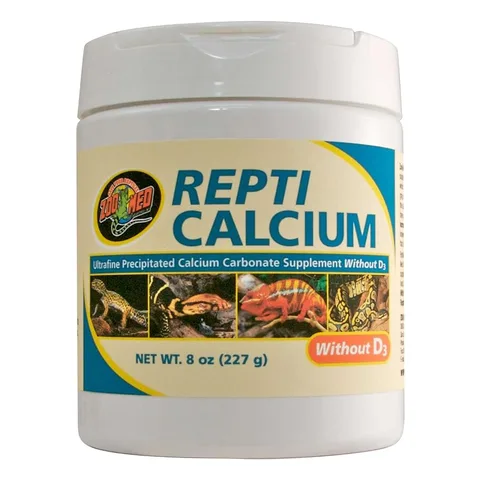
Calcium matters more than people expect. The California Wildlife Center has seen a rise in young crows admitted with metabolic bone disease, which it links to human-provided food and early separation from parents. Merck’s temporary diet adds 150 mg of elemental calcium per kilogram of body weight twice a day. A rehabber can tell you which supplement to use and how much.
To prepare it, Hines soaks the kibble, heats the mix to 160 °F to kill bacteria and cools it to about 95 °F before feeding. Don’t microwave the finished food, because microwaves leave hot spots. Aim for a texture thicker than oatmeal and thinner than mashed potatoes. Make it fresh and throw away leftovers.
Merck’s full songbird formula is a weighed recipe with powdered egg white, calcium carbonate and avian vitamins, and its authors warn that ingredients “should not be deleted or substituted haphazardly.” Don’t improvise a formula. The mash above is a stopgap until a rehabber takes over, ideally the same day.
Foods that harm baby crows
- Milk, cheese and other dairy. Birds are lactose intolerant and get diarrhea. McGowan writes that no bird can live on bread and milk.
- Bread, pasta and rice. Merck lists bread and uncooked rice among foods not to feed orphaned birds, and Hines calls starches empty calories. The RSPB warns that dry bread can choke young birds.
- Earthworms. Wild crows eat them, but Hines notes rehabbers avoid them because soil worms can carry gapeworm, a parasite picked up from infected bird droppings.
- Hamburger and raw meat. Merck lists hamburger as a food not to feed, and McGowan says young crows can’t live on hamburger alone.
- Canned cat or dog food. McGowan says it is too low in protein for a growing crow.
- Avocado, chocolate, onion and garlic. Avocado contains persin, which damages bird heart muscle. Chocolate’s theobromine and caffeine cause seizures and death. Onion and garlic damage red blood cells.
- Chips, fries and other salty food. Salt dehydrates birds.
How to feed a baby crow
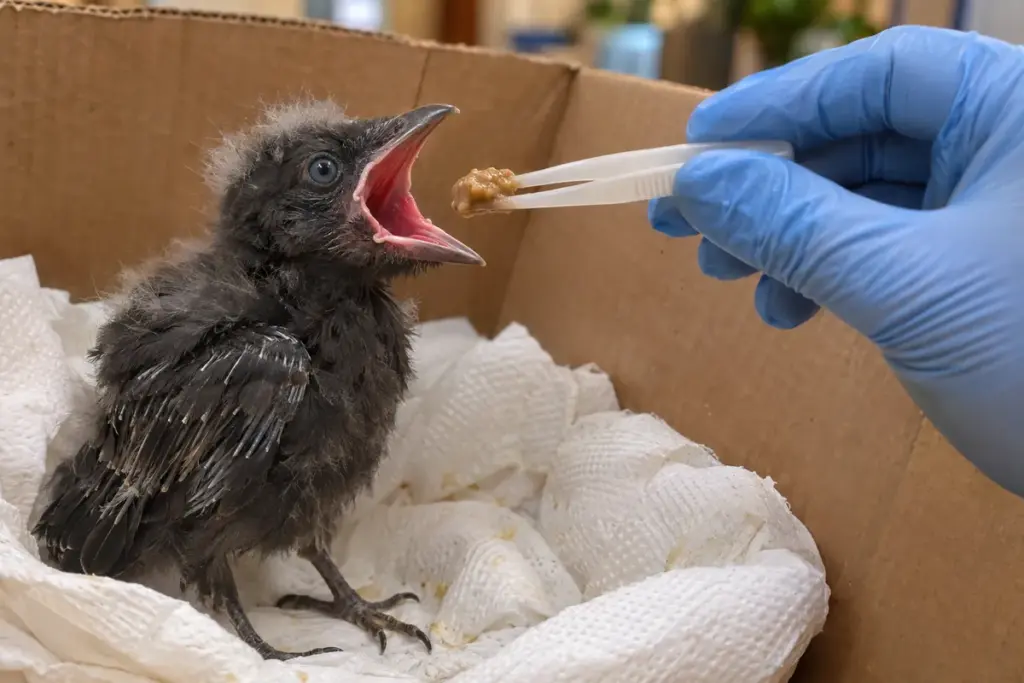
Baby crows gape: they open their mouths wide and show a bright pink lining, and the parents push food in. Hand-feeding copies that. Only feed a bird that is warm and alert.
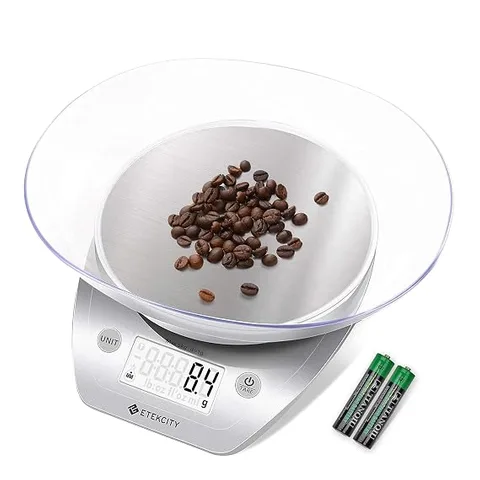
- Weigh it in grams every morning on a kitchen or postage scale. Merck and Hines both say a growing bird should gain weight every day until it flies.
- Keep the bird upright in its nest box. Never feed a bird on its back.
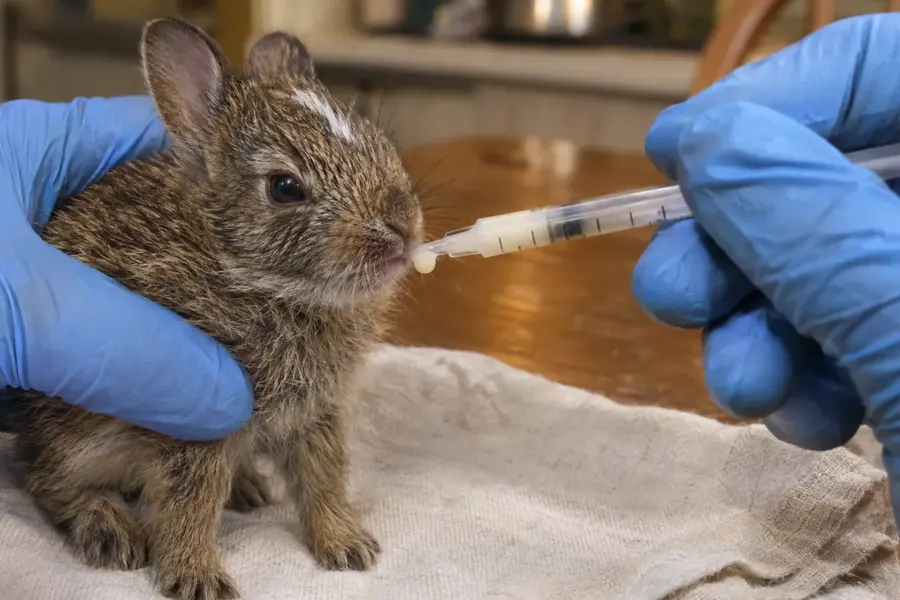
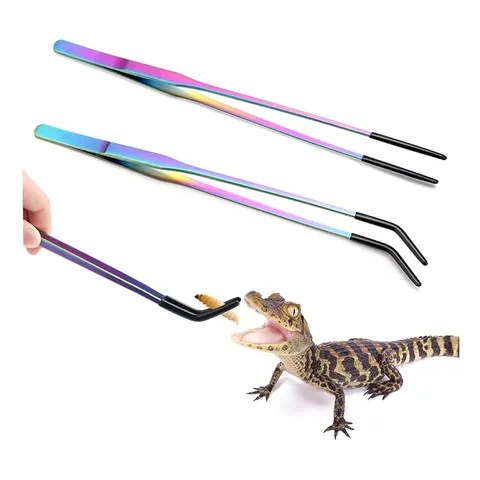
- Use blunt plastic tweezers or forceps, as Hines does. Pick up a pea-sized bite of mash.
- Wait for the gape. When the baby opens wide, place the bite in its mouth and let it swallow.
- Stop when it stops begging. Merck notes that corvids stop begging when full, unlike finches. Hines feeds until the bird responds only halfheartedly and doesn’t push the last bite.
- Never force food or water. Merck warns that overfeeding causes regurgitation and aspiration pneumonia, which is food in the lungs.
McGowan warns that crows under about 26 days old beg at anything that moves. Hand-raised crows imprint on people, which is another reason the feeding belongs with a rehabber who raises crows in groups.
Baby crow feeding schedule by age
The schedule follows the American crow. Feeding frequency follows Hines’s taper, from every 15 to 20 minutes for a naked hatchling to every 2 to 3 hours for a young crow that has started to fly. McGowan’s own figure is every 10 to 20 minutes from dawn to dusk for the whole dependent period. No source feeds at night: Merck and Hines both give baby birds 8 to 10 hours of dark, quiet sleep. If you don’t know the age, use the “looks like” column.
| Age | What it looks like | Food | Amount | How often | Notes |
|---|---|---|---|---|---|
| 0–1 week | Naked with sparse gray down tufts, eyes closed, pink mouth, can't stand | Rehabber only. Stopgap: soaked, blended kitten kibble with egg and calcium | Small bites until it stops gaping; corvids stop begging when full | Every 15–20 minutes, sunrise to sunset; no night feeds | Keep it at 95–97 °F. Warm before any food. Needs a rehabber today. |
| 1–3 weeks | Eyes open, dark pin feathers coming in, blue eyes, pink gape | Kibble or starter mash with egg and calcium; cut-up insects | Until it stops gaping; weigh daily in grams, it should gain every day | Every 30–45 minutes, sunrise to sunset | Lower the heat about 5 °F a week. Under about 26 days it begs at anything that moves and imprints on people. |
| 3–5 weeks | Feathered, short tail, blue eyes, pink mouth corners, stands and perches | Mash, chopped egg, insects dusted with calcium | Until it stops gaping | Every 30–60 minutes in daylight | Crows leave the nest at about 35 days (30–45). Feathered and perching means fledgling. |
| 5–8 weeks | Looks like a small adult with a short tail and blue eyes; hops on the ground, can't fly well | Mash and insects by hand; a dish of the same food and a water dish | Hand-feed until it stops begging; keep the dish full | Every 1–2 hours, 12 hours a day | Wild fledglings spend 7–10 days on the ground before they fly, fed by parents. Reunite if you can. |
| 8–12 weeks | Flying, follows adults, still begs with a nasal caw | Mash and insects, then chopped unsalted peanuts, corn and fruit in a dish | Dish free choice | Hand-feed every 2–3 hours, then cut back gradually | Parents feed young for 6 weeks to 2 months after fledging. Don't stop hand-feeding all at once. |
| 12 weeks and up | Flies well, feeds itself, stays near the family group | Varied diet from a dish; mice and chicks once it tears food apart | Free choice | Eats on its own | Crows depend on parents for about 2.5 months. Rehabbers raise and release them in groups. |
Write the morning weight down every day. A baby crow that stops gaining or loses weight needs a rehabber or an avian vet.
Ravens and fish crows are fed the same way. Ravens are larger and stay in the nest longer, 28 to 50 days against about 35 for American crows, so go by the bird’s feathers and behavior rather than the age column.
Weaning: when young crows feed themselves
Wild crows go on feeding their young for 6 weeks to 2 months after they leave the nest. Weaning is slow, and Hines warns against stopping hand-feeding all at once.
- A dish of the same mash from about 5 weeks, when the bird perches. Keep hand-feeding alongside it.
- A shallow water dish once it perches and feeds itself, never before.
- Insects dusted with calcium, whole once the bird can handle them. Mealworms only a few at a time: McGowan warns that their tough shells cause blockages in large numbers.
- Self-feeding foods from about 8 weeks: McGowan lists unsalted peanuts, corn, sunflower seeds and fresh fruit.
- Whole mice and day-old chicks once the young crow tears food apart on its own, usually late summer.
- Cut hand-feeds back gradually as the bird eats more from the dish.
Can baby crows eat peanuts, bread or dog food?
Peanuts, yes, but only unsalted, chopped and for a crow old enough to feed itself. The RSPB warns that whole peanuts can choke young birds and salted ones dehydrate them. Bread, no: it fills a baby crow up without the protein and calcium it needs. Dog food is a split among sources. McGowan’s rehab recipe uses high-protein dog food, but Merck lists soaked dog food among foods not to feed orphaned birds, so this guide uses kitten kibble instead.
Signs something is wrong
- No droppings within an hour of a feed, or dry or green droppings: Toronto Wildlife Centre uses this test to tell whether a bird is being fed enough. Call a rehabber.
- Food coming back up, or out of the nostrils: the bird was overfed or fed too fast, and food may have reached the lungs. Stop feeding and call a rehabber.
- No weight gain, or weight loss: the diet or the amount is wrong. It needs a rehabber or avian vet.
- A drooping wing, blood or a foot that won’t grip: an injury. McGowan says not to try to fix it at home.
- Any contact with a cat: an emergency even with no visible wound. Take it to a rehabber the same day.
- A diet without added calcium: even if the bird looks fine, it risks metabolic bone disease. Ask a rehabber about a supplement.
Printable baby crow feeding chart
The cheat sheet fits on one page. It has the safe, small amounts only and never food lists, the schedule by age, the emergency steps and a log for weight, feeds and droppings. Print it in color or in black and white and keep it by the nest box.
Supplies for feeding a baby crow
These are the items rehab and vet sources name. On the first day you need a heat source, a gram scale and, if a rehabber asks you to feed, kitten kibble and blunt tweezers.
More about crows
See how to tell the two big black corvids apart in differences between ravens and crows, and separate a crow from grackles and starlings with our black bird identification guide. Crows remember faces and teach their young to avoid people who threatened them, which is why they made our list of animals that can hold a grudge. Their adult diet shows up in the characteristics of omnivores. If you found a different baby bird, see what to feed a baby pigeon. All our bird articles are in the birds section.
Frequently asked questions
What can I feed a baby crow in an emergency?
Warmth comes first, then a call to a licensed wildlife rehabilitator. Don't give food or water to a cold or weak bird. If a rehabber asks you to feed it before you can get there, use dry kitten kibble soaked until soft and mashed with chopped hard-boiled egg, offered in pea-sized bites with blunt tweezers until the bird stops gaping. Never use bread or milk.
Do baby crows need water?
Not by mouth. Baby birds get their water from their food, and water dripped into the beak from a dropper or syringe can run into the lungs. A young crow gets a shallow water dish only once it perches and feeds itself, at about 5 to 8 weeks.
Can baby crows drink milk?
No. Birds are lactose intolerant, and milk, cheese and other dairy give them diarrhea. Kevin McGowan of the Cornell Lab of Ornithology writes that no bird can live on bread and milk.
Can baby crows eat dog food?
This guide says no. Kevin McGowan's rehab recipe uses high-protein dog food, but the Merck Veterinary Manual lists soaked dog food among foods not to feed orphaned birds. Soaked dry kitten kibble, which both Merck and veterinarian Ron Hines use, is the safer stopgap. Canned cat and dog food are too low in protein for a growing crow.
Can baby crows eat worms?
Not earthworms. Rehabbers avoid them because soil worms can carry gapeworm, a parasite picked up from infected bird droppings. Mealworms, crickets and waxworms are used, dusted with a calcium supplement and only as part of a mash, because insects alone are low in calcium and too many mealworms can cause blockages.
Can baby crows eat peanuts or bread?
Bread, no: it is empty calories, and dry bread can choke a young bird. Peanuts only unsalted, chopped and for a crow of about 8 weeks or older that already feeds itself. Whole peanuts can choke young birds and salted ones dehydrate them.
How often do you feed a baby crow?
It depends on age. Veterinarian Ron Hines feeds a naked hatchling every 15 to 20 minutes from sunrise to sunset, a nestling with open eyes every 30 to 45 minutes, and a fledgling about every hour, then every 2 to 3 hours. Baby birds are not fed at night. Feed until the bird stops begging and weigh it every morning: it should gain weight every day until it flies.
How can I tell how old a baby crow is?
A bird with closed eyes and sparse gray down is under a week old. Open eyes and dark pin feathers mean about 1 to 3 weeks. A fully feathered crow with blue eyes, a short tail and pink mouth corners that hops but can't fly is a fledgling of about 5 to 8 weeks. American crows leave the nest at about 35 days.
Is a baby crow on the ground abandoned?
Usually not. Crows leave the nest 7 to 10 days before they can fly, and their parents keep feeding them on the ground. A feathered young crow hopping on a lawn from late May to July is normal. Watch from a distance for 2 hours and step in only if it is hurt, caught by a cat or in danger.
Will the parents reject a baby crow I touched?
No. Crows do not abandon young because a person touched them. Put a nestling back in its nest, or in a basket fixed in the same tree, and put a fledgling on a nearby branch or leave it where you found it, then watch for the parents.
Is it legal to keep a baby crow?
Not in the US without a permit. American crows, fish crows and common ravens are protected by the federal Migratory Bird Treaty Act. Anyone may pick up an orphaned or injured one to take it straight to a licensed rehabber or vet, but keeping or raising it at home is illegal. Hawaii protects all crows.
Can a hand-raised crow be released?
Only if it is raised with other crows. Crows under about 26 days old beg at anything that moves, and a crow raised by people imprints on them. Of six hand-raised crows Kevin McGowan marked and released, all died or disappeared in their first fall or winter. Rehab centers raise young crows in groups and release them as a flock.
Sources
- Baby Crows and Frequently Asked Questions About Crows, Kevin J. McGowan, Cornell Lab of Ornithology
- Care of Orphaned Native Birds and Mammals, Merck Veterinary Manual
- Raising Orphaned Wild Baby Birds, Ron Hines DVM PhD
- Crows and Ravens: Renesting and Reuniting, San Diego Humane Society
- I found a fledgling songbird and I found a nestling songbird, Toronto Wildlife Centre
- Help! I’ve found a baby crow, Kaeli Swift, Corvid Research
- For the Love of Crows, California Wildlife Center
- 50 CFR 21.76 Rehabilitation permits and 50 CFR 10.13 Birds Protected by the Migratory Bird Treaty Act, US Fish and Wildlife Service
- American Crow Life History, Cornell Lab of Ornithology