Ask ten travel blogs what grows in Costa Rica and you’ll get the same five photos: a heliconia, an orchid, a bromeliad clinging to a branch, repeated in a different order. What almost none of them tell you is which of those plants actually evolved here and which one a Victorian plant collector dragged in from Africa or Asia because it looked good on a hotel driveway.
That distinction matters more than it sounds like it should. Costa Rica sits on a land bridge that’s been shuttling species between two continents for roughly 3 million years, then spent the last century as a magnet for ornamental horticulture. The result is a country where “native,” “endemic,” and “introduced” get mashed into one vague category — “tropical plant” — on almost every list you’ll find before you go.
This one sorts it out. Instead of another top-ten countdown, we’re organizing by where plants actually live and what they actually do: the canopy epiphytes riding fifty meters up, the understory species duking it out for scraps of light, the ones locals still boil into tea, and the showy imports that get mistaken for the real thing.
Table of Contents
- Native, Endemic, or Introduced — What’s the Difference?
- The Canopy: Epiphytes Riding the Treetops
- The Understory: Heliconias, Gingers, and the Fight for Light
- The Forest Floor: Where the Real Work Happens
- Plants Ticos Actually Use
- The Impostors: Common Plants That Aren’t From Here
- Where and When to See Them
- The Short Version
Native, Endemic, or Introduced — What’s the Difference?
These three words get used interchangeably in travel writing, and they shouldn’t be.
Native means a species evolved in Costa Rica or arrived here without human help — carried by wind, water, birds, or bats — long before anyone was keeping records. Endemic is a tighter category: a native species found nowhere else on Earth, not even across the border in Panama or Nicaragua. Introduced means a person brought it, whether last century or last decade, and it stuck around.
The scale of what’s native here is real: Costa Rica holds well over 9,000 flowering plant species in an area smaller than West Virginia, and to qualify as one of the world’s 36 recognized biodiversity hotspots, a region needs at least 1,500 endemic vascular plants found nowhere else — a bar Costa Rica clears comfortably, according to Royal Botanic Gardens, Kew. That’s the headline stat every tourism site quotes. What they skip is that a good chunk of the “jungle” scenery in resort gardens and roadside plantings is imported — beautiful, but not what was growing here before 1500.
The Canopy: Epiphytes Riding the Treetops
Fifty percent of a Costa Rican rainforest’s plant species live in the canopy, and most of them aren’t rooted in soil at all — they’re epiphytes, plants that grow on other plants, using bark as a foothold and pulling water and nutrients from rain, air, and decomposing leaf litter caught in their roots. They’re not parasites. The host tree is just real estate.
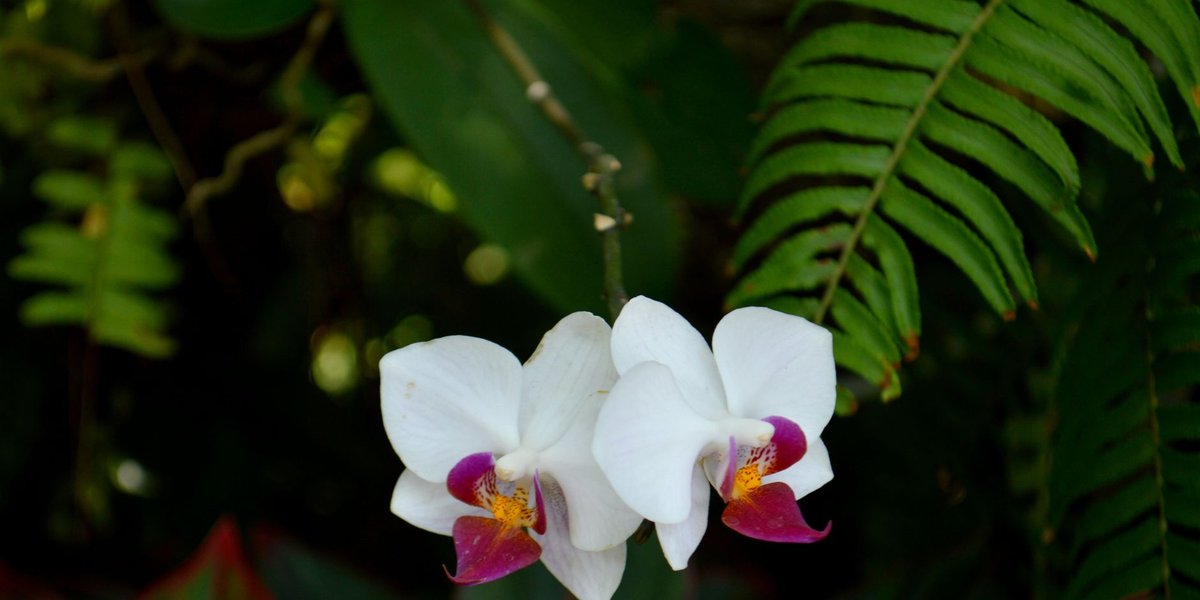
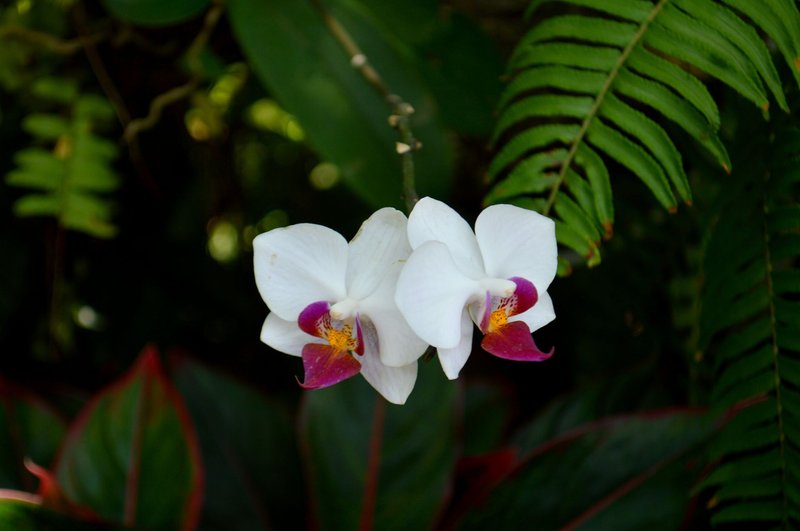
The showcase species is Guarianthe skinneri, the guaria morada — Costa Rica’s national flower since 1939, blooming purple from January through April high in the branches where sunlight actually reaches. It’s one entry in an enormous family: Costa Rica hosts roughly 1,400 orchid species, and about a fifth of those exist only here. Rarer relatives like Cattleya dowiana and Peristeria elata (the “Holy Spirit” orchid, Panama’s national flower but also found in Costa Rican wet forests) share the same canopy real estate but are far harder to spot in the wild.
Bromeliads work the same angle from a different family — their tank-like rosettes of leaves pool rainwater, creating tiny elevated ponds that tree frogs and insects use as nurseries. Epiphytic ferns fill in the gaps. None of this is decoration. It’s a vertical neighborhood competing for the one thing that’s scarce sixty meters up: direct light.
The Understory: Heliconias, Gingers, and the Fight for Light
Drop below the canopy and the light budget changes completely — only a few percent of full sun reaches the understory, and the plants here are built around that constraint rather than despite it.
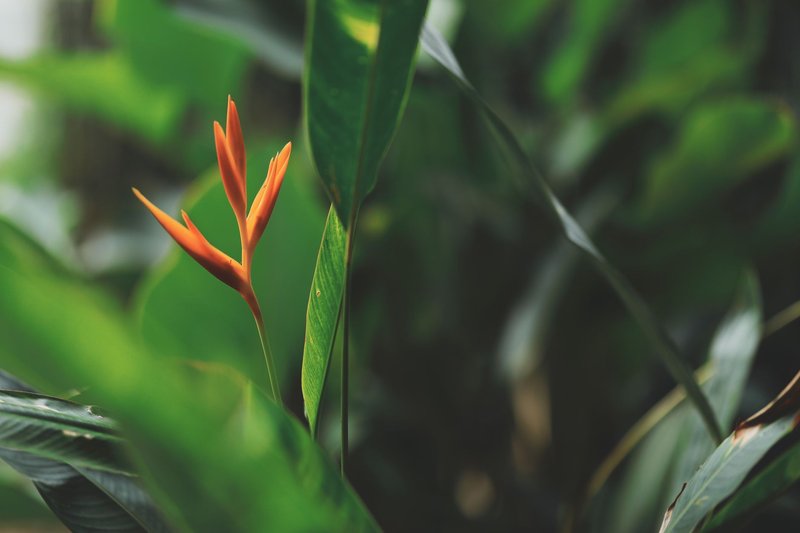
Heliconias are the obvious standout: their waxy, boat-shaped bracts (the red-and-yellow “structures” people photograph aren’t petals, they’re modified leaves) hold nectar that only long-billed hummingbirds like the green hermit can reach, a pairing that evolved together over millions of years. Costa Rica has more than 30 native heliconia species, and they’re genuinely native — unlike a lot of the ginger-family lookalikes sold in nurseries, which are Southeast Asian imports planted because they resemble heliconias without needing the same specific pollinators.
Large-leafed understory plants — native philodendrons and anthuriums among them — solve the light problem differently, growing broad, thin leaves to catch every available photon and often starting life as a vine that climbs a host trunk toward brighter air rather than waiting at ground level.
The Forest Floor: Where the Real Work Happens
The forest floor gets less than 2% of the light hitting the canopy, so the plants down here have mostly given up competing for sun and specialized in other jobs: decomposition, opportunism, and waiting.
Walking palms (Socratea exorrhiza) are the local celebrity — a palm with stilt-like roots that, according to persistent local guiding folklore, let the tree slowly “walk” toward light gaps as old roots die and new ones grow toward brighter ground. Botanists are more skeptical of the walking claim than the guides are, but the stilt-root structure itself is real and does help the palm stabilize in thin, wet soil. Ferns and low, shade-tolerant shrubs fill in around fallen logs, growing fast when a canopy gap opens and a shaft of real sunlight hits the ground, then slowing back down once the gap closes.
This layer is also where most forest regeneration starts. Seeds from canopy trees drop here and sit dormant, sometimes for years, until a falling giant opens a hole in the ceiling above them.
Plants Ticos Actually Use
Long before eco-lodges existed, Costa Rica’s indigenous communities — and later campesino households — built an entire home-pharmacy out of native plants, and a lot of that knowledge is still active today. Researchers have documented over 300 plant species used medicinally across the country, many of them still growing in home gardens rather than deep forest.
Gavilana (Neurolaena lobata), a bitter native shrub, gets brewed into tea as a digestive cleanse and anti-parasitic — a use documented across multiple Central American traditional medicine systems, not just folklore. Cat’s claw (Uncaria tomentosa), a native woody vine named for its curved thorns, shows up in preparations for inflammation. A 2022 study published via the National Institutes of Health cataloging home gardens in Heredia found dozens of medicinal species still in active household use, most passed down rather than learned from a book.
None of this is a suggestion to forage and self-medicate on vacation — dosage and preparation matter, and plenty of native plants are toxic in the wrong quantity. But it’s a reminder that “native plant” in Costa Rica isn’t just a scenic category. It’s a working pharmacy that predates the tourism industry by centuries.
The Impostors: Common Plants That Aren’t From Here
Here’s the section most competitor articles skip entirely, and it’s the one worth reading closest if you actually want to identify what you’re looking at.
The African tulip tree (Spathodea campanulata) is probably the single most-photographed “jungle” tree in Costa Rica, its clusters of orange-red blooms lighting up roadsides and hotel grounds. It’s not native — it was introduced from tropical Africa in the late 1800s, popularized locally through the Lankester Botanical Garden, and it has since been flagged by the IUCN’s Global Invasive Species Database as one of the world’s more aggressive ornamental invaders. The African tulip is just one of many invasive species threatening Costa Rica’s ecosystems, crowding out native regrowth in disturbed forest edges. It’s strikingly beautiful and it is, functionally, a weed.
Bougainvillea, common in fence-line hedges across the country, is native to South America, not Costa Rica. Many of the “tropical ginger” varieties sold as heliconia look-alikes at nurseries trace back to Southeast Asia. Even some palm species planted for their looks around resorts and parking lots — certain fan palms in particular — are imports rather than natives, despite reading as generically “jungle” to a visitor’s eye.
None of this makes these plants bad. It makes them a different story than the one most sites are telling when they caption a photo “lush native Costa Rican flora.”
Where and When to See Them
If you want the real thing rather than the resort-garden version, location and season both matter.
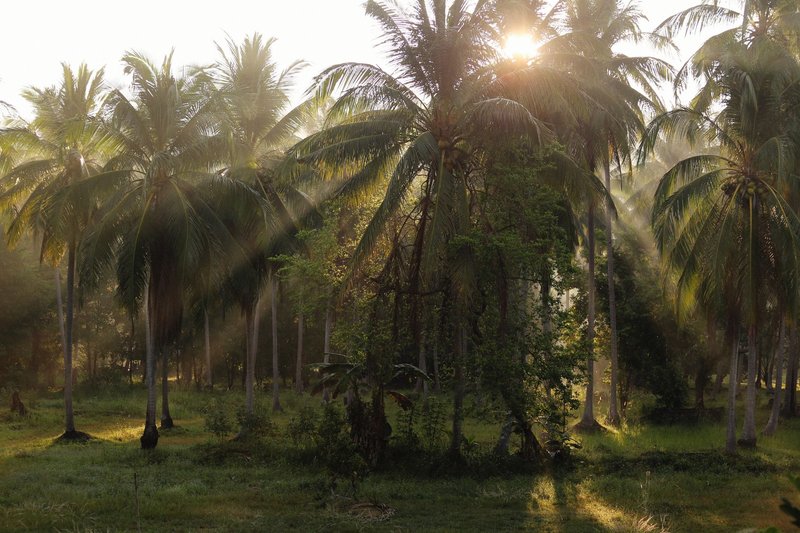
Monteverde, up in the cloud forest, is the best bet for high-elevation epiphyte density — the near-constant mist keeps orchids, bromeliads, and mosses saturated year-round, and the reserve’s cooler temperatures support species you won’t find at sea level. Corcovado National Park, on the Osa Peninsula, is lowland wet forest at its most intact — one of the last sizable stretches of Pacific rainforest in Central America, with old-growth canopy trees and the full layer structure described above still standing. La Selva Biological Station, on the Caribbean slope, is the most research-dense site in the country — decades of botanical fieldwork have happened there, and it’s a strong choice if you want a guided walk where the guide can actually name what you’re looking at down to species.
Timing shifts what’s blooming. Guaria morada peaks January through April. Heliconias flower more consistently but hit their fullest display in the wetter months, May through November, when nectar-feeding hummingbirds are most active. Dry season (roughly December to April) makes hiking easier and photography better lit, but wet season is when the understory is at its most saturated green and the epiphytes are working hardest.
The Short Version
Costa Rica’s plant life sorts itself by where the light lands: epiphytes claiming canopy real estate, heliconias and broad-leafed natives dividing up the dim understory, and forest-floor specialists waiting on the next gap to open. Layer that against a working tradition of medicinal plant use passed down through generations, and against a parallel layer of imported ornamentals — the African tulip trees and bougainvillea that photograph just as well but arrived in a shipping crate, not an ecosystem.
Next time a caption calls something “lush native jungle flora,” it’s worth asking which of those three words is actually doing honest work. Most of the time, at least one of them isn’t.