Table of Contents
- Why Red Birds Are Red
- Male vs. Female: Why the Red Usually Disappears
- 10 Red Birds You Can Actually Identify
- Quick Comparison Table
- How to Attract Red Birds to Your Yard
- What It Means When You See a Red Bird
- FAQ
Why Red Birds Are Red
A red bird didn’t eat something red. It ate something yellow.
Red feathers come from carotenoids, the same pigment class that colors carrots and egg yolks, but birds can’t manufacture them. They pull them from berries, seeds, and insects, then run them through a liver enzyme called CYP2J19 that converts the yellow pigment into a red one before it’s deposited in growing feathers. Researchers identified the gene behind this conversion in 2016, and it explains something birders already suspected: a bird’s diet in the weeks before it molts directly controls how red it turns out. Skimpy carotenoid intake, and a male House Finch molts orange or even yellow instead of red.
That diet-dependence is why the color stuck around as a signal. A male that’s managed to eat well enough to turn fire-engine red is, in effect, advertising that he’s healthy, parasite-free, and good at finding food — which is exactly what a female wants to know before she commits a breeding season to him.
Male vs. Female: Why the Red Usually Disappears
Open a field guide to almost any red species and you’ll find the female pictured a few inches away, in olive, buff, or streaky brown. That’s not an oversight. It’s the same carotenoid economics running in reverse.
Red plumage is expensive to produce and, worse, easy to spot. For a male trying to attract a mate or hold a territory, visibility is the point. For a female who’s going to sit on a nest for two weeks, visibility is a liability — a red female is a red target for a hawk. So sexual selection pushed males toward brightness and pushed females toward camouflage, and in most red species that split is nearly total.
The Northern Cardinal is the exception worth knowing: females aren’t drab. They carry a warm brown body with distinct red highlighting through the crest, wings, and tail, and they’re one of the few female songbirds in North America that sings full, complex song from the nest — likely to coordinate feeding duties with her mate. Most other red species don’t split the difference; the female is simply a different-colored bird.
10 Red Birds You Can Actually Identify
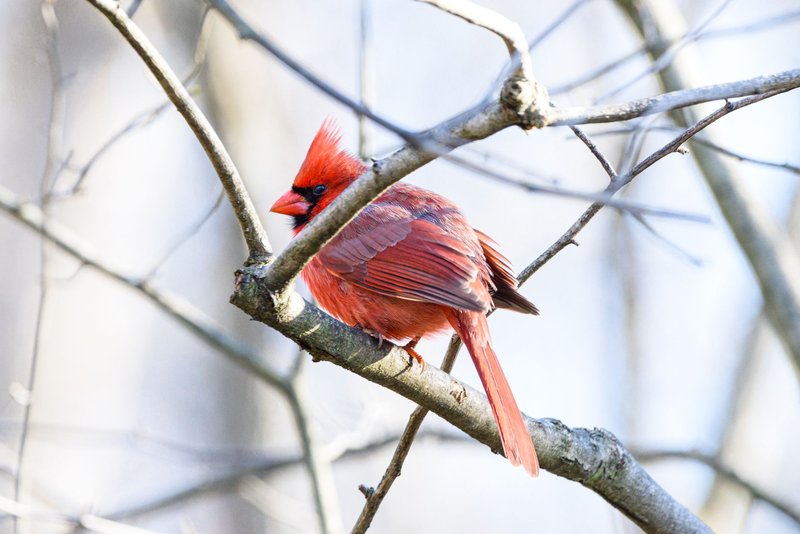
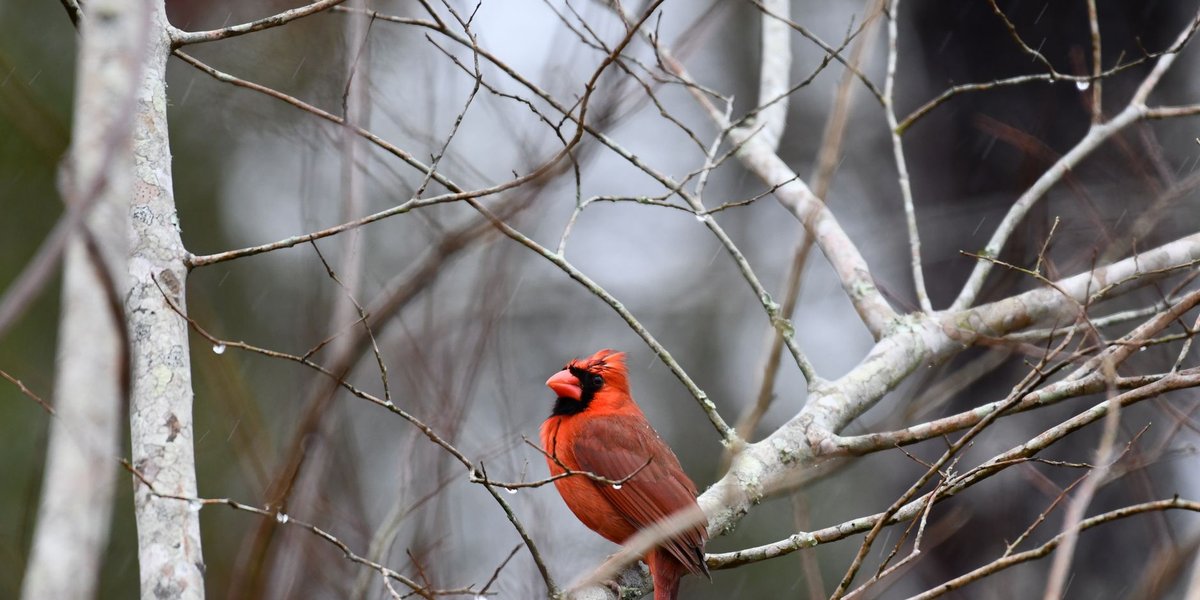
1. Northern Cardinal (Cardinalis cardinalis)
The one everyone already knows, and the baseline every other red bird gets measured against. Solid red body, black mask running from the face to the throat, a crest, and a thick, cone-shaped orange-red bill built for cracking sunflower seeds. Cardinals don’t migrate — the bird at your feeder in January is the same individual (or its offspring) you’ll see in July. Range covers the eastern and central U.S. down through Mexico, and it’s still expanding north as winters warm.
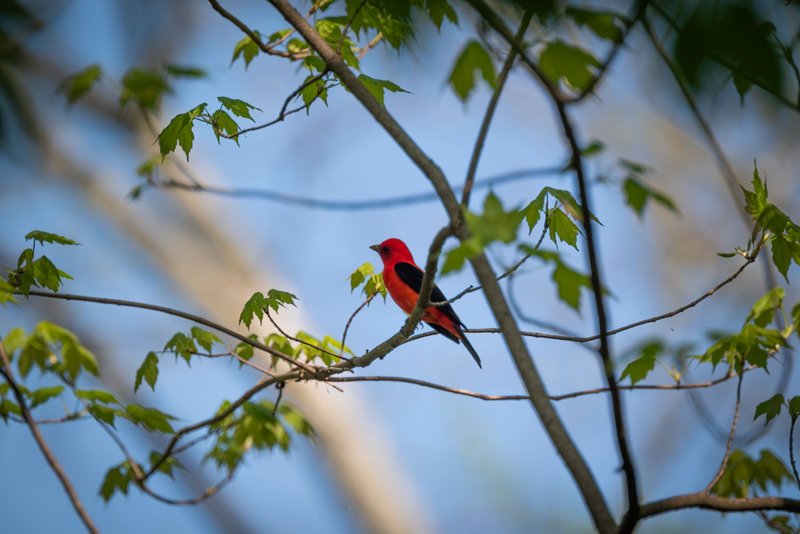
2. Scarlet Tanager (Piranga olivacea)
Breeding males are a red so saturated it looks almost synthetic, set off by wings and tail that are jet black — the contrast is the tell, since nothing else in eastern forests pairs those two colors. They stay high in deciduous canopy, so you’ll hear the raspy, robin-with-a-sore-throat song before you spot the bird. By fall they molt to greenish-yellow with black wings for the flight to the western Amazon, and most people never notice the switch.
3. Summer Tanager (Piranga rubra)
Take the Scarlet Tanager’s red and remove the black — Summer Tanager males are rose-red head to tail, no markings at all, the only entirely red bird in North America. They favor open pine-oak woodlands across the South and have a specialty diet quirk worth knowing: they hunt bees and wasps, and they’ve learned to beat the insect against a branch to knock the stinger loose before eating it.
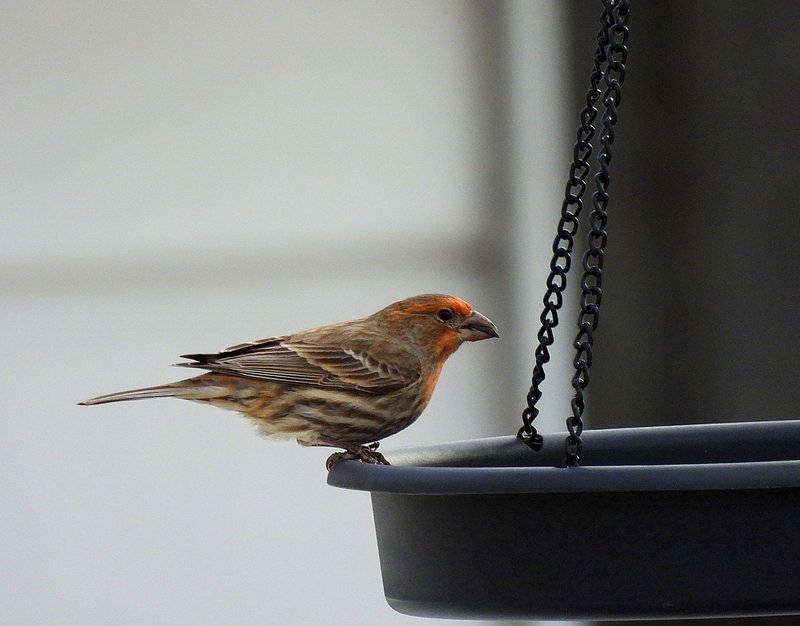
4. House Finch (Haemorhous mexicanus)
The streaky brown finch with a red-washed head, throat, and rump that shows up at nearly every feeder in the continental U.S. Native to the West, but the entire eastern population descends from a batch of caged birds released (illegally sold as “Hollywood Finches”) in New York in 1940. Because their red comes straight from diet, House Finch color is genuinely variable — you’ll spot pale orange and even yellow males in the same flock as deep-red ones, all healthy, just eating different berries.
5. Purple Finch (Haemorhous purpureus)
Roger Tory Peterson described the male as looking “dipped in raspberry juice,” and it’s still the best one-line ID out there. Unlike the House Finch’s patchy red, Purple Finch color washes evenly over the head, breast, and back, giving it a more uniform, saturated look. It prefers coniferous and mixed forest over suburban yards, so a Purple Finch at your feeder is a better day than a House Finch.
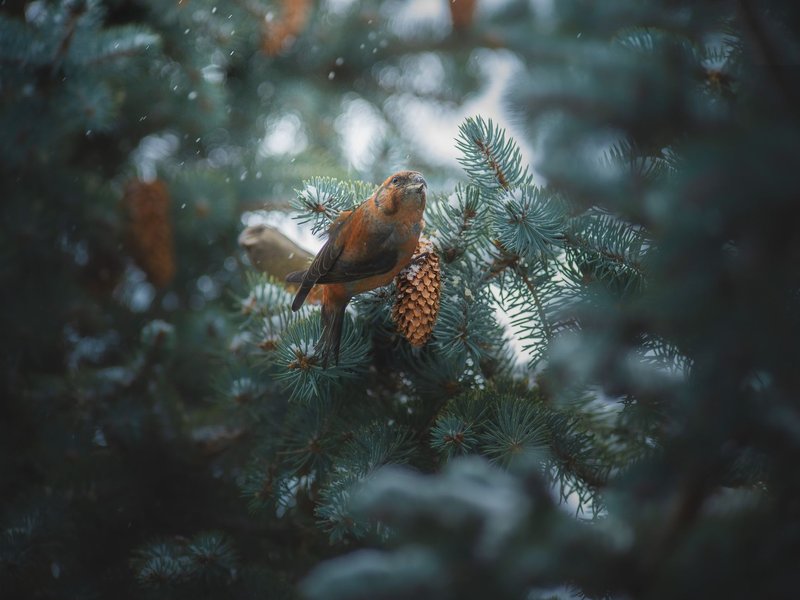
6. Red Crossbill (Loxia curvirostra)
The mandible tips cross past each other — an odd enough bill shape that it’s basically diagnostic on its own — evolved specifically to pry seeds out of closed conifer cones. Males run brick-to-orange-red, and the species is nomadic rather than migratory: flocks chase good cone crops around the continent unpredictably, so the same spot can go years without one and then get flooded with them in a single winter.
7. Pine Grosbeak (Pinicola enucleator)
A big, chunky finch — noticeably larger than the others on this list — with rose-red males and soft gray flanks that mute the color rather than amplify it. It breeds in boreal and subarctic conifer forest and only shows up farther south during irruption winters when northern seed crops fail. Pine Grosbeaks have a reputation for tameness that borders on indifference; birders sometimes get within a few feet before one bothers to move.
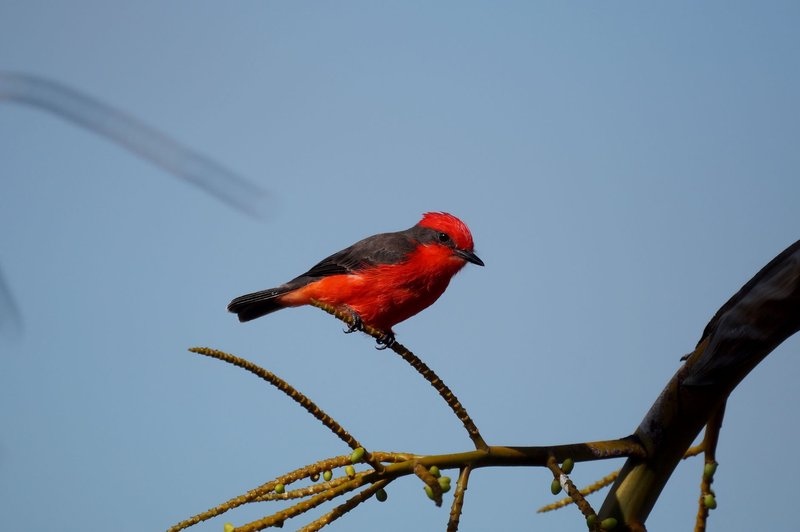
8. Vermilion Flycatcher (Pyrocephalus rubinus)
The most electric red on this list, and the one most likely to make someone stop their car. Males are scarlet through the head and underparts against a dark brown back, wings, and eye-mask. Found in the arid Southwest, from riverside cottonwoods to desert scrub, perched low and sallying out after flying insects before returning to the same twig — a hunting style that makes it one of the easier red birds to actually watch, not just glimpse.
9. Common Redpoll (Acanthis flammea)
A small, energetic arctic finch named for its red cap — “poll” being old English for the top of the head — with some males adding a pink wash across the breast. They breed in the far north and only reach the northern U.S. during irregular irruption years, arriving in loose, chattering flocks that mob nyjer feeders for a few weeks and then vanish.
10. Red-headed Woodpecker (Melanerpes erythrocephalus)
Unmistakable: a fully crimson head against a bold black-and-white body, no gradient, no blending — like someone dipped just the head in paint. Found in open woodlands and farm edges across the eastern and central U.S., it catches insects in flight and caches food in bark crevices for winter, a habit that sets it apart from most other woodpeckers. It’s also one of the steeper decliners on this list; the American Bird Conservancy tracks a population drop of more than 70% since the 1960s, tied mostly to the loss of dead trees for nesting.
Quick Comparison Table
| Species | Range | Size | Signature ID Feature |
|---|---|---|---|
| Northern Cardinal | Eastern/Central US, Mexico | 8.5–9 in | Black face mask, crest |
| Scarlet Tanager | Eastern US (breeding) | 6.5–7 in | Red body, black wings |
| Summer Tanager | Southern US | 7–7.5 in | Solid rose-red, no markings |
| House Finch | Continental US | 5–5.5 in | Streaky brown, red head/rump |
| Purple Finch | Northern US, Canada | 5.5–6 in | Even raspberry wash |
| Red Crossbill | Coniferous forests, nomadic | 5.5–6.5 in | Crossed bill tips |
| Pine Grosbeak | Boreal Canada, N. US in winter | 8–10 in | Large size, gray flanks |
| Vermilion Flycatcher | Southwest US | 5.5–6 in | Scarlet head/underparts |
| Common Redpoll | Arctic, irruptive south | 5–5.5 in | Red cap only |
| Red-headed Woodpecker | Eastern/Central US | 7.5–9.5 in | Solid red head, no gradient |
How to Attract Red Birds to Your Yard
Cardinals are the easiest win, and the trick is the feeder, not just the seed. They’re heavy birds and clumsy on hanging perches, so a platform or hopper feeder loaded with black-oil sunflower or safflower seed outperforms a tube feeder every time. Safflower has a bonus: cardinals and finches eat it readily, but squirrels and grackles mostly leave it alone.
For the finches — House, Purple, and Redpoll alike — nyjer seed in a fine-mesh sock feeder is the standard, though House Finches will happily hit a regular sunflower feeder too. Crossbills and Pine Grosbeaks are a different game: they follow conifer seed crops, not backyards, so the real move is planting or living near spruce, pine, or fir rather than expecting a feeder to pull them in.
Tanagers and the Vermilion Flycatcher barely touch seed feeders at all — they’re insect and fruit specialists. Audubon’s guidance on attracting birds points to native fruiting shrubs — serviceberry, elderberry, dogwood — as the better investment, since they draw the insects tanagers hunt and supply the berries that fuel a red molt in the first place. Skip the pesticides if you want them to stay; a lawn with no bugs is a lawn tanagers fly straight over.
A birdbath or shallow water source pulls in nearly everything on this list regardless of diet, and it’s often the single cheapest upgrade a yard can make.
What It Means When You See a Red Bird
The folklore around red birds, cardinals especially, runs deep and mostly predates any of the science above. The most common version circulating today — “when a cardinal appears, a loved one is near” — traces to a grief-poem verse that’s been passed around for decades, and it’s stuck hard enough that cardinal imagery shows up on sympathy cards and memorial gifts as a kind of shorthand.
Older sources go further back. Several Native American traditions, including some Cherokee teachings, associate the cardinal with good fortune, vitality, or a coming change, often tied to its status as one of the only birds that stays bright red through a gray winter — visible when almost nothing else in the landscape is. In Christian symbolism, the color connects to sacrifice and renewal, which is part of why cardinals became fixtures of Christmas cards long before Hallmark existed.
None of that requires belief to enjoy. Whatever you make of it, a cardinal against snow is one of the more reliably arresting sights in a backyard, which is probably the real reason the symbolism took hold in the first place.
FAQ
Is every red bird a cardinal? No — the Northern Cardinal is just the most familiar and widespread. Scarlet and Summer Tanagers, House and Purple Finches, Vermilion Flycatchers, and several others are entirely unrelated species that happen to share the color.
Why is my male cardinal orange instead of bright red? Diet. Carotenoid intake before and during molt directly determines saturation, and it varies by individual and by what’s locally available that season. It’s not a sign of illness on its own, though chronically pale color can indicate a bird that’s struggling to find enough food.
Do female cardinals ever show red? Yes, more than most red species’ females. Female cardinals are warm brown overall but carry noticeable red in the crest, wings, and tail — nowhere near as saturated as males, but far from drab.
What’s the rarest red bird likely to show up in North America? Among regulars, Vermilion Flycatcher and Red Crossbill are the least predictable — the flycatcher because its range barely clips the southern border states, the crossbill because it goes wherever the cone crop is. True rarities like Scarlet Ibis occasionally get reported but are almost always escapees, not wild vagrants.
Can a bird’s red color change within its lifetime? Yes. Because the pigment is diet-dependent and rebuilt at every molt, the same individual can be noticeably brighter in a good berry year and duller the next, with no change in health.