Table of Contents
- Are White Snakes Really White?
- Albino vs. Leucistic: How to Tell Them Apart
- White Snakes in the Wild
- Popular White Snake Morphs You Can Own
- The “White Rattlesnake” and “White Oak Snake” Are Trick Questions
- The Legend of the White Snake
- FAQ: White Snakes
TLDR
White snakes exist, but “white snake” isn’t a species — it’s a genetic condition layered on top of an existing species. Albinism strips out melanin and leaves red or pink eyes; leucism blocks pigment cells more broadly and usually leaves the eyes blue or black. Wild examples turn up as one-off mutations in kingsnakes, rat snakes, and garter snakes, while breeders have locked the trait into predictable pet morphs like the snow corn snake and the blue-eyed leucistic ball python. Two names that sound like they belong on this list — the “white rattlesnake” and the “white oak snake” — don’t. Those are just old regional nicknames for snakes that aren’t white at all.
Are White Snakes Really White?
Here’s the thing nobody says plainly: there’s no such species as “the white snake.” Every white snake you’ll ever see is a normally-colored species — a corn snake, a ball python, a kingsnake — expressing a pigment mutation. Strip the search results down and you get two real phenomena wearing the same white coat: albinism and leucism. They look similar from across a terrarium and get treated as interchangeable online. They’re not.
Both conditions interfere with how a snake produces or distributes pigment, but they hit different machinery. That distinction is the difference between a $40 corn snake at a reptile expo and a $2,000 designer ball python, and it’s also why one snake handles daylight fine while another needs its enclosure lit like a submarine.
Albino vs. Leucistic: How to Tell Them Apart
Check the eyes first. That’s the fastest tell breeders use, and it works almost every time.
Albinism is the absence of melanin production, caused by a mutation in the enzyme pathway (usually tyrosinase) that makes that pigment. No melanin means no dark pigment anywhere it would normally show up — including the eyes, where the blood vessels behind the iris show through as pink or red. Albino snakes often keep other pigments like yellows and oranges, which is why an albino corn snake reads more cream-and-orange than pure white.
Leucism, on the other hand, is a broader failure of pigment cells to migrate or develop properly across the skin, while the eyes usually keep their own coloring — typically blue, sometimes black. A leucistic snake can be solid white with zero pattern, or it can carry patches of normal color where pigment cells did make it through. That patchiness is the giveaway leucism gives you that albinism generally doesn’t.
There’s a third look-alike worth knowing: hypomelanism, a partial reduction in dark pigment that produces a lighter, washed-out version of the normal pattern rather than true white. Breeders combine it with other genes constantly, so you’ll see it in morph names even when the snake isn’t white at all.
White Snakes in the Wild
Truly white snakes are rare outside of captive breeding, for a simple reason: pigment isn’t cosmetic, it’s camouflage. A leucistic or albino snake in the wild is easier for hawks and coyotes to spot and easier for prey to spot coming, so the trait usually gets weeded out fast. When wild white snakes do show up, they make local news.
California kingsnakes, black rat snakes, and common garter snakes are the species most frequently documented with wild leucism or albinism, usually as single individuals rather than stable populations. A few isolated pockets buck that trend — the most famous being a small colony of leucistic eastern diamondback and timber rattlesnakes discovered in South Carolina, protected specifically because the mutation is so uncommon in a free-living population. Herpetologists monitor sightings like these because a wild white snake surviving to adulthood is itself a small data point about local predation pressure.
Popular White Snake Morphs You Can Own
The pet trade solved the “how rare is a white snake” problem decades ago, by breeding for it deliberately. Three morphs dominate:
Snow corn snake — a corn snake homozygous for both the amelanistic (albino) and anerythristic (no red/orange pigment) genes at once. Strip out both and you get a nearly pure white snake with red or pink eyes and, often, a faint ghost pattern still visible. It’s one of the most accessible white morphs in the hobby and a common first “designer” corn snake for new keepers.
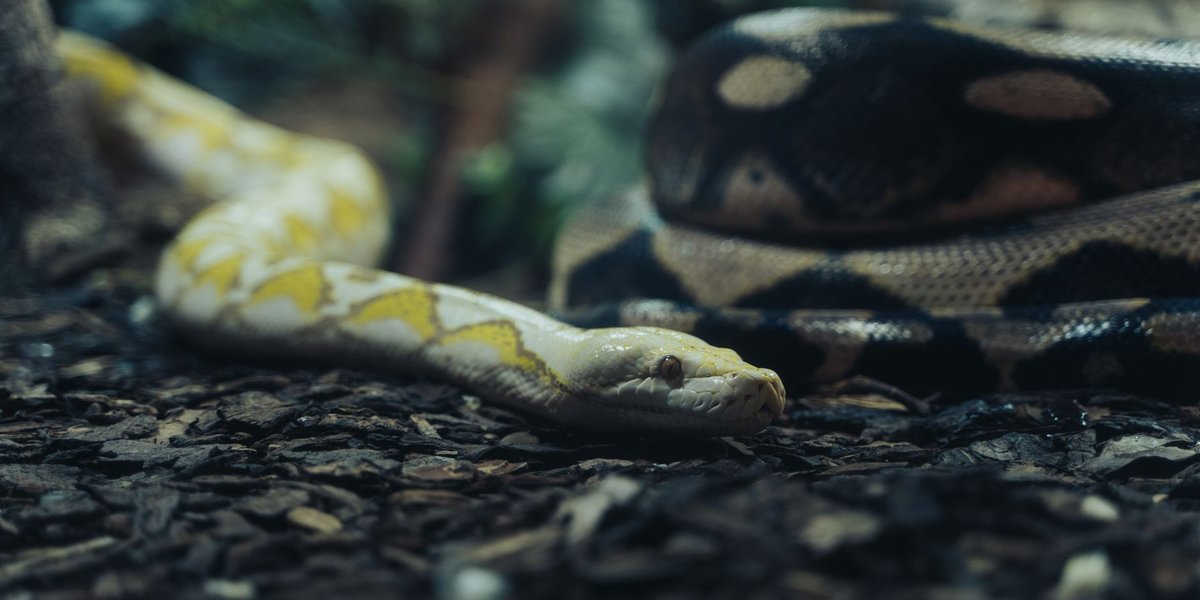
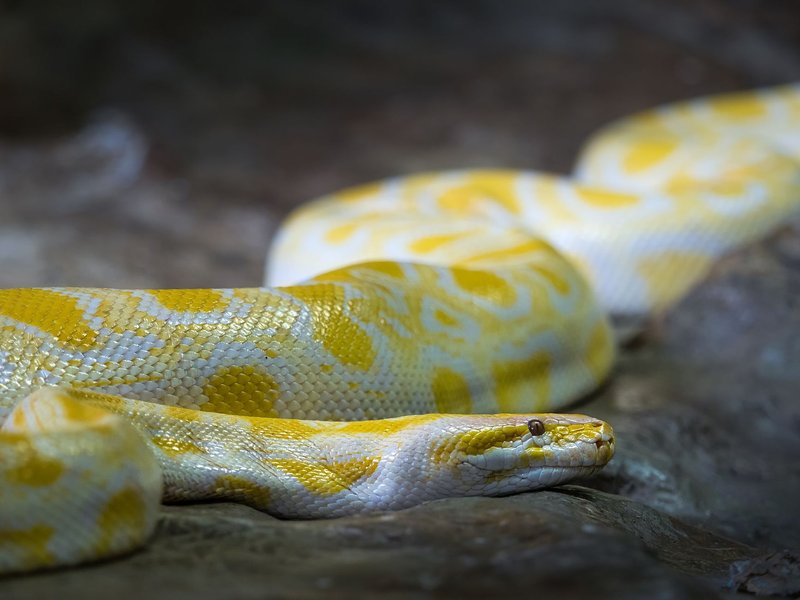
Albino Burmese python — a striking yellow-and-white combination rather than pure white, since Burmese pythons carry strong yellow pigmentation that albinism doesn’t remove. Still frequently sold under “white python” search terms because of how pale the base color reads.
Leucistic ball python — bred in a few genetic combinations, the best known being the blue-eyed leucistic (BEL), which pairs solid white skin with striking pale blue eyes. BELs are among the most sought-after ball python morphs specifically because the color combination doesn’t occur outside of deliberate line breeding.
None of these morphs occur reliably without human intervention. Breeders pair known carriers over multiple generations to lock in recessive genes, which is also why snow corns and BELs cost more than their normally-patterned counterparts — you’re paying for generations of selective pairing, not just a color.
The “White Rattlesnake” and “White Oak Snake” Are Trick Questions
If you landed here after hearing either of these names, the honest answer is: neither snake is white.
“White rattlesnake” is a regional common name for the speckled rattlesnake (Crotalus mitchellii), a venomous pit viper native to the southwestern United States and northern Mexico. It earns the nickname from a pale, sandy base color that can look almost bleached against desert rock — not from any albinism or leucism. It’s camouflage, not a pigment mutation.
“White oak snake” is an old folk name for the copperhead (Agkistrodon contortrix), used in parts of the southeastern U.S. because copperheads are often found near white oak trees and share a similar mottled bark-like coloring. Again — venomous, patterned, and not remotely white. Wikipedia’s entries on both names are little more than disambiguation stubs, which is exactly why the confusion persists: there’s nowhere online that actually explains what these nicknames refer to and why they’re misleading.
The practical takeaway: if you’re trying to identify a snake you saw and someone called it a “white rattlesnake” or “white oak snake,” you’re looking for a speckled rattlesnake or a copperhead — both venomous, neither white.
The Legend of the White Snake
Long before geneticists had words like “leucism,” white snakes were already loaded with meaning. In Chinese folklore, the Legend of the White Snake (Bai Suzhen) is one of the Four Great Folktales, dating back over a thousand years. A white snake spirit takes human form, falls in love with a mortal man, and is ultimately hunted by a monk who sees her true nature as a threat to be contained rather than a life to be respected. The story has been retold in opera, film, and television across China for centuries, and it’s still one of the most recognizable folk narratives in East Asian culture, according to Google Arts & Culture’s overview of the legend.
The symbolism runs deeper than a monster story. Bai Suzhen represents nature, feminine autonomy, and desire pushing against rigid social and religious order — the snake isn’t cast as inherently evil, but as something powerful that authority figures feel compelled to control. That’s part of why the tale has aged into a more sympathetic retelling over centuries rather than fading as a simple cautionary myth. In broader Chinese symbolism, white animals in general — white snakes, white deer, white tigers — are often read as omens of transformation or spiritual significance, precisely because their coloring is rare enough to feel supernatural.
FAQ: White Snakes
Are white snakes rare? In the wild, yes — genuinely rare, since the mutation that produces them also strips away camouflage. In captivity, no — decades of selective breeding have made morphs like the snow corn snake affordable and common in the pet trade.
Are white snakes venomous? Depends entirely on the species underneath the color, not the color itself. A snow corn snake is non-venomous; an albino or leucistic version of a venomous species would still be venomous. Color is not a safety indicator — never assume a pale snake is harmless.
Do albino snakes have worse eyesight? Many keepers report albino snakes appear more light-sensitive, likely tied to the same pigment absence affecting the eyes, though snakes generally rely more on heat-sensing and chemical cues (via their tongue and Jacobson’s organ) than sharp vision regardless of color morph.
Can two normal-colored snakes produce a white offspring? Yes, if both parents carry the recessive gene without expressing it. That’s exactly how breeders produce predictable white clutches — pairing two visually normal snakes that are both known “het” (heterozygous) carriers.
Are leucistic snakes healthier or weaker than normally colored ones? The mutation itself doesn’t inherently cause health problems, but line-bred morphs occasionally carry linked issues (some ball python leucistic lines have documented neurological wobble in certain genetic combinations), which is why buying from a reputable breeder who can speak to lineage matters more than the color itself.