TLDR
Philippine tarsiers are the only fully carnivorous primates on Earth. They eat live insects almost exclusively — crickets, beetles, moths, ants, grasshoppers, cicadas — and occasionally ambush small vertebrates like lizards, birds, and bats. A tarsier can eat 10 to 12 grams of prey a night, roughly matching a tenth of its own body weight, with pregnant females eating close to double. Nothing about that diet survives a cage well, which is a big part of why captive tarsiers so rarely do either.
Table of Contents
- A Primate That Eats Nothing but Meat
- What’s Actually on the Menu
- How a 120-Gram Animal Hunts
- How Much a Tarsier Eats in a Night
- Diet, Breeding, and the Insect Calendar
- Why the Diet Is the Reason Tarsiers Die in Captivity
A Primate That Eats Nothing but Meat
Every other primate on the planet, from the smallest mouse lemur to the largest gorilla, eats some combination of fruit, leaves, seeds, or bark. The Philippine tarsier eats none of it. Not a leaf, not a berry, not a stray fig dropped by a hornbill overhead. Its digestive system simply isn’t built to process plant matter, which makes it the only primate classified as a true carnivore rather than an omnivore or folivore.
That’s not a matter of preference. Offer a tarsier fruit and it will ignore it entirely, the same way a housecat ignores a salad. Everything it eats has to have been alive moments before it eats it.
What’s Actually on the Menu
The bulk of a Philippine tarsier’s diet is insects, and it’s not picky about which ones as long as they’re moving. Crickets, cicadas, beetles, moths, ants, and grasshoppers make up the everyday catch. According to the Animal Diversity Web, a University of Michigan zoology database, tarsiers will also take termites and butterflies when they’re available in numbers.
Beyond insects, a hungry tarsier trades up when the opportunity presents itself. Small vertebrates are fair game: skinks and geckos, nestling birds, and — in one of the more startling documented behaviors for an animal this size — small bats snatched out of midair as they pass. A tarsier weighing around 120 grams taking down a bat isn’t a fluke; it’s a predator using exactly the tools evolution gave it, abilities that set it apart from virtually every other living primate.
How a 120-Gram Animal Hunts
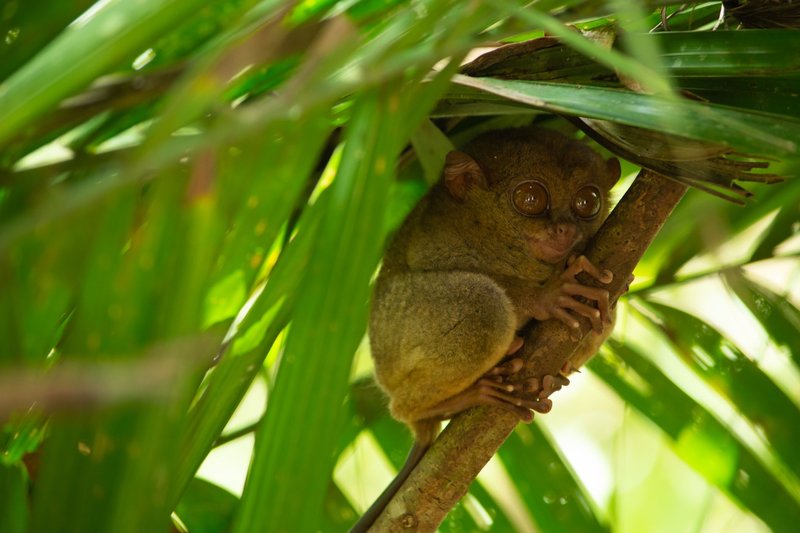
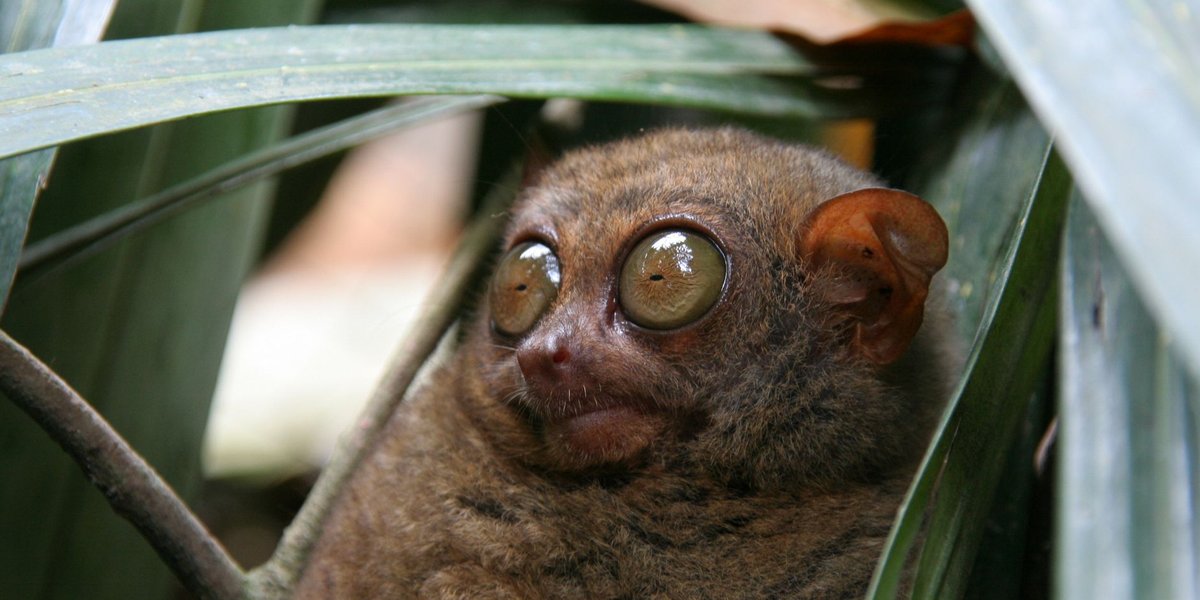
A tarsier’s eyes are each roughly the size of its brain — proportionally the largest eyes of any mammal — and they’re fixed in the skull, unable to swivel. To compensate, the tarsier can rotate its head almost 180 degrees in either direction, scanning the forest floor and understory without moving its body and giving away its position.
Once it locks onto movement, the hunt is fast and almost entirely silent. A tarsier sits motionless on a vertical branch, ears constantly rotating independently of each other to triangulate the faint rustle of an insect in leaf litter. When it strikes, it leaps — tarsiers can cover distances more than 40 times their own body length in a single jump, powered by legs proportionally longer than a frog’s — and lands on the prey with both hands, pinning it before it can react. The kill is usually a bite to the head or thorax, delivered in the same motion as the landing. There’s no chase, no second attempt. It’s ambush and seizure, over in under a second.
How Much a Tarsier Eats in a Night
Because tarsiers are nocturnal and rarely observed feeding in the wild, most of what’s known about intake comes from captive studies and field notes rather than large-scale wild surveys — but the numbers that exist are striking. A typical adult eats somewhere around 10 to 12 grams of food per night. That sounds small until you weigh it against the animal doing the eating: a Philippine tarsier averages about 120 grams, meaning a normal night’s meal runs close to a tenth of its body weight, with some individual feeding bouts reported at closer to half. Pregnant females eat roughly double the standard amount, which tracks with the energy cost of gestation in an animal this size.
For comparison, a 70-kilogram human eating at the same relative rate would need to put away 7 kilograms of food in a single sitting — about 15 pounds. Tarsiers don’t graze through the night; they hunt in short, high-effort bursts and then rest, conserving energy between kills.
Diet, Breeding, and the Insect Calendar
Tarsier reproduction isn’t spread evenly across the year — it clusters around the seasons when insect populations spike, particularly at the start of the rainy season when the forest floor fills with newly hatched crickets, moths, and beetles. Mating and births track closely with that surge, which makes sense for an animal that can’t store fat reserves the way a fruit-eating primate can. A tarsier’s body is built for a lean, high-turnover metabolism, not for coasting through a lean season on stored energy, so reproduction has to line up with when live prey is abundant enough to support a nursing female.
This is one of the clearer examples in the animal kingdom of diet directly setting a reproductive calendar — not water availability, not day length, but simply where the bugs are.
Why the Diet Is the Reason Tarsiers Die in Captivity
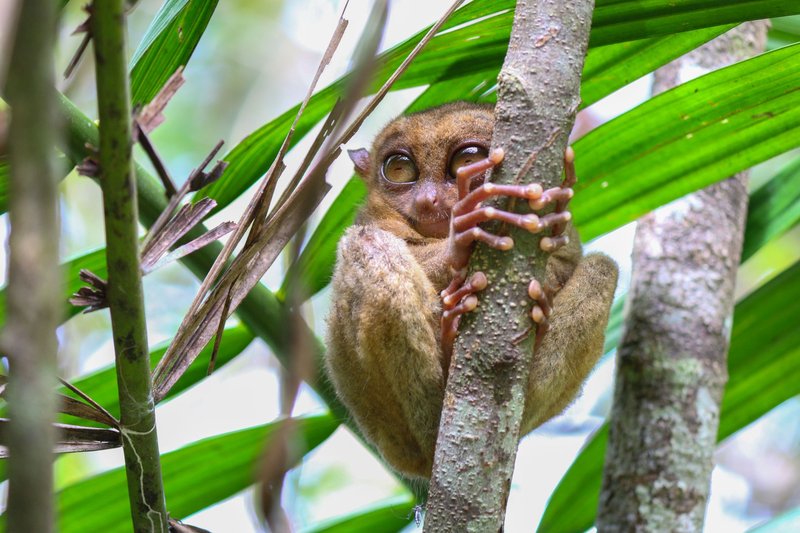
Philippine tarsiers have a well-earned reputation as one of the worst primates to keep in captivity, and it’s not because they’re aggressive or hard to handle physically. It’s because almost nothing about a cage matches what their biology expects.
The diet is the core of the problem. A captive tarsier needs a constant supply of live, varied insect prey — not dead crickets from a pet store bin, not fruit, not the commercial primate chow that works for nearly every other captive primate on Earth. Zoos and rescue centers that have tried to keep tarsiers report chronic difficulty sourcing enough live prey variety to prevent nutritional deficiencies, and animals on inadequate diets show weakened bone density and poor coat condition within weeks.
Layered on top of that is a stress response that’s become the animal’s grim claim to fame. Tarsiers are so sensitive to captivity that they’ve been documented smashing their heads against enclosure bars and branches, pulling out their own fur, and refusing food entirely when exposed to bright light, camera flashes, loud noise, or handling by tourists. Their skulls are thin and their bodies are built for speed rather than durability, so a stress-driven collision that a larger animal would shrug off can be fatal. Combine that fragility with a diet that’s almost impossible to fully replicate, and the result is a species with essentially no successful history of long-term captive breeding — animals that survive transport often decline within months.
It’s part of why the International Union for Conservation of Nature lists the Philippine tarsier as Near Threatened rather than a candidate for captive-breeding conservation programs the way pandas or condors have been. For this species, the forest isn’t just habitat. It’s the only place its diet actually works.
If you’re planning to see one in Bohol or elsewhere in the southeastern Philippines, the respectful version of that encounter is a sanctuary that keeps visitors quiet, flash-free, and at a distance — which, not coincidentally, is also the version that gives the tarsier the best shot at catching its next cricket in peace.