Short answer: On dog clipper blades, the higher the number, the shorter the cut. A #10 blade leaves about 1/16 inch (1.5 mm) and is the standard for sanitary areas, ears and paw edges. A #7F leaves 1/8 inch, a #5F leaves 1/4 inch and a #4F leaves 3/8 inch, which covers most short body clips. For an inch or more of coat, snap a comb attachment over a #30 or #10 blade.
The numbers confuse almost everyone at first, because they run backward: a #40 shaves almost to the skin and a #3F leaves half an inch. The most common home-grooming mistake is grabbing a #10 for the whole body and ending up with a dog that looks shaved. The chart below gives the length each blade leaves, then covers finish-cut versus skip-tooth blades, comb attachments, blades by breed and how clipping direction changes the result.
This article contains Amazon affiliate links. Florafaunafun earns a commission on qualifying purchases. See our affiliate disclosure.
Dog clipper blade size chart
These are the standard detachable blades (the A5 snap-on type) that fit most professional and home clippers from Andis, Oster and Wahl. Andis and Oster print the same lengths; Wahl’s own blades run a little longer on the close sizes and a little shorter on the long ones, so they get their own column.
| Blade | Length left | mm (Andis, Oster) | Wahl blade (mm) | Common uses |
|---|---|---|---|---|
| #50 | 1/125″ | 0.2 | 0.4 | Surgical prep at the vet only |
| #40 | 1/100″ | 0.25 | 0.6 | Surgical prep; ultra-close detail work for experienced groomers |
| #30 | 1/50″ | 0.5 | 0.8 | Base blade under comb attachments; poodle faces and feet |
| #15 | 3/64″ | 1.2 | 1.5 | Paw pads, poodle face and feet, schnauzer and cocker ears |
| #10 | 1/16″ | 1.5 | 1.8 | Sanitary trim, belly, ears, heads; base blade for combs |
| #9 | 5/64″ | 2 | 2 | A slightly longer, gentler alternative to the #10 |
| #8.5 | 7/64″ | 2.8 | 3 | Close body work between a #9 and a #7F |
| #7F | 1/8″ | 3.2 | 3.8 | Short body clip; standard blade for shaving out mats |
| #5F | 1/4″ | 6.3 | 6 | Short body clip on terriers, spaniels, poodles |
| #4F | 3/8″ | 9.5 | 8 | Fuller short body clip, short puppy trim |
| #3F (Andis #3 3/4FC) | 1/2″ | 13 | 10 | Longest standard body blade; plush trims, doodle bodies |
| 5/8″ HT, 3/4″ HT (Andis) | 5/8″, 3/4″ | 16, 19 | n/a | Long legs and bodies without a comb |
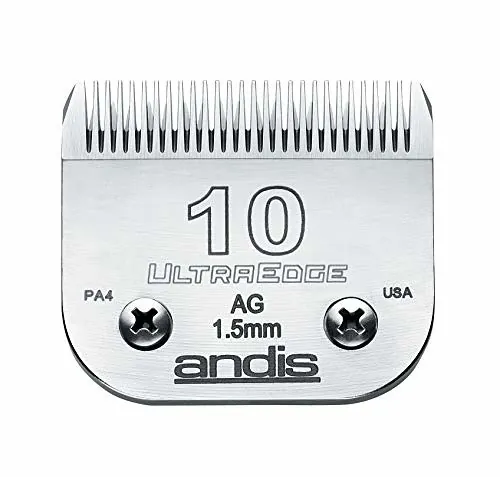
Andis also sells in-between sizes: a #6FC at 3/16 inch, a #4.5FC at 5/16 inch and a #3.5 at 3/8 inch. Andis has no “3F”; its 1/2-inch blade is the #3 3/4FC. Wide blades (#10W, 5/8 inch Wide-Toe) cut a wider path for big dogs, and their length is not the same as the standard blade of the same number, so read the stamp.
Which blade leaves the length you want
Start from the coat length you want on the dog, then pick the blade or blade-and-comb combination. No detachable blade leaves a full inch; past about 3/4 inch you need a comb attachment or scissors.
| Length you want | Blade or setup |
|---|---|
| Shaved to the skin | #40 or #50, which is a vet job (surgery prep) |
| About 1/16″ (very short) | #10 |
| 1/8″ | #7F |
| 3/16″ | Andis #6FC, or #7F clipped with the grain |
| 1/4″ | #5F |
| 3/8″ | #4F |
| 1/2″ | #3F (Andis #3 3/4FC) |
| 5/8″ to 3/4″ | Andis 5/8″ or 3/4″ HT blade, or a #30 with a 5/8″ or 3/4″ comb |
| 1″ | #30 (or #10) with a 1″ comb |
| 1 1/4″ to 2″ | #30 with a 1 1/4″ comb, then scissors |
What “F” means: finish-cut vs skip-tooth blades
The F stands for finish (Andis writes FC, for finish cut). A finish-cut blade has evenly spaced teeth and leaves a smooth, even coat. A skip-tooth blade of the same number leaves the same length but has wider gaps between some teeth, so it pushes through thick or tangled coat faster and leaves a rougher finish.
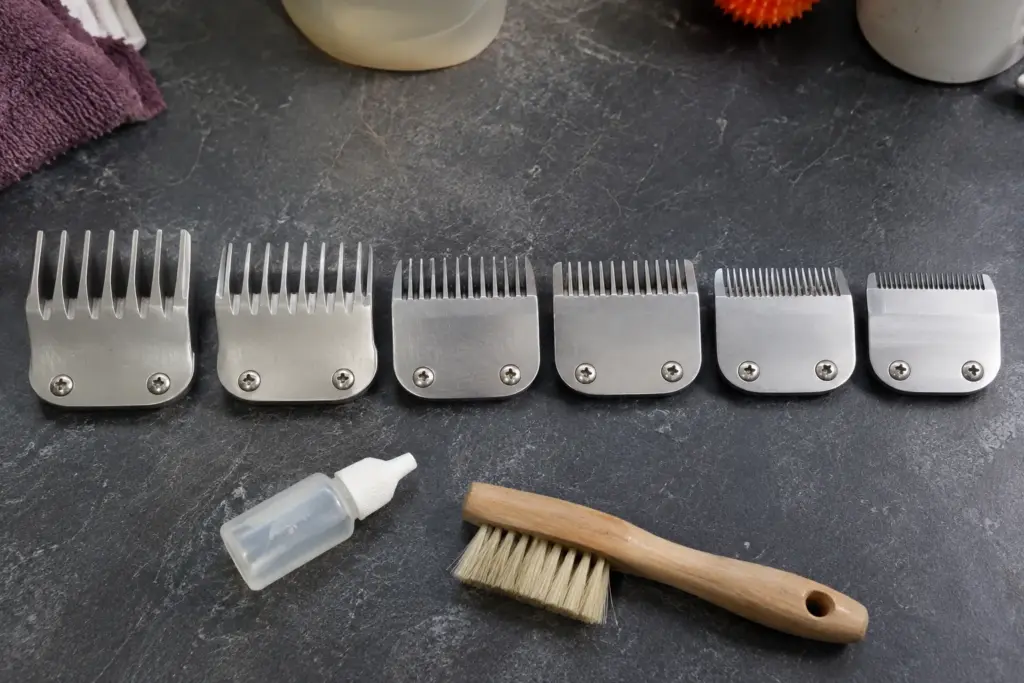
Skip-tooth teeth can catch loose skin in armpits, the groin, folds and ear edges. Keep the skin taut with your free hand, and save skip-tooth blades for flat areas like the back and sides. Andis warns against using them on cats at all. For a home groomer with one clipper, the F blades are the better buy.
Comb attachment sizes
Snap-on comb attachments (also called guard combs or universal combs) clip onto a short blade and hold it off the skin, so the clipper leaves the comb’s length instead of the blade’s. They are how groomers get a puppy cut of an inch or more with a clipper. Oster’s combs fit #10, #15 and #30 blades; Andis lists #9 through #30 for its small set. A #30 is the usual base blade.
| Comb set | Lengths | Fits |
|---|---|---|
| Andis small set (9 combs) | 1/16″ to 9/16″ in 1/16″ steps | #9, #10, #15, #30 blades |
| Andis large set (8 combs) | 5/8″, 11/16″, 3/4″, 13/16″, 7/8″, 15/16″, 1″, 1 1/4″ | #10 to #30 blades |
| Oster stainless set (10 combs) | Fractional sizes; the 3/8″ comb finishes like a #4F blade, the 1/2″ like a #3F | #10, #15, #30 blades |
| Wahl numbered combs (UK) | No. 1 = 3 mm up to No. 8 = 25 mm | Wahl clippers |
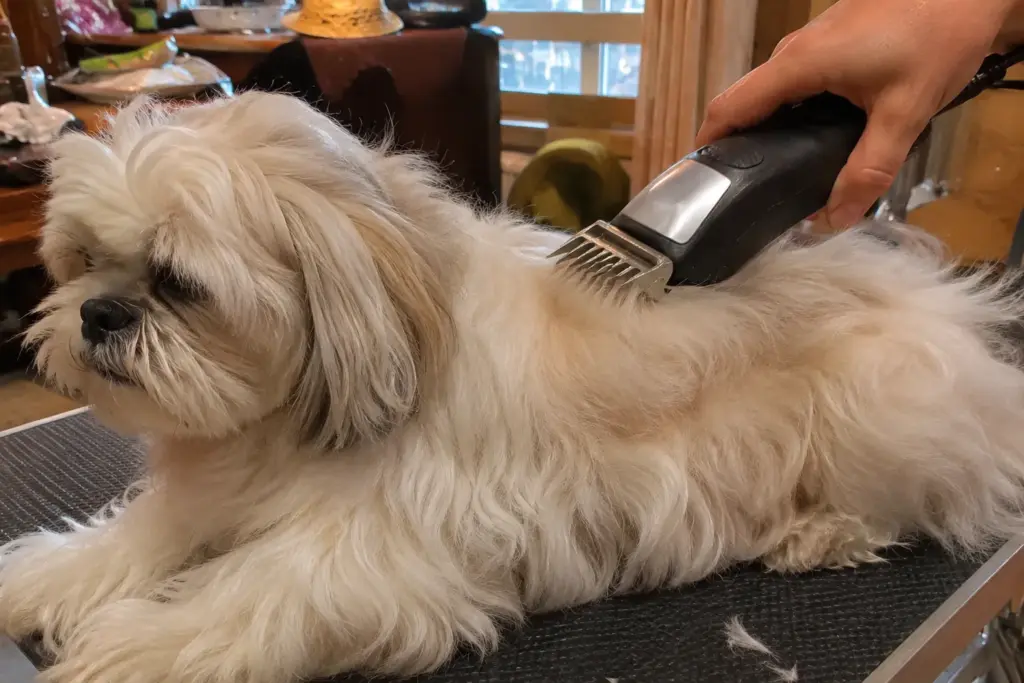
Metal combs hold their shape in thick coats better than plastic ones. A stainless steel snap-on comb set that matches your blade type covers most home trims. Comb numbers like #0, #1A or #1.5 belong to human hair clippers, not dog blades, so ignore them when reading a dog chart. Combs work best on a clean, brushed-out coat; they skip over mats and lift out of tangles.
Blade sizes by breed
These are the manufacturer breed charts from Andis, Oster and Wahl, condensed. They are starting points for a pet trim; go one size longer for a fluffier look or if your dog has sensitive skin. Pads take a #15 and sanitary areas a #10 on every breed.
| Breed | Body | Face, head, ears | Notes |
|---|---|---|---|
| Poodle (kennel or summer clip) | #7F, #5F or #4F | Face, feet, base of tail #10 or #15 (#30 for a close show look) | Legs often #30 with a 3/4″ or 1″ comb |
| Shih Tzu | Puppy trim #30 + 1″ comb; short trim #4F or #3F | Scissors | Head, tail and ears by hand |
| Maltese, Yorkie | Puppy trim #30 + 1″ comb; short trim #4F | Ears #10 | Silky terrier: 3/4″ comb |
| Schnauzer | #7F, #5F or #4F | Head, ears, cheeks, throat #10 | Leg furnishings and beard: comb or scissors |
| Cocker spaniel | #7F, #5F or #4F | Face, ears, throat #10 or #15 | Feathering on legs by scissors |
| Bichon | Pet trim #4F or #3F | Head #30 + 3/4″ to 1 1/4″ comb | Round head is shaped with scissors |
| Doodles, curly mixes | #4F or #3F | Teddy bear face #3F or #30 + 3/4″ to 1″ comb; poodle face #10 | Tail by scissors |
| Double coats (husky, golden, Pomeranian) | Do not clip short | Tidy with scissors | Sanitary and pads only |
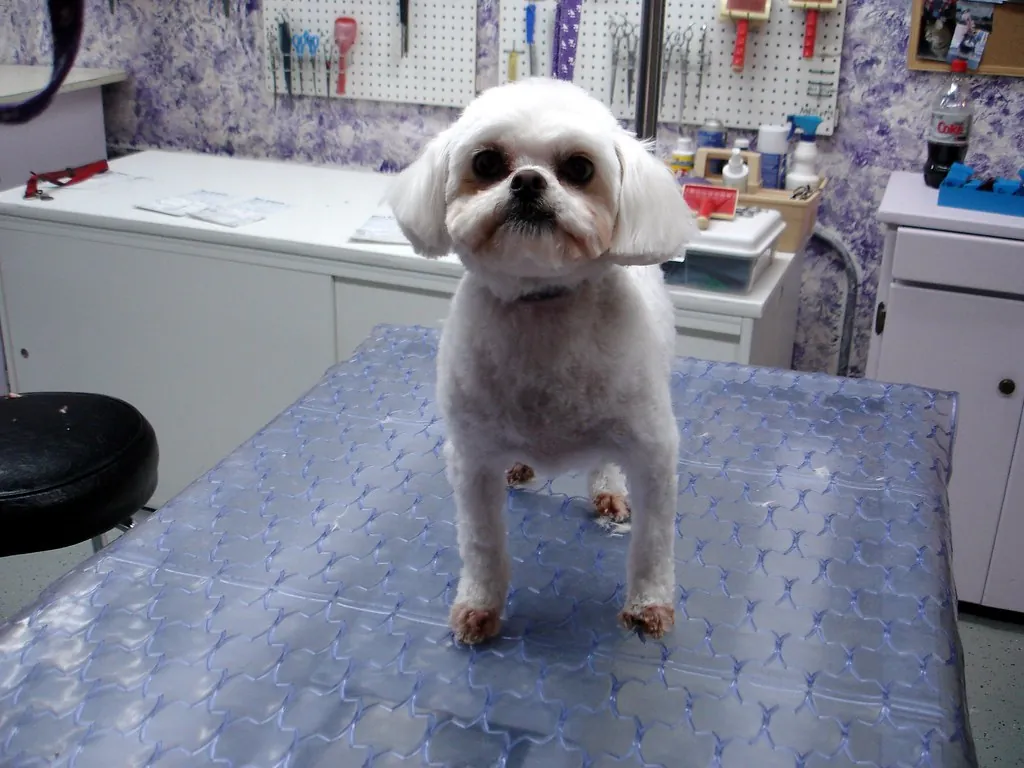
Matted coats are the exception to every breed chart. Groomer charts call for a #7F on very matted dogs and a #5F on light matting, because a comb attachment or a longer blade cannot get under a mat. Expect the dog to come out short, and let the coat grow back from there.
Clipping with or against the grain
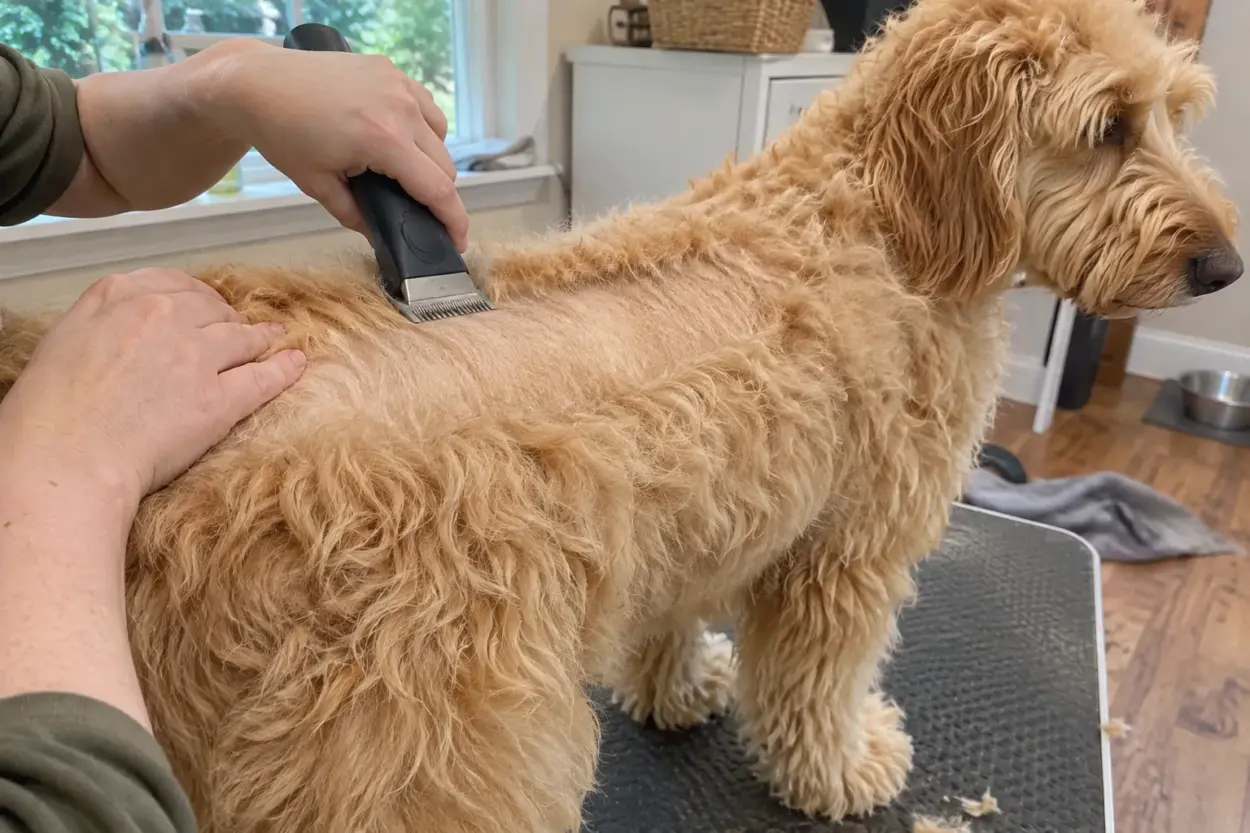
Clipping against the direction the hair grows cuts one to two blade sizes shorter than clipping with it. The lengths printed on blades are the against-the-grain result, the shortest the blade will go. Run the same blade with the grain and the coat can come out close to twice as long: a #7F that leaves 1/8 inch against the grain leaves nearer 1/4 inch with it.
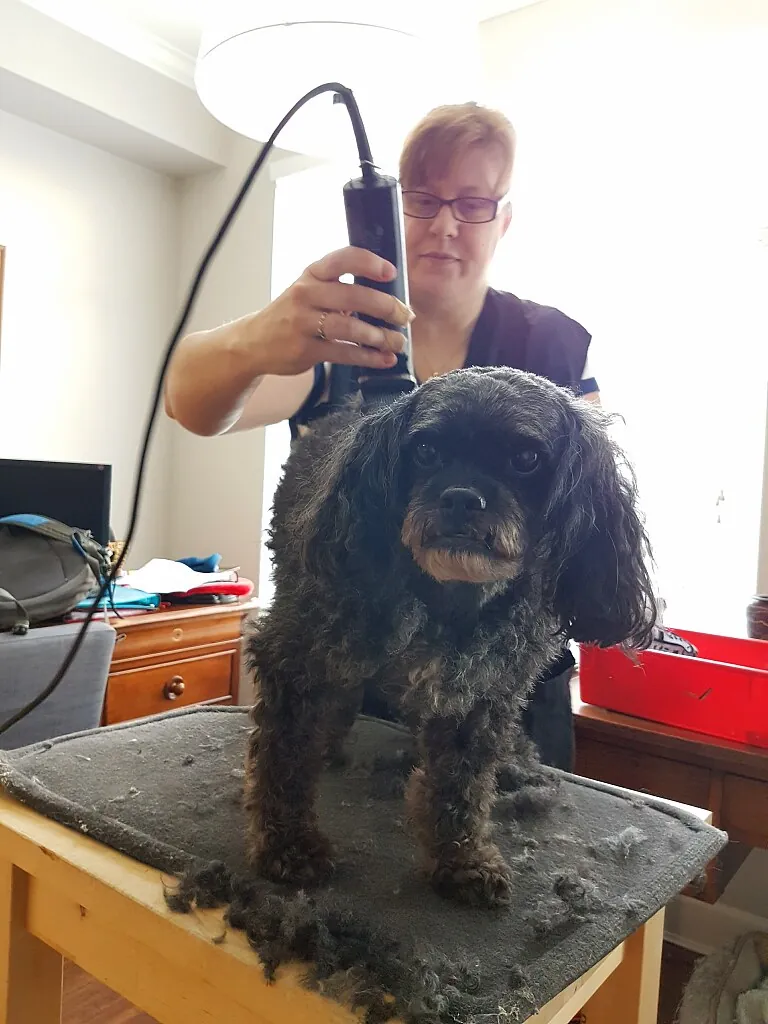
- Clip with the grain for most pet body work. It is gentler on the skin and leaves fewer marks.
- Clip against the grain for a closer, smoother finish, or to remove clipper tracks, but drop to a longer blade to land on the same length.
- Do not switch directions partway through one area. Mixed passes leave patches of two different lengths.
Adjustable blade settings (Wahl 5-in-1, Andis Easy Clip)
Many cordless home clippers use an adjustable blade with a lever instead of detachable blades. The lever positions borrow the detachable blade numbers, but they do not cut the same lengths. Wahl’s own figures for its 5-in-1 blade:
| 5-in-1 setting | Wahl 5-in-1 length | Detachable blade of the same number |
|---|---|---|
| #9 | 3 mm (about 1/8″) | 2 mm |
| #10 | 2.4 mm (about 3/32″) | 1.5 mm |
| #15 | 1.9 mm (about 5/64″) | 1.2 mm |
| #30 | 1.3 mm (about 1/20″) | 0.5 mm |
| #40 | 0.7 mm (about 1/32″) | 0.25 mm |
Every 5-in-1 setting leaves more coat than the detachable blade it is named after, so a “#10” on a 5-in-1 is closer to a detachable #9. The Andis Easy Clip Li adjusts from #30 to #9 and ships with six combs from 1/8 to 1 inch for longer trims. Adjustable blades top out near 3 mm, so body lengths of 1/4 inch and up always need a comb on these clippers.
Do clipper blades fit other brands?
Most detachable dog blades follow the A5 standard and swap between brands. Andis says its UltraEdge and CeramicEdge blades fit Andis AG-series clippers and the Oster A5. Oster says its blades fit Andis, Wahl and Laube detachable-blade clippers. The Wahl KM2 and KM10 also take A5 blades, though a few third-party blades sit loose on the KM2.
Blades that do not swap: T-blades for trimmers, the Wahl 5-in-1 and other adjustable blades, and the small blades on human hair clippers. Check your clipper’s manual for “A5” or “detachable blade” before ordering.
Blade safety: heat, close blades and maintenance
Clipper burn, the red, raw rash that shows up hours after a groom, comes from hot blades, very short blades, pressing too hard and going over the same spot again and again. Puppies, small dogs, fine or light-colored coats and the groin, face and paw pads are the most prone.
A blade coolant spray cools and lubricates without stopping, and a bottle of clipper blade oil keeps the blade cutting cleanly between sharpenings. Coolant does not replace oil. Wahl recommends sharpening about every six months for fine coats and every three months for thick, coarse or curly coats.
Frequently asked questions
Yes. A #40 leaves about 1/100 inch while a #4F leaves 3/8 inch. The fraction-named blades such as the Andis 5/8 inch and 3/4 inch HT are the exception, since their names give the length directly.
No detachable blade leaves a full inch; the longest standard blades stop at about 1/2 to 3/4 inch. Put a 1 inch comb attachment over a #30 or #10 blade instead.
For a puppy cut of about an inch, groomers use a #30 blade with a 1 inch comb. For a shorter puppy cut they use a #4F or #3F blade, which leaves 3/8 to 1/2 inch.
The body usually takes a #4F or #3F blade. The face is left longer with a #3F or a #30 blade under a 3/4 inch or 1 inch comb, then shaped round with scissors.
The #10 is the all-purpose close blade. Groomers use it for sanitary areas, the belly, ear edges and heads, and as the base blade under comb attachments.
The #10 is shorter. It leaves about 1/16 inch, while a #7F leaves about 1/8 inch.
A #7F or #5F for the body and a #10 for sanitary areas is a forgiving start. Avoid #30 and #40 blades on bare skin until you have more practice.
Choppy lines usually come from switching clipping direction, a dull blade or a coat that was not brushed out first. Bathe, dry and brush the coat fully, then clip each area in one direction.
Sources
- Andis Company. Grooming chart and blade guide (form 12666)
- Oster Professional. Canine blade chart
- Wahl. Ultimate Competition blades cutting guide
- Wahl. Cut length settings of the 5-in-1 blade
- Wahl. How often to sharpen animal clipper blades
- Andis. 9-piece small comb set
- Wahl UK. A guide to clipper combs for grooming dogs
- American Kennel Club. Is it OK to shave your dog?
- AllGroom. How long does a blade leave the coat?
- Learn2GroomDogs. Avoiding clipper irritation