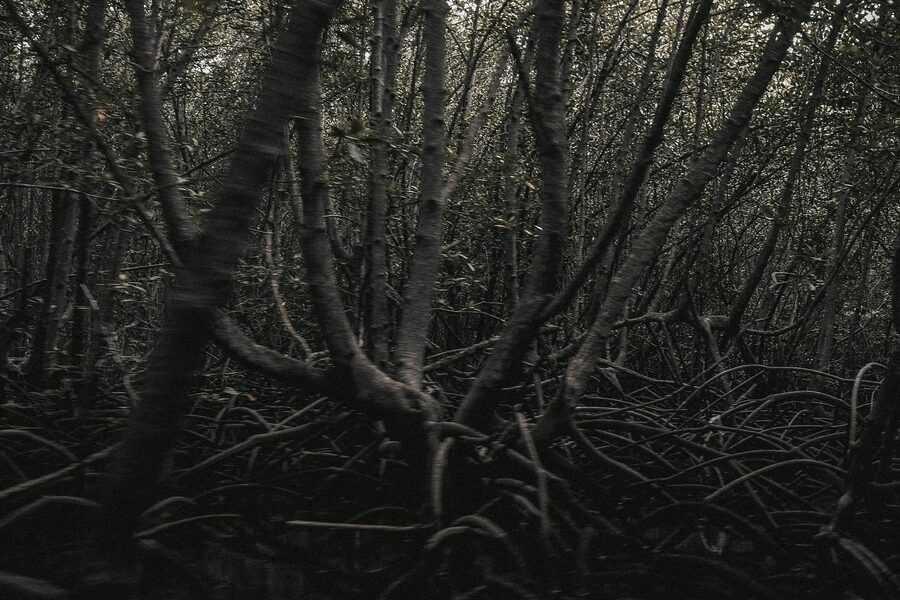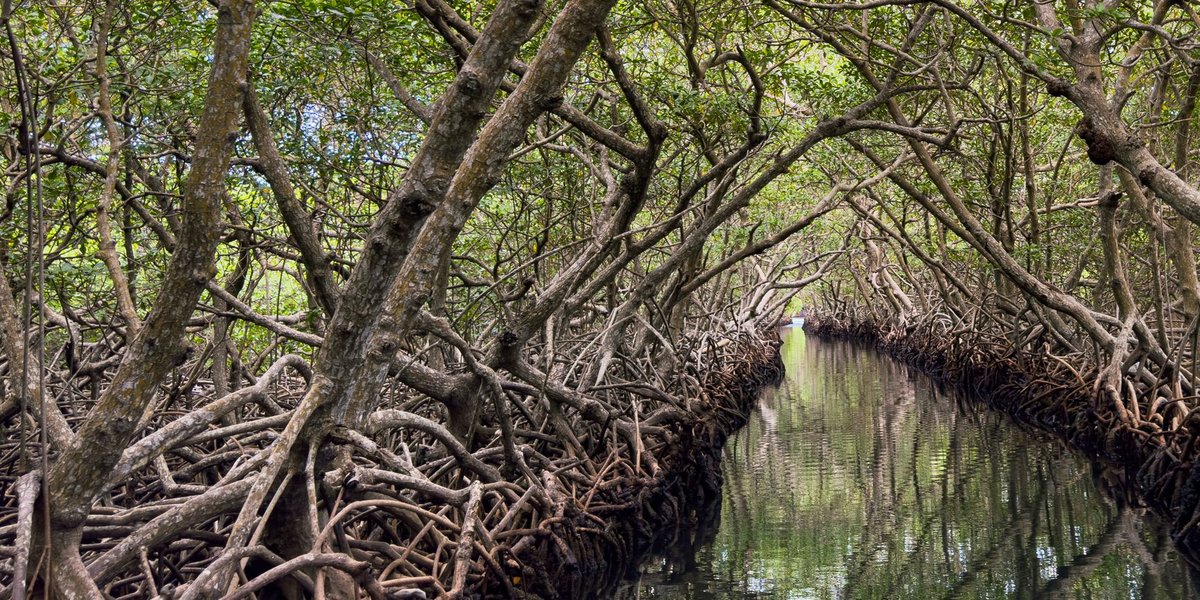
Mangroves and swamp trees aren’t two competing categories. “Mangrove” is a group of salt-tolerant tree species. “Swamp” is a type of wetland dominated by woody plants. A mangrove forest is one kind of swamp, and the trees people usually mean by “swamp trees” are the freshwater ones: baldcypress, water tupelo, red maple, green ash.
So the real question behind mangroves vs swamp trees is salt. One group grows with its roots in seawater. The other would die in it.
Table of Contents
- TLDR
- Mangroves vs swamp trees at a glance
- What counts as a mangrove
- What counts as a freshwater swamp tree
- Roots: prop roots, pneumatophores and knees
- How mangroves handle salt
- Swamp vs marsh vs mangrove forest
- What each ecosystem does for the landscape
- FAQ
TLDR
- Mangroves are salt-tolerant trees of tropical and subtropical coasts. Freshwater swamp trees grow on inland floodplains and river edges.
- Mangrove forests are a saltwater or brackish swamp. Cypress and tupelo forests are freshwater swamps.
- Both have roots that cope with waterlogged, oxygen-poor mud, but they solve the problem differently: prop roots and pencil-like breathing roots in mangroves, “knees” and flared bases in cypress and tupelo.
- Only mangroves have to deal with salt, and they have several separate tricks for it.
Mangroves vs swamp trees at a glance
| Mangroves | Freshwater swamp trees | |
|---|---|---|
| Water | Saltwater or brackish, flooded by tides | Freshwater, flooded by rivers, rain or high water tables |
| Where | Tropical and subtropical coastlines, estuaries, lagoons | Inland floodplains, river bottoms, lowland forests |
| Example species | Red, black and white mangrove | Baldcypress, water tupelo, swamp tupelo, red maple, green ash |
| Root strategy | Prop (stilt) roots, pneumatophores | Cypress knees, swollen buttressed trunks |
| Leaves | Evergreen | Mostly deciduous (baldcypress drops its needles in fall) |
| Salt handling | Excrete or block salt | None needed, and most can’t tolerate it |
| Reproduction | Many species drop live seedlings (propagules) | Conventional seeds and cones |
What counts as a mangrove
“Mangrove” isn’t a botanical family. It’s a lifestyle: any woody plant that evolved to live in the intertidal zone of tropical and subtropical coasts. Around 80 species qualify worldwide, scattered across unrelated plant families, which is why mangroves from different oceans can look so different. NOAA’s overview of mangroves describes them as trees and shrubs that grow in saline coastal habitats.
Florida has three true mangroves, and you can tell them apart from the water:
- Red mangrove (Rhizophora mangle): arching prop roots that look like a tangle of legs. Grows at the seaward edge, in the wettest spot.
- Black mangrove (Avicennia germinans): a carpet of pencil-thin roots poking out of the mud around the trunk. Sits slightly higher up the shore.
- White mangrove (Laguncularia racemosa): the least dramatic roots, smooth rounded leaves, and a pair of small salt glands at the base of each leaf stalk. Grows furthest inland of the three.
That sequence, red to black to white as you move away from the water, is a classic zonation pattern that shows up again and again along protected coastlines.
What counts as a freshwater swamp tree
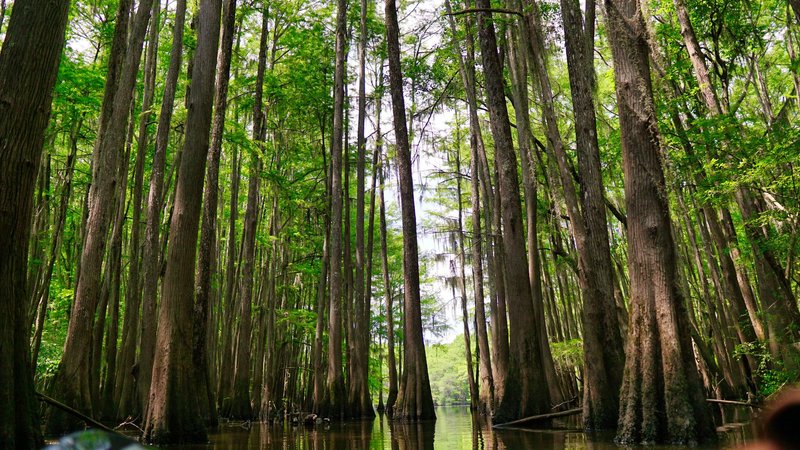
Freshwater swamp trees are species that tolerate soil that stays flooded for long stretches of the growing season. In the southeastern United States, the headliners are baldcypress and water tupelo, often growing together in standing water. Red maple, green ash and black gum fill in on slightly drier ground. A wider list of swamp trees shows how far this group reaches beyond the southeastern US.
Baldcypress is the one people remember. It’s a conifer that drops its needles every autumn (hence “bald”), and old specimens develop a swollen, fluted base. According to the USDA Forest Service Fire Effects Information System, baldcypress is a long-lived species of wet bottomlands and swamps across the southeastern US. Some trees in North Carolina’s Black River swamp are more than 2,000 years old.
Roots: prop roots, pneumatophores and knees
Waterlogged mud holds almost no oxygen, and roots need oxygen. Both groups of trees solve this by getting part of the root system into the air.
Mangrove prop roots arch out from the trunk of red mangroves and brace the tree against waves and tides. The upper parts have small pores called lenticels that let air in.
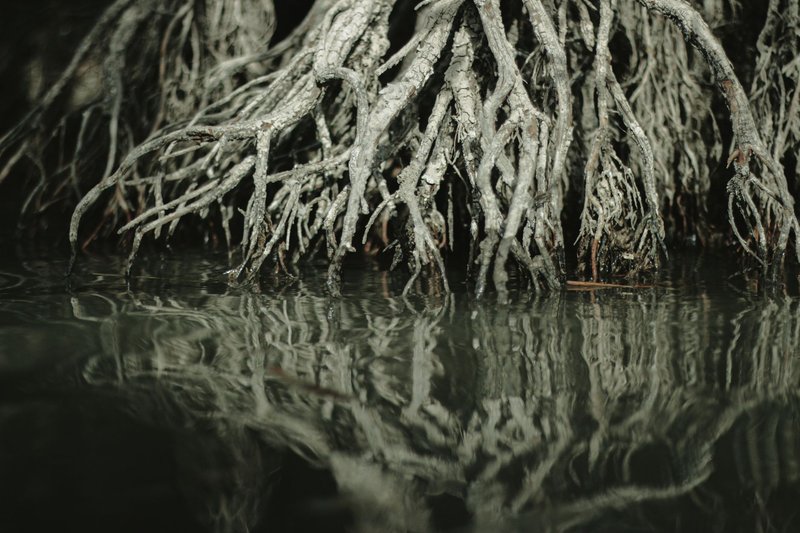
Pneumatophores are the black mangrove’s version. They’re vertical roots that grow upward from the underground network and stick out of the mud like a field of pencils, taking in air at low tide.
Cypress knees are woody projections that rise from baldcypress roots above the waterline. They look like gnarled stumps and can top six feet in deep water. People long assumed they were breathing structures. Research hasn’t confirmed that, and their purpose, whether anchoring, storage or something else, is still debated.
Water tupelo takes a third route: a heavily swollen, buttressed base that stabilizes the tree in soft, flooded soil.
The lookalike roots are a classic trap. If you’re staring at spikes sticking out of the water, check the water. Salty or brackish and near a coast means pneumatophores. Fresh, inland and next to a tree with feathery needles means cypress knees.
How mangroves handle salt
This is what separates mangroves from every swamp tree on the list above. Seawater would kill a baldcypress. Mangroves use three overlapping strategies, depending on species:
- Filtering at the roots. Red mangroves block most of the salt before it enters the plant. Their roots work like a filter, leaving most dissolved salt outside.
- Excreting it through the leaves. Black mangroves pull in salt and push it out through glands on their leaves. Lick a black mangrove leaf on a dry day and you’ll find a crust of salt crystals. White mangroves have glands at the base of the leaf for the same job.
- Dumping it in old leaves. Some mangroves concentrate salt in leaves that are about to drop, then shed them.
Many mangroves also reproduce by vivipary: the seed starts to grow while still attached to the parent. Red mangrove seedlings, called propagules, hang from branches like green cigars. When they drop, they can float for weeks or months before lodging in mud and rooting. That’s a handy way to colonize a shoreline you can’t reach by walking.
Swamp vs marsh vs mangrove forest
Part of the confusion comes from the surrounding vocabulary.
- Swamp: a wetland dominated by trees and shrubs. Can be freshwater or saltwater.
- Marsh: a wetland dominated by grasses, sedges and other soft-stemmed plants. No woody canopy. Also freshwater or saltwater.
- Mangrove forest (mangal): a coastal swamp of salt-tolerant trees. Sometimes called a mangrove swamp.
If it’s trees, it’s a swamp. If it’s grass, it’s a marsh. If the trees are mangroves, it’s a saltwater swamp, and the “mangrove swamp vs cypress swamp” comparison comes down to what’s in the water.
What each ecosystem does for the landscape
They overlap more than you’d expect. Both slow floodwater and trap sediment. Both hold roots in soft ground that would otherwise erode. Both shelter young animals: crabs, juvenile snapper and snook shelter among mangrove roots, while cypress swamps support catfish, herons, alligators and migrating songbirds.
Where they differ is the coast. Mangrove forests blunt wave energy before it reaches shore, which protects the land behind them during storms. They also store large amounts of carbon, much of it in the waterlogged soil beneath them. The Smithsonian Ocean portal covers how mangroves act as nurseries and coastal buffers.
Freshwater swamps, meanwhile, act as inland sponges. They absorb river flooding, filter runoff and recharge groundwater.
FAQ
Is a mangrove a swamp tree? Yes, in a broad sense. A mangrove is a tree that grows in a saltwater swamp. But “swamp trees” in everyday use usually means freshwater species like cypress and tupelo.
Can mangroves live in freshwater? Some can survive in it, and they’re often grown in freshwater in nurseries. In the wild, they’re outcompeted there by plants better suited to fresh conditions, so they stick to the coast.
Can baldcypress grow in salt water? It tolerates brief, low-level salt exposure but can’t handle sustained seawater. Salt intrusion is a real threat to coastal cypress forests as sea levels rise.
Where do mangroves grow? Mostly between about 25 degrees north and 25 degrees south of the equator, with some extending further where coasts are warm. Florida is the northern limit of the Atlantic range in the US, and the Indo-Pacific has far more species than the Caribbean.
What’s the easiest way to tell them apart? Check the water and the location. Salty, coastal and tidal means mangrove. Fresh, inland and flooded seasonally means cypress, tupelo or another swamp tree.