TLDR
Greater galagos — the thick-tailed bushbabies of the genus Otolemur — are gum specialists first and opportunists second. Tree gum makes up the bulk of the diet for most populations, topped off with fruit and insects, and occasionally a bird, an egg, or a small lizard when the chance comes up. The exact ratio isn’t fixed: it swings hard by species, by season, and by where the animal actually lives. A brown greater galago in South Africa’s dry lowveld and a northern greater galago in Kenya are eating almost different diets.
Table of Contents
- Why They’re Gum Specialists
- What’s Actually on the Menu
- Diet by Species
- Diet by Season
- Diet by Region
- Nocturnal Foraging and Termite Flights
- Wild Diet vs. Zoo Diet
- Occasional Meat, Eggs, and Birds
Why They’re Gum Specialists
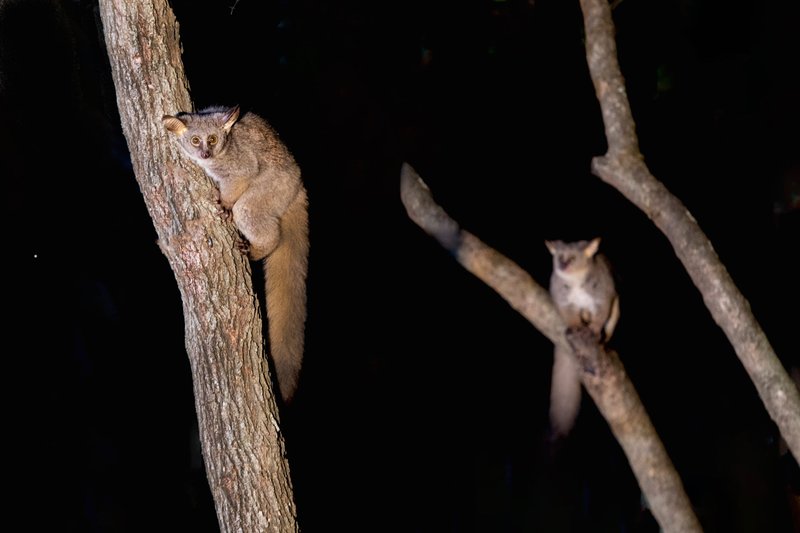
Gum feeding isn’t a fallback for greater galagos — it’s what their mouths are built for. Their lower incisors and canines angle forward into a tight row called a tooth comb, which they drag across acacia and other tree bark to open gouges that weep sap. Once a gouge is scored, a galago can revisit it for weeks, checking back the way you’d check a tapped maple tree.
The claws back this up. Unlike most primates, which grip branches with flat nails, greater galagos have keeled, claw-like nails on every digit except the big toe. That lets them cling to vertical trunks at odd angles for as long as it takes to lick a gum flow dry, something a flat-nailed hand would struggle to do without slipping.
This is the trait that separates greater galagos from the fruit-and-leaf diet you’d expect from a mid-size nocturnal primate. Researchers call animals with this setup exudativores, and the tooth comb plus keeled nails combination shows up again and again in the Animal Diversity Web account of Otolemur crassicaudatus as the defining anatomical feature of the genus.
What’s Actually on the Menu
Strip out the anatomy and the diet breaks into four categories, in rough order of volume: gum, fruit, insects, and small animal prey. Gum from acacias and other exudate-producing trees anchors the diet almost everywhere greater galagos are found, because it’s available year-round and doesn’t require chasing anything down.
Fruit fills in behind it — figs, marula, and whatever’s fruiting locally — and insects add the protein a gum-and-fruit diet can’t provide on its own. Beetles, moths, and grasshoppers get picked off bark and foliage during the nightly foraging circuit, and termites get eaten in bulk during specific windows covered below. The small-animal category is the one that surprises people: eggs, nestling birds, and small reptiles show up often enough in stomach-content and observation studies that it’s not considered a fluke.
Diet by Species
The genus Otolemur splits into three greater galago species, and they don’t eat in the same proportions. Habitat drives the difference more than anything else — gum-rich savanna woodland versus fruit-dense coastal forest produces two very different foragers.
| Species | Habitat | Gum | Fruit | Insects |
|---|---|---|---|---|
| Brown greater galago (O. crassicaudatus) | Dry savanna and lowveld woodland (southern Africa) | 60-70% | 20-25% | 5-10% |
| Garnett’s galago (O. garnettii) | Coastal and riverine forest (East African coast, Zanzibar) | 25-30% | 45-50% | 20-25% |
| Northern greater galago (O. monteiri) | Woodland and forest-edge habitat (East Africa) | 20-30% | 15-25% | 50-70% |
Brown greater galagos are the gum specialists of the three — they’re also the largest-bodied, and the extra energy demand of a bigger animal is easier to meet with a steady, low-effort gum supply than with insects that have to be hunted one at a time. Garnett’s galago, living somewhere with fruiting trees available most of the year, leans away from gum and toward fruit. The northern greater galago is the outlier: in parts of its Kenyan range, insects — mostly termites — outweigh gum as the primary food source, which is the opposite of what the “greater galago” label implies if you’ve only read about the brown species.
Diet by Season
Even within a single population, the gum-to-fruit ratio moves with the calendar. Gum consumption climbs during the dry season, when fruiting trees have shed their crop and food options thin out — gum is available in a bark gouge in July the same way it was in January, so it becomes the reliable fallback. Fruit consumption spikes in the wet season, when marula, figs, and other fruiting trees come online and provide a higher-calorie, lower-effort meal than scraping sap.
This isn’t a subtle shift. Field studies on brown greater galagos in southern Africa’s lowveld describe near-total dependence on gum during the coldest, driest months of the year, with fruit intake dropping close to zero until the rains bring fruiting trees back.
Diet by Region
Geography changes the diet as much as season does. In South African populations, insects typically make up only around 5% of intake — gum and fruit cover almost everything else. Move north to Kenyan populations of the northern greater galago, and insects can account for 50-70% of the diet, largely because termite mounds and swarming events are more abundant and predictable there than in the drier south.
The Endangered Wildlife Trust’s assessment of the thick-tailed bushbaby notes the same pattern from the conservation side: population density and foraging behavior track local food availability closely enough that you can’t describe “greater galago diet” as one fixed thing without naming the region.
Nocturnal Foraging and Termite Flights
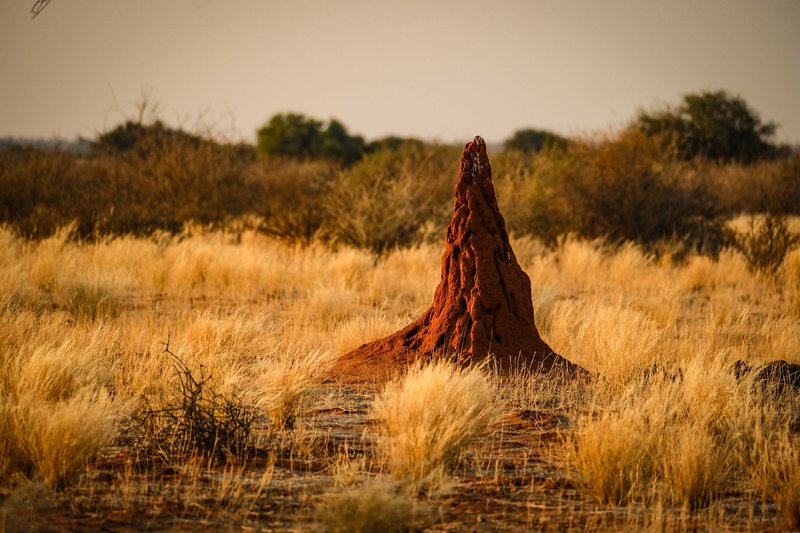
Greater galagos forage after dark, moving through the canopy on a route that revisits known gum sites, fruiting trees, and insect-rich patches in a loop that can cover a mile or more a night. Most of that foraging happens above ground. Termite flights are the exception.
When a termite colony releases its winged reproductives — usually right after the first rains of the season — galagos will come down to the ground to feed on the swarm directly, something they rarely do for any other food source. It’s a short-lived event, sometimes lasting only an hour or two, but the caloric payoff is large enough that galagos treat it as a priority over their usual route. This ground-level opportunism, on an animal that’s arboreal the rest of the time, is one of the more distinctive feeding behaviors documented in the genus.
Wild Diet vs. Zoo Diet
Captive greater galagos eat a version of the wild diet with the scarcity removed. Zoo diets typically center on a commercial leaf-eater or primate biscuit for baseline nutrition, supplemented with chopped fruit and vegetables, gum arabic to satisfy the exudativore instinct, and a rotating insect supply — mealworms or crickets — for protein.
The difference isn’t just convenience. In the wild, seasonal gum dependence and regional insect availability shape both diet and behavior; in captivity, that pressure disappears, and a galago fed consistently doesn’t need to make the same seasonal trade-offs its wild counterparts do. Keepers still gouge bark or provide gum feeders to give the animals something to work for, since the gouging behavior itself seems to matter to the animal’s routine even when food security isn’t the driver anymore.
Occasional Meat, Eggs, and Birds
Greater galagos aren’t strict herbivore-insectivores. Observations across multiple populations document them raiding bird nests for eggs and nestlings, and taking small vertebrates — chameleons, geckos, and other small reptiles — when the opportunity presents itself. It’s opportunistic, not a planned hunt, and it makes up a small fraction of total intake. But it’s frequent enough across independent field reports that it’s treated as a normal part of the species’ foraging repertoire, not an anomaly.
That opportunism is really the throughline of the whole diet. A greater galago isn’t locked into gum, fruit, or insects — it’s built to default to gum when nothing better is around, switch to fruit when it’s abundant, gorge on termites during a swarm, and grab an egg out of a nest if one happens to be there. The species profiles that reduce this to “eats gum and fruit” aren’t wrong, just incomplete.